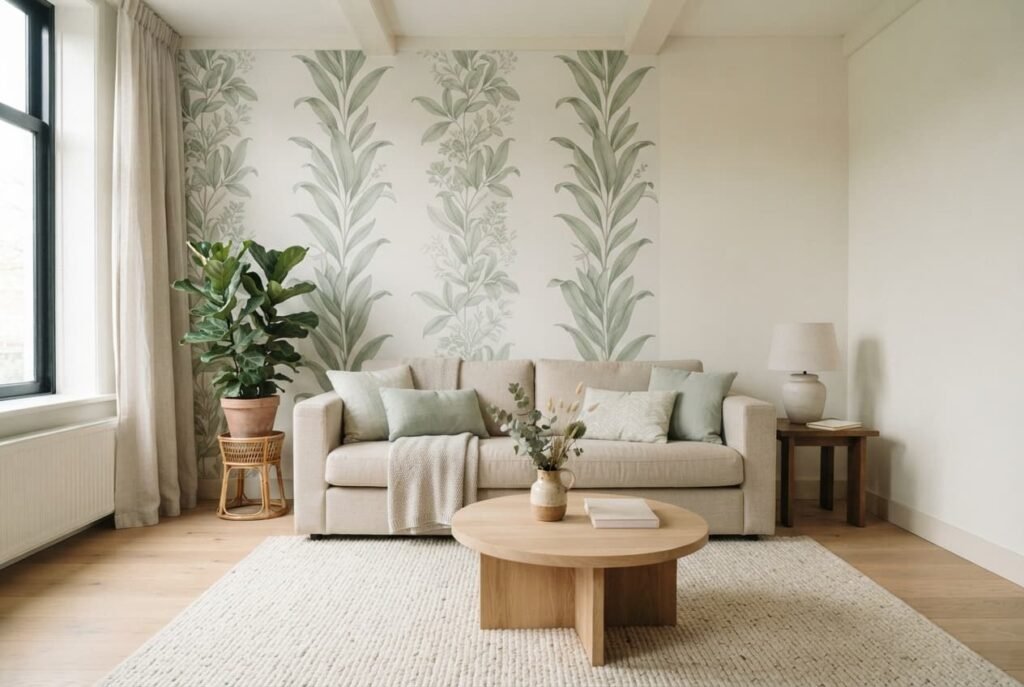
The sofa is placed exactly at the wall’s centre, and the wallpaper pattern still looks lopsided behind it. Nobody hung anything crooked, and the spirit level agrees. The cause is arithmetic: strips are hung from a corner, which means the pattern’s centre falls wherever the roll width puts it. This page measures one Utrecht living room, runs four readings from the sofa and finds three faults, the fixes starting at zero cost. A costly repair that changes little closes it. All figures describe this wall. Take your own. None of it calls for a decorator, and all of it can be tested in an evening.
Why Does a Wallpaper Pattern Look Lopsided Behind a Sofa?
Furniture sets the centre line that the eye expects. Faces and furniture invite the eye to look for symmetry, and a bold vertical line gives it something to measure against. The wall measures 340 cm across, and the sofa spans 220 cm, with its centre at 170 cm. The paper comes in strips 53 cm wide, each carrying one tall motif whose axis sits 26.5 cm from the strip’s edge. Hung from the left corner, the axes land at 26.5, 79.5, 132.5, 185.5 cm and on across the wall.
Compare the two. The nearest axis to the sofa’s own centre is 185.5 cm, which is 15.5 cm to the right. A tall vertical motif spans the whole 250 cm height, and that gives the eye a far clearer axis than a scattered print would. As a working rule (an assumption, not a standard), a bold motif looks off once it strays about 5 cm from the furniture’s centre at 2.5 m. Owners usually shift the sofa or straighten a frame, yet the pattern’s centre line follows the roll width, while the wall itself is unchanged.
Check the wall against the furniture before blaming either.
Four Readings From the Sofa
Sit in the sofa’s centre seat and take these readings with a notepad and a tape. Even a single reading can make a wallpaper pattern look lopsided.
1. Centre offset: measure from the left corner to the sofa’s centre, then to the nearest motif axis. Here 185.5 − 170 = 15.5 cm. The limit is 5 cm. Miss.
2. Arm phase: note how far each sofa end sits inside a motif column. The left arm ends at 60 cm, 7 cm into the column that starts at 53 cm. The right arm ends at 280 cm, 15 cm into the column that starts at 265 cm. A gap of 8 cm reads as uneven. Miss.
3. Corner sliver: divide the wall by the strip width. 340 ÷ 53 gives six full strips and 22 cm, and a last strip under half a motif (26.5 cm) looks like a leftover. Miss.
4. Squint: stand 2.5 m back and narrow your eyes. When the columns still stand out as stripes, any offset shows. Here they do. Miss.
One miss is enough to explain a lopsided look. This wall misses all four.
Three Faults Behind a Lopsided Wallpaper Pattern
Each fault can make a wallpaper pattern look lopsided alone. Check each separately and stop when a reading turns.
The axis misses the middle. This is the placement fault, and the offset is 15.5 cm. The eye expects a pattern to balance about the sofa, and the nearest motif column sits to the right of that line. Free: hang a frame or mirror 80 cm wide that you already own, centred at 170 cm. It spans 130 to 210 cm and swallows the axis at 185.5 cm. The eye then reads the frame’s middle instead. Rearrange: slide the sofa 15.5 cm to the right, which centres it on the motif, then fill the 75.5 cm gap beside the left arm with a side table. Purchase: a framed print 90 cm wide serves when no frame fits. Lift the sofa rather than dragging it, because dragging marks the floor.
The last strip is a sliver. This is the scale fault. The repeat is 53 cm across, and the wall holds six of them with 22 cm left over. That remainder shows under half a motif and reads like an offcut at the corner. Free: stand a tall plant 25 cm across against that corner. Rearrange: move a bookcase 30 cm wide into the corner, covering 310 to 340 cm. Purchase: a slim shelf unit of the same width if you own neither. Check that it clears the skirting and any socket on that stretch.
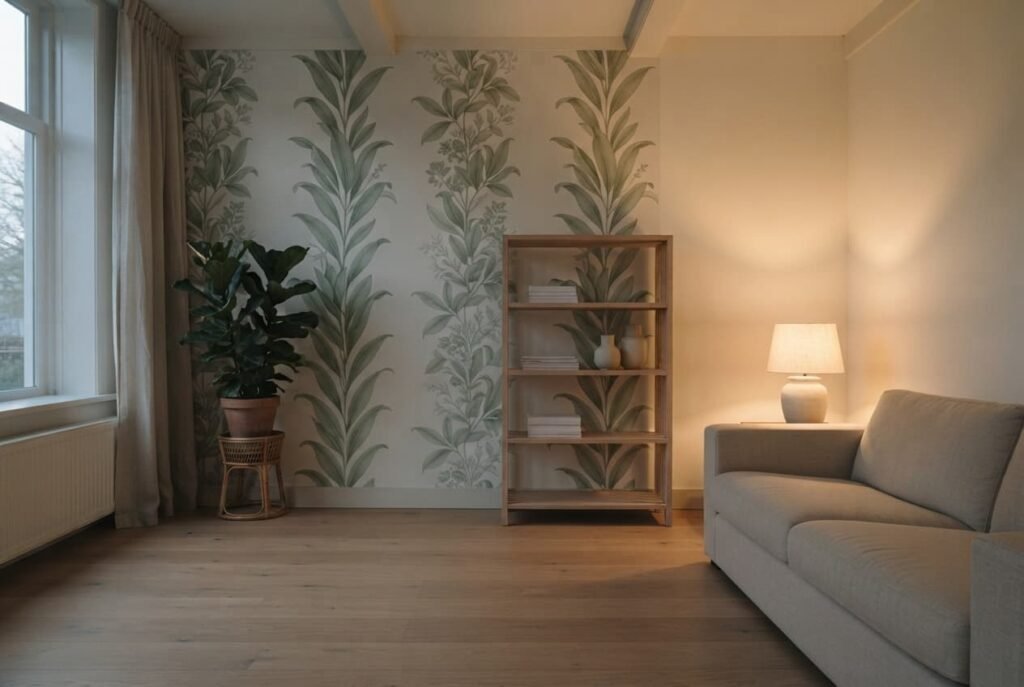
One lamp lights one end. This is the colour fault. A 2700 K lamp 40 cm from the left end gives the left part of the wall about 90 lux against about 45 lux on the right part, which are sample readings from a light-meter app. The warm glow turns that half of the pattern golden, and the unlit half stays cool. The wall seems to change tone across the sofa. Free: switch the lamp off at dusk and use the ceiling light. Rearrange: move a second lamp you own to the other end so each side matches. Purchase: a twin of the first lamp at the same colour rating, which is printed on the box.
How to Plan a Pattern Before the Paper Goes Up
Prevention starts with the centre line, not the corner. Mark 170 cm on the wall and hang the first strip so that its motif axis lands on that mark, which puts its left edge at 143.5 cm. Strips then run outwards on both sides, and each end finishes with a trimmed piece 37.5 cm wide, more than half a motif. The same wall hung from the corner left a 22 cm sliver.
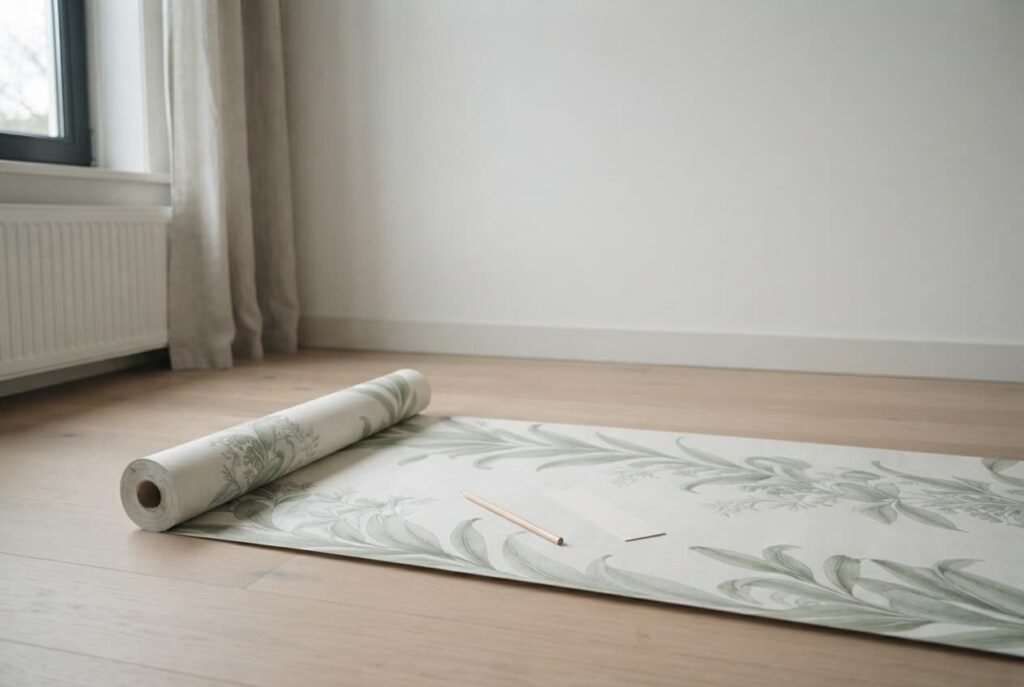
Nothing makes a wallpaper pattern look lopsided more reliably than starting at a corner. Unroll two lengths next to each other in the shop and step back 3 m. Choose a repeat under one tenth of the width, since a bold motif widens every offset. Ask for a spare roll, because a single bad strip is easier to swap than to hide.
Start hanging at the wall’s midpoint.
A Costly Repair That Changes Little
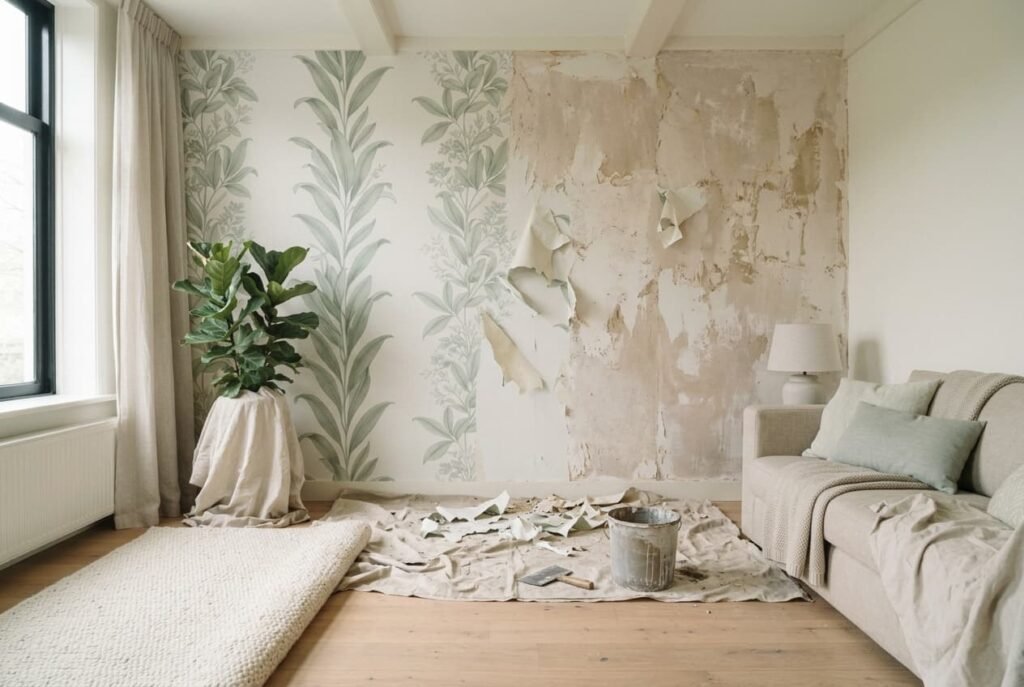
Many owners strip the whole wall and re-hang it from the centre, and it seldom pays back. The offset does disappear, which is why the idea tempts. A full re-hang costs seven new strips and a weekend, all to correct an offset that a frame hides for free. Seven strips of 250 cm come to 17.5 m of paper. The old strips can seldom be reused once they are off, and a tenant must usually restore the wall before moving out.
Darker paint on the other three walls fails likewise. It sharpens the contrast around the patterned wall and makes the offset easier to find.
Buying a wider sofa is another tempting move. At 260 cm it would span 40 to 300 cm and still leave the offset and the sliver in view. It adds cost without changing the readings.
Tonight, sit in the sofa’s centre seat and do the four readings. Many walls gain from two free moves: a frame over the axis and the lamp off. Photograph the wall from the same seat before and after, to show what moved. If you rent, ask the landlord before putting anything on the wall, though a single frame hook is usually fine. Should one reading still miss, adjust only that item. A week later, return to the doorway, where a lopsided look appears first. Keep both photographs, since a memory of the old view fades once the wall looks right. Nothing else needs touching.
Questions and Answers
Why does the pattern look lopsided when the sofa is centred?
Strips start at a corner and are 53 cm wide, which puts the motif axes at fixed spots across the wall. Unless the wall width happens to fit whole strips, no axis lands on the sofa’s centre. Here the nearest axis is 15.5 cm away, enough for the eye to notice.
What is the quickest thing to try tonight?
Hang a frame or mirror at least 60 cm wide over the sofa’s centre so that it covers the nearest motif axis, and switch off any lamp that lights only one end. Ten minutes will do. Nothing is bought or drilled beyond a hook. Photograph the wall before and after to compare.
Do I need to strip the paper and hang it again?
No. A frame hides the offset. Plants and bookcases cover a sliver. A second lamp evens the colour. All three leave the wall untouched. Re-hanging is only worth considering when the paper itself is damaged or the whole pattern clashes with the room.