A hanging chair takes more of a small room than the armchair it replaces. When hanging chairs for a Dutch living room look light, it’s because the floor underneath remains visible, and that is an illusion with a price. Many Dutch flats have concrete ceilings, which makes the question a real one. Take a living room measuring 360 × 480 cm in Arnhem, where the slab is 250 cm overhead and the sofa runs 210 cm. The verdict arrives after the sums, and it comes with a limit. These figures describe one made-up room. Measure yours before you drill anything.
How Hanging Chairs Reached the Small Dutch Living Room
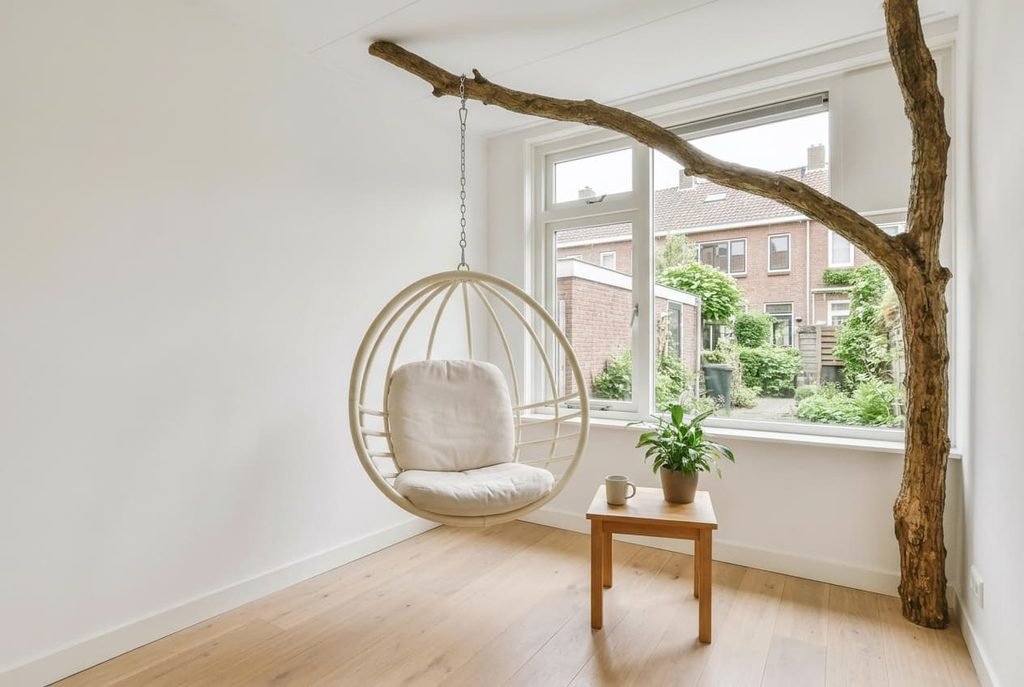
Hanging seats began outdoors, swinging from a single branch. Indoors they needed a ceiling that could take a fixing, and many Dutch flats have one in the form of a concrete slab. That made the idea possible long before it was sensible.
Two things carried it into the living room. Open-plan layouts left one corner without a job, and a chair that hangs looks as if it needs no floor at all. Photographs helped too, because a seat floating above bare boards reads as calm and uncluttered.
Tenants face an extra question. A fixing in a ceiling is a hole that stays after the chair leaves, so the landlord has to agree. The anchor must also be rated for far more than the weight of the person in the seat. Neither point appears in a photograph.
Ordinary plasterboard rarely provides a fixing without a joist behind it, which is why the slab matters. The chair is attractive because it looks light. The next section measures how light it really is.
What a Ceiling-Hung Seat Does to the Floor
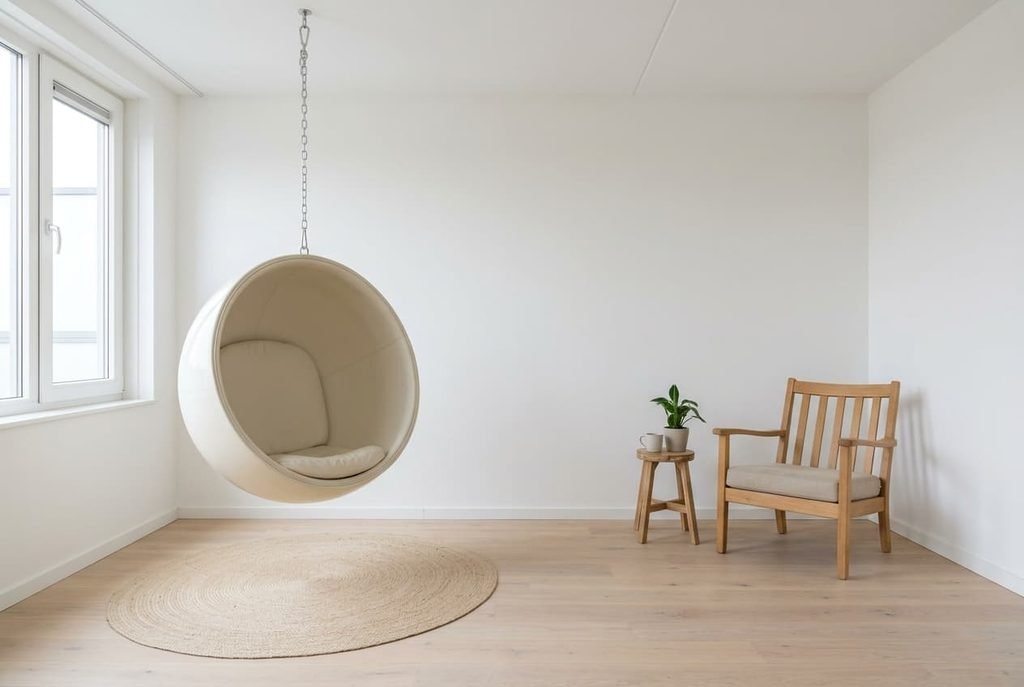
Start with the armchair it replaces. One measuring 80 by 85 cm occupies 6,800 cm², or 0.68 m², a share of 3.9 per cent in the 17.28 m² room.
Now hang a chair 100 cm across so that its seat sits 45 cm up, from fixings in the 250 cm slab. The chain from fixing to seat is 250 − 45 = 205 cm long. Allow a gentle sway of 10 degrees, an assumption for quiet sitting. The seat then travels 205 × sin 10° = 36 cm to either side.
Add that to the chair’s radius of 50 cm and the clear radius becomes 86 cm. The circle that must stay empty is π × 86² = 23,235 cm². A hanging chair therefore asks for 2.32 m² of clear floor, or 13.4 per cent of this room, against 0.68 m² for the armchair. That’s 3.4 times as much.
Two inputs move the circle, and neither moves it far. A ceiling at 240 cm shortens the chain to 195 cm, so the sway shrinks to 34 cm. The radius becomes 84 cm and the circle 2.22 m², which saves only 0.10 m². A livelier sway of 15 degrees travels 53 cm, which gives a radius of 103 cm and a circle of 3.33 m², or 19.3 per cent of the room. Hanging chairs for a Dutch living room cost a lot of floor however you set them.
Which Living Rooms Can Spare the Corner
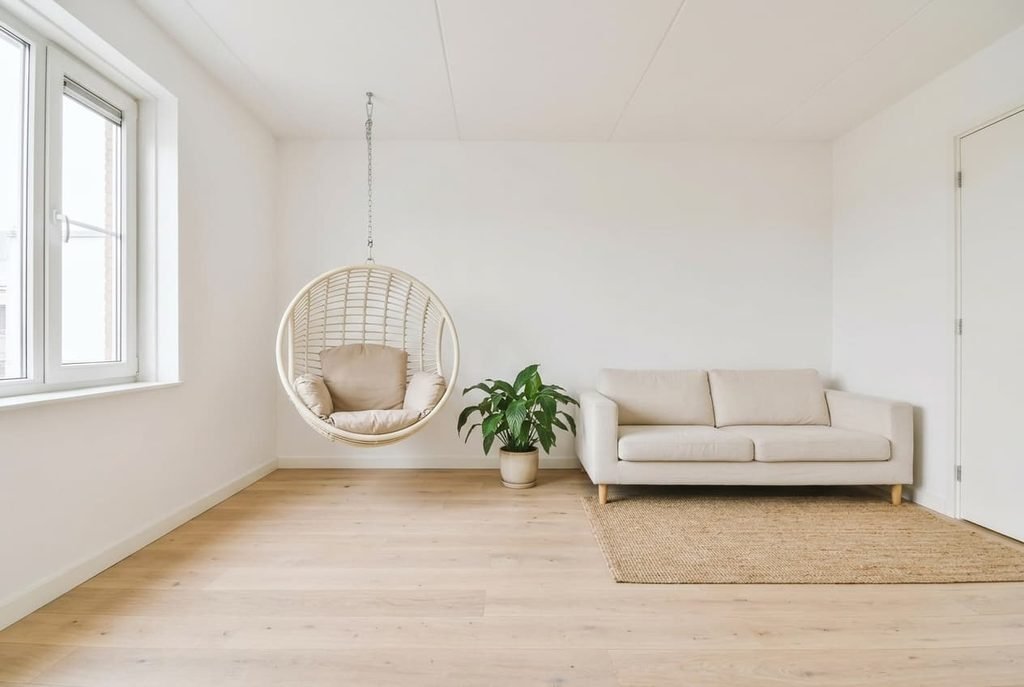
A circle of 172 cm needs a square corner of 172 × 172 cm, which is 2.96 m². Here that is 17.1 per cent of the room. Put the chair in the corner of the longest wall that sits away from the door, and keep the sofa on that wall too. Together they take 210 + 172 = 382 cm out of the 480 cm available, leaving 98 cm for walking. The circle’s centre must sit 86 cm from each wall, because a chair hung closer would strike the plaster at the end of every swing.
Width is the next limit. This room is 360 cm across, so 188 cm remains beside the circle, enough for a path past it. A room 300 cm across would leave only 128 cm, and the chair would sit nearly in the walkway.
Check the door too, since one in the chosen corner rules the spot out. Its 80 cm leaf sweeps π × 80² ÷ 4 = 5,027 cm², or 0.50 m², and that arc can’t overlap the chair’s circle.
Hanging chairs for a Dutch living room suit only rooms with a corner nobody uses. They also need a concrete ceiling and a landlord who has agreed in writing. A single adult who reads for an hour gains most from the seat. A family that needs floor for children to play loses, since the circle can’t be shared.
Are Hanging Chairs for a Dutch Living Room Worth It?
For most small rooms the answer is no. The rule is to keep the armchair unless a corner already measures 172 cm each way. A refusal from the landlord ends the plan at no cost, so ask before anything else.
Where a dead corner exists and the ceiling will take a rated anchor, the chair earns its place. It turns 2.96 m² of unused floor into a seat that a person actually uses. Where the corner holds a sideboard or a lamp, the chair simply displaces them.
A wrong guess is expensive in a way an armchair never is. The hole stays in the ceiling after the chair goes, and a tenant may have to pay to fill it.
A room that fails any one of the checks should keep what it has.

The Version That Goes Too Far
The extreme version hangs two chairs as a pair from the same beam. Two circles cost 2 × 2.32 = 4.64 m². Two hanging chairs take 4.64 m², or 26.9 per cent of this room, and the sofa takes another 1.89 m². That leaves 17.28 − 4.64 − 1.89 = 10.75 m² for everything else, which leaves 62.2 per cent free.
Side by side, the pair spans 2 × 172 = 344 cm of the 360 cm width. Only 16 cm remains at the walls, and nothing is left for a route to the window.
Nobody can stand between the two chairs while both swing.
A pair also doubles the fixings: another hole and anchor, plus a second consent. The photograph looks generous and the space feels like a waiting area. Hanging chairs for a Dutch living room work as single pieces, one to a spare corner. Two at this room size show that the layout has stopped working.
A String and Tape Test Before You Drill
Pin a string 86 cm long to the spot on the floor directly below the intended fixing. Walk the free end round and mark the circle with tape. Live with that circle for seven days.
Check three things. The path from door to window must stay at least 70 cm wide. Every socket must stay reachable. And nobody should find themselves stepping around the tape.
A circle that passes all three has earned a conversation with the landlord. One that fails has answered your question before a drill touched the ceiling. Note the three readings, so the verdict comes from measurements.
The idea behind this chair is a trade of floor for a seat that hangs, and the trade is measurable. In this room it costs 2.32 m² to gain a place to read, and the corner pays for that only when it holds nothing else. Count the circle first, then ask about the ceiling, and let the tape make the final call.
Questions Readers Keep Asking
Should I replace my armchair with a hanging chair?
Only if a corner already measures 172 cm each way and the landlord agrees to the fixing. Otherwise you’d swap 0.68 m² of floor for 2.32 m² and gain nothing the armchair couldn’t give. Tape the circle first. Tape costs little and settles the question within a week.
Who suits a hanging chair best?
A single adult or a couple who sit in turns suit it best, in a room wide enough to leave a path past the circle. It helps anyone with a dead corner and a concrete ceiling. Households with small children, or rooms under 3 m across, usually do better with a floor-standing chair.
How long will the trend last?
Nobody can forecast it, and the forecast matters less than the geometry. A circle of 172 cm needs the same floor in any season. The chair can come down in minutes once the room stops suiting you, yet the ceiling keeps its hole, so decide with that in mind.