A sofa in a Dutch flat has a seat deck 58 cm deep, with cushions cut to match. By the end of an evening the seat cushions creep forward until their leading lip hangs about 4 cm past the frame. You rebuild the seat before every sit-down. The fault has four possible causes, and just one is the cushion itself. Most of the cures below cost nothing. This page sorts them with a level and a cushion you already own. All figures are round assumptions for an ordinary three-seater, so adjust them to your own measurements.
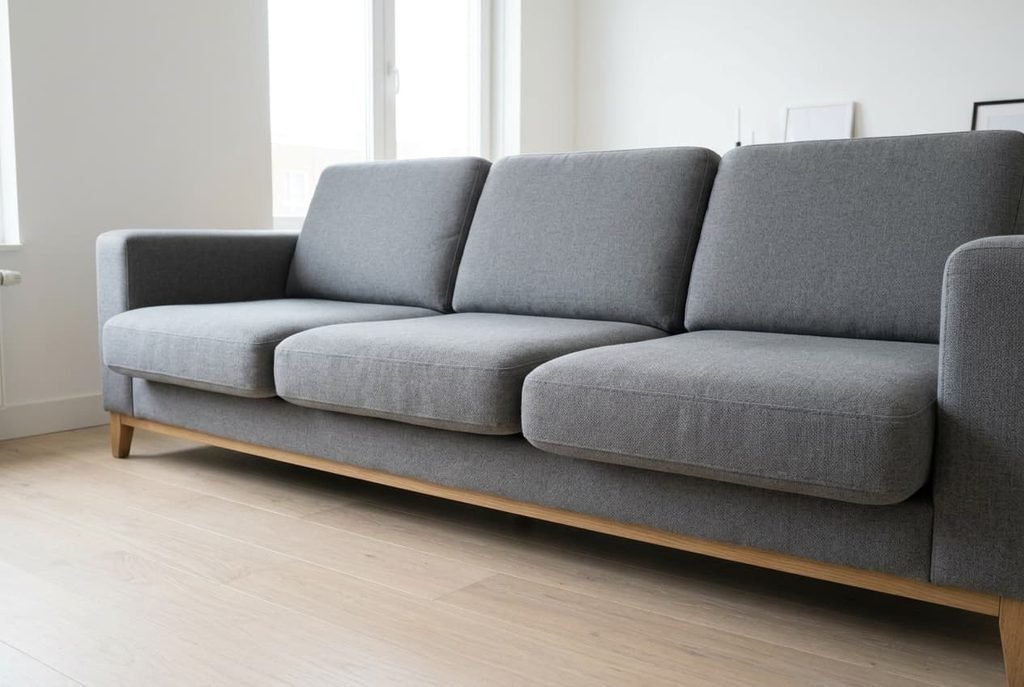
Why Seat Cushions Creep Forward
A cushion doesn’t slide in one go, and the ratchet that moves it instead is the whole problem.
Each time you sit down, your hips glide forward a little as they settle, and the cushion beneath you goes with them. Each time you stand, the cover drags the cushion back by less than it moved. The weave grips better in one direction than the other.
Say a single sit-down nudges the cushion 3 mm and the stand-up recovers a third of it. That leaves 2 mm of net creep. A household sits down 12 times in an evening, which makes 2.4 cm. A few days of that leaves a cushion hanging well past the frame.
In short, the cushion creeps whenever each sit-down pushes it forward more than each stand-up brings it back. Anything that raises the push or lowers the grip will speed it up. A seat deck tilted forward by 1° adds a steady pull of roughly 1.7% of your weight. A reclined backrest turns part of your weight into a forward shove. Slick fabric underneath lets both work with little resistance.
Four causes follow from that. They are the slope of the deck and the lean of your back, plus the grip of the base and the squash of the foam.
Four Checks to Tell Which Version You Have
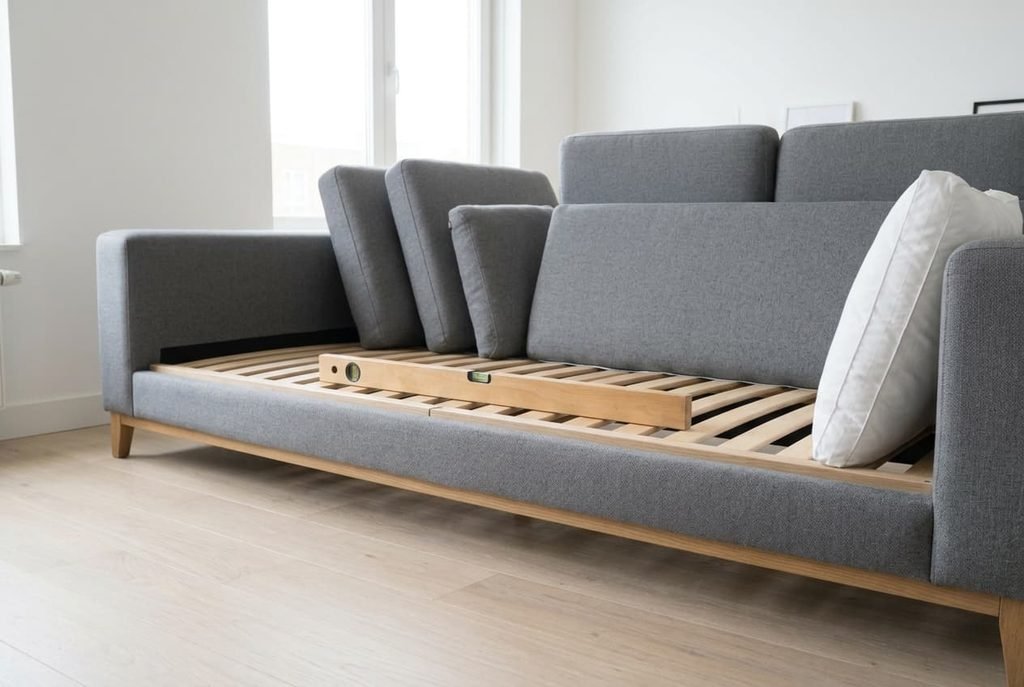
Ten minutes and a level will tell you which cause you have. Take the cushions off and lay the level on the bare deck, front to back. If the bubble drifts and the front sits more than 1 cm lower over 50 cm, slope is feeding the problem. Seat cushions creep forward on every sofa with that tilt, however grippy the base is.
Put one cushion back and push its rear edge with a flat palm, firmly, as you’d press a doorbell. If it moves 1 cm or more from one push, the base grips too little.
Press the leading lip of the cushion with a fist, then press the rear edge the same way. If the front sinks 3 cm further than the rear, the foam has compressed into a wedge that tips you forward.
Last, sit upright for half an hour with a firm pillow behind your lower back. If the cushion barely moves, your lean is the main driver, and the other three checks matter less.
Four Fixes From Free to Professional
Swap and turn the cushions, because a wedge of squashed foam is the cheapest cause to remove. Exchange the cushion from the busiest seat with the one from the quietest. Then turn each one back to front, so the squashed edge faces the frame and the firmer edge faces you. The cost is nothing, and the swap returns an even thickness under your hips. It lasts a few weeks before the new front compresses too. It works as a trial. If the creep stops for a fortnight, foam was your culprit. A firmer core is the permanent answer.
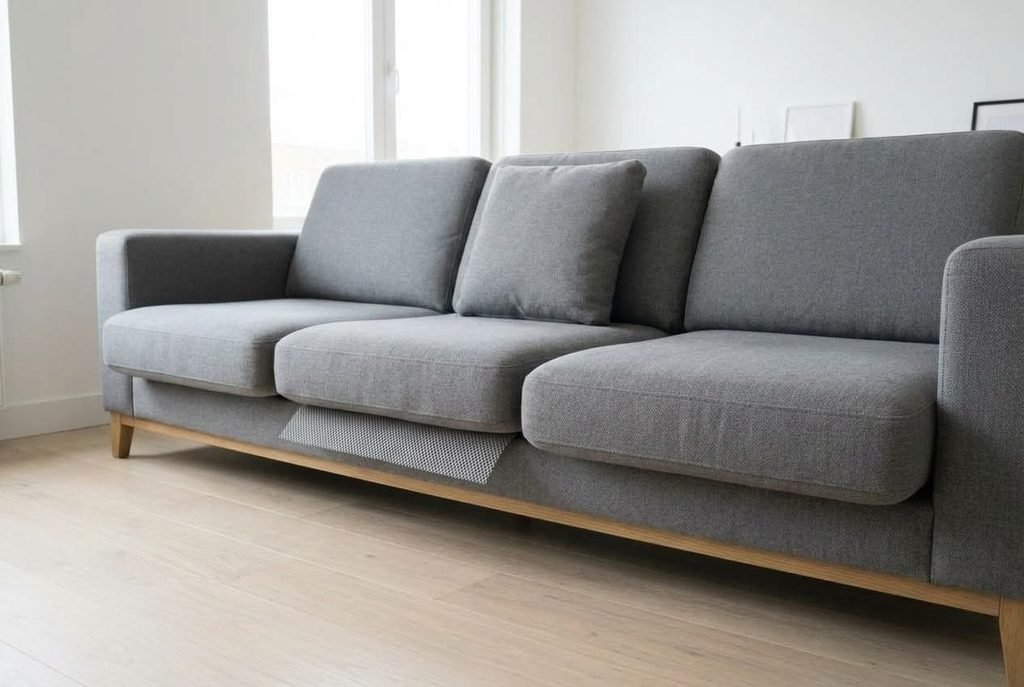
Prop a firm pillow behind your lower back if the lean test showed the cushion barely moved. A pillow 12 cm thick brings your torso upright by some degrees. That cuts the forward shove on each sit-down, which was the force driving the ratchet. You probably own one already, so the cost is nothing. The pillow helps only the person using it. A second person on the sofa with no pillow still pushes their own cushion forward. The pillow also changes nothing about slope or a slippery base.
Cut a grip layer for under each cushion when the push test moved one by a centimetre or more. A sheet of rubberised mesh trimmed to 58 × 60 cm raises the friction between cushion and deck. The stand-up then recovers more of what the sit-down pushed. It costs little, and it stays hidden under the cover. Its weak spots are pale fabrics, which it can mark. A forward-tilted deck defeats it too, because friction only holds back a slope up to a point. Trim it 2 cm smaller than the cushion so no edge shows. Seat cushions creep forward most on smooth covers, so this is the fix for them.
Have an upholsterer re-web the deck when the level showed a forward drop and the frame has sagged. New webbing pulls the deck flat again and removes the steady pull at its source, which the other three fixes only soften. It’s the dearest fix by a distance, so it makes sense only when the frame is sound and the sofa is well loved. A repair won’t cure a leaning back or a slippery base. The sofa also needs to be empty for a day, so plan where you’ll sit meanwhile.
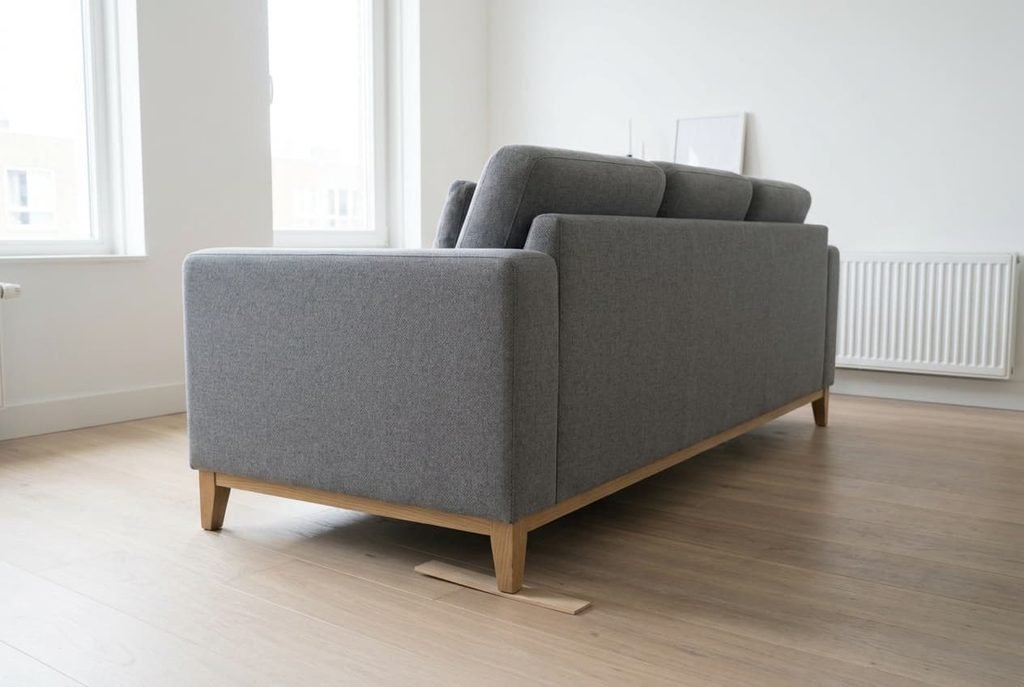
Forward Creep of Seat Cushions in a Sloping Flat
Fixed architecture limits what you can alter. Many older Dutch flats have floors that fall 1 to 2 cm across a room. A sofa that faces the window often sits with its front on the low side. Say the floor falls 1.5 cm across the 90 cm depth of the sofa. That’s a tilt of just under 1°, and it adds about 1.5% of your weight as a steady forward pull.
The floor is fixed. The sofa often can’t move either, because the radiator sits behind it and the door needs 80 cm to swing. A 1.5 cm shim under each rear foot levels the deck again. A spirit level confirms it before you fix the shims with a dab of putty so they can’t wander.
Shims under the rear feet are the one fix the floor allows.
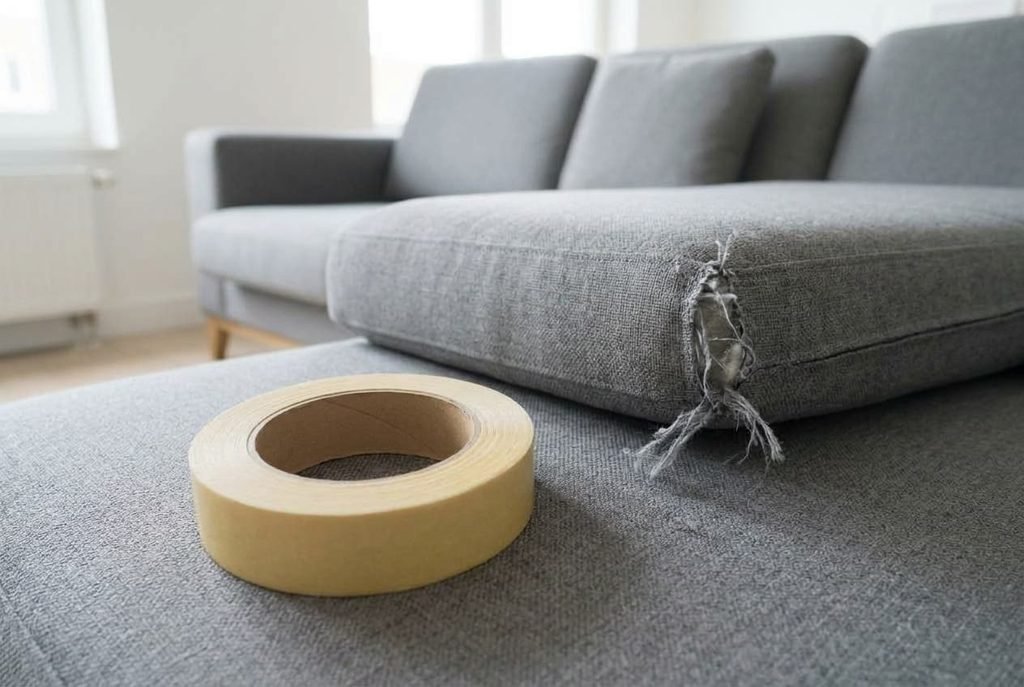
The Fix That Moves the Problem
Double-sided carpet tape under the cushions seems the sensible answer, and it isn’t one. The tape grips cover and deck at once, so the cushion can’t flip or turn. Every sit-down loads the stitching instead of the base. The seam fails first. Leftover residue on the deck also makes the grip layer from the third fix harder to place. Any glue-based fix turns a ten-minute test into a weekend of peeling.
It treats a symptom, too. If the push comes from a leaning back or a sloping deck, the force simply moves into the cover. You get a cushion that holds still above a seam that slowly opens. Run the checks first and keep the tape in the drawer, since the four tests take ten minutes and point at a cause that tape can’t touch.
Seat cushions creep forward for reasons you can measure, so measure before you spend. A level and a palm, plus half an hour of sitting upright, will name the cause on the first evening. Treat the cause you found first, then quit as soon as the cushions stay put. A sofa that holds its seat beats any single clever product. Ten minutes of testing also beats a weekend of guessing.
Questions Readers Keep Asking
Can this be fixed at all?
Yes, in almost every case. Run the four checks first, since each cause has its own remedy and a wrong guess wastes a weekend. Most sofas need one or two of the fixes above, and only a sagging frame needs a professional.
How much does fixing it cost?
Swapping the cushions and propping a pillow cost nothing. A grip layer costs a small amount, and shims cost less. Re-webbing is the large cost, so keep it for after the free and cheap steps have failed and the level has shown a forward slope.
What is the most common cause?
A slippery underside combined with a reclined back. Most sofas are sat in leaning back, which pushes the cushion forward on every sit-down. A grip layer under each cushion usually solves it, and the push test tells you within a minute whether yours needs one.