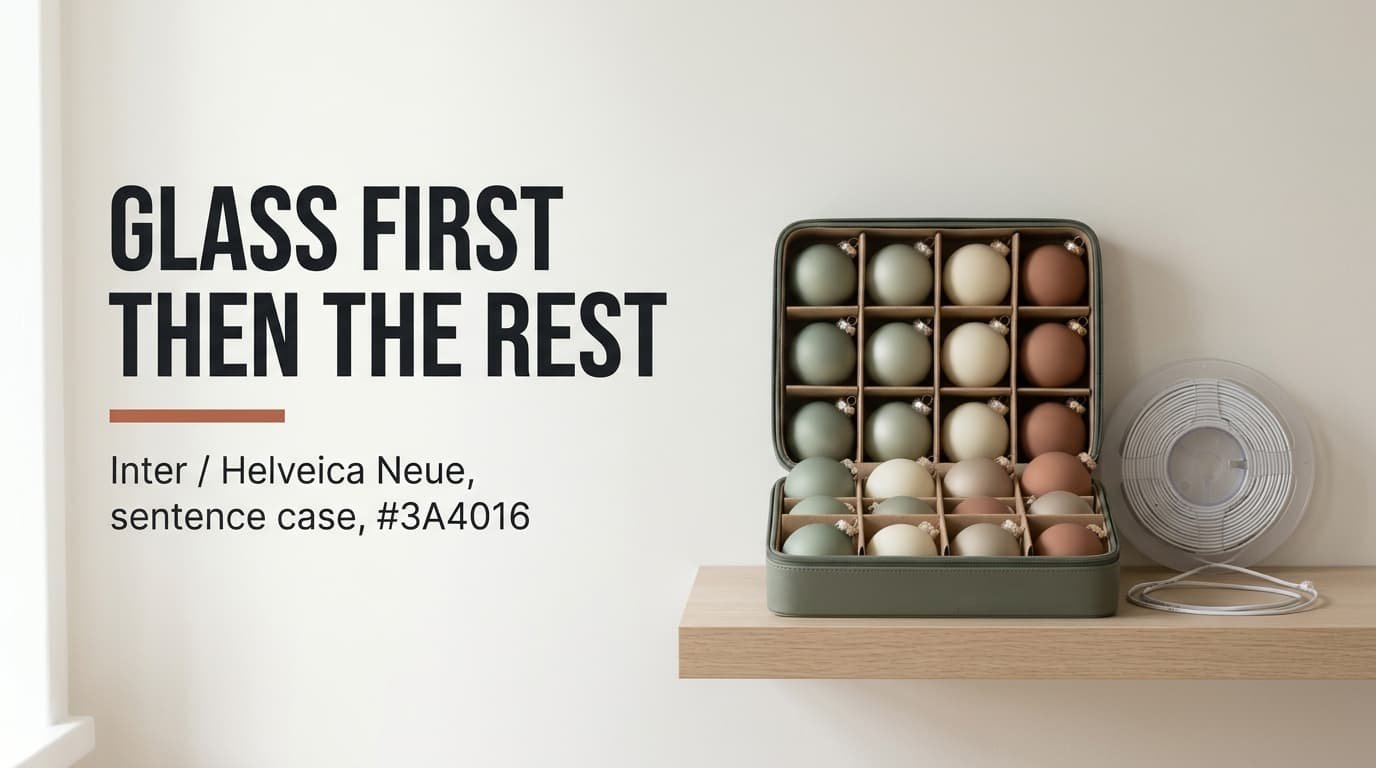
Buy the box for whatever breaks first. That single rule shapes a decoration store for a small flat, and it puts the bauble case ahead of every other purchase. Our case is a 58 m² flat in Eindhoven with one spare shelf above the wardrobe, measuring 100 × 50 cm with 40 cm clear overhead. Everything lives there for 339 days of the year. Each kind of object needs a different kind of box, and the sequence below shows which. Five purchases in a fixed order fill that shelf, with the last one scaled down so the rest fit.
What Decides a Decoration Store for a Small Flat
Decorations are on show for 26 days and stored for 339. The store therefore works for 93 per cent of the year. The shelf sets two limits. Its volume is 100 × 50 × 40 = 200,000 cm³, or 200 litres. Its floor area is 100 × 50 = 5,000 cm². Height is cheap on a wardrobe shelf, so judge each box by the floor it claims.
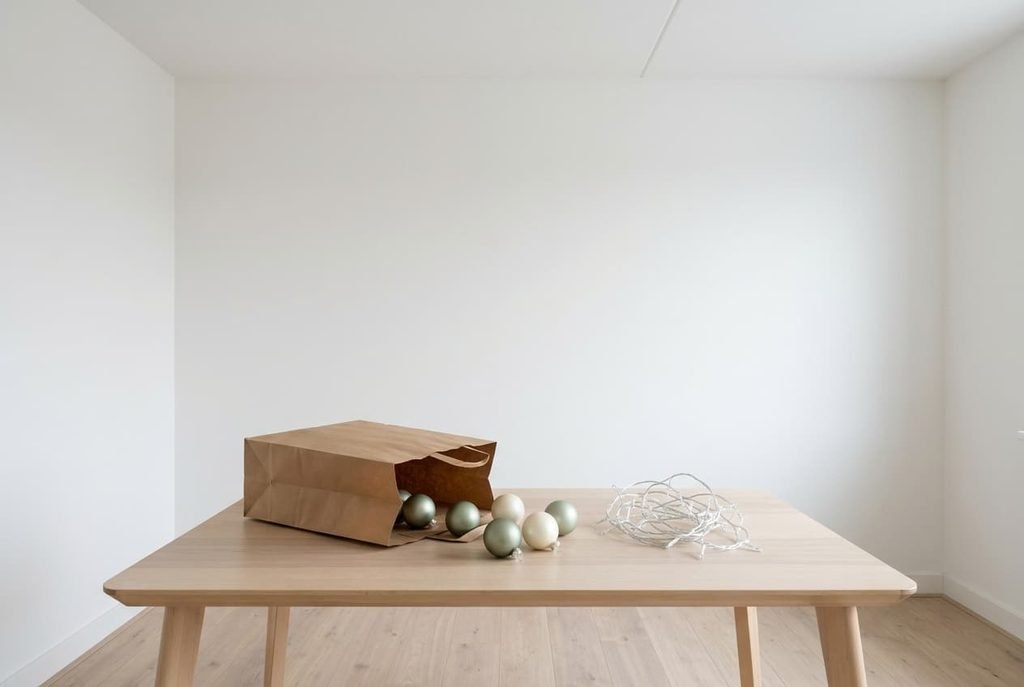
Breakage sets the order of buying. Suppose three baubles crack every year, a modest guess for a flat where the glass lives in a bag. After five years 15 of the 40 are gone, which is 37.5 per cent of the set. Most of those losses come when glass touches glass in a loose carrier bag, so separation has to come first.
Ten metres of light string left loose will knot within one season, because the loops shuffle each time the shelf is opened.
A 150 cm tree is the bulkiest object and the most forgiving, since its three sections of 50 cm are sturdy. Ranked by fragility, glass leads the order while the tree trails far behind. That ranking is the buying order below.
Five Purchases in Order for a Small Flat Decoration Store
The dearest mistake comes first. Every entry pairs a size with a tier, then names the fault to reject.
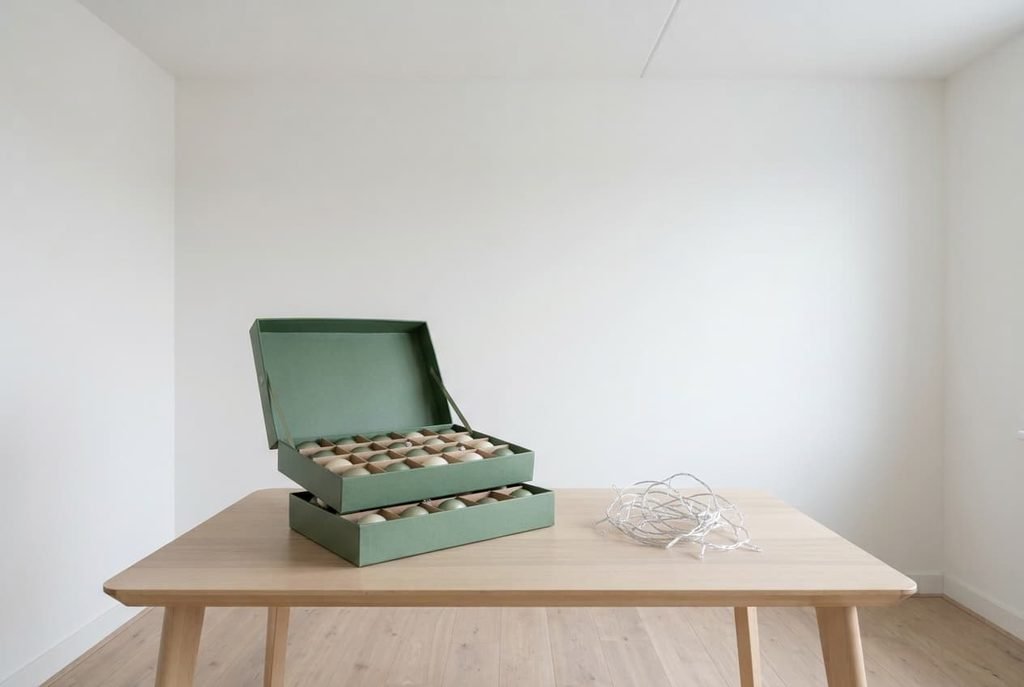
1. A two-layer bauble case with 20 cells of 6.5 cm per layer comes first, because a cell stops glass touching glass. Tier: BUY ONCE. Cells formed in one piece with the tray hold their form for years, and a hinge formed from the same piece outlasts a glued one. Reject card dividers that slide loose, since the baubles slide with them. The case measures 26 × 32.5 × 16 cm and claims 845 cm² of shelf.
2. Next come three light reels, each a 15 cm square with a 5 cm width. Tier: BUY CHEAP. A reel only holds wire, so a rigid plastic body is enough. Ten metres wound on a 15 cm frame makes about 17 turns, and at 3 mm a turn those fill the 5 cm width. Reject a reel with a sharp-cut slot, since that edge chafes the insulation on the first pass.
3. Then a tree box of 55 × 32 × 30 cm takes the three folded sections, each 50 × 28 × 9 cm, which stack to 27 cm. Tier: MID. This box carries whatever sits above it, and stitching quality outranks the fabric. Reject handles sewn into a single layer of fabric, which tear out when the full box is lifted. It claims 1,760 cm² of shelf.
4. After that comes a lidded box measuring 40 × 30 × 20 cm for 38 small ornaments, with the three reels laid on top. Tier: BUY CHEAP. The role is to keep soft pieces flat, and a plain polypropylene body does that. Reject a domed lid, because nothing can be stacked on it and the clearance above goes to waste. It claims 1,200 cm².
5. Last is a round wreath case, 42 cm across, 12 cm deep. Tier: BUY CHEAP. A rigid shell keeps the ring round, and a one-piece lid with a plain catch is all it needs. Reject glued-on clasps, which let go after one winter. It claims 1,764 cm² of floor, a figure the next section puts to the test.
Why the Wreath Case Is the Item to Scale Down
No other purchase breaks the shelf budget like this one, and it’s the only one that fails the sum. The boxes already bought take 845 + 1,760 + 1,200 = 3,805 cm². That leaves 5,000 − 3,805 = 1,195 cm² free, and a case of 1,764 cm² won’t fit in it. Buying all five would ask for 5,569 cm², or 111 per cent of the shelf.
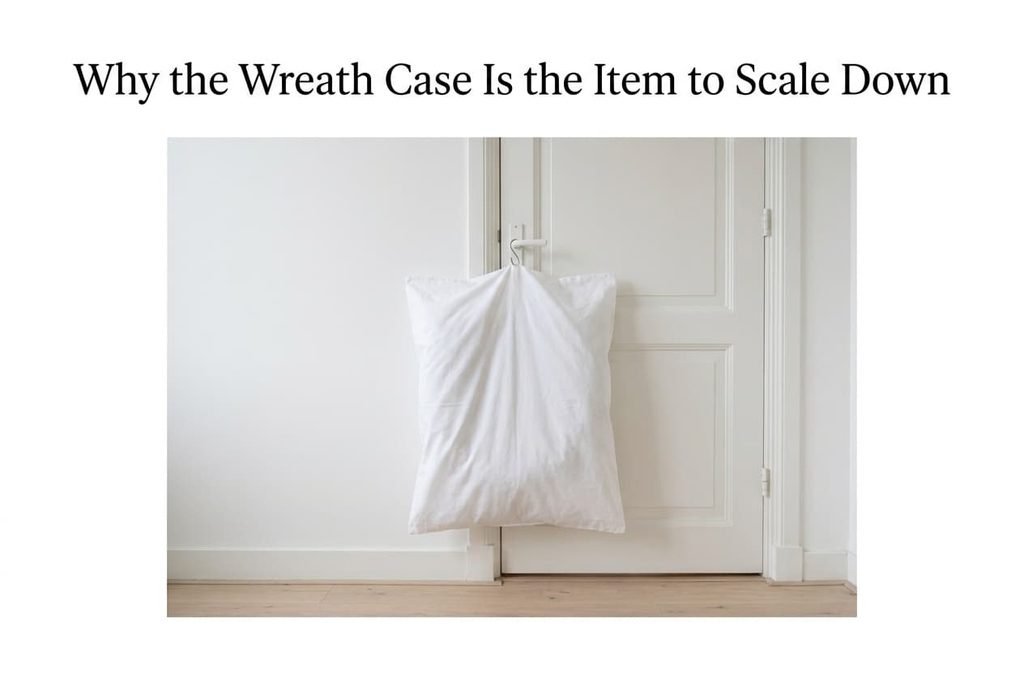
A good decoration store for a small flat spends floor only on things that are fragile or bulky, and a wreath is neither. It weighs little and needs only its ring kept round, which a hanging bag does as well as a shell. A cotton pillowcase of 50 × 75 cm, which you already own, takes a wreath 38 cm in diameter and 9 cm thick with room to spare. Hung from a hook behind the bedroom door, the wreath keeps its shape and claims no shelf at all.
Without the case, the shelf holds 3,805 cm², or 76 per cent of its floor. The remaining 1,195 cm² stays free for whatever you acquire next, such as a second bauble set.
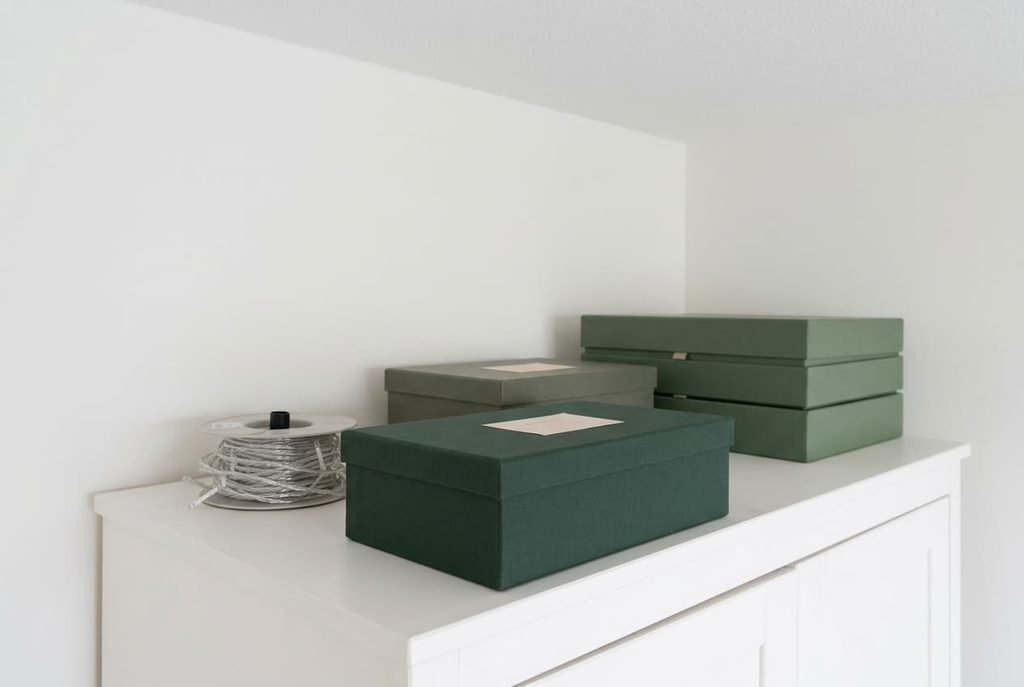
Habits That Keep Every Box Findable in January
Take-down costs 10 + 12 + 8 + 6 = 36 minutes. The first 10 go on 40 baubles at 15 seconds each, and winding three strings takes 12 more. The tree and ornaments take the last 14. Do it in one sitting, with the boxes open on the floor.
Test every light string before you wind it. A string that fails in January costs a minute to bin, while one that fails on the tree in December costs an evening.
A decoration store for a small flat pays off when you can find the right box in under a minute. Write a number on each lid to match your unpacking order, with the tree box as number one. Slide number one to the lip of the shelf and push the bauble case to the back wall, where it’s out of every elbow’s reach. Don’t stack the tree box above the bauble case, because a fall from a high shelf would end the set.
Write the year on a tape strip inside every lid.
What to Skip
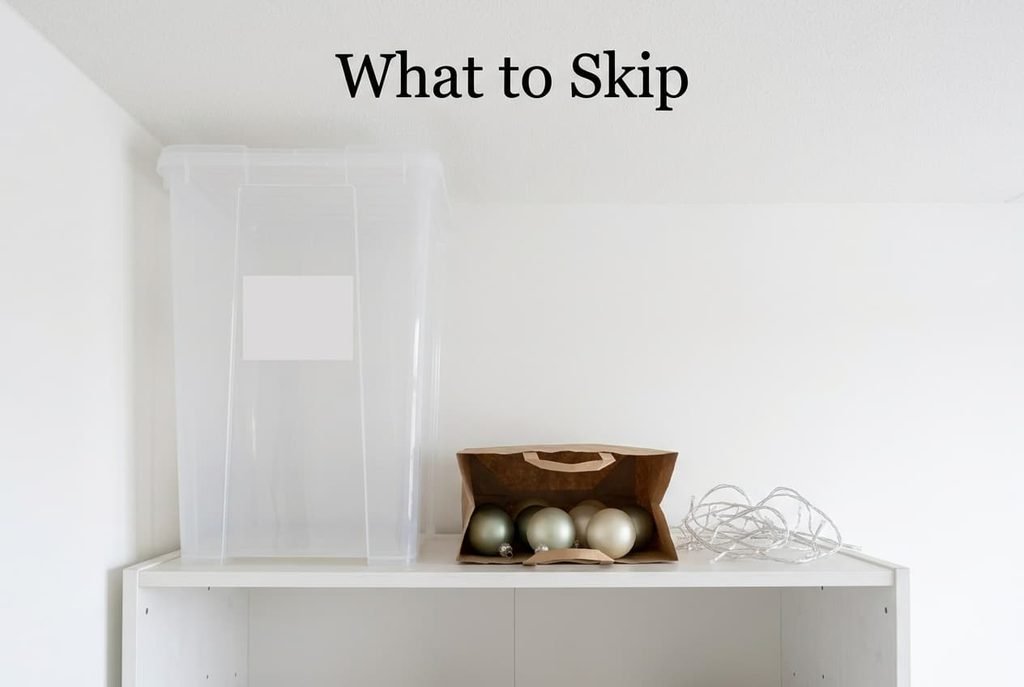
Skip vacuum bags for the tree, since compressed branch tips keep their kink for a whole season. A 150 cm tree loses its shape at the joints where the sections are squeezed, and fluffing the tips back out takes longer than the bag saved. Skip stacking crates of 60 litres or more for a decoration store for a small flat. A crate that size can stand 40 cm tall and spend the whole clearance on one lid. Skip any bauble case with 60 cells, which holds 20 more than the set and stands 7 cm taller for no gain. Skip tissue paper by the roll as well, because each cell already separates the glass.
Four purchases do the real work, and the fifth is a pillowcase. That’s the part most buyers resist, because a case looks like care and a pillowcase looks like thrift. Glass is the one item you can’t replace by the metre, which is why the bauble case heads the list. Buy it first, spend least on the reels, and the shelf will carry the set for years. You’ll notice the difference the first December nothing is cracked.
Questions Readers Keep Asking
How many boxes do I need to start?
Start with the bauble case and one reel per string. Glass and cable fail in storage more often than anything else, and both cost money to replace. The tree box can wait a year, because sturdy sections survive a plain bin bag, and the ornament box can wait until the felt pieces start to crease.
When in the year should I buy them?
Buy the bauble case in November, before the first baubles come out, and fill it as you take the decorations down in January. Leave the reels and the ornament box until January too, when you know which strings still work. A tree box can wait for the following autumn, once you’ve seen how the sections fold.
How do I judge a bauble case in a shop?
Measure a cell against your largest bauble, because the cell should be 5 mm wider: 6.5 cm for a 6 cm ball. Press down on the closed lid, as a lid that bows will push on the glass. Lift the case by its hinge edge, since a weak hinge shows up under load.