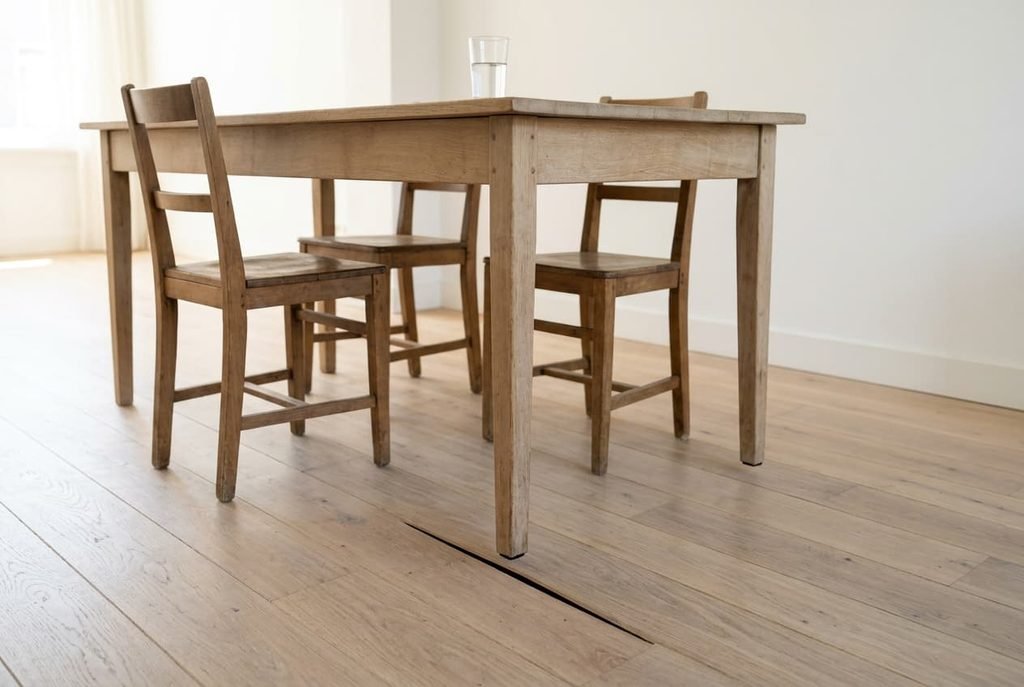
Rocking at the dinner table almost always means one leg is hanging a few millimetres above the boards. Closing that gap rarely takes more than an hour. The case here is a 90 × 180 cm table standing on the old timber floor of a Dutch flat. Its legs stand 70 cm apart across the width and 160 cm apart along the length. Below you’ll find a quarter-turn test that names the cause. Four remedies follow, running from costing nothing to calling a joiner. Take your own measurements first, since the right remedy depends on how large the gap is.
Why a table that wobbles on an uneven floor never settles
Three points make a plane, and a fourth lands on it only by luck. A table with four rigid legs rests on any three, so the fourth hangs wherever the floor drops away. The rocking comes from one leg standing shorter than the floor allows, and the gap beneath it equals the size of the error. If the boards fall 6 mm along the 160 cm spacing, one foot floats 6 mm clear.
The top then pivots about the diagonal that joins the two legs carrying the load. One corner rises by 6 mm and the opposite corner sinks to match. A full glass near an edge slops over its rim.
A flexible frame can absorb a gap under 1 mm by twisting, so a light table may stay quiet where a heavy hardwood one rocks.
Pressing down on a corner hides the real cause. It can also persuade you that the table is faulty when the boards are the problem. The gap jumps to another leg, and many people chase it round the table without finding it. Only the rocking diagonal tells the truth, because two opposite legs bear the weight while the other pair take turns being airborne.
Confirm which version of the wobble you have
Three faults feel identical, and a single test separates them. Turn the table a quarter turn without touching the floor beneath it, then watch where the gap shows up next.
If the gap stays put in the room, the floor is at fault: a hollow or a slope under that patch hasn’t moved. A gap that follows the same leg round means the legs differ in length. Should the gap wander while the table twists like a hinge along a diagonal, the frame has lost its square and the joints have loosened.
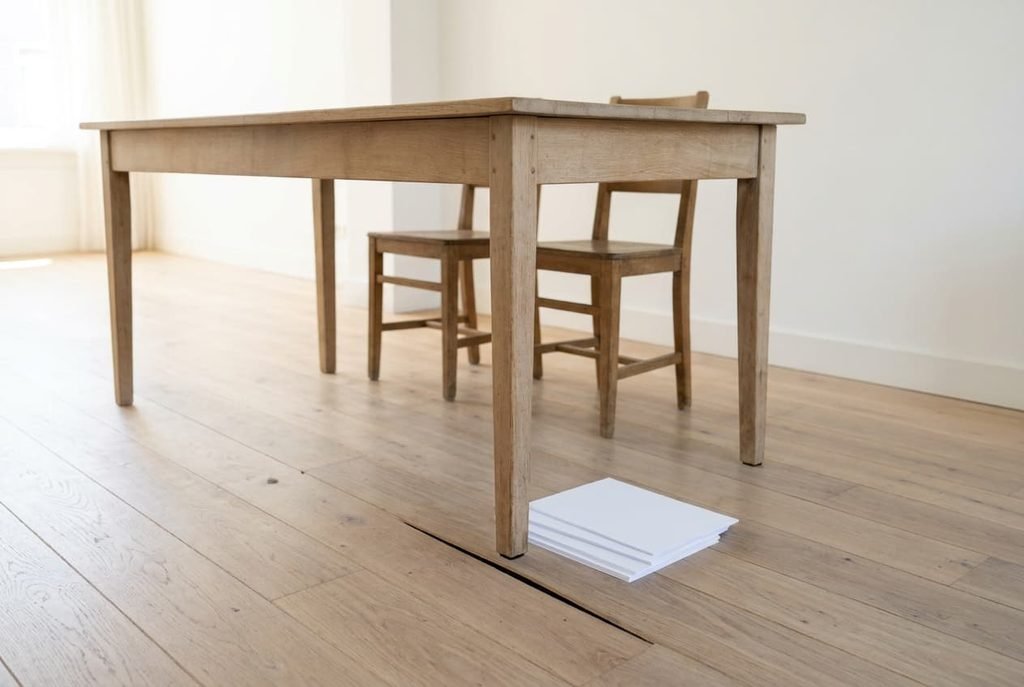
Put a number on it as well. A sheet of printer paper is about 0.1 mm thick, so a 6 mm gap swallows roughly sixty sheets. Slide a few under the short leg and count how many it takes before the table stops moving. That count sizes the problem. It also sorts the remedies below into those that can reach it and those that can’t. It spares you buying a part too short for the job.
Four ways to steady a table that wobbles on any uneven floor
Turning the table or shifting it by 20 cm, because floors vary in patches and a hollow under one foot may vanish half a metre away. Turn the table a quarter turn and press each corner. Nothing is spent, and the test reads the floor directly. Often a table that wobbles on an uneven floor steadies after the smallest move. Press each corner after every turn, then mark the one spot where all four legs settle with a pencil dot. It fails when the whole room slopes, or when the table has to stay under a pendant light or against a window.
Tightening every bolt and bracket on the frame, because loose joints let the legs drift out of plane and a racked table rocks even on glass. Lay the table upside down on a blanket and tighten the fittings with a hand screwdriver, working across the diagonals in small turns. It costs ten minutes. Start with the brackets that carry the most load, and tighten them again after a week as the wood settles. Legs cut to different lengths won’t respond to it, and old glued joints may need a clamp and fresh glue.
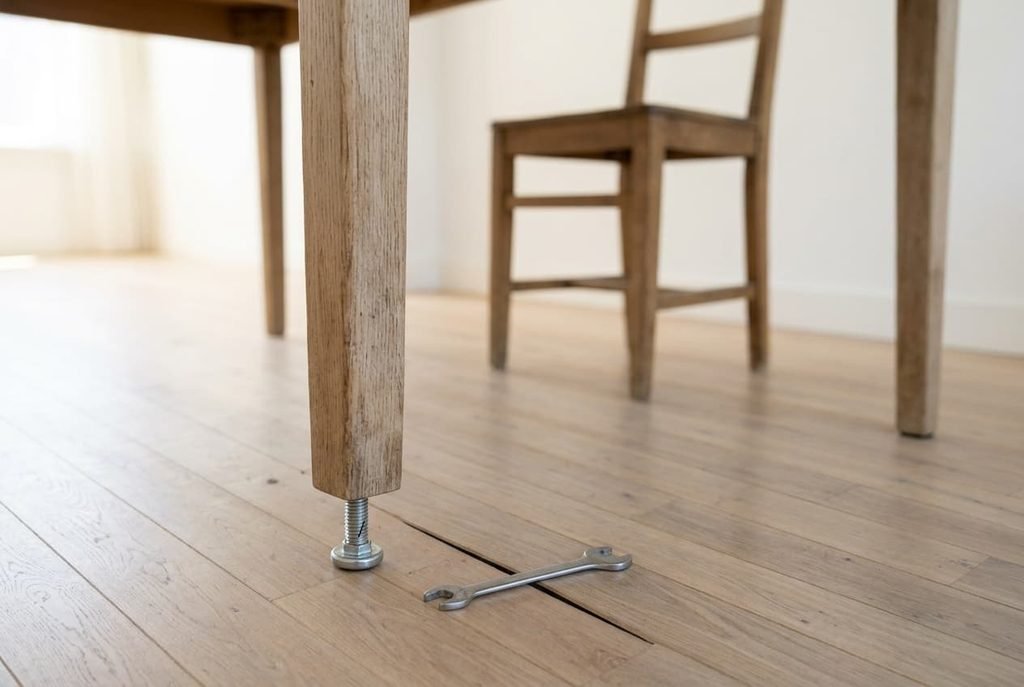
Fitting threaded levelling feet to the short legs, because a screw-out foot adds exactly the length that one leg lacks. A typical foot travels about 10 mm, which covers our 6 mm gap with 4 mm to spare. It needs a modest outlay and a spanner. Turn the foot on the short leg until the table stops moving. Lock its nut afterwards, and mark the setting with a pencil line so you can restore it after cleaning. Hollow or tapered legs want an insert first, and the feet show when someone moves the table.
Asking a joiner to trim the legs to a common length, because after cutting, all four ends lie in one plane and the table rocks nowhere on a flat surface. The joiner marks each leg against a true reference and removes the excess from the longer ones. It is the dearest option. Ask the joiner to cut a little at a time. Test the table on your own floor after each pass, because every millimetre removed is gone for good. A table trimmed for one floor may rock on a different one in the next flat.
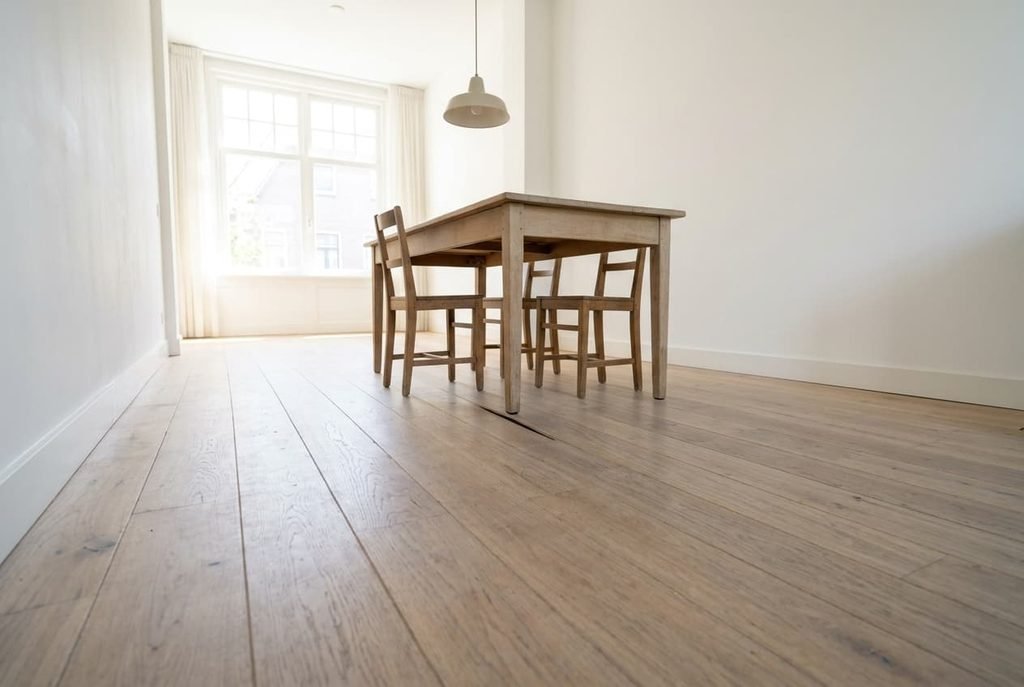
What this room’s own floor decides
Old timber floors often fall towards the outer wall, and nobody renting gets a vote on it. Our 6 mm drop over 160 cm is about 0.4%. The slope runs parallel to the wall, which leaves the pair of legs nearest the window lower than the others. That fall belongs to the building.
That limits the first remedy. Moving the table won’t help when all the boards fall the same way, because every position has the same drop. For a table that wobbles on an uneven floor like this one, levelling feet suit better, since they adapt to the slope and leave the floor alone.
Check their travel before ordering. A slope of 15 mm over 160 cm, close to 1%, is beyond a foot that adds 10 mm. A floor that steep needs a taller foot or a trim by the joiner.
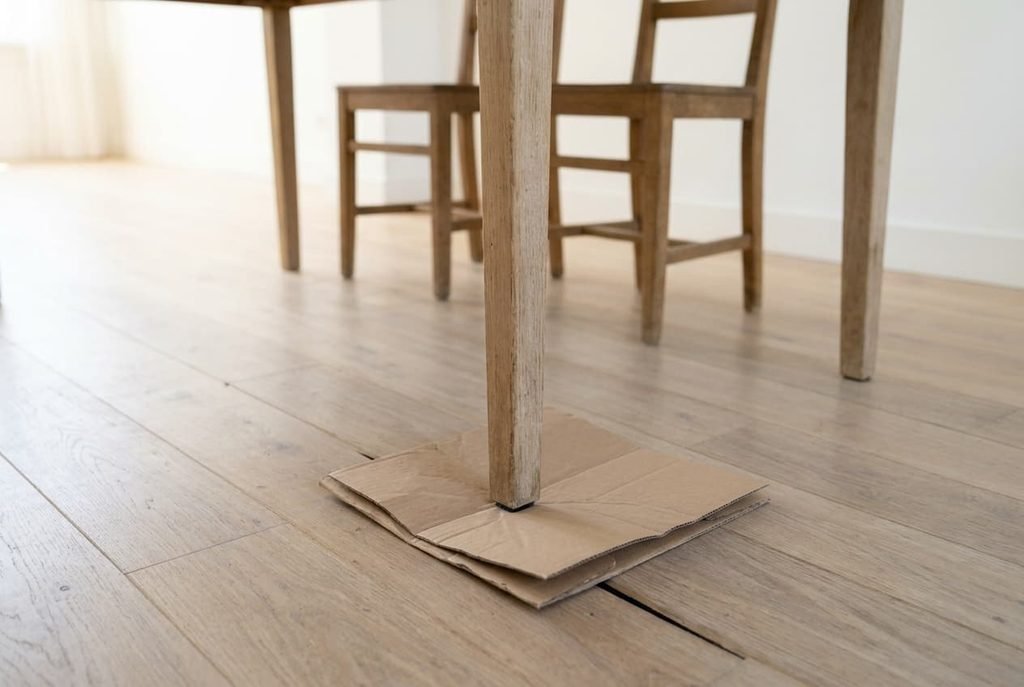
The fix that doesn’t work
Tucking a folded beer mat or a wad of paper under the short leg is the most common repair, and it fails within weeks. Cardboard squashes under the table’s weight, so a 3 mm pad shrinks to 1 mm and the rocking comes back. It also slides out whenever the table is moved or the floor is swept.
The pad has a second flaw. It makes the table seem fixed while the cause stays where it was. The gap closes just enough to pass a casual push, then reopens under a loaded dinner, and by then nobody remembers there’s a pad to replace. Even a good pad shifts each time the table gets dragged out for guests.
A felt pad with a firm core lasts longer, yet only a screw foot follows the gap as it changes.
Match the remedy to the version you found, and recheck the table after a fortnight. A table that wobbles on an uneven floor can nearly always be steadied by one of the four remedies, so keep whichever costs least and holds. Check again after the first wet winter. Timber floors move a little with the seasons, and a fix that holds in August may need a half turn in January.
Questions readers keep asking
Can every wobbly table be fixed?
Almost every one. A gap up to 10 mm is within reach of a levelling foot, and a bigger one can go to a joiner. The rare failure is a cracked leg or a split frame, which needs mending before levelling means anything, so inspect the joints first.
How much does it cost to fix?
Turning the table and tightening the bolts cost nothing but a few minutes. Levelling feet cost a little to buy, and a joiner’s visit is the biggest expense by a wide margin. That ordering is why each rung comes after the one that costs less.
Why does my table only wobble in one room?
That points to the floor instead of the table. A table that rocks on a sloping timber floor may stand firm on a flat one. Give it a quarter turn first, and if the gap stays put, fit levelling feet in place of cutting the legs.