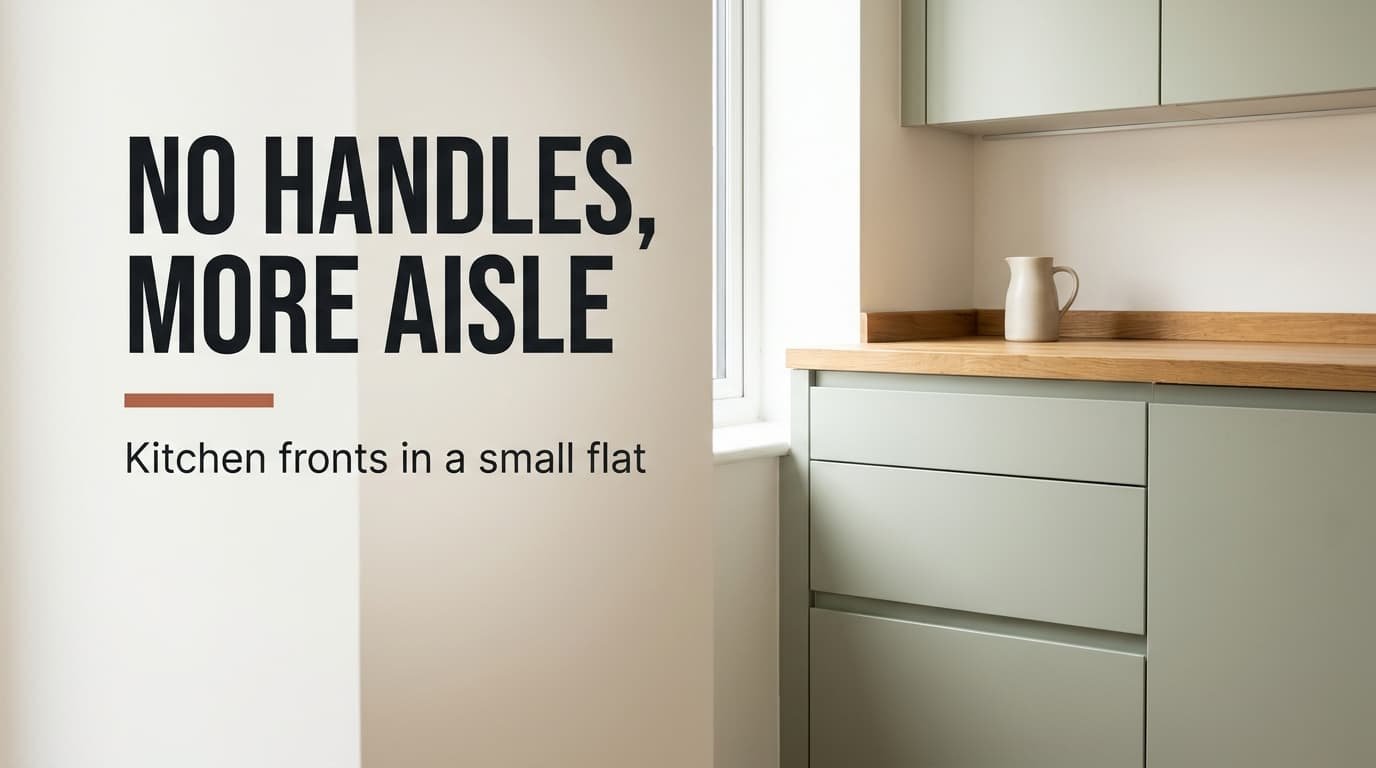
The spread of handleless kitchen fronts replacing bar handles can be checked with nothing more than a tape measure. Take a Dutch galley kitchen with a pair of facing base runs, each 270 cm of wall and 60 deep, and 100 cm of aisle between them. Together they carry 14 fronts. The real question is whether the calmer look justifies itself in a small flat. A common bar handle juts out 3.5 cm and sits on two screws, so every figure below is plain geometry. We’ve kept the numbers simple on purpose. No brands or showrooms appear, and there are no forecasts about where kitchens are heading.
Where the bar handle came from
A flat front offers a hand nothing to hold, and a bar is the most economical way to supply it. One bar suits a door of any thickness. It takes years of daily pulling without complaint, and a replacement needs only a screwdriver. Nobody ever had a reason to blame the handle. It also tells you at a glance where to pull, which a plain front never does.
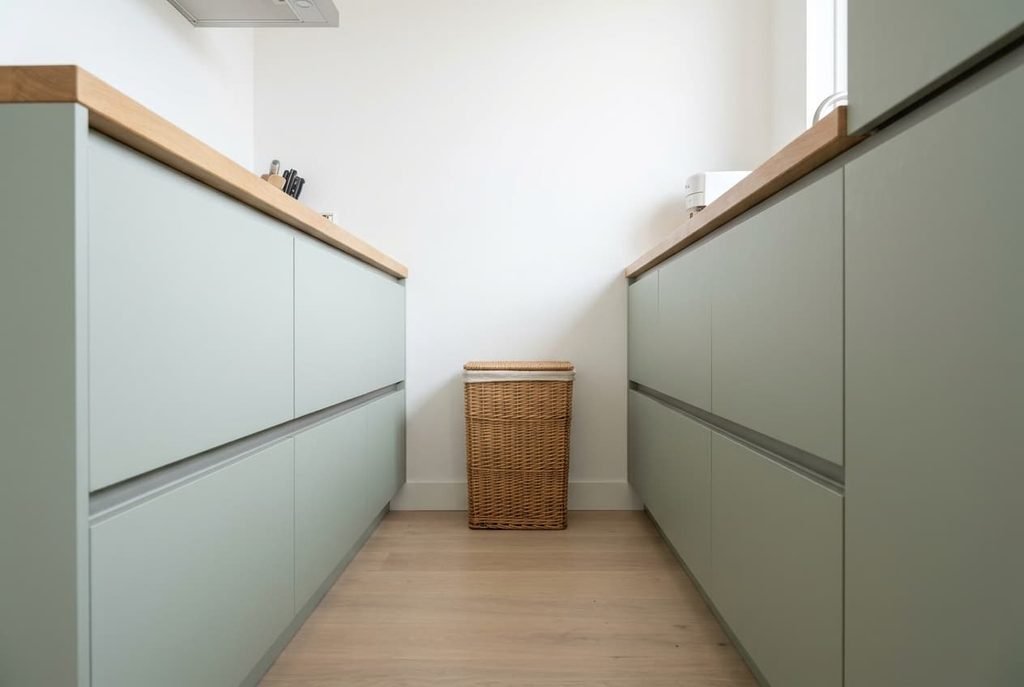
The kitchen around it moved on. Many Dutch flats now squeeze two facing runs into a floor plan where the aisle is roughly 100 cm across, and a person with a basket of washing or a heavy pan uses all of it. A handle that did no harm in a roomy kitchen begins to matter in a tight one, because the aisle was drawn without it.
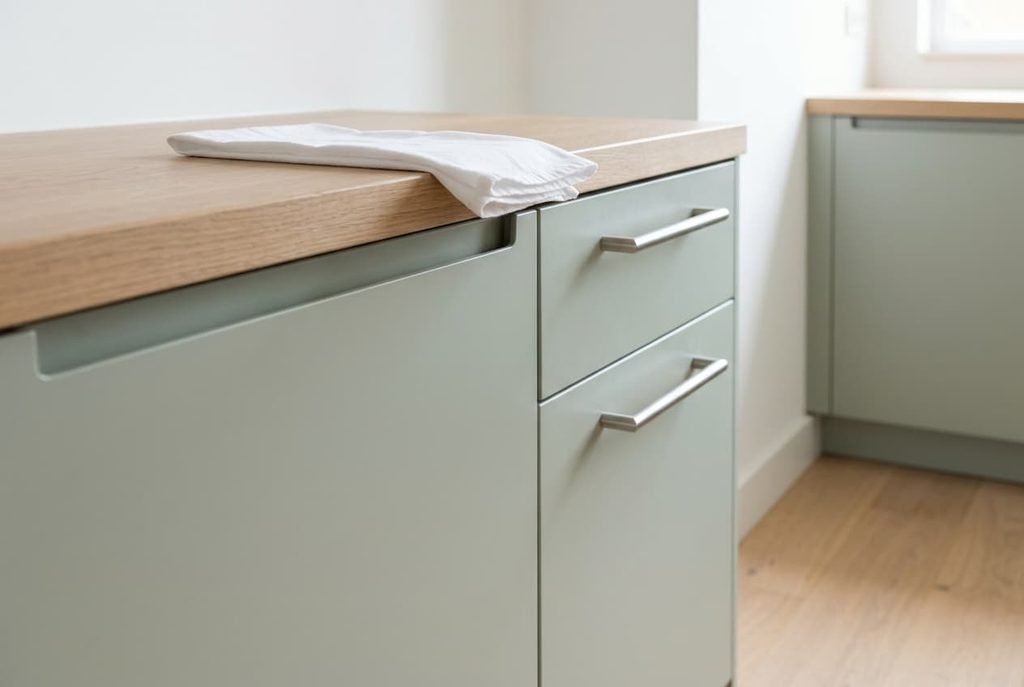
Fronts changed as well. A board of 18 mm thickness is deep enough to take a groove along its edge, or to leave a finger-wide gap above it. Thin boards can’t do either, so the look had to wait for thicker material. A groove cut into that edge leaves the face of the door bare.
What changes with handleless kitchen fronts replacing bar handles in your kitchen
Three measurements differ once the bars come off, and each can be read from the floor plan.
The aisle widens first. A handle at hip height projects 3.5 cm from each run, which leaves 93 cm of the original 100 where the handles sit. With the bars gone, free width at hip height rises from 93 cm to 100 cm, a gain of 7.5%. Measure once from handle tip to handle tip, then again from front face to front face.
Loose fixings go next. Two screws per bar across 14 fronts make 28 holes bored into the boards, and any one of them can work loose over a year. Plain fronts have no such holes, and 28 small crevices where grease gathers disappear with them. A wipe along a flat front takes seconds, where a bar needs a cloth wrapped round it.
The grip gap is the third change, and it is a cost. With a bar, the top edge of a front sits 0.3 cm under the worktop. A finger-grip wants roughly 2.5 cm of clearance there. On a top drawer that strip becomes dead front, and the drawer behind it opens a little less deeply.
A laundry basket 55 cm wide shows the net effect. With bars it crosses the aisle with 38 cm in hand, and without them it crosses with 45 cm.
Two adults passing sideways need roughly 90 cm of clear width, since each is about 45 cm across. The bars leave 3 cm to spare. Plain fronts leave 10 cm, and that’s enough that neither person has to stop and turn.
Who handleless fronts suit, and who bar handles still serve
Tight kitchens gain the most. An aisle of 100 cm or less is where 7 cm decides whether two people can pass each other. Once the aisle reaches 120 cm, the 3.5 cm lost on each side hardly registers, and the bars cost you nothing. They’d cost you more to remove than they ever cost to keep.
Households whose hands are often wet or floury may keep the bars. A finger-grip needs a dry fingertip and a little nail, whereas a bar takes a full hand or a wrist. Low doors opened by small children are easier with a handle as well, because a child finds a bar sooner than an edge.
Rented kitchens change the sums. The fronts and every hole in them belong to the landlord. Unscrewing the bars leaves 28 holes that someone has to fill, and many tenancies expect the kitchen back as it was found. That turns the handleless look into a deposit risk, which usually outweighs the pleasure of a smoother wall.
Material counts too. A grip routed into a thin or hollow front may chip, so ask about the thickness and the core before a router comes out. Handleless kitchen fronts replacing bar handles works best on solid boards, which also hold their edges when the finger pulls on them every day.
Is replacing bar handles with handleless kitchen fronts worth it
For our galley the answer is yes, but only conditionally: change when the aisle is 105 cm or less, or when the fronts need replacing anyway. A gain of 7.5% decides whether a basket passes or scrapes, and 28 holes vanish. The price is a 2.5 cm grip gap and a fresh set of fronts.
That condition carries the decision.
A wide kitchen has a different answer. When the aisle is generous and the fronts are sound, a bar handle costs nothing and works every morning. Paying to remove something harmless is a poor bargain.
Between those cases, ask what the gain buys. Below 5 cm, nobody walks differently. At 7 cm, sometimes. Put the figure beside the quote for new fronts and see whether it looks proportionate, because a small gain for a large bill is rarely worth it.
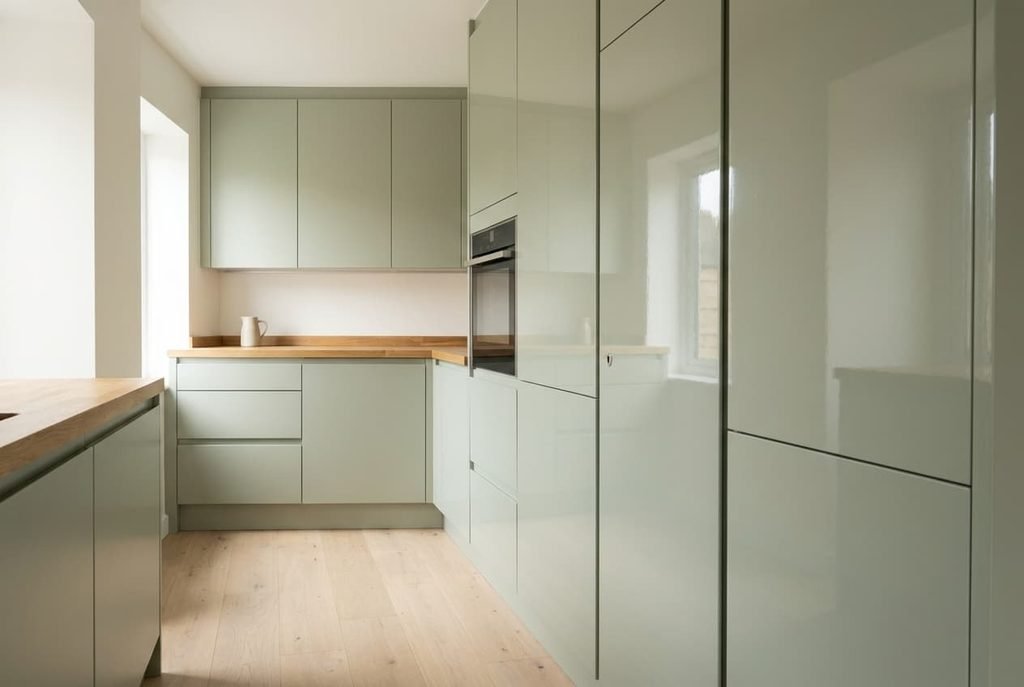
The extreme version to leave alone
The extreme case is a full wall of push-to-open fronts with no grip anywhere, down to the oven housing and the tall fridge door. Each front hides a spring latch that must be nudged in the right spot. Heavy drawers press awkwardly on that mechanism, and a latch that tires leaves a front that won’t stay closed.
Glossy, grip-free surfaces carry another problem. A glossy front shows a fingerprint wherever you press it, so the surface meant to stay clean collects marks at every push point. It also reads as one particular moment in taste, which makes it the form most likely to look dated when handleless kitchen fronts replacing bar handles has become ordinary.
A calmer version puts finger-grips on the heavy drawers and keeps push-to-open for the light doors. That spares most latches and keeps the clean line. A pan drawer holding 12 kg shouldn’t hang its weight on a spring the size of a thumb.
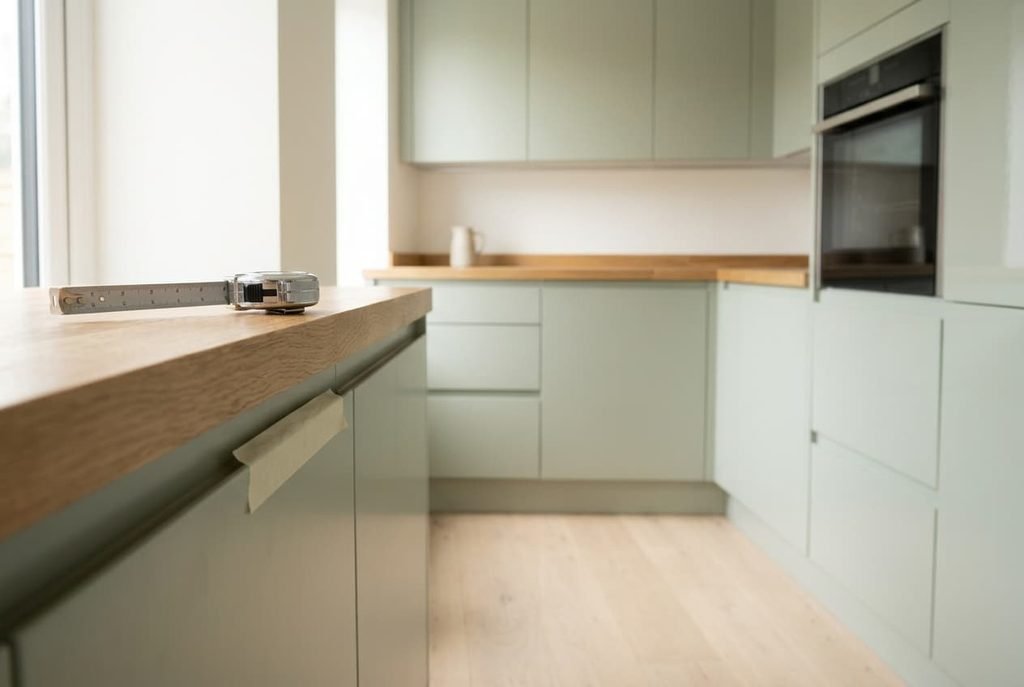
A quick test before you spend anything
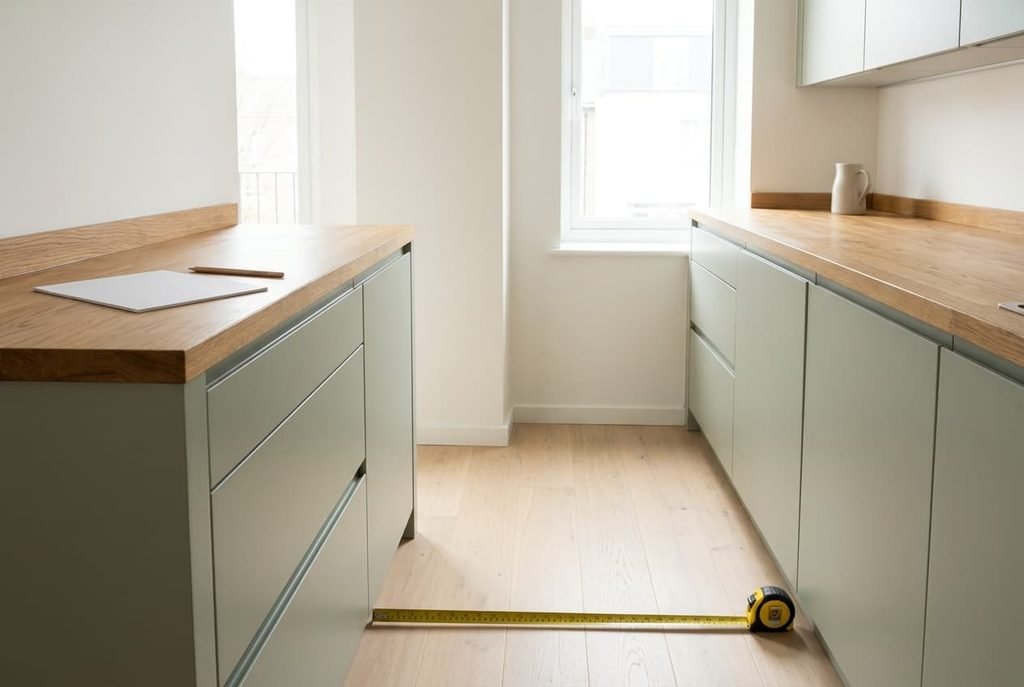
Put a tape across the aisle at hip height, handle tip to handle tip, and note the figure. Then measure front face to front face. The difference is the room the change would return, so record both numbers before deciding, and keep the tape level.
Next, try opening one front by its edge alone. Press a fingertip against the 18 mm edge and see whether it holds. If your fingers find nothing, the kitchen would need a grip profile, and that goes on the quote. Try the same on the heaviest drawer, since that’s where an edge grip is tested hardest.
If the gain is under 5 cm and the edge test fails, the old handles can stay. Anyone pricing new fronts will ask for both measurements, so keep them together on one page. Handleless kitchen fronts replacing bar handles is a change with a clear logic, and the logic holds only where the aisle is tight, so let the tape decide before the catalogue does.
Questions readers keep asking
Should I replace handles that still work?
Only when the aisle gain changes how the kitchen works, or when the fronts are being replaced for another reason. A sound bar has years left in it. The cost is labour plus filling the holes. If the gain is under 5 cm, the old handles have earned their place. Spend the effort elsewhere.
Do handleless fronts suit a small kitchen?
Often they do. A small kitchen tends to have a narrow aisle, where 3.5 cm on each side matters. If the aisle is wide and nothing feels cramped, bars work just as well. Look at how the grip gap affects the top drawers before you commit.
How long will handleless fronts last compared with bars?
A front lasts as long as its board and finish, whatever sits on it. Latches and edge grips wear before the board does, while a bar can be exchanged in a minute. Because tastes move on, a plain profile ages more gracefully than a bespoke one, and it’ll be easier to change later.