Turn a phone charger over and read the line of small print on its back. That line decides more than any shop display about whether you need a travel adapter for every country on your list. Our example is Nadia’s household in Leeds, which makes three trips in one year. Spain comes first. The USA and Japan follow. The family packs five things to charge. Three alternatives to buying an adapter per trip follow, each one trading away something different. No product is named, because names age faster than the method. Swap in your own trips and chargers as you read.
What a Travel Adapter for Every Country Has to Solve
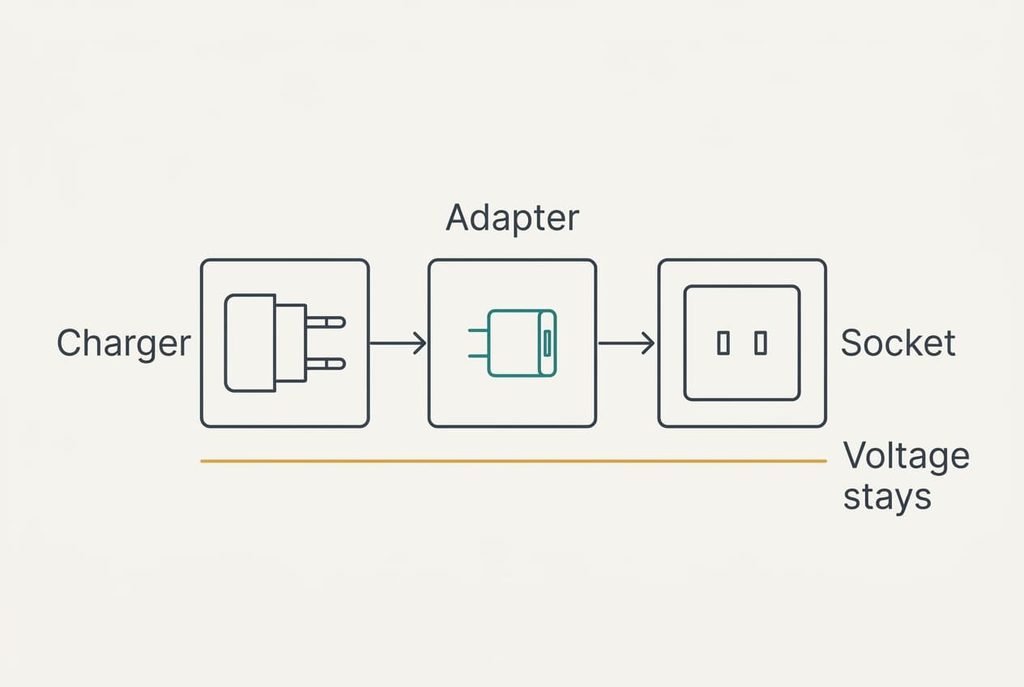
An adapter solves one problem, the shape of the pins. The electricity behind the socket stays whatever the country supplies, and the adapter leaves it untouched. Round pins fit sockets across much of continental Europe. Flat pins cover a good part of the Americas and Japan. Nadia’s three destinations therefore fall into two shapes, with Spain on round pins and the USA and Japan on flat ones. Her shopping list holds 2 shapes and not 3 adapters, so a travel adapter for every country becomes a travel adapter for every shape. Count shapes before you count flags.
The second job belongs to each charger. All five of hers carry a printed range reading 100–240 V, which comfortably spans the 100 V of Japan and the 230 V of Spain. A charger marked 100–240 V needs a pin adapter and nothing more, whichever country you land in. Her hairdryer is the exception, because its label reads 230 V alone and flat-pin sockets would run it weakly. It stays home while the hotel supplies one.
Three Ways to Charge Abroad Without Buying Adapters Again
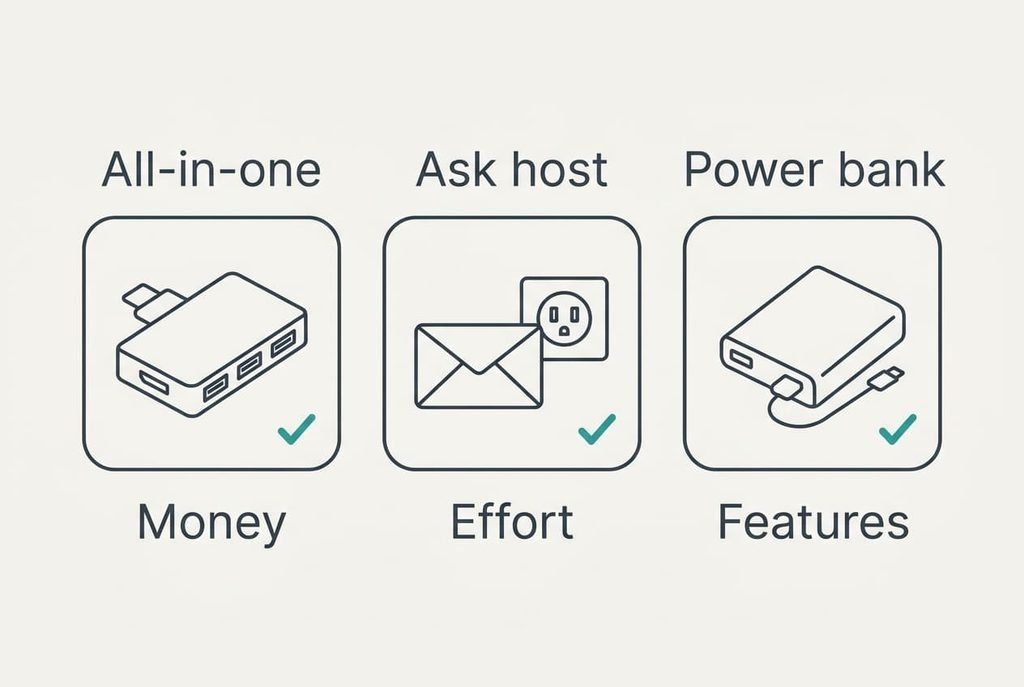
Every route sacrifices a different thing. Read each failure line before its benefit.
1. Pay once for an all-in-one adapter with USB ports. This suits anyone who flies several times a year with more than one device, and it asks for the most money up front but nothing afterwards. One wall socket feeds a few USB ports and a mains slot, so Nadia charges 4 of her 5 items together and the camera charger waits its turn. Bulk is the cost, since the block hangs heavy in a loose wall plate and covers the socket beside it. Failure shows in an old wall socket. The weight tips the block downward, and the contact drops out overnight. Rest it on a book to take the strain. A family sharing one socket by the bed gains most from this route.
2. Ask your host and travel with cables only. This suits short city stays booked through hosts, and it costs effort in place of money. Message the host ahead to ask for a spare adapter or a USB socket by the bed. That takes about 10 minutes per trip. Phones and tablet then charge by cable, and the laptop borrows the host’s adapter. Silence is the failure. If the host never replies, you arrive at night with 15% battery and no way to charge, so keep a fallback in the bag. A host who owns a spare will usually say so in one line, which is why the booking message is the best moment to ask.
3. Carry a power bank and charge less. This suits week-long trips with phones only, and it costs features. The laptop and camera stay unpowered in the bag. A bank holding about three phone charges covers Nadia’s two phones for 36 hours. The bank itself still needs one overnight fill, so you carry one pin shape for one socket anyway. On day two the bank empties, and the trip needs a wall socket after all. Long walking days with few sockets are where this route earns its place.

The Cost That Shows Up on the Third Trip
Any plan that replaces a travel adapter for every country looks tidy on the first flight and wears down by the third. Assume one trip in six ends with an adapter left behind in a hotel wall. At 3 trips a year that costs Nadia an adapter every two years, so the all-in-one block, being the priciest piece, deserves your name written on it. By the third trip, the item left in a wall socket is nearly always the adapter, because it sits flush with the plate and hides behind a bedside lamp.
The host route frays differently. Hosts forget and spare adapters go missing. Message number three gets a shorter reply than message number one. The power bank loses a little capacity with each year of charging, so a bank that covered 36 hours in January covers about 24 by the second winter.
Whichever route you pick, tie the checks to your packing list.
A Sequence for Switching Before Your Next Departure
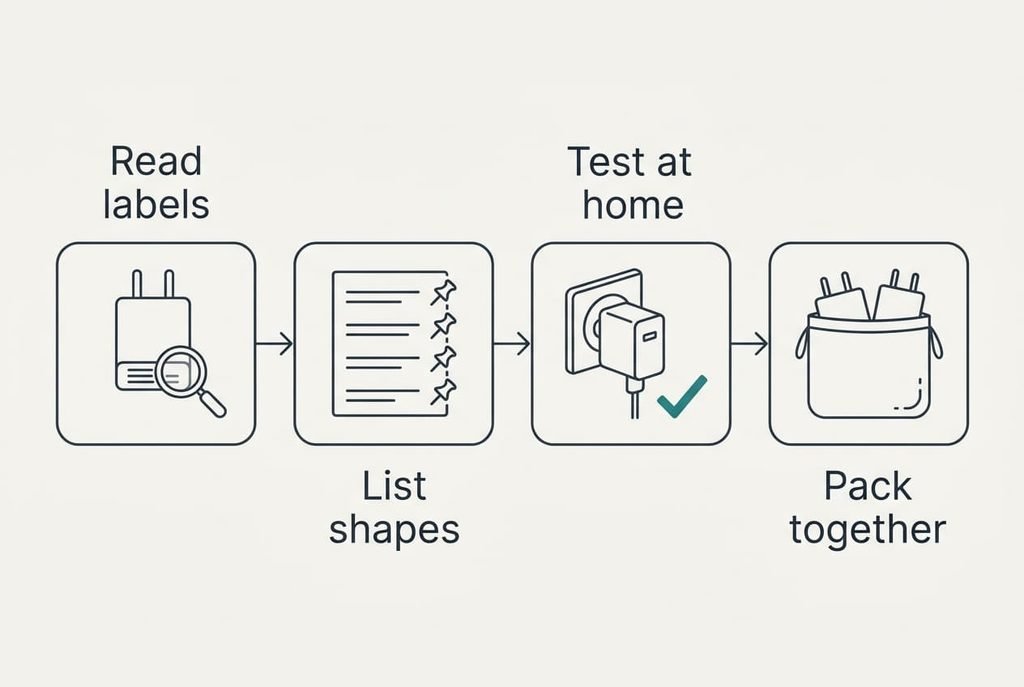
Spend one evening on this about two weeks before you fly. Lay out every charger you plan to carry and check the label of every one, which takes about 5 minutes for five items. Write the input range beside each name. Next, list your destinations. Mark the pin shape for each, and Nadia’s three trips collapse to 2 shapes. Choose the route that fits your shortest trip first, because the weakest plan shows up there.
Buy any piece at least a week early. Plug it into a socket at home with each charger in turn and tug the cable lightly to confirm that nothing wobbles. Slide the output pins out and in ten times. A stiff slider is better found on your own landing than at a hotel desk. Pack the adapter in the same pouch as the chargers so it travels with them and never in a separate bag.
When One Adapter Per Destination Still Wins
Keep the plain approach if you fly to the same country twice a year or charge a single device. A cheap plain adapter left permanently in the suitcase pocket beats every other route on effort, since nothing needs planning and nothing can be forgotten. Nadia’s brother visits one cousin in Spain each summer and carries a phone and a tablet. He owns one round-pin adapter, kept in the pocket of his case between trips, and his packing takes no thought at all. Buying a travel adapter for every country is overkill when you visit one place.
The plain route also wins when your devices outnumber your patience. A household that adds a new gadget every year shouldn’t rebuild its kit around each purchase. The simple adapter fits whatever arrives. Check it once a year by plugging a charger in and tugging, and replace it when the fit loosens.
A route you never think about beats a clever one you pack badly.
The Label Test: Which Travel Adapter Works in Every Country
Before you trust any plan, read the input line on every charger and write the range on one note. Each line shows a minimum and a maximum voltage. If your destination’s mains voltage sits inside that range, the charger is ready for a pin adapter. If it sits outside that range, the item stays home. A separate converter is the only other way, and that piece is bigger and heavier than any adapter.
A pencilled note on the underside of every charger, such as ok up to 240, saves you rereading it in a dim hotel room. Add the pin shape you checked for each destination, so the note works as a packing list and a test record at once.
Then add the watts printed on the chargers you’ll use at once and set that total against the rating on your adapter. Nadia’s laptop charger is the largest item, and her USB-fed phones add little. Read your labels tonight and count your pin shapes, then pick the route whose failure you could live with.
Questions Readers Keep Asking
Will the chargers I already own work in other countries?
Most will, if the label reads 100–240 V. That range covers the mains voltage across the destinations in this example, so only the pin shape needs solving. Items marked with a single voltage, such as a hairdryer at 230 V, should stay at home. Read each label before packing and note the range on one list.
Is an all-in-one adapter dearer than plain ones?
It costs more than one plain adapter and less than several. Nadia needs 2 shapes, so two plain adapters would cover her trips, though each serves one device at a time. The all-in-one starts to pay once you add a third shape or a second device to charge at the same moment. Count shapes first, then compare.
Is it worth changing how I pack for one trip a year?
Rarely. With a single trip a year, a plain adapter kept in the case between journeys asks for no planning and seldom fails. The evening of label reading still helps, and it takes five minutes. Move to the all-in-one only when you start carrying more devices or visiting new shapes of socket.