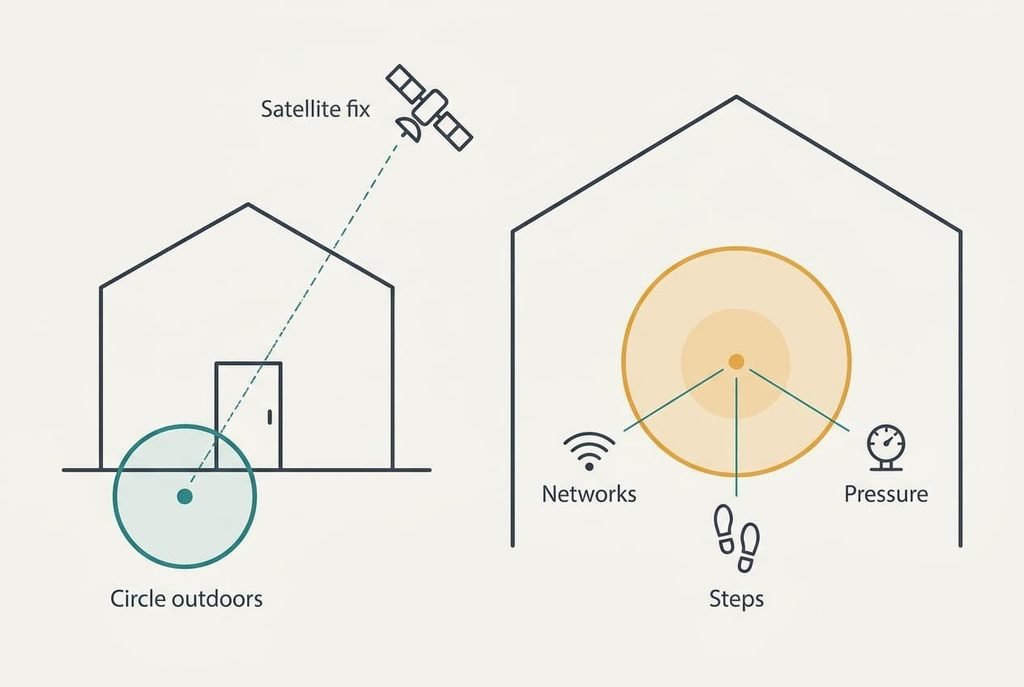
A phone can know where you are indoors because it switches from satellites to three weaker clues. The first is the nearby wireless networks it can hear. The second is your step count, and the third is the air pressure around it. Each clue is rough alone, and together they narrow your position to a circle of roughly twelve metres. Here is the short answer, then one walk into a shopping centre traced from entrance to second floor. An analogy and the limits follow. After them come three wrong beliefs, then a rule for trusting the blue dot.
How a phone can know where you are indoors: the short answer
In short, the phone starts from the last good satellite fix, then updates it from networks and steps and finally from pressure, keeping a circle of doubt around the result. A walker covers about 42 m in half a minute, so the last fix limits where you can be. That sentence explains why the dot keeps moving after the satellites go silent, and why it sometimes lands in the wrong shop.
Several details sit outside it. Satellite signals fade at a doorway because they arrive weak after a 20,000 km trip. A phone turns network strengths into a position by matching them against a stored map built from earlier visits. The blend of the clues is easiest to see in a worked case. The next section traces one.
Assume satellites give a circle of 5 m outdoors and about 12 m indoors. Treat these numbers as illustrations. Real phones differ, and each keeps its own scale private.
The circle is the honest part of the answer.
One walk into a shopping centre: where you are, indoors, as the phone sees it
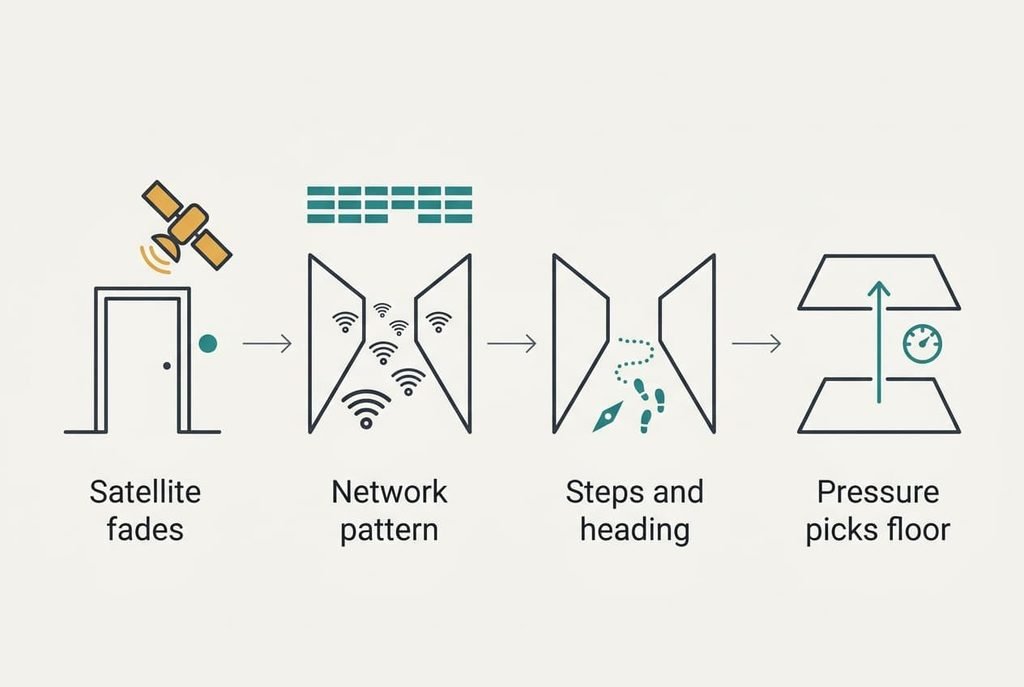
At the entrance the phone holds a good satellite fix with a 5 m circle. You step through the doors. Within about thirty seconds the roof and walls cut the satellite signal to a fraction of its outdoor strength, and the phone notices that the fix has stopped improving. It keeps the last position and the last circle, since they still limit where you can be.
Next it listens for wireless networks. Say it hears six, each with a signal strength. A shopping centre is full of networks, and a stored map tells the phone roughly which strengths appear at which spots. The six strengths look most like the pattern from the ground-floor corridor, so the position narrows to about 15 m.
Meanwhile the motion sensors work. You take 40 steps, and the phone multiplies by a stride of 0.7 m to get 28 m, while the compass supplies a direction. That moves the dot along the corridor between wireless checks. The estimate drifts by a few percent over every 100 m, so a wireless reading has to correct it now and then.
Then you ride an escalator. Air pressure falls about 12 Pa for each metre you rise, so a 4 m climb lowers it by around 48 Pa, and the phone’s pressure sensor can read that change. The phone concludes you’ve gone up one floor and moves the dot to the second-floor map. The circle sits at about 12 m once more.
Each clue narrows the others. Wireless strengths correct the drift in the steps, and the steps fill the gaps between wireless readings. The pressure picks the floor. Whenever you ask where you are, the phone answers from this blend. Once you’re past the doorway the satellites play no part, and you do nothing at all. A phone that can know where you are indoors this way has simply moved its trust from the sky to the building.
A ship’s navigator and a lighthouse, and where the comparison breaks
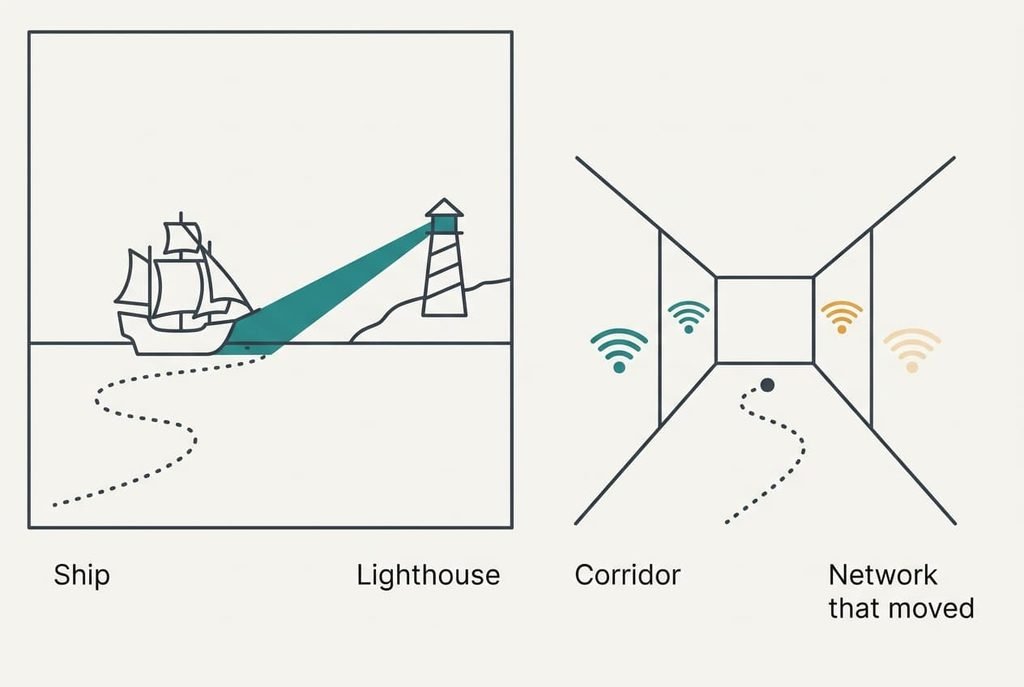
Think of a navigator on an old ship with no sight of land. She knows the speed and the heading. The hours elapsed tell her how far the ship has run, so she plots where it must be. Now and then a lighthouse appears, and she corrects her plot against it. The steps and the compass play the part of the log, and the wireless networks play the part of the lighthouses.
The picture fails twice. Lighthouses stay where the chart says, but a wireless network can move or vanish overnight, which is why the stored map goes stale. Ships drift slowly over hours, whereas a phone in a pocket swings and tilts with every stride, so its step count piles up errors much faster.
What indoor positioning cannot do
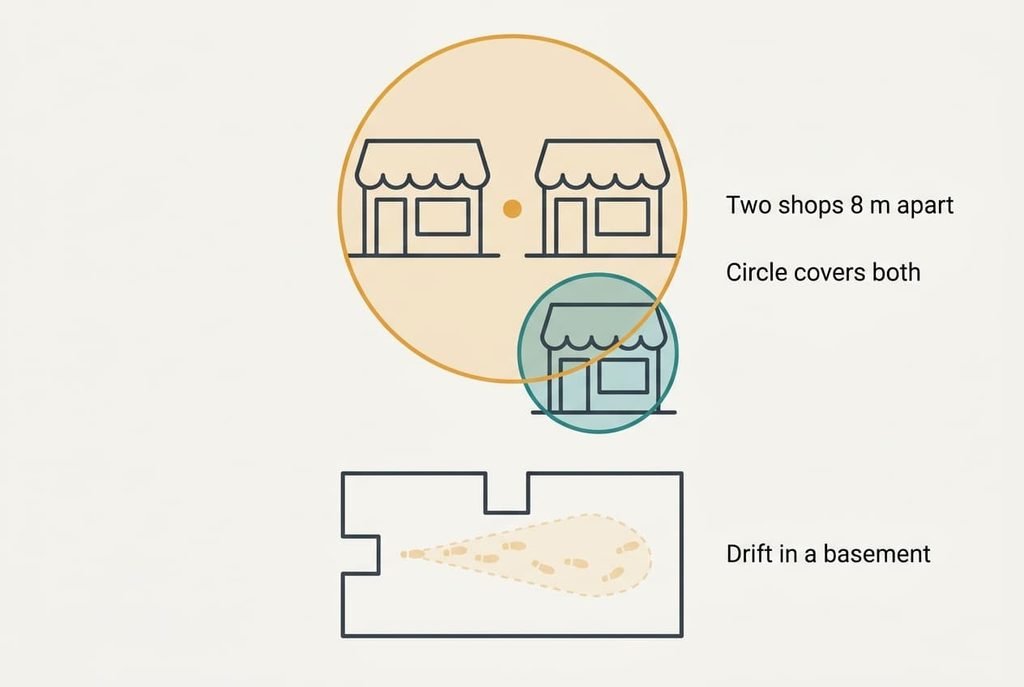
The dot is an estimate with a circle of doubt, and the circle matters more than the dot. A 12 m circle can’t separate two shops that sit 8 m apart, so the phone may show you in the neighbour’s doorway while you stand in the right one.
Rooms are always harder to pin down than floors.
Other limits follow. Pressure changes steadily with height, which makes floors easier. Even so, a sealed building can shift pressure when a door opens. A basement with no satellite signal and few networks leaves the phone relying on steps alone. Steps drift. A building that has just moved its networks will confuse the stored map until someone rebuilds it.
Crowds absorb wireless signals, so the same spot can show different strengths at noon and at closing time. A phone that tries to know where you are indoors at the busiest hour often has the least reliable data.
Three beliefs that make people think the phone knows exactly where they are
People assume the blue dot is the position, because it’s drawn as a point. In fact it’s the centre of a circle, and the circle can be wider than the shop you’re standing in. The map hides it for tidiness.
Another belief says satellites do the indoor work, because the app draws the dot either side of the door. Behind the scenes the app is switching sources, and the sudden jump between them explains the wandering you sometimes see near entrances.
The third belief says the phone has to download your position from the internet. Satellite receiving is one-way, so the phone can work out its own location without sending anything. The internet supplies maps and stored wireless data, which is why the dot can feel slower on a weak connection. The position itself is computed on the phone.
When to trust the blue dot
Trust the dot when its circle is smaller than the distance between the options you’re choosing from. If two entrances are 40 m apart and the circle is 12 m, the dot will point to the right one. If two shops sit 8 m apart, treat the dot as a hint and read the signs on the doors.
When the circle looks wide, step outside for a moment, or find a window. A fresh satellite fix shrinks the circle to about 5 m, and the indoor estimate then restarts from a better place. Check the circle before you rely on a meeting point.
For a meeting, agree on a landmark as well. Both of you can see a fountain, while neither can see the other’s dot. A phone that can know where you are indoors to within twelve metres still can’t say which of two identical corridors you’re standing in. Naming the shop to a friend costs a few seconds and often saves a ten-minute walk. Glance at the circle once more before you set off, because it shrinks as you near a window.
Questions readers keep asking
How accurate is indoor location?
Roughly ten to fifteen metres in a typical shopping centre. It improves near many networks and gets worse in basements and open halls. Most of the time the phone picks the right floor and wing. Two neighbouring doorways are another matter, since it can’t reliably separate two neighbouring doorways, so rely on the circle and not on the dot.
Do I need to leave location switched on for this to work?
For the dot to follow you indoors, yes. The phone needs permission to use networks and motion sensors. For a single route, switch it on while you navigate and off afterwards. The phone will find you again when you switch it back.
Is it the same as GPS?
No. GPS is the satellite part, and it works best outdoors under a clear sky. Indoor positioning borrows from networks and from motion and air pressure when satellites fade. Most phones blend both, so the dot you see is usually a mix of the two.