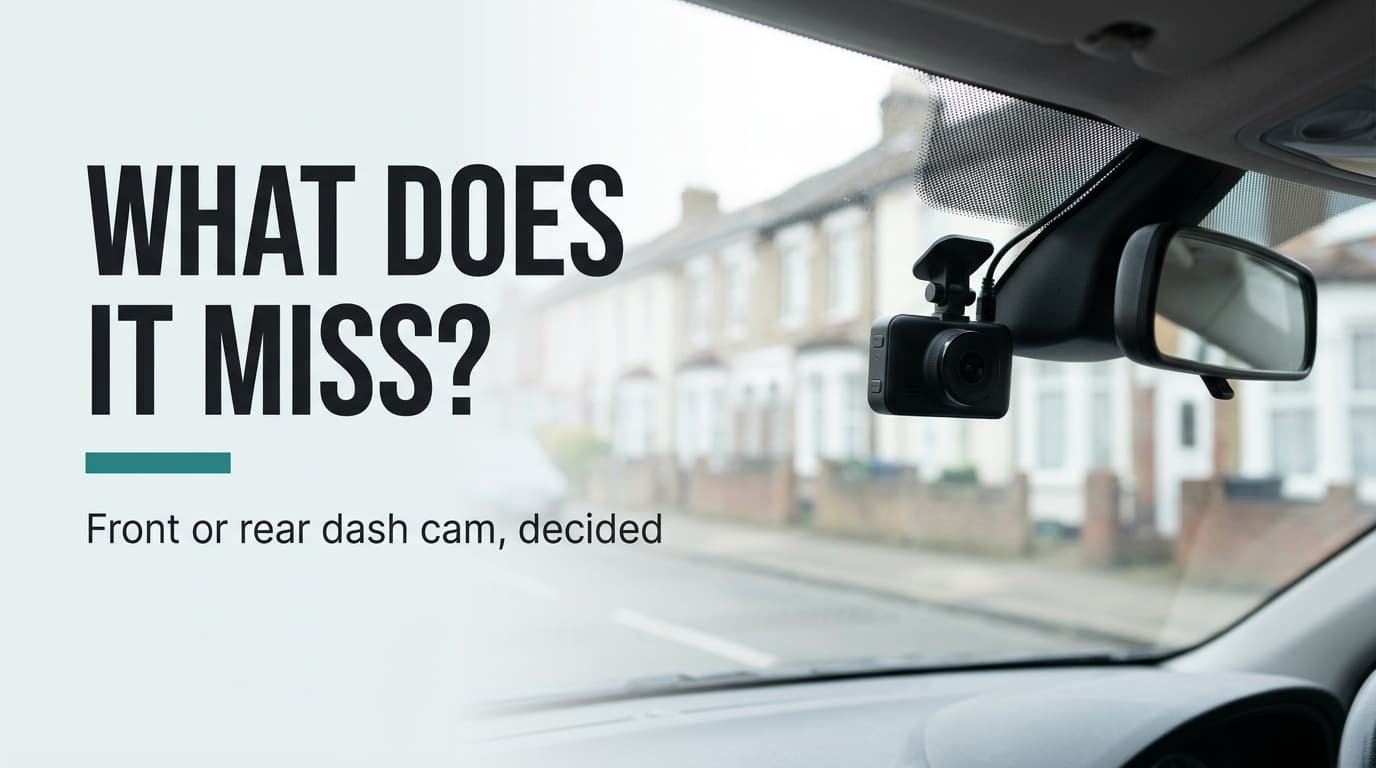
Which part of a journey would a forward-facing camera never record? Anything that arrives from behind. For a dash cam for everyday driving, choose the front-only model if you drive open roads and seldom queue, and the front-and-rear pair if cars regularly sit close behind you. The deciding property is angle: one lens sees about 140° of the 360° around the car. The calculations assume a UK saloon with 1080p lenses and a 128 GB card, and each figure here is a rounded assumption. Swap in your own measurements. We leave out brands and prices, because they date quicker than geometry does.
The one property that decides a dash cam for everyday driving
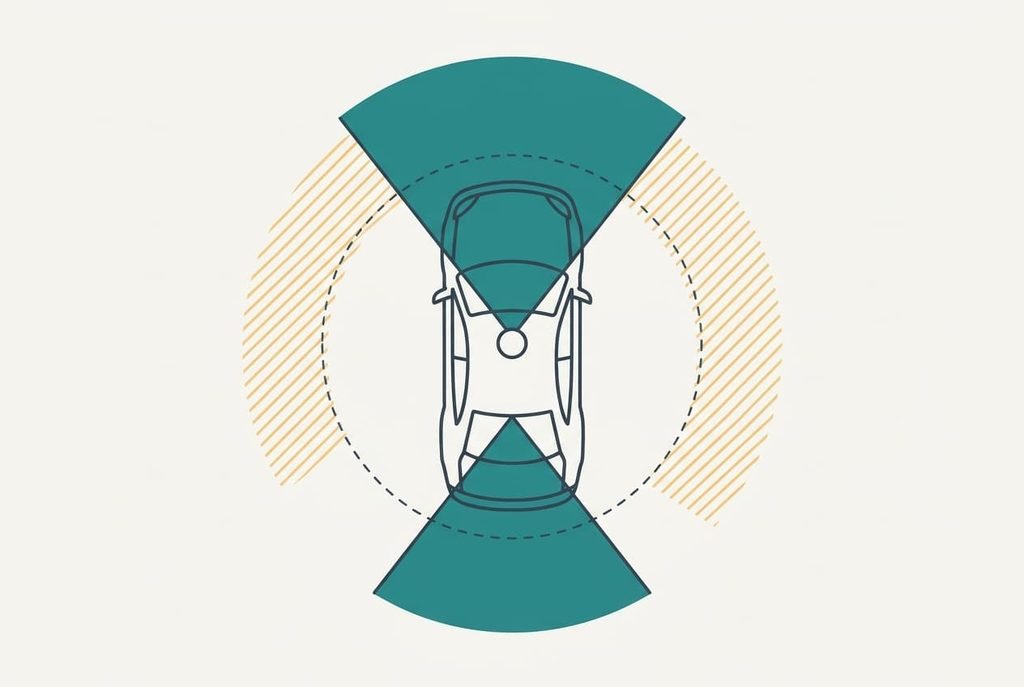
Picture quality and card size draw the eye, yet neither tells you what a camera will miss. What matters is the share of the 360° around your car that the lenses can see, because a lens records nothing outside its angle. One front lens at 140° covers 38.9% of the circle. Add a rear lens at 130° and the pair covers 270°, which is 75%. The other 90° on the sides stays unseen either way. Sideways incidents at junctions are caught by neither, so the pair improves your odds without ending the blind spots.
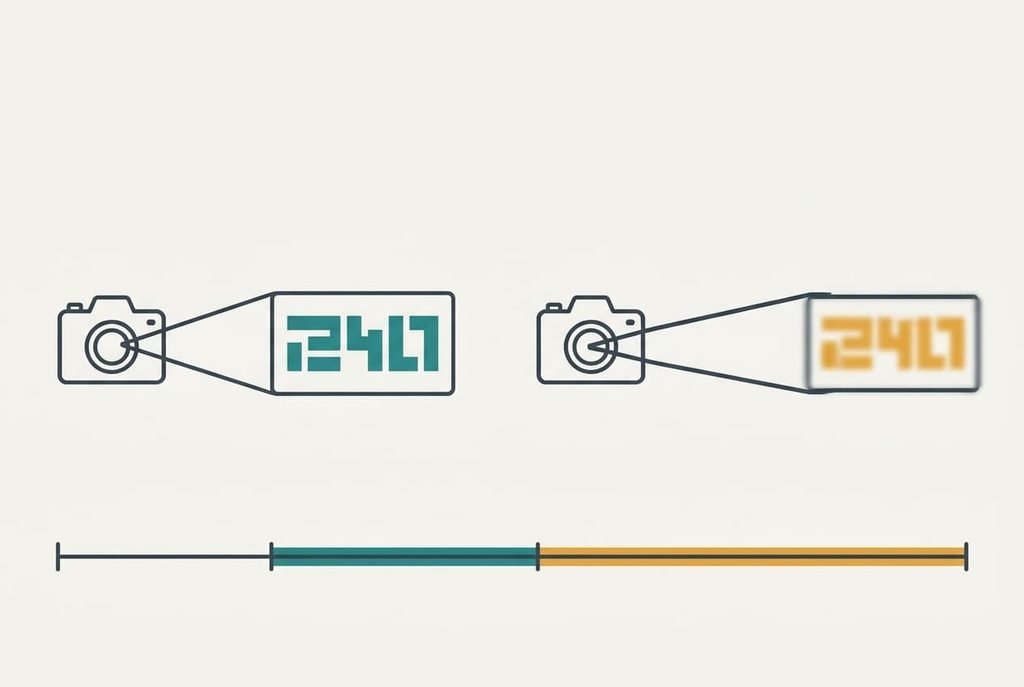
A second number matters as much: how far away a number plate can still be read. A plate 52 cm wide, filmed by a 1080p lens spread over 140°, occupies about 408 ÷ d pixels at distance d in metres, measured on the middle of the frame. If you need 100 pixels to read the characters, that limit is 4.1 m. A rear lens at 130° stretches it to 4.4 m.
A wide lens proves who hit whom, and it names a car only up close.
So a dash cam for everyday driving is judged by its angle first and its reading distance second.
Front-only and front-and-rear dash cams compared for everyday use
Compare the two by what they record and what they cost in effort. Six checks follow, and you can test most of them before you buy anything. The rows leave out price and speed on purpose, since both date quickly. Neither changes what a lens can see. Read each pair of cells as a trade: whatever the second camera adds in coverage, it takes back in data and cable, plus the extra glass.
| Check | Front-only | Front-and-rear |
|---|---|---|
| Angle covered around the car | 140°, or 38.9% | 270°, or 75% |
| Plate readable in the middle of the frame | Up to about 4.1 m ahead | 4.1 m ahead and 4.4 m behind |
| Recorded per hour of driving | 5.4 GB | 9.0 GB |
| History held on a 128 GB card | About 22 hours | About 13 hours |
| Cable to route | About 3.5 m | About 10 m in two runs |
| Glass carrying a lens | Windscreen | Windscreen and rear window |
The plate row surprises people. A lens wide enough to show a whole junction resolves a plate only inside about 4 m, so footage settles who braked or pulled out far better than it identifies a car that drove away.
Where the front-only camera wins
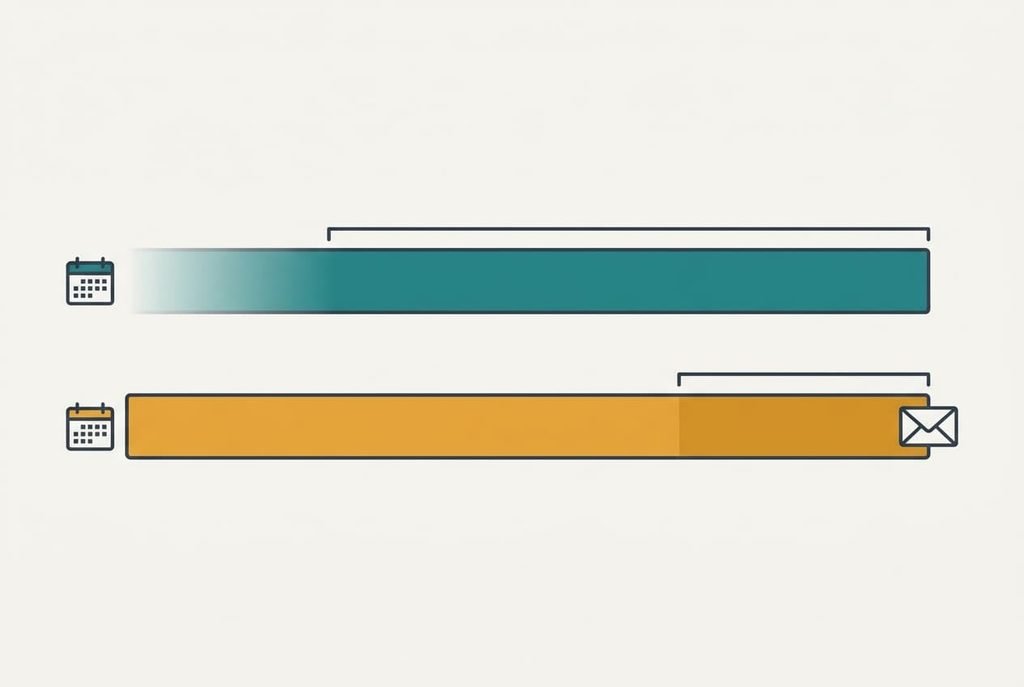
History is where front-only leads, for a dash cam for everyday driving. We assume 1.5 hours of driving a day and 119 GB of usable space on a 128 GB card. At 5.4 GB an hour, the card holds 22.0 hours, which is 14.7 days before the oldest clip is overwritten. A pair recording 9.0 GB an hour holds 13.2 hours, or 8.8 days. A letter about a scrape often arrives ten days later, and a front-only card still has the journey while the pair has already recycled it.
Simplicity is the second case. One lens means one cable of about 3.5 m and one device to mount, which is a job of roughly 15 minutes against 45 for the pair. There’s one glass surface to keep clean and one card to check. A single unit has fewer places to fail.
The front view also holds most of what road disputes turn on. Signals and lane markings are there, and so is who pulled out and how fast the road ahead moved. For a driver on open roads with few stops, where nobody follows close, that view carries nearly everything.
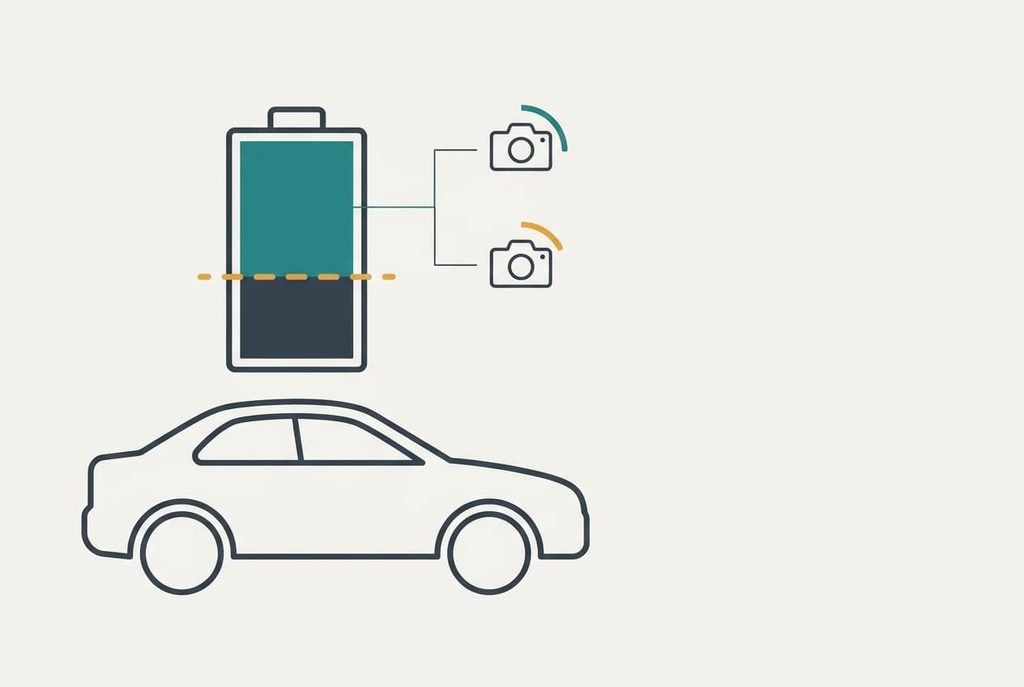
Where the two-camera setup wins
Coverage is where the pair leads. The pair sees 270° against 140°, and the missing angle is the one where a following car arrives. A front lens records nothing of a bump from behind, while the rear lens shows the approach. A car 4.4 m behind and closing at 5 m/s reaches you in 0.88 s. Recorded at 30 fps, that’s 26 frames of its approach, enough to show its plate and its speed.
A second view also cross-checks the first. Two files with matching time stamps show your car stopped at the lights while the other one kept moving. That single comparison answers a question the front lens can’t.
Queues are the third case. If you stop with a car within 4 m behind you several times on a typical journey, each stop is a chance for a rear bump that a front lens will never see. The pair costs about 3.6 GB more per hour of driving, and in this case the extra data is the purpose.
When neither is the right answer
A parked car on a street overnight needs something different. Both options record only while the engine runs, unless they’re wired to the car’s supply. A car battery of 60 Ah at 12 V holds 720 Wh. Such a kit might spare 30% of it, which is 216 Wh. At 5 W a front camera then runs 43 hours, and a pair drawing 8 W runs 27 hours. A cold night makes it worse, because a cold battery gives up less of its charge, so treat those hours as a ceiling.
That’s barely two days of coverage, so the question changes from front against rear to how long the car will sit. A fitted kit with a voltage cut-off is the answer for a car left for a week. Ask a fitter, and pick the camera second. A street space adds a second reason, because nobody else will check your car while you sleep.
Which to choose in each case
If you stop with a car within 4 m behind you more than about four times a journey, choose the front-and-rear pair. Count the stops as a passenger over one week. The rear view then matters most, and the extra 3.6 GB an hour is a fair price in effort.
If your journeys are mostly open road with few stops, choose the front-only model. You keep 14.7 days of history. The fit takes 15 minutes, and there’s one lens to maintain. Add a rear lens later if your routes change. Neither choice is permanent, because both cameras share the same mount point and the same card type, and either can be reversed in an afternoon.
A dash cam for everyday driving rewards one honest week of counting before you spend. Test the view with a phone held where the lens would sit. Check the card each month, since a camera that stopped recording last spring helps nobody. Revisit the choice after any change of commute. Then buy once, fit it in one sitting and leave it until the card needs a check.
Questions readers keep asking
How long does fitting each option take?
About 15 minutes for a front-only unit and 45 for a pair, on our assumptions. The extra half hour goes on routing about 6.5 m of cable along the roof lining to the rear glass. Most of the effort is tucking the cable neatly. The camera itself clips on in a minute.
What happens when the memory card wears out?
The card is rewritten constantly. At 1.5 hours a day a front-only card is overwritten about 25 times a year, and a pair’s card about 41. A tired card can stop recording without a warning. Format it monthly and replay one clip to confirm it still works.
Which suits a long daily commute?
A long motorway commute with steady speed often suits front-only, because few stops mean few rear hazards. A long town commute with queues suits the pair. Count your stops rather than your miles, since stops decide how often a following car is close enough to matter.