Most people complain that a small living room TV sounds thin, as if the voices were coming through a letterbox. The cause is geometry: the sound comes from a box too narrow for the distance you sit from it. For speakers for a small living room TV, the verdict depends on who sits where. Choose bookshelf speakers if you sit on the centre line and care about music, and a soundbar if people sit off to the side or dialogue matters most.
For the sums, the room is a British living room 3.0 m wide, with a sofa seat 2.6 m from the screen and a TV 95 cm wide. The numbers are round assumptions.
The one property that decides speakers for a small living room TV
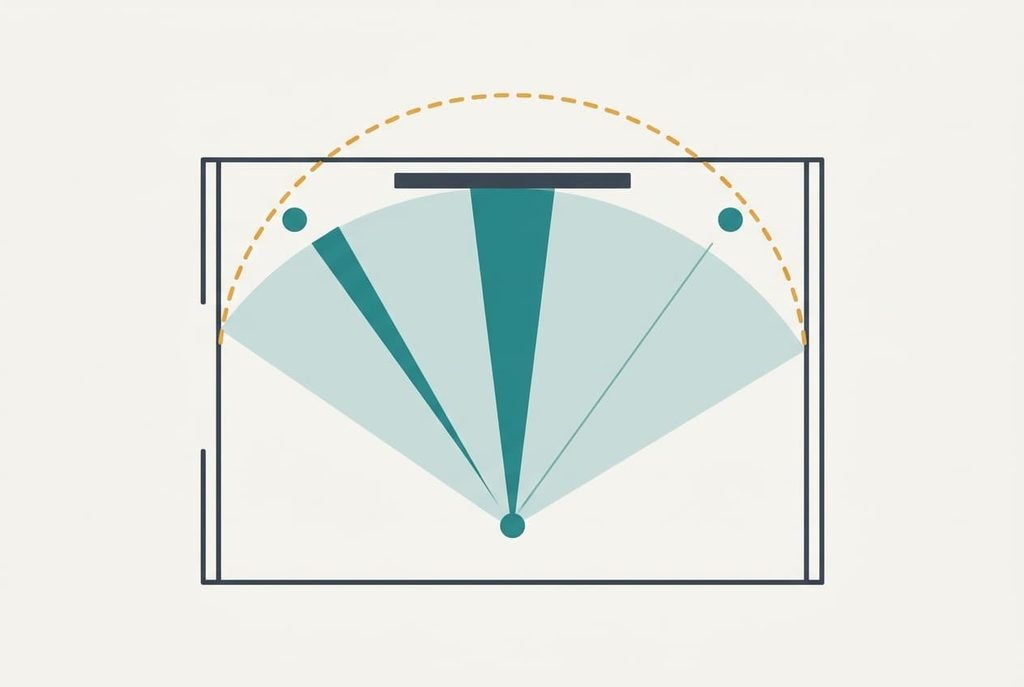
Price and power get the attention, and neither explains why one pair sounds wide and another narrow. What matters is how far apart the left and right sources are compared with the distance to your seat. The angle between them, measured from where you sit, sets the width of the sound picture. Wider means that a singer can sit in the middle with the instruments spread to either side. A narrower angle squeezes everything towards one point, and the ear hears a small, flat scene. Distance works against you, because the same pair of boxes covers a smaller angle the further back you sit.
A soundbar 90 cm wide, seen from 2.6 m, spans 2 × atan(0.45 ÷ 2.6), which is 19.6 degrees. Two bookshelf speakers 2.4 m apart span 49.6 degrees. For a full 60-degree picture you’d need them 3.0 m apart, which is as wide as the room.
A narrow source can’t make a wide picture.
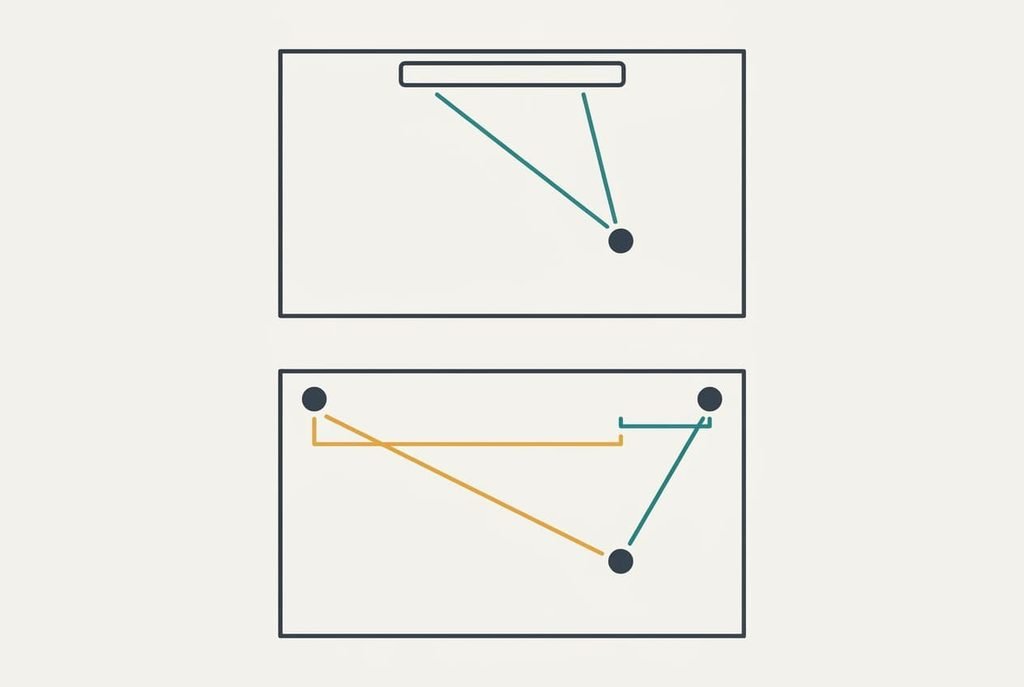
There is a second number that matters as much. Sound from the nearer source arrives first. If the two arrivals differ by more than about 1 ms, the ear pulls the whole image to the nearer one. The geometry of the bar keeps that gap small, and the geometry of the pair doesn’t.
Soundbar and bookshelf speakers compared for a small living room TV
Judge each option by what it does at your seat, not by the numbers on its box. Six situations follow, and you can check each one without buying anything.
| Situation | Soundbar | Bookshelf speakers |
|---|---|---|
| Width of the sound picture at 2.6 m | About 20 degrees | About 50 degrees at 2.4 m apart |
| Sitting 1 m off the centre line | Voices stay near the screen | Voices drift to the nearer speaker |
| Low notes | Small drivers shared between two channels | Larger cones, one pair for each side |
| What you plug in | One cable to the TV | An amplifier plus cables and stands |
| Where the sound leaves the box | About 45 cm up, below ear height | At ear height, if the stands are tall enough |
| If one part fails | The whole unit goes | The amplifier or one speaker can be replaced alone |
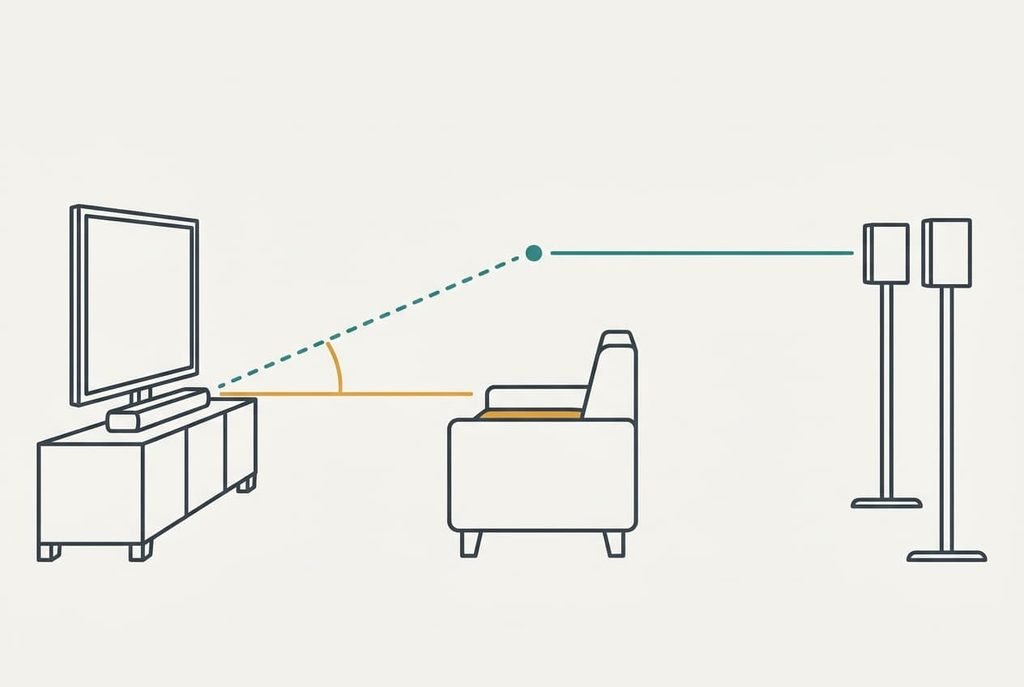
The ear-height row surprises people. A soundbar under a TV sits near 45 cm, and your ears sit near 100 cm. The highest notes leave the bar about 12 degrees below the line to your head. High notes beam narrowly, so the voice loses some clarity on the way. Bookshelf speakers on stands solve that, and they ask for the stands and the floor space to go with them. Both facts are about placement, so you can check them with a tape measure before you spend anything.
Where a soundbar wins
Dialogue is the clear case for speakers for a small living room TV. Sit 1.0 m right of the centre line, and a soundbar’s left end is 2.98 m from you while its right end is 2.66 m away. That 0.32 m difference is a gap of 0.93 ms, just under the 1 ms that drags the image to one side. The voices stay in the middle, near the screen where the lips are.
A pair of speakers 2.4 m apart gives 3.41 m against 2.61 m for the same seat. The gap grows to 2.33 ms. The nearer speaker then carries most of what you hear, and an actor in mid-screen seems to talk from the sofa arm.
A bar also suits a wall of one shelf and one outlet. You plug in a single cable. Nothing needs stands or wires along the skirting, and there’s no need for a spare 40 cm either side of the TV. In a rented room, that matters.
Where bookshelf speakers win
The wide picture is the clear case for speakers for a small living room TV. At 2.4 m apart they fill 49.6 degrees, against the bar’s 19.6. Music sounds placed, with a singer in the middle and instruments to either side, and films get a stage that reaches the walls beside the screen.
Low notes follow cone area. We’ll take a 13 cm woofer in each speaker, at about 95 cm² of moving surface. A bar with four 5 cm drivers offers about 39 cm² per side. A bigger cone moves the same air with less travel, so bass stays clean at a volume where a smaller driver starts to buzz.
Speakers also age better. The amplifier is separate, so when a new technology arrives you change that and keep the speakers. If one fails, you replace one box.
The cost is a seat on the centre line. Within about 40 cm of it the delay gap stays under 1 ms and the picture holds. From the end of a long sofa it slides to one side.
When neither is the right answer
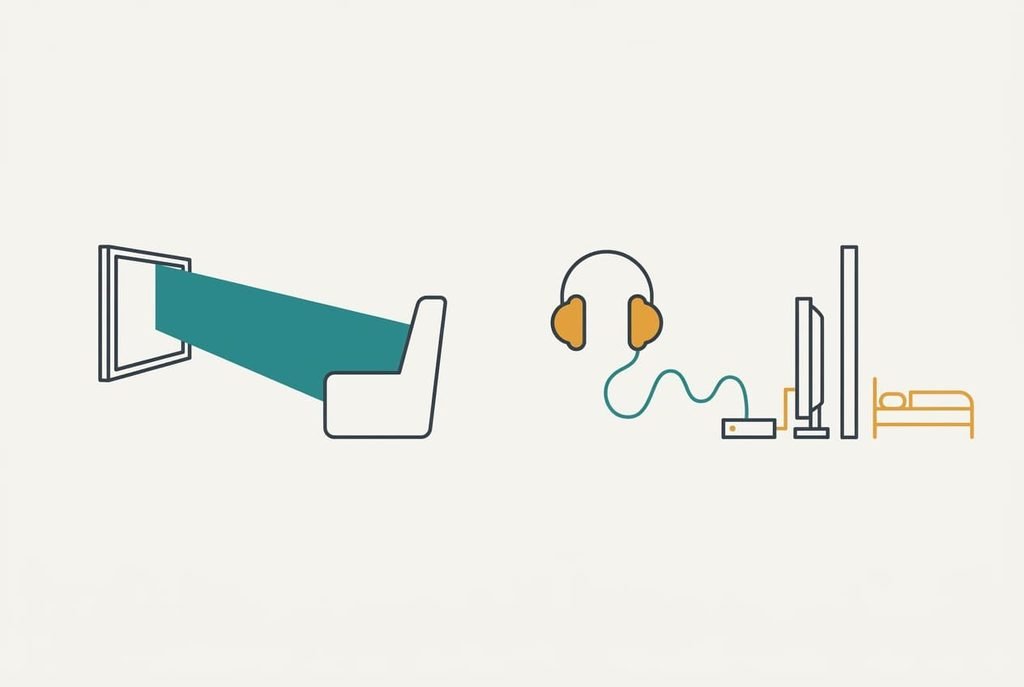
Closed-back headphones fed from a small transmitter beat both when the household sleeps while you watch. The volume that suits the evening carries through a party wall at midnight. Headphones keep the sound between you and the screen, and a transmitter lets you sit wherever the sofa suits you.
Short viewing distances change the sums as well. At 1.2 m from the screen, a TV 95 cm wide already spans 43 degrees with its own speakers. That is close to what a pair of bookshelf speakers gives at 2.6 m. A desk setup or a bedroom TV watched from the bed needs neither.
An alcove with nothing beside the TV has the same problem. Speakers have nowhere to go there, and a bar is hard to fit under a stand with a shelf.
Sort out the room before spending, because a shelf at ear height is the cheapest improvement of all.
Which to choose in each case
Choose the soundbar when two or more people share the sofa, or when you want voices clear from any seat. The bar’s narrow body keeps the arrival gap under 1 ms for a seat 1 m off the line. You give up the wide picture and some bass depth, and in return you get one cable and a set-up that takes ten minutes.
Choose bookshelf speakers when one person sits on the centre line, and music matters as much as films. In return you get a 50-degree picture and a pair of larger cones. You give up a simple set-up, since the amplifier needs room, and so do the cables and the stands.
Speakers for a small living room TV reduce to one figure, the angle at your seat, and one habit, where you sit. Check both before buying. If you can’t decide, put a box the width of the bar in its spot and sit in your usual seat. Then think about who else sits where, because the answer usually settles itself within a minute.
Questions readers keep asking
Is a soundbar cheaper to run than a pair of speakers?
Usually about the same. A bar draws power for one amplifier, and a pair draws for the amplifier that feeds it. The difference comes from the standby draw of each box. Choose by the room and the seat, and check the standby figure on the label if the electricity bill matters.
Can I mix a soundbar with speakers later?
Some sets accept both, but there’s no rule. A bar’s own amplifier is built into the case, so it rarely has an output for passive speakers. A separate amplifier with a pair of speakers is easier to expand, because you can add a subwoofer or change either part.
Do bookshelf speakers need to stand on the floor?
They need to sit with their tweeters at ear height, about 100 cm from the floor for a sofa. Stands or a deep shelf do the job. On a low cabinet at 45 cm the highs leave below your head, which is the same flaw the soundbar has.