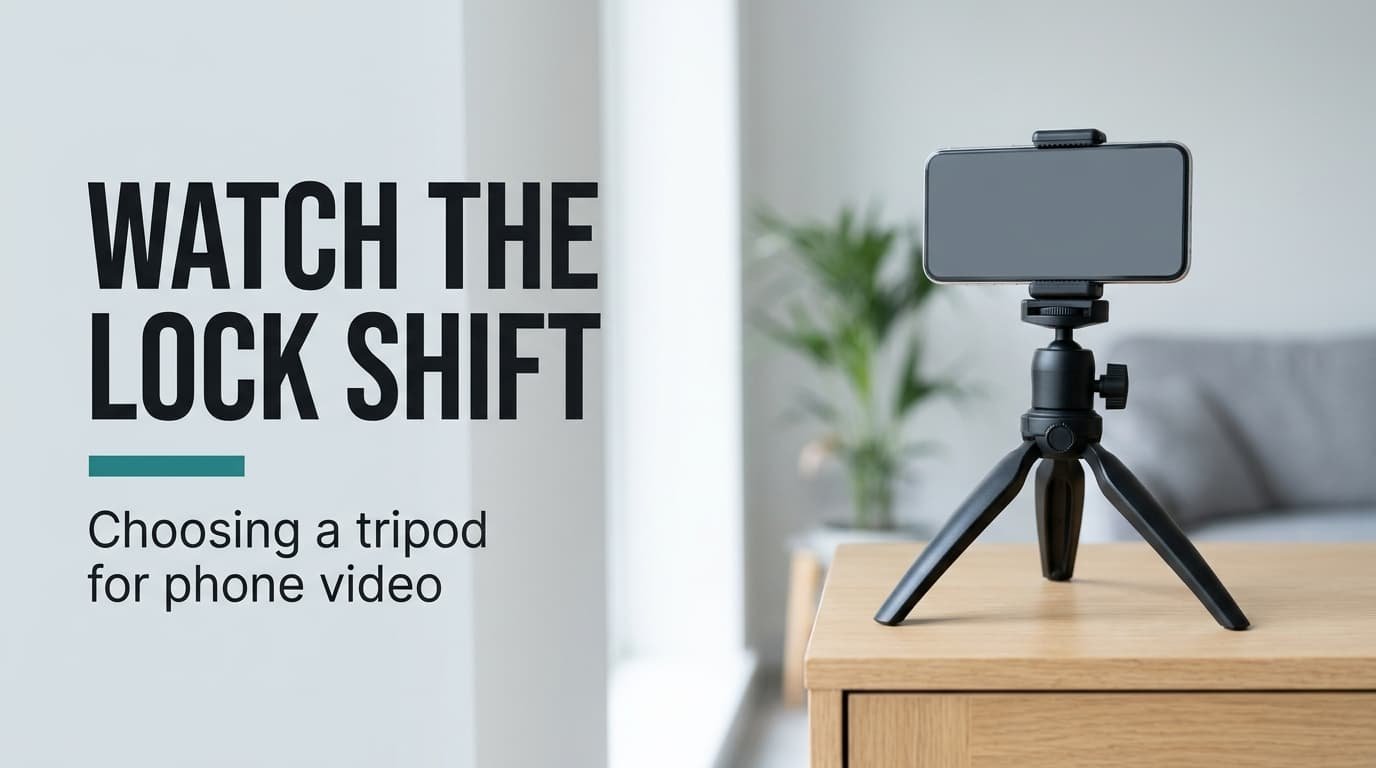
The weight rating is the first figure shoppers check on a tripod, and it almost never decides anything. A phone in its clamp weighs about 290 g, and even a small stand is rated for a kilogram. To choose a tripod for filming videos, test how far the picture jumps when you lock the head. I’d treat that lock shift as the one number worth measuring. Leg height and clamp fit come second. The sums that follow use a made-up UK living room, and the figures are assumed and round, so test your own phone on your own shelf.
What decides a tripod for filming videos: the lock shift
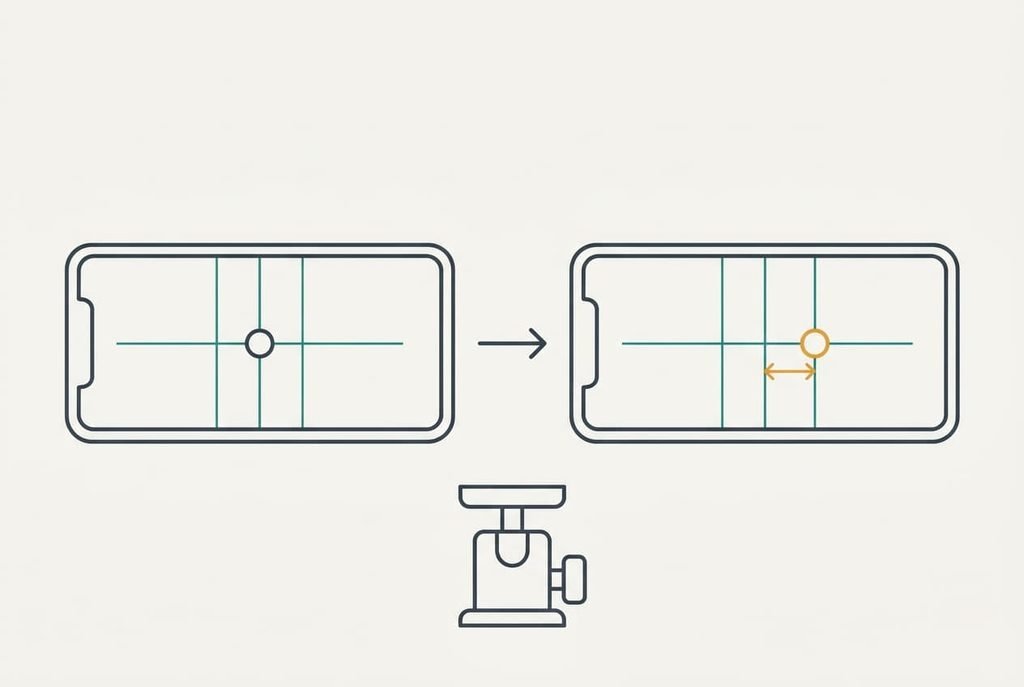
Every head has a lock that bites as you tighten it, and the bite nudges the phone. You frame the shot and turn the knob. The subject slides to a new spot. Then you loosen the knob, correct the framing, then tighten again. Ball heads tend to shift more, because the ball turns slightly as the socket closes around it.
Take a phone whose main camera frames like a 24 mm lens, filming at 1,920 pixels wide. That puts the focal length at about 1,280 pixels. A lock shift of 1.5° moves the picture by 1,280 × tan 1.5°, which is 34 pixels. At 2 m from the subject that’s 5.2 cm of a 3.0 m wide frame. That’s 1.8% of the frame width. Cut two takes together and the subject visibly hops. A good head shifts 0.5° or less, which is 11 pixels. Makers rarely print the figure, and no standard forces them to. The number to compare is how far the picture moves when you lock the head. You have to measure it yourself with the camera app’s grid, and the test is over in a minute.
Choosing a tripod for filming in priority order
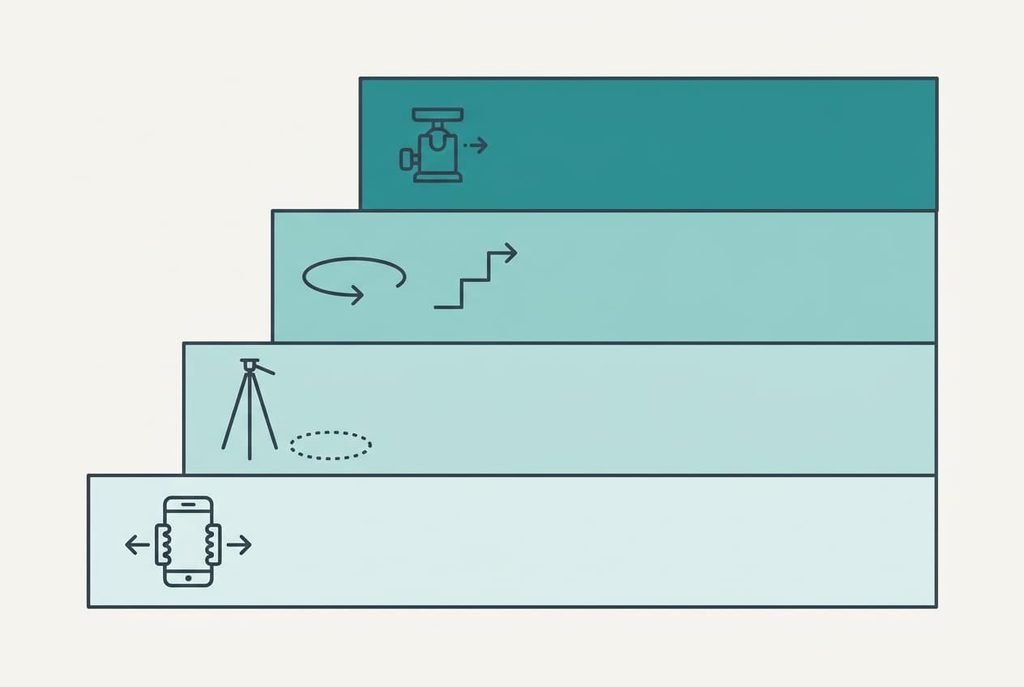
Work down this list, and stop when a stand fails an item. Most stands fail at the first.
1. Lock shift. Frame the edge of a door on a grid line, tighten the head, then read the gap. Accept 0.5° or less, which is 11 pixels. At 1.5° you’ll be reframing before every take, so reject the stand. Heads rarely loosen up enough with use to fix this, and the shift tends to grow once the lock wears. A second clip framed from the same spot will not match the first.
2. Pan release. A pan of 90° over 6 seconds turns at 15° a second. At 30 frames every second that’s 0.5° a frame, or 11 pixels. A head that sticks, then lets go in a 2° jump, moves the picture 45 pixels in a single frame, four times the smooth rate. Pan slowly across a bookshelf and watch the vertical lines. If they stutter, move on. Test the tilt in the same way, with a slow nod up to a ceiling light.
3. Height and footprint. A seated subject’s eyes sit near 120 cm, so the lens wants to be at 125 cm. With legs splayed 25° from vertical, each leg is 138 cm long and the feet spread to a circle 1.17 m across. A gap of 90 cm between sofa and bookcase won’t take that stance, so you’d need shorter legs or a narrower spread. Also check the height with the centre column down, since a raised column adds sway.
4. Clamp fit. A phone 78 mm wide in a case that adds 3 mm per side measures 84 mm. The clamp should open to at least 90 mm, and a spring that grips by tension beats a screw you must turn. Look for rubber pads on both jaws, so the case can’t twist during a pan, and a thread on the clamp itself that lets you remove the phone without undoing the head.
What does not matter as much as the listings claim
A weight rating in kilograms leads nearly every listing, and the margin is huge. A phone and clamp at 290 g sit under a 1,000 g rating by a factor of 3.4. Even a pocket stand rated for 500 g leaves 1.7 times the load. Nothing you mount will ever reach the limit. Maximum height is another loud figure, with 170 cm printed in large type. A stand at full stretch with the column raised sways most, so the useful number is the height at which the column stays down.
Leg material is the next distraction. Carbon fibre versus aluminium saves a few hundred grams, and the phone’s weight doesn’t care. A remote shutter saves a tap before filming starts and does nothing for the picture.
The count of leg sections matters little for video. More sections fold smaller and add flex at each joint, which a phone barely notices at 290 g.
Matching the choice to your phone and your shots
For cooking clips on a worktop, a tripod for filming videos is only 25 to 35 cm tall, and lock shift matters most because short ball-head stands lean on it. A seated interview wants the full 125 cm and a footprint that fits the room. For slow pans around a garden, pan release rises to first place, because a stutter at 15° a second shows up on every frame. A wide room scene needs the footprint item moved up as well.
Travel changes the ranking again. A stand that folds to 40 cm slides into a bag, but its thinner legs tolerate less breeze, so keep it for indoor use.
Your flooring decides how much a light stand rocks, so test on the surface you’ll use.
What to walk away from
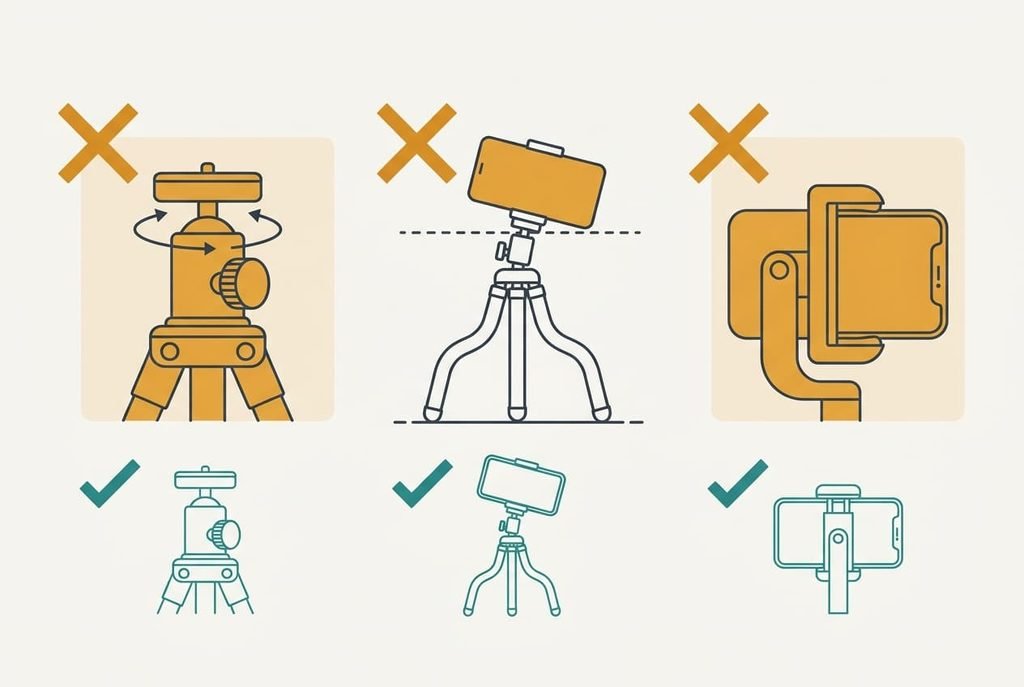
Walk away from a head with a single knob that locks every axis at once. Tilt and pan then bite together, so the lock shift is at its largest, and you can’t loosen one without freeing the other. Check that pan and tilt have separate locks. A head with separate locks lets you fix the tilt once and then pan freely, which also halves the number of nudges.
Bendy-leg stands are fine for propping a phone on a branch. For a tripod for filming videos in a living room they sag out of level under any push, and the horizon tilts without warning. A centre column raised by 20 cm on a 125 cm stand also adds sway, since the same 290 g sits further from the legs. A clamp whose jaws press on the side buttons is a third fault, since the recording can stop or the volume change mid-take.
All three faults come with the stand, and no accessory repairs them later.
The two-minute check before you commit
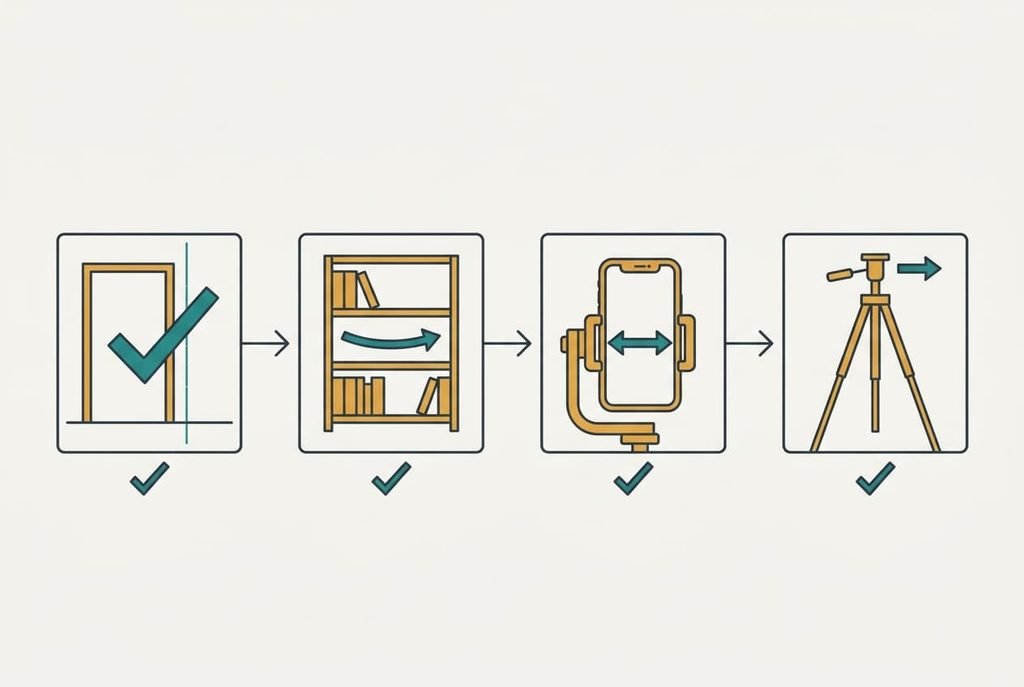
Start by framing a door edge on a grid line, then lock the head and look again. A drift of more than a few pixels means the head has failed. Next, pan slowly across a bookshelf and watch for stutter. Then put the phone in its case into the clamp and check that it opens wide enough. Last, extend the legs to 125 cm and give the top a light push to see how long it sways. A shop that lets you test a stand is worth ten that don’t, and a returns window is the next best thing.
A tripod for filming videos is chosen by what the head does when you lock it. The weight rating and the remote come afterwards. Reject any stand that moves the picture, then buy the height you need. Write down the lock shift you measured so you can compare the next stand.
Questions readers keep asking
Does a heavier tripod film steadier?
A little, outdoors, where weight resists a gust. Indoors the phone’s 290 g is the only load, so the head decides how steady the picture is. Test the lock shift before you weigh anything, since a heavy stand with a sloppy head still jumps by 34 pixels.
How tall should a phone tripod be for a seated subject?
Put the lens at the subject’s eye level. A seated adult’s eyes sit near 120 cm, so a stand that reaches 125 cm gives a straight, flattering angle. A stand that only reaches 80 cm tilts the camera upwards and makes the shot look as though it was taken from a table.
Can a table-top tripod replace a full-size one?
For cooking clips on a worktop it does the job. A stand of 25 to 35 cm sits level with the pan, and a short stand has fewer joints to flex. For a seated interview it isn’t tall enough, and propping it on books adds wobble.