For a rented flat, smart bulbs win, because they need no change to the fixed wiring and they travel with you when you move out. That verdict holds as long as nobody flips the wall switch, and the deciding property is whether the smart part still has power once the switch is off. Smart switches keep their power and stay reachable, but they need a landlord’s consent and an electrician. This guide compares smart bulbs or smart switches on that one property. Then it shows where each wins, what to do when neither fits and which to pick for your own wall. All sums use UK mains voltage and a lounge with five ceiling fittings.
Why smart bulbs or smart switches come down to one property
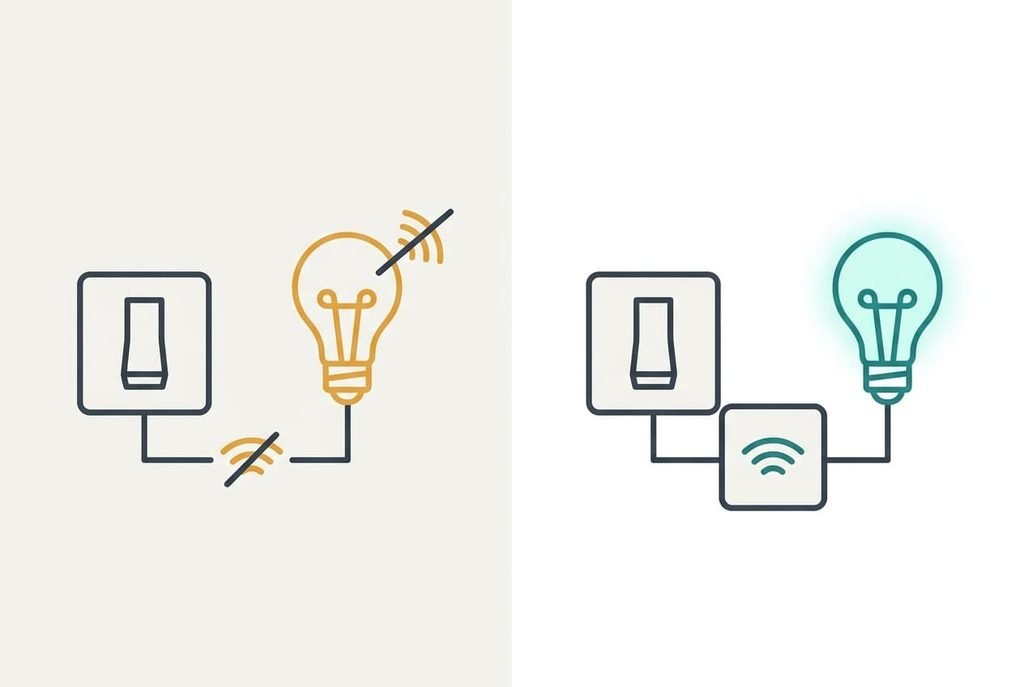
A smart bulb carries its radio inside the glass. It listens for a command only while it has power, so when the wall switch is off, the bulb is unreachable. A smart switch keeps the radio in the wall plate, which stays powered whatever you do to the light itself. That single difference decides almost everything else.
Take a lounge with five ceiling fittings on one switch. With bulbs, you own five wireless devices, and all five vanish from the network the moment someone presses the old switch. A smart switch gives you a single device that controls all five fittings together.
The difference shows up the first time a visitor or a tired housemate presses the wall switch. A young child will do it within the hour. A bulb treats a switch press as a power cut, while a smart switch treats it as a command, and the app then reports the bulb as offline. Nothing is broken, but the routine you built that week stops working until someone presses the switch back on.
You can test the property on your own wall. Count the people who use that switch, then ask how many of them would read a note beside it.
The two options side by side
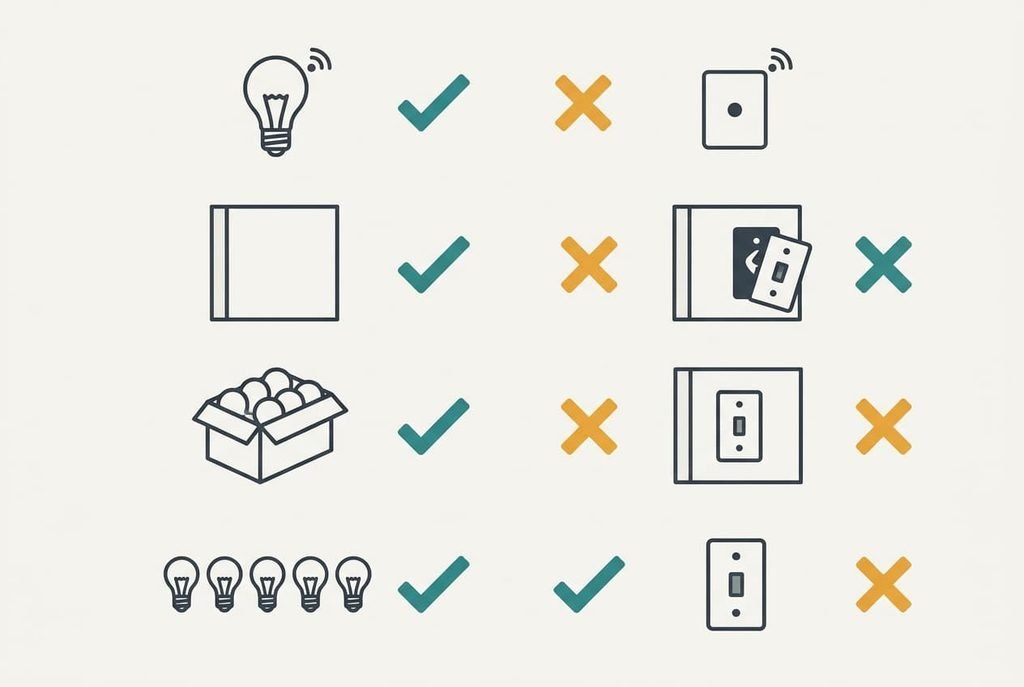
Six facts cover the whole comparison, and none depends on a maker or a model. Each row below describes how smart bulbs or smart switches are built, which is why the answer stays the same however the market changes. Check each row against your own flat before you read the verdicts.
| Property | Smart bulbs | Smart switches |
|---|---|---|
| Where the radio sits | inside each bulb | inside one wall plate |
| Change to fixed wiring | none | the wall plate is replaced |
| Wall switch pressed | bulb loses power and goes offline | switch stays powered and reachable |
| Devices for five fittings | five | one |
| Colour changes per bulb | possible | none, as the circuit only dims |
| Goes with you at the end | yes, in a box | no, it stays in the wall |
Read the table from the top and notice how often the same fact repeats. A bulb keeps its radio where the power can vanish, while a switch keeps it where the power can’t. The fourth row is the one most people overlook. Five bulbs mean five radios sharing your network, and every one of them has to rejoin after a power cut, whereas one switch rejoins once. That’s why a larger lounge feels less reliable with bulbs, even though each bulb is quick.
Where smart bulbs win
Bulbs win in any home you don’t own. Fitting them takes a minute and needs no tools. When you move out, you simply swap the originals back in. A switch replacement alters fixed wiring, so it needs your landlord’s written consent and a qualified electrician. Both can take weeks, and neither is yours to take with you.
Colour is the second advantage. A bulb can shift from cool white at midday to a warm tone at 21:00, and each bulb can differ from its neighbour. A switch controls only the circuit, so every fitting behaves the same way. If you want a reading lamp warm while the ceiling stays bright, only bulbs can do it.
They also fit whatever fitting you already have. A bulb works in a spotlight track and a table lamp alike, wherever the base fits, so you can mix rooms freely. For a first trial, buy two bulbs for the lamp you use most and see whether the routine suits you before you commit to five.
Bulbs are the portable choice for any tenant.
Where smart switches win
Switches win when more than one person presses the wall plate, which is where smart bulbs or smart switches differ most. Because the plate stays powered, a guest who flips the old switch gets the ordinary result and the routine keeps working. That’s the whole advantage, but in a shared home it outweighs the colour options. The first press of a switch on the first evening shows which one you chose.
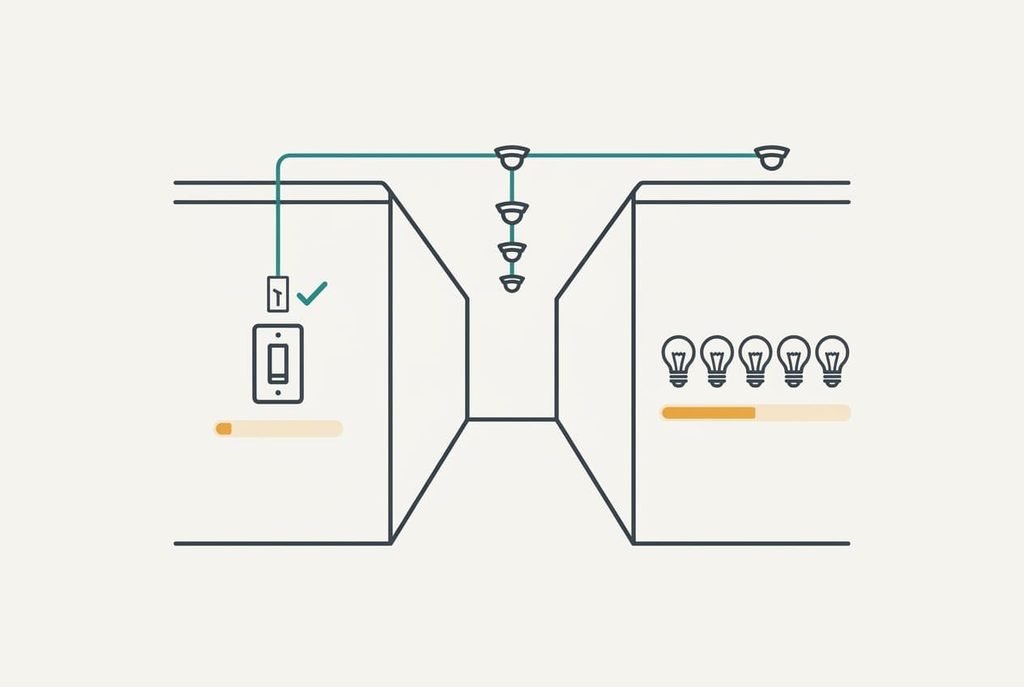
Switches also win on count. One wall plate runs all five fittings on a circuit, so one radio rejoins after a power cut. It can also dim the whole circuit through one control, which keeps the lounge consistent. You set one level and every fitting follows, with no bulb lagging behind its neighbours.
Standby draw is lower too. Assume a bulb draws 0.3 W while idle, so five bulbs draw 1.5 W, which comes to about 13 kWh a year. A switch draws around 0.5 W, so under 5 kWh a year. The gap is small, but it adds up over every room, and it counts in your favour in a home you plan to keep for years.
When neither is worth it
If you only want a warm light in one corner, a lamp with a plain inline dimmer needs no radio at all, and nothing can drop off a network because there’s no network. A smart system also adds an app and an account, plus a hub that the household has to understand. A single reading lamp rarely justifies that effort, and an inline dimmer is easy to move from room to room.
Skip both when the lights follow a fixed routine every day. A mechanical timer on a lamp handles that routine, and it asks for no attention.
A fixed routine needs a fixed tool.
Neither option is worth it either when your lighting is mostly floor and table lamps. A plug-in timer on each lamp does more with less fuss than a bulb in every shade, because a lamp can be moved and a ceiling fitting can’t. Count your fittings first: below three ceiling lights, the case for either system is weak.
Switches or smart bulbs: the verdict for a rented flat
If you rent and live alone or with people who respect a note on the wall, buy smart bulbs, then put a switch guard over the old switch so it can’t be pressed by accident. You keep every bulb when you leave, and the failure mode is gone. A guard costs little effort to fit and removes in seconds when you hand the flat back.
If you own the home or have written consent, and several people use each switch, choose smart switches and ask an electrician to fit them. The cost is the visit and the wiring work. You get a system that survives anyone’s habits, and one that nobody has to explain to guests.
Either way, trial one room first, whichever you’ve picked. Keep the receipt for a month. Both feel simple on day one, and the real test is the first week with other people in the house. Run it for seven days, note every time the lights misbehave and decide from that list. Smart bulbs or smart switches then stop being a guess and become a measured choice.
Questions readers keep asking
Is it cheaper to start with bulbs or switches?
Bulbs, because the entry cost is one or two bulbs and nothing else. Switches need the plate plus an electrician’s visit. Over many rooms the balance can flip, since one switch replaces several bulbs, but for a first room bulbs are the lower-effort start.
Why do my smart bulbs show as offline?
Almost always because the wall switch was pressed. The bulb has no power, so it can’t answer the app. Turn the switch back on and wait a minute, and the bulb rejoins. A switch guard stops it happening again, and it’s the first thing to try.
Which suits a flat with children?
Switches, if you have consent, because children press wall switches without a thought. If you rent, use bulbs with a switch guard, and set the guard at a height that suits the household. Label the guard so visitors know what it’s for.