A phone can recognise your face after you grow a beard because it keeps a list of numbers describing your face, and it accepts any new scan that lands close enough to that list. A beard shifts your numbers a little, usually short of the limit, and so does a haircut. Many phones then nudge the stored list towards the new you after each success, so the gap closes again. Below you’ll find the short answer and one six-week case traced from start to finish. After that come an analogy and the limits. Three wrong beliefs and a rule for relying on the feature close the guide.
How a phone can recognise your face after you grow a beard: the short answer
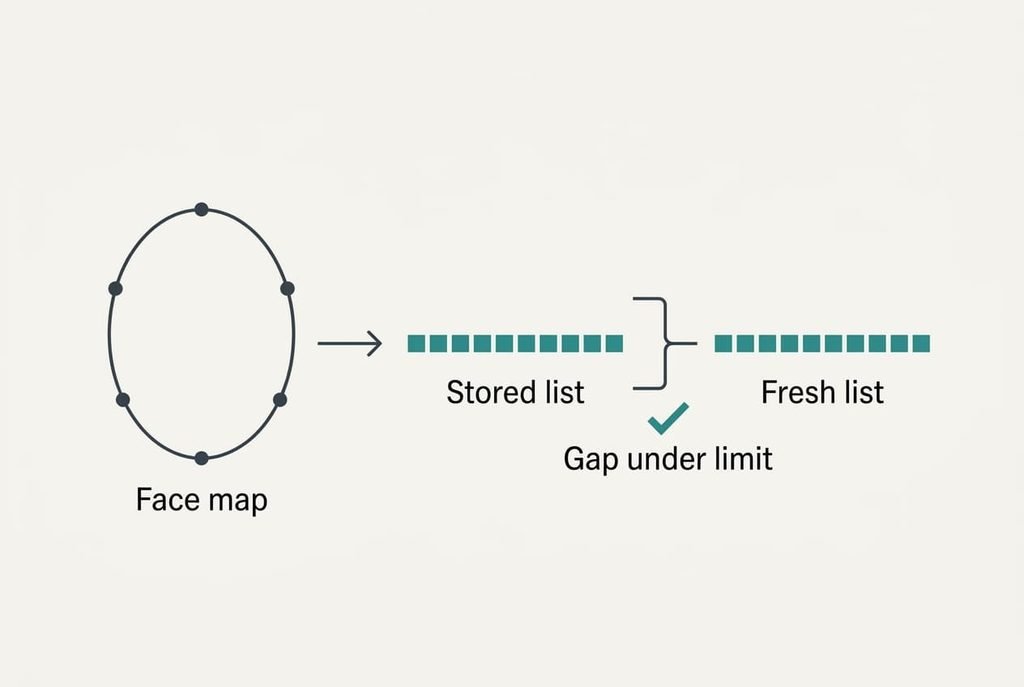
In short, the phone compares a fresh list of numbers with the stored one and opens when the gap falls under a set limit, and that single comparison explains why a beard still fits inside it. Each list holds a few hundred numbers produced by a trained model, and every number captures a tiny aspect of your face, such as the spacing of your eyes or the curve of your jaw.
Several details fall outside that sentence, and each gets its own explanation here. One is how the model turns a camera image into numbers, which takes training on enormous sets of faces. Another is the choice of limit, a design trade-off described under the limits below. The last is how the stored list changes over time, which the next section shows with a worked case.
Picture the gap as a score from 0, an identical match, to 100, a complete stranger. Assume the limit sits at 35, so any scan scoring below it opens the phone. These figures are illustrations, and real phones keep their own scale private.
The gap is the only thing the phone ever checks.
One face, six weeks of beard, traced step by step
On day 0 you set up the feature. The camera and a depth sensor build a map of your face, and the model reduces it to the stored list. The picture is thrown away after that, and only the numbers remain on the phone.
On day 1 you open the phone ten times in a normal day. Each fresh scan differs slightly because of light and angle, so the scores land between 2 and 6. That scatter is normal, and a limit of 35 leaves a wide margin around it.
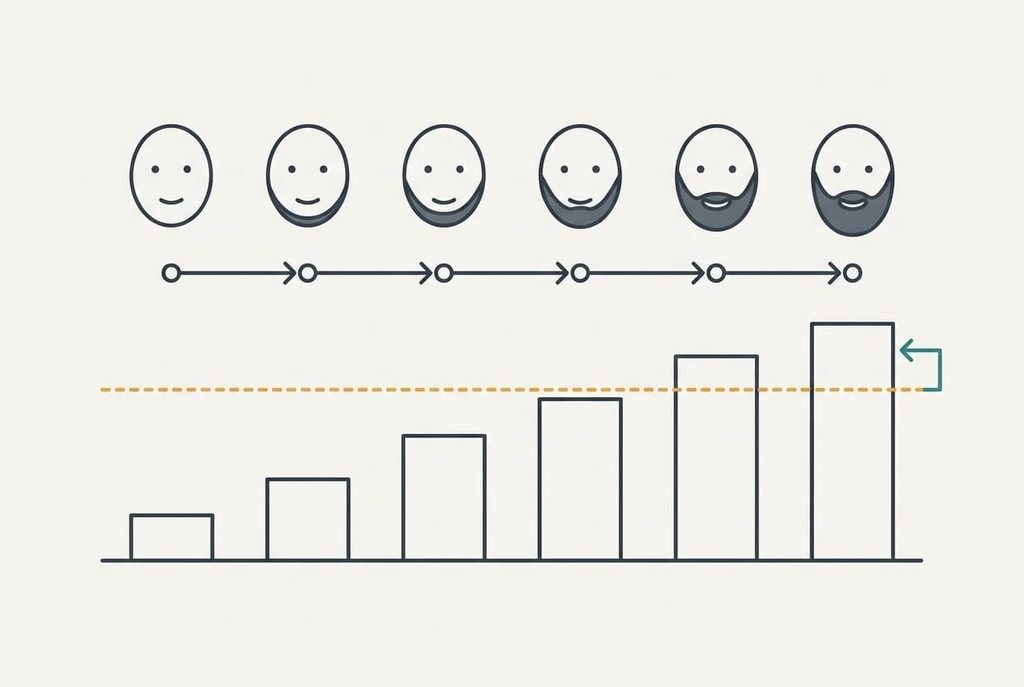
Next, the beard begins as you stop shaving. By week 2 the scores average 14, by week 4 they average 27 and by week 5 they sit near 33. Each pass still opens the phone, but the margin is shrinking, because the model reads your new jaw outline as a growing difference from the stored list. Nothing visible happens on screen during this stretch.
On day 38 the score reaches 37, which is over the limit. The phone refuses and asks for your passcode. You type it correctly. Many phones treat that moment as proof that the odd-looking face is you, and they move the stored list roughly one tenth of the distance towards the new scan. The gap shrinks from 37 to roughly 33, which is under the limit, so the next attempt works.
Every later success nudges the list a little further, so the gap keeps falling without any effort from you. That’s how a phone can recognise your face after you grow a beard without a second setup. After a handful of openings the stored list describes the bearded you, and the scores fall back towards single digits. The phone never needed a photo for any of this, and it never asked you to repeat the setup. Run the same story backwards after a shave and it plays out the same way, only faster, because the jump is larger. The only cost was a single passcode entry on day 38.
A doorman with a sketch pad, and where it breaks
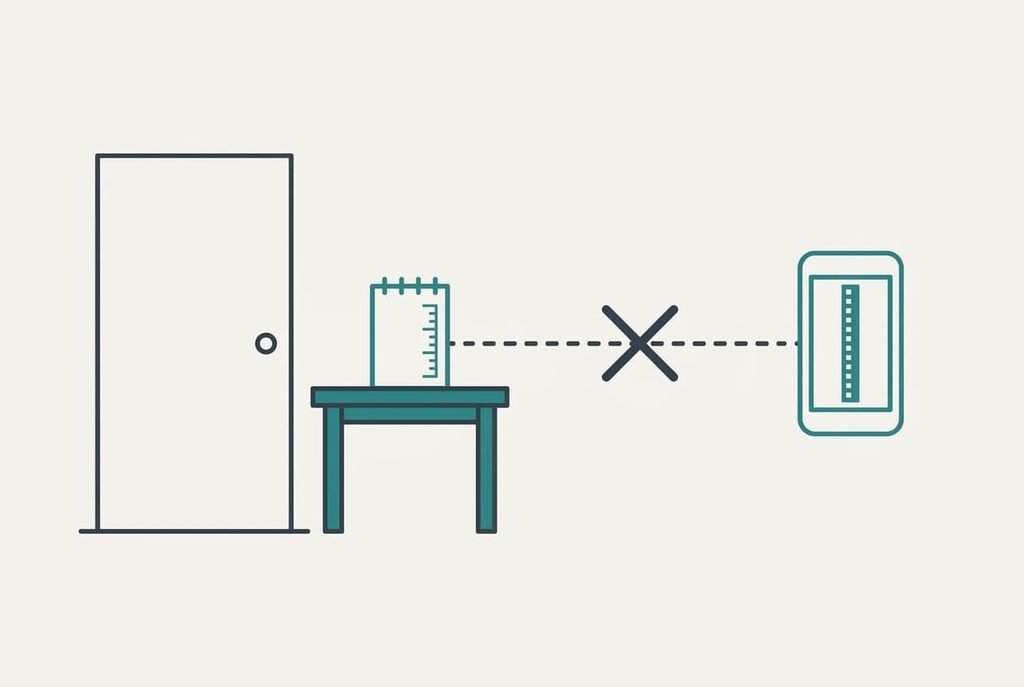
Picture a doorman who knows you from a sketch of 300 measurements. Each morning he measures you again and compares what he sees with the sketch. A haircut changes a few measurements, so he waves you in, and if you arrive with a beard he asks for your name and then redraws the sketch.
Two things differ from the real system. A doorman remembers your face as a picture and can describe it to anyone who asks. The phone keeps only numbers, which can’t be turned back into a recognisable image. A doorman also uses judgement about context, such as who stands beside you, while the phone applies one fixed limit to every scan from every face.
What face recognition cannot do
The limit is a trade-off. Set it high and the phone accepts nearly every scan of you, but it also accepts lookalikes. Set it low and it rejects strangers, but it also refuses you on a bad-light morning. A designer chooses that setting once, so some people will always pass who shouldn’t, and sometimes you’ll fail, which is why a passcode always sits behind the face.
Other limits follow. Phones that use only an ordinary camera are easier to fool with a photograph than phones that also map depth. Strong sunlight behind you, a scarf over your chin or a face mask can push your score over the limit. A sibling who looks a lot like you may score close to your own scans, which is why a twin can sometimes open a phone, and the phone has no way to know the difference.
Sunglasses and heavy shadow hide the features the model weighs most. Taking them off usually solves it.
A phone can’t tell a lookalike from you by effort alone.
Three beliefs that make people think a phone can’t recognise your face after a beard grows
People assume the phone stores a photo of your face, because setup shows your face on the screen. The screen is only guiding you. What’s saved is the numeric list, while the image is discarded.
Another belief says a beard or glasses breaks the feature for good. That idea comes from early systems that used a fixed template and never updated it. Current ones adjust to gradual change, which is why a slow beard is easier than a sudden shave.
Each belief survives because it sounds plausible, even though a phone can recognise your face after you grow a beard. A third belief says face recognition works like a fingerprint because both are called biometrics. The label is shared, but the mechanisms differ. A fingerprint is a pattern that stays nearly the same for years, while a face changes with weight and age. Light changes it too, so face systems have to tolerate drift.
When to rely on it
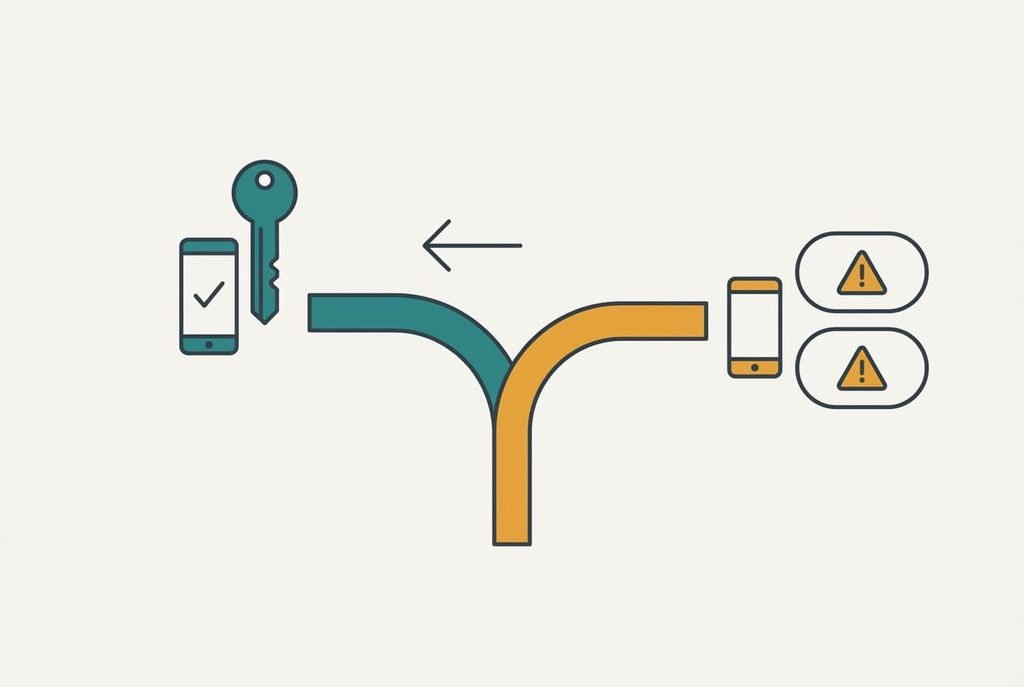
Rely on the face check when nobody who looks much like you could pick up your phone and you keep a strong passcode behind it. For a quick test, ask a sibling to try ten times with your consent. If they pass twice or more, switch the feature off for payments and banking apps and keep the passcode for those.
Where nobody resembles you, keep it on for everything else, since it’s faster than typing. A passcode of six digits or more is a sensible floor, because the face check never replaces it. Change it every year or so, and don’t reuse it for other accounts.
A phone can recognise your face after you grow a beard, and the rule above covers the case where it recognises someone else too. Treat the passcode as the real lock and the face as a quick convenience, then retest the sibling check after a big change to your look. If your look changes sharply, such as a shave after months of beard, expect one passcode entry while the stored list catches up, and then carry on as before.
Questions readers keep asking
Can a twin or a relative open my phone?
Sometimes, yes. If their face scores under the limit against your stored list, the phone opens. Identical twins are the clearest case, and close siblings occasionally manage it. If that worries you, rely on the passcode for sensitive apps and keep the face check for casual use.
Do I need face recognition at all?
No, a good passcode alone works. The face check saves a few seconds each time and helps you avoid typing a code where others can see it. If you’re often in crowded places, the convenience is worth having. If your phone holds very little, a six-digit passcode is enough.
Is it safer than a fingerprint?
Neither wins everywhere. A fingerprint changes little over the years, while a face drifts, so face systems accept more variation. Depth-mapping faces resist photographs well, and ordinary-camera faces resist them poorly. Compare the sensor type on your own phone and keep the passcode strong in both cases.