Every morning the glass is streaming and the sill is wet. A night of breath in a closed room causes it, and the change that most often cures it is to double the rate at which the room swaps its air. That’s the pattern when the windows run with condensation every morning, and each section here puts numbers on one part of it. Our model bedroom runs 2.8 m by 3.4 m beneath a 2.4 m ceiling, so it holds 22.8 m³ of air, and two adults use it overnight. Every moisture load and air-swap rate below is my estimate, so substitute measured figures where you have them.

What is actually happening when windows run with condensation every morning
Warm air holds more water than cold air, and glass is the coldest surface in the room, so surplus water drops out there as droplets. At 18 °C and 65% humidity the dew point is 11.3 °C. On a 2 °C morning the inner pane of an older double-glazed window sits near 9 °C, so the glass collects water. Condensation forms when the glass is colder than the dew point of the room’s air.
Two adults give off roughly 40 g of vapour an hour each, so eight hours adds 640 g. Air at 18 °C holds up to 15.4 g per cubic metre, so 22.8 m³ stores 351 g at saturation. That’s 182% of it, and the surplus must leave through gaps or settle on the coldest surface.
Assume the room swaps 0.6 of its volume an hour. Outdoor air at 2 °C and 85% humidity carries 4.8 g per cubic metre, so the room settles near 10.6 g, which is 69% humidity. At 1.2 swaps an hour it settles at 7.7 g, or 50%, and the dew point falls to 7.4 °C. That’s under the 9 °C glass, so the window stays dry.
The window runs wet because the air leaves slower than the water arrives.

Confirm which version of morning condensation your windows run with
Three quick checks separate the causes. First, look at where the water sits. Droplets on the inner face, heaviest along the bottom edge, mean too much humidity. The fixes below apply. Water trapped between the two panes means a failed seal. No habit cures that, and it is one for a glazier or the landlord’s repair list. Water on the outside of the glass on a clear, cold morning is normal on efficient glazing and needs nothing from you.
Next, time it. If the glass is clear by 11 am, the load comes from the night. If it stays wet until evening, moisture is arriving from elsewhere in the home, perhaps from the bathroom next door or the kitchen below.
Last, compare a wet frame corner with dry glass mid-pane. That points to a cold spot in the frame itself, and only the fourth fix below helps there. The first version is the usual one in a bedroom, sometimes with a trace of that third one.
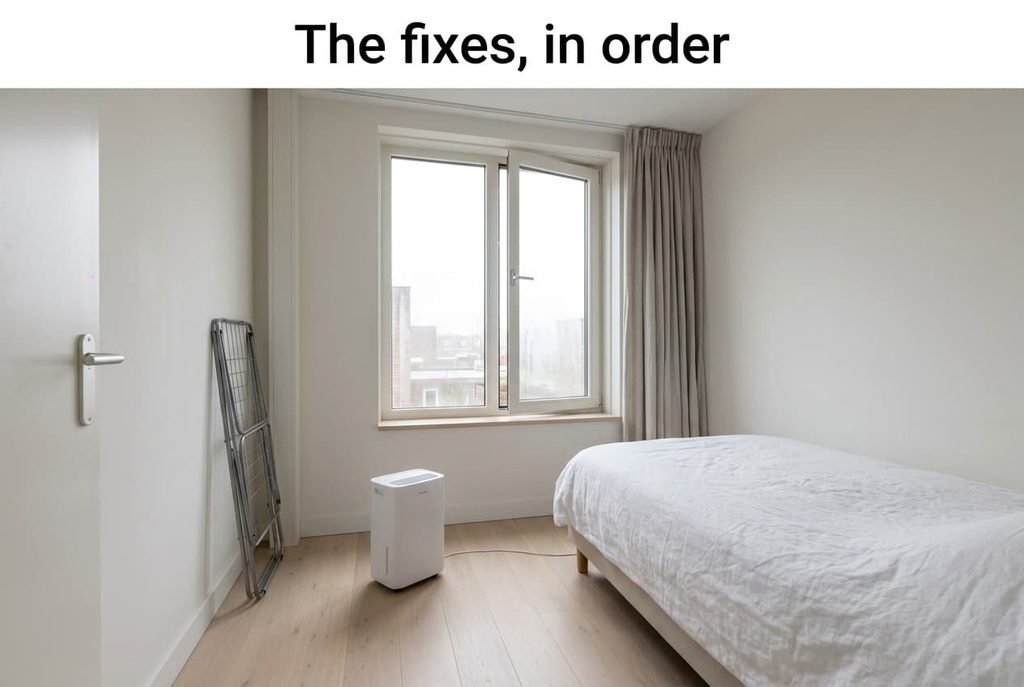
The fixes, in order
Dry the washing somewhere else, which addresses the moisture source. A rack holding one wash load releases about 1,000 g of water, which is more than a night of breathing at 640 g. Moving it puts the night’s output back to 640 g. All it takes is a different spot for the rack, such as the bathroom with the fan on. It does nothing if you don’t dry washing in the bedroom, because the breath remains. The washing still needs a home, such as a rack by a window in another room.
Open the window 2 cm and shut the bedroom door, which addresses air exchange. In our model that lifts the swap rate from 0.6 to 1.2 an hour, so humidity falls from 69% to 50%. The price is a room a few degrees cooler by morning. Street noise can make it hard to keep up on some nights. On a rainy day the outdoor air carries more water, so the gain shrinks. Keep the opening small. A wide gap lets heat leak out and adds little extra air.
Run a small dehumidifier for the last hours of the night, which addresses removal. Assume it pulls 300 g an hour and clears the 640 g in about two hours. You pay for the unit and for the electricity it draws. It lowers the dew point without warming the glass, so it does best once the first two are in place. It hums beside the bed, and the tank needs emptying each morning. Stand it a metre away with the door shut, so it works on the room’s air and not the corridor’s.
Request trickle vents or newer glazing from the landlord, which addresses the glass temperature. A modern pane has an inner surface near 14 °C on the same morning, which sits above the 11.3 °C dew point even at 65% humidity. The landlord bears the cost, and the wait can be months. Tight new windows leak less air, so without a vent the humidity can climb instead. Until then, a strip of clear secondary film, if the lease allows it, warms the pane’s inner surface by a few degrees. It’s a stopgap that suits a tenancy of a year or two. Fix these four in order and the windows run with condensation every morning only on the coldest nights.

What this bedroom’s own architecture means for you
The room holds 22.8 m³ and can’t grow, so at 18 °C it stores at most 15.4 × 22.8 = 351 g of vapour. Even one night’s 640 g overshoots that. In a room this small the air has no spare storage to lean on. That’s why the windows run with condensation every morning so quickly here.
Two more fixed features set the baseline. The window is 110 by 135 cm, so 1.49 m² of glass is the coldest surface in the room, and no curtain colour changes that. A curtain hung behind the 12 cm sill traps cold air against the pane. The door is 78 cm wide and passes air only as a draught. With it shut, the room breathes through the window alone. That explains why the second fix works so well here.
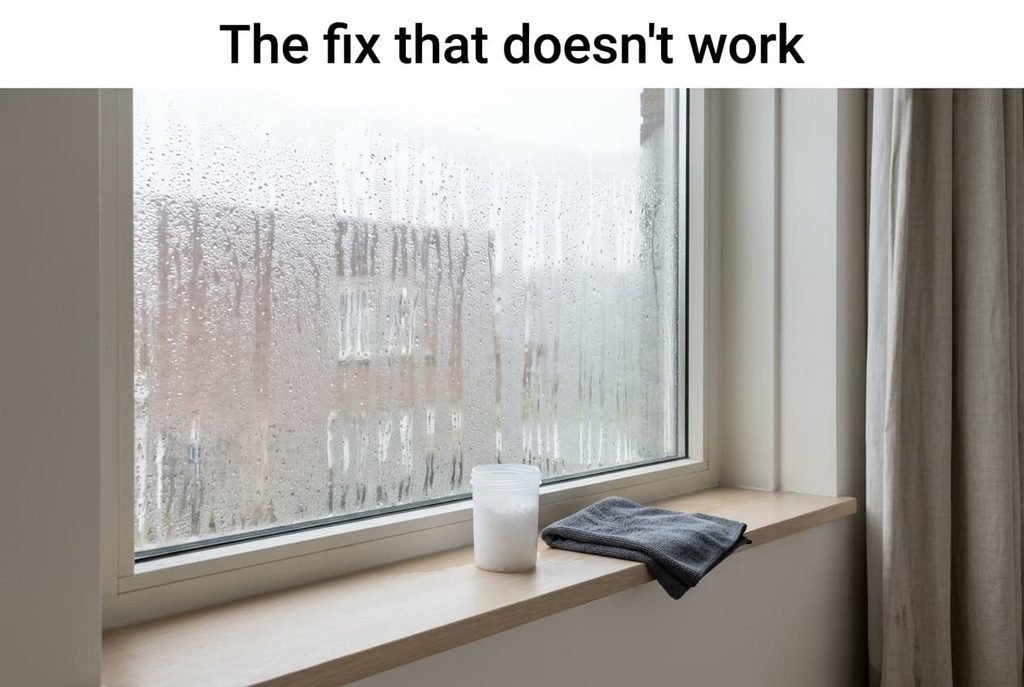
The fix that doesn’t work
A pot of silica crystals on the sill is the usual cheap remedy, and it misses the mechanism. Assume one pot absorbs 200 g before it’s full. A night produces 640 g, so a single pot covers under a third of it and is spent within days. The crystals also sit at one point on the sill while the water arrives across 1.49 m² of glass and the walls. The air has to carry it to them first.
Nothing on the sill can store that much water.
Heating the room harder is a half-measure. It leaves the water in the air in place, so the dew point stays near 12 °C. The glass only clears if it warms above that. A radiator at full blast can manage it. The cost climbs, and the glass cools again towards morning.
Wiping the glass each morning fails in a similar way. The cloth clears the droplets and leaves the 640 g in the curtains and the wall behind them. A room where the windows run with condensation every morning needs less water and more fresh air. Tonight, move any washing out. Tomorrow, open the window 2 cm. Then close the bedroom door. None of this costs a cent, and each step moves the humidity toward 50%.
Questions readers keep asking
Can condensation on bedroom windows be fixed at all?
Yes, in most rented bedrooms. The water comes from breath and washing rather than from the building. Cut the humidity or swap more air and it stops. The exception is moisture between the two panes, which is a failed seal that the landlord must repair.
What does it cost to stop it?
Two of the fixes are free. A small dehumidifier is the only purchase, plus the power it draws. It pays back only once the window and the washing habits are sorted. New glazing is the landlord’s expense and the last resort.
Is drying washing in the bedroom the main cause?
It’s the largest single source when it happens. A rack holding one wash load adds about 1,000 g of water, more than a night of breathing at 640 g. If you don’t dry washing there, suspect the closed room itself.