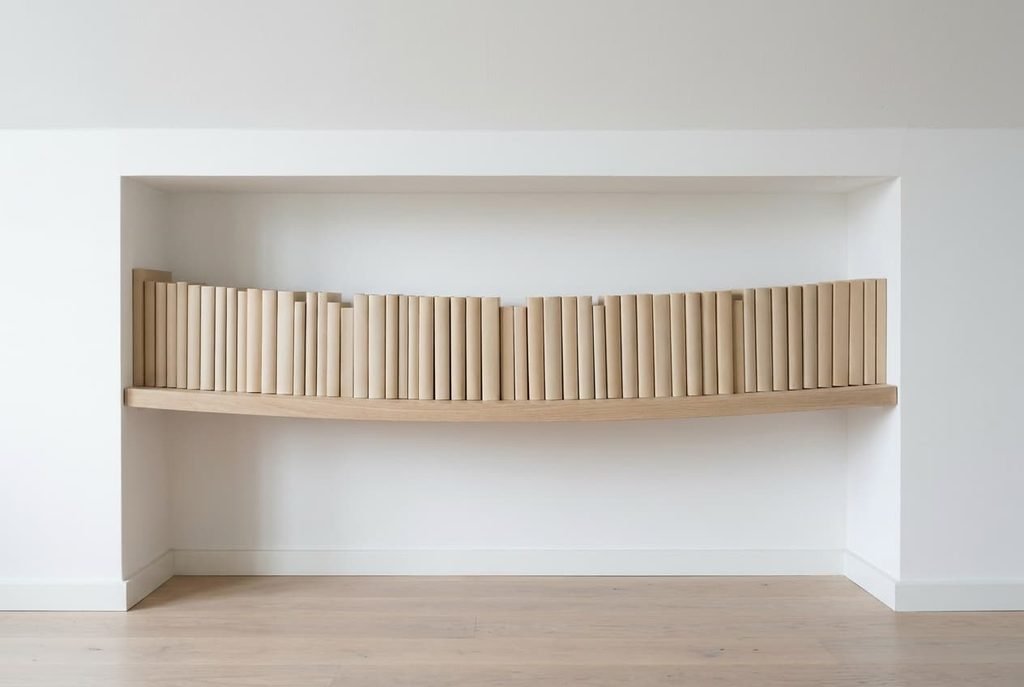
A pencil rolls towards the centre of the shelf, and that’s the first sign. Our example sits in a Utrecht living room. An alcove holds a single board of 18 mm chipboard. It is 90 cm long and 25 cm deep, and hardbacks fill it. A bookshelf that bows in the middle has settled into a curve over about two years, and the dip now measures 6 mm. The board is at fault and the screws are fine, so tightening them achieves nothing. Below you’ll sort the versions of the fault and rank four repairs, cheapest first. These numbers are rounded, so confirm each on your own board.
What Makes a Bookshelf That Bows in the Middle Bend
A shelf board is a beam resting on two supports, one at each end. Books press down on it and the board resists by bending, so the middle drops while the ends stay put. Assume 24 hardbacks at 0.9 kg each, about 22 kg spread over 90 cm, which is 0.24 kg for every centimetre. Chipboard adds a slow effect called creep. Under steady load its fibres give way a little each month. A dip that began at 2 mm grows and doesn’t spring back when you lift the books off.
Three levers determine how large the dip becomes, and a heavy load on a long, thin board gives the biggest bend. The first lever is where the weight sits. A load standing in the middle bends the board about 1.6 times as much as the same load spread along its length. The second is how far apart the supports stand, since a longer board sags further. The third is thickness, where stiffness rises with depth cubed, so a board twice as thick is eight times as stiff.
Every repair below pulls one of those three levers.
Three Quick Tests to Confirm Which Version You Have
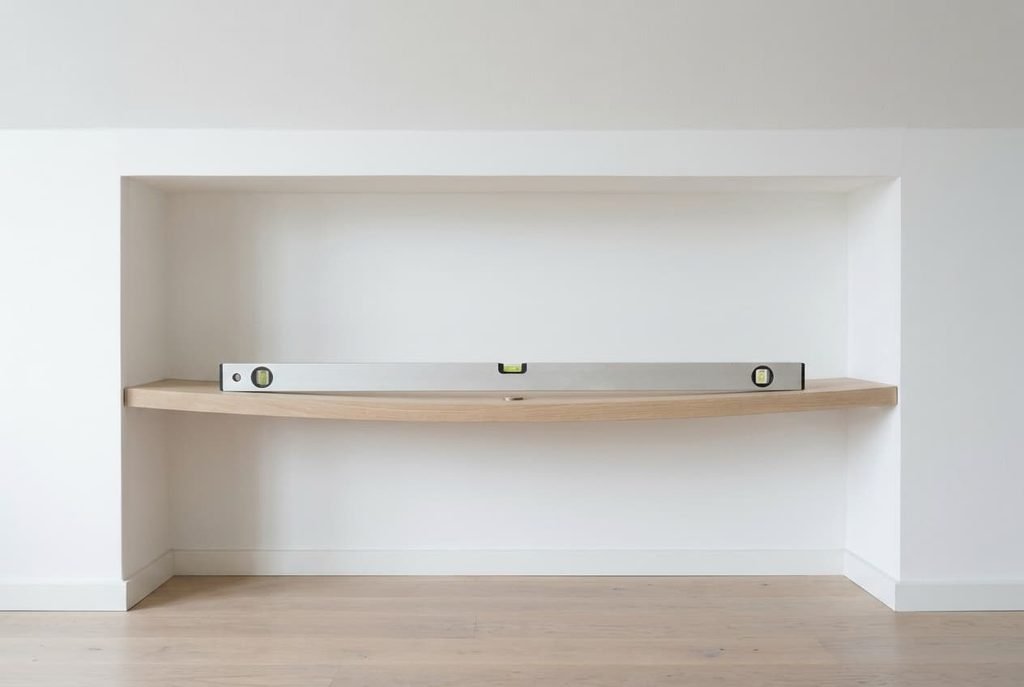
Across the board, lay a straight edge such as a long spirit level. Slide a coin under the middle and see how much room it has.
A gap widest at the centre and zero at both ends means a bookshelf that bows in the middle through plain bending. Write the gap down in millimetres, because 6 mm is the starting figure we’ll measure against. Photograph the coin with a ruler beside it, for a before-and-after comparison.
If one end sits lower than the other, a support has slipped. Refit it first and measure again, since the board itself may be fine. If the straight edge rocks with no gap anywhere, the board is twisted from side to side. None of these repairs will cure that.
Then empty the board for a day and test again. A gap that halves was elastic bending, while a gap that stays is creep, which only a stiffer board will stop. A missing back panel can also let a cabinet lean and mimic a bow.
Four Repairs, Cheapest First
Spread the weight along the board, because the same books bend it less when they don’t gather at the centre. Put the heaviest hardbacks nearest the ends, where the supports carry them, and keep paperbacks in the middle. Spreading a load instead of centring it removes the 1.6 factor, so 6 mm falls to about 3.8 mm. That costs nothing. Measure again after a week, and if the gap has stopped growing, the creep has slowed. It can’t straighten what has already bent.
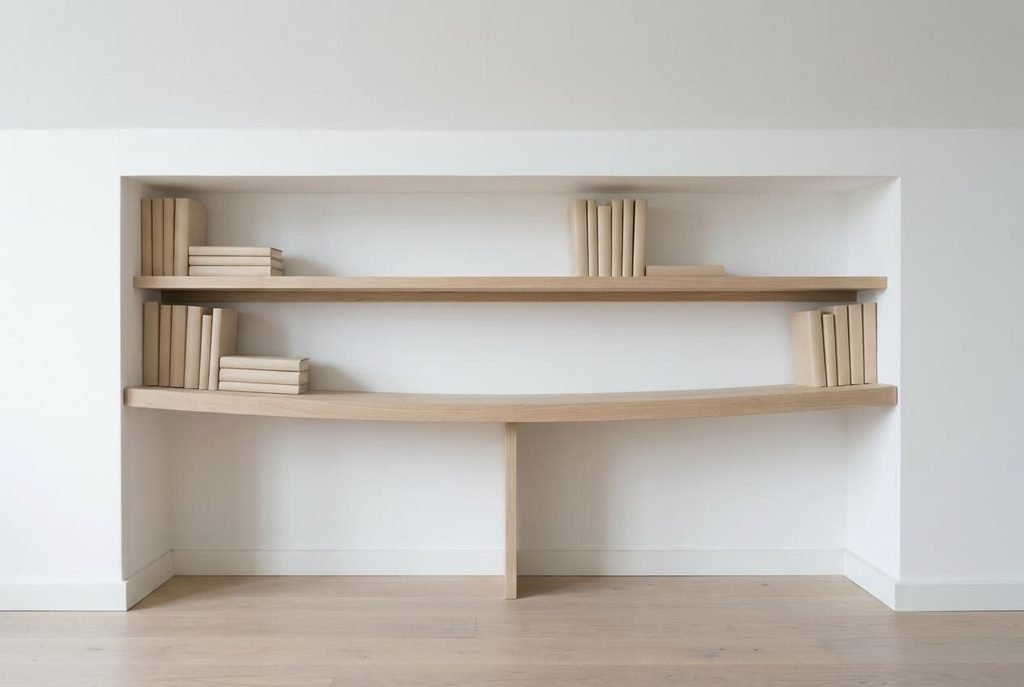
Add a central divider, because it halves the span and gives the board a third support. A vertical panel under the middle takes the load. In theory the dip drops below a tenth of its value, under 0.6 mm. You need a small piece of timber cut to the gap, and it must stand on something firm, such as the board below. Place it so each half-span is about 45 cm, because a divider off-centre leaves one half longer and bending more. A divider also keeps a bookshelf that bows in the middle from drifting back.
Glue and screw a batten under the front edge, a strip 4 cm deep and 18 mm thick. It works as a deep flange. Stiffness follows the cube of depth, so the shelf becomes about 6 times as stiff if the glue holds. That brings 6 mm down to roughly 1 mm. You pay for a metre of timber and some wood glue, and screws alone deliver only part of the stiffness. Clamp the batten along its full length for a day, so the glue line takes the shear.
Swap the board for a thicker one, a solid plank or a thicker panel cut by a joiner. Replacing 18 mm with 25 mm gives about 2.7 times the stiffness, or roughly 2.2 mm of dip. This costs more than any other repair here, and a heavier board needs brackets that can carry it. A solid plank keeps its stiffness better than chipboard of the same thickness, which means the real result can beat the figure.
Rank the four by what you’ll pay and how long each lasts: the free one buys weeks and the dearest buys years.
Fixing the Middle of a Bookshelf That Bows in Your Alcove
Your own walls decide which repair suits you. In our Utrecht alcove both side walls are brick, so a support fixed there takes real weight. An alcove built as a plasterboard partition would pull brackets out of the wall, which makes the central divider the better choice.
Depth matters as well. A 25 cm deep alcove gives scant room to a batten that sticks out, so cut it to sit flush under the board’s front edge.
The gap above the shelf is fixed too. If the next board is only 30 cm higher, a divider has to be short enough to slide in. A deeper batten won’t fit at all.
Last, look at the floor. A unit standing on a sloping floor loads its supports unevenly. A wedge under one foot can shift the bend before you touch the board.
The Fix That Only Looks Like a Cure
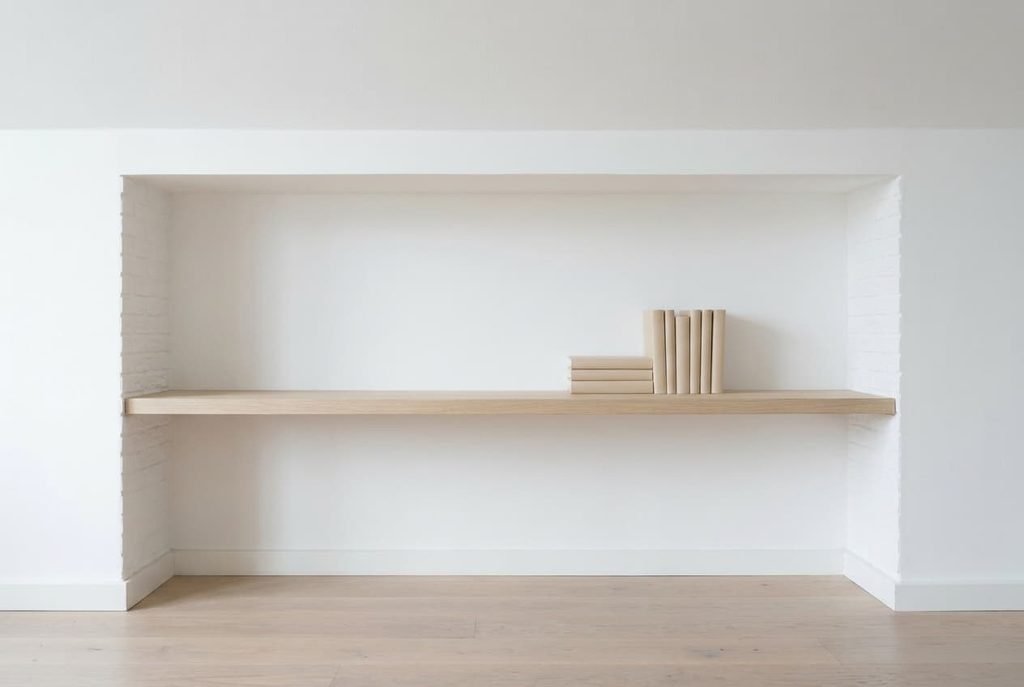
Turning the board upside down looks like a cheap cure, because the bow now points up and the shelf appears flat for a while. It doesn’t last. The fibres on the new underside have been squeezed. The new load starts the creep again, so within months the dip is back. A folded card wedged under the middle is a weaker cousin of the trick, since it props the sag until the card slips.
Strengthening the board from below is the honest version of the same idea. A batten or a divider changes how the board carries its load.
A shelf that has already crept keeps part of its curve for good. The repairs stop it growing and reduce how far it moves under books. They won’t pull 6 mm back to nothing, and a bookshelf that bows in the middle never quite forgets it.
If the remaining dip bothers you, hide it with a shallow lip along the front edge and a row of upright books that pulls attention to the line of the spines. Nobody checks a board with a coin. Pencils will still roll a little, which is simply the price of a board that has crept and the reason the cheap repairs are worth doing early.
Questions Readers Keep Asking
Can a shelf that has already bowed be made straight?
Not entirely. Creep leaves a permanent set, so part of the 6 mm stays even with the books off. A divider or batten stops the dip growing. It also reduces how far the board moves under load, which is usually enough for the shelf to look level again.
How much will fixing it cost compared with replacing it?
Spreading the weight is free. A divider or batten costs a little timber and glue. A new thicker board costs more and needs sturdier brackets. Try the cheap repairs first, because they often leave the original board serviceable for years.
Why do shelves bow even with light books?
Usually the board is slim for its length. A 90 cm span of 18 mm chipboard gives little stiffness, and months of steady load add creep. Doubling the thickness would make it eight times as stiff, which is why a deeper edge cures it so well.