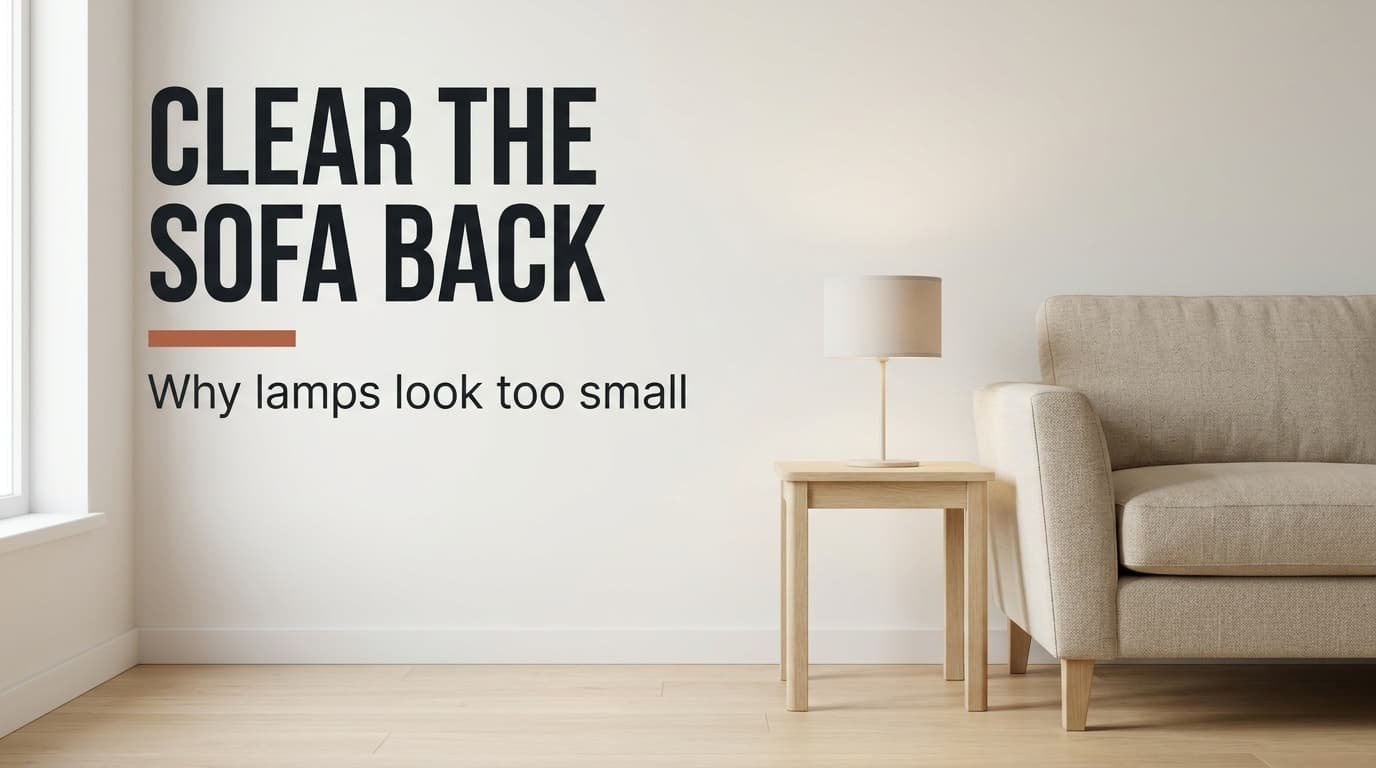
Both lamps stand on their side tables and light the room well enough. Still, table lamps look too small next to the sofa, and measuring them tells you nothing. The eye compares each lamp with the sofa behind it, so a lamp of a sensible size can look like an ornament for a doll’s house against 220 cm of upholstery. Three faults cover almost every case. The setting is an Amsterdam flat whose living area measures 380 × 460 cm. Its sofa back is 85 cm high, each side table measures 45 × 45 cm and stands 50 cm tall, and each lamp measures 40 cm with its shade on.
What makes table lamps look too small beside a sofa that suits the room
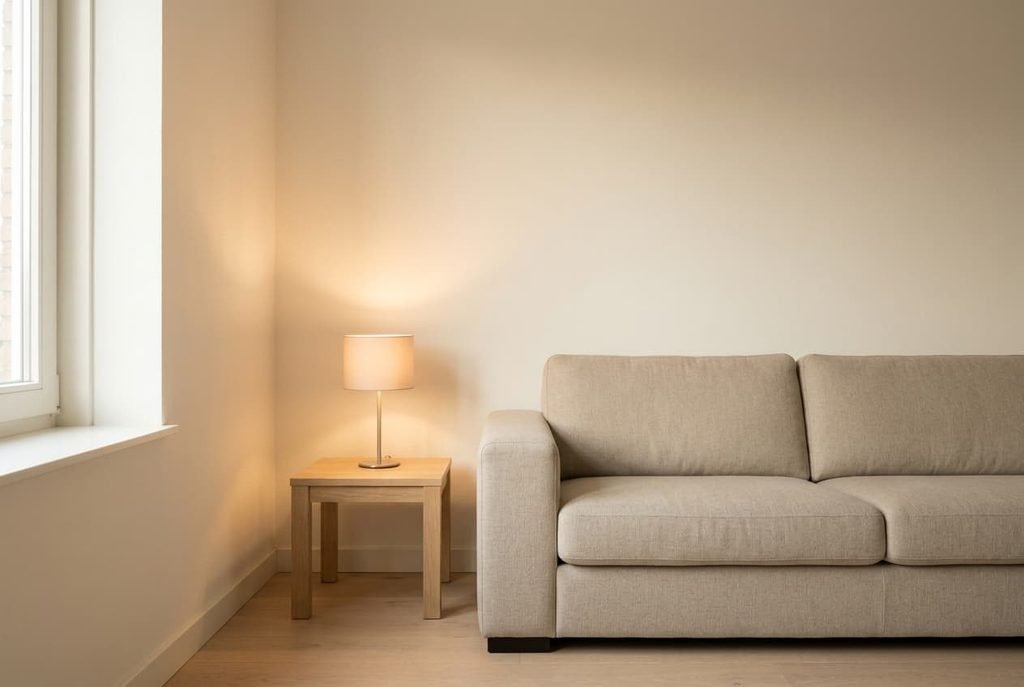
Anyone looking at a lamp judges it against the tallest object near it, and that object is the sofa back. When the lamp’s top only just clears the back, the sofa seems to swallow it. The top of the lamp stands at 50 + 40 = 90 cm, which is 5 cm above a back of 85 cm. That margin is 6% of the back’s height. Assume the top should clear the back by a quarter of that height, or 21 cm. It then belongs at 106 cm, and our lamp is 16 cm short.
Two other relations matter as well. The first is how near the lamp stands to the sofa arm, since a lamp standing apart seems to join the wall instead. The second is how much of the lamp seems to glow once it’s lit. Break either one and the lamp loses visual weight, even at the right height, which is why a correct measurement can still leave the room feeling off.
Blaming the shade and buying a wider one treats the wrong measurement, because width doesn’t make a lamp look small. Height against the sofa back does that, and a broad shade on a short base simply looks heavy.
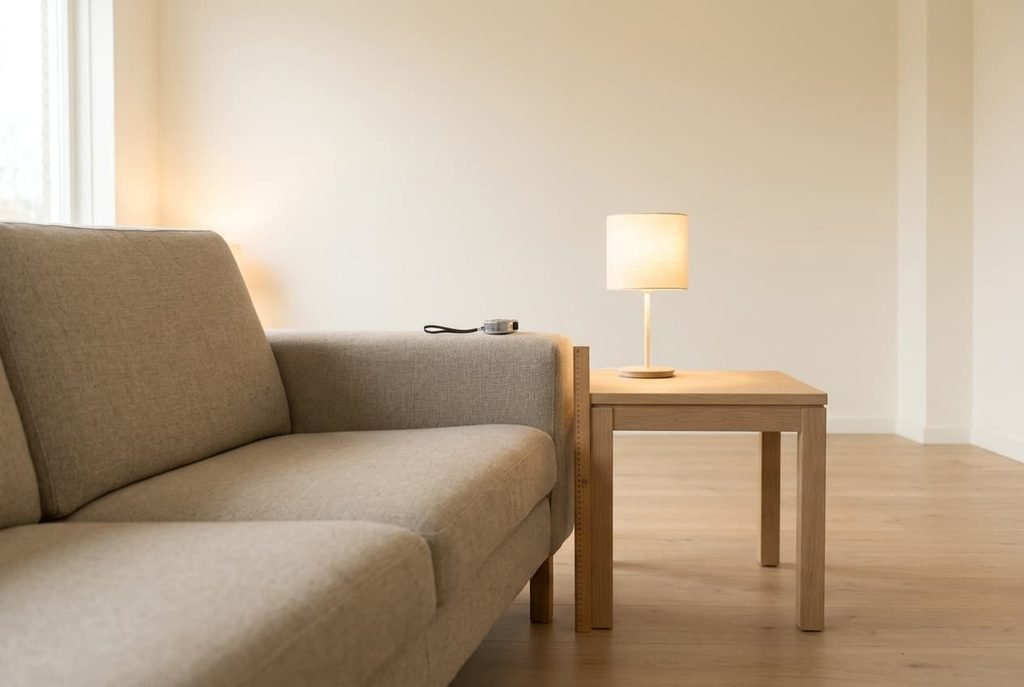
Table lamps that look too small: a checklist from the sofa
To learn why table lamps look too small in your own room, settle into your regular seat at dusk, both lamps lit. A tape measure answers every question below.
1. Measure from the side table’s top up to the shade’s highest point, add the table’s height, then subtract the height of the sofa back. Under 15 cm means the lamp is swallowed.
2. Measure from the arm of the sofa to the lamp’s base. Above 15 cm, the lamp drifts towards the wall and away from the sofa.
3. Glance at the lower edge of the shade from your seat. Seeing the bulb means the shade sits above your eye. A shade far below your eye makes the lamp look squat.
4. Compare the lit shade with the wall behind it. A dark shade on a pale wall makes a hard step in tone, so the lamp reads as a small dark drum.
5. Count what stands on the side table. One neighbour isolates the lamp, while a crowd hides it.
Our room fails on the first check and the second. It also fails the fourth.
Three faults behind lamps that read small
“The lamp seems to hover on its own, away from the sofa.” Placement is the culprit. The side table is pushed against the wall and sits 28 cm from the arm, so the lamp lines up with the wall and the sofa’s end looks bare. Slide the table until it nearly touches the arm, so only about 5 cm remain. Leave it there through a week of evenings, because a new position looks odd for the first two days. No money changes hands. The sofa’s own side sets the limit, because a table that’s too close to the seat edge blocks the step you take when you sit down.
“The lit lamp looks like a dim dot against the wall.” Contrast explains this one. A dark linen shade passes little light, so the wall behind it shows a narrow pool of about 60 cm and the shade itself looks like a black cylinder. Borrow the pale shade from a lamp in another room, which spreads a glow roughly twice as wide, about 120 cm. That counts as a rearrangement, not a purchase. Another room loses a little of its look in return, and you’ll notice that within a day. The borrowed shade must also fit this lamp’s fitting, so try it on before you settle on the swap.
“The lamp looks like a toy beside the sofa.” Scale decides this. With the top at 90 cm, the lamp needs 16 cm more to reach 106 cm. Test that first by lifting the lamp on a pile of books 16 cm high, which costs a minute. If the picture improves, buy a lamp with a taller base. Choose one that is 56 cm overall or more, and check the shade width against the 45 cm tabletop. Only this step costs money. The shade sets the limit, because its lower edge has to stay below seated eye level, which I’d put at 105 cm. A 56 cm lamp on a 50 cm table puts the shade’s lower edge at about 90 cm, so the bulb stays out of sight.
Work down the three in order, and recheck from your seat after each change.
Checks before the next lamp
Build a stand-in before you order a taller lamp. Pile boxes or a cardboard tube up to 56 cm and cap it with a paper cylinder 26 cm wide for the shade. Leave it on the side table for a day. Sit down, look across the room, then walk past it. A shape that feels right at that height should feel right in the real lamp too.
Total height is the figure shoppers skip. When table lamps look too small, it’s the one to chase. Listings often quote the base alone and leave the shade out, so ask for the height from the table top to the highest point of the shade.
Matching lamps pass these tests more easily. One on each side table frames the sofa, whereas a single tall lamp with nothing opposite pulls the whole group sideways.
The fix that isn’t worth doing
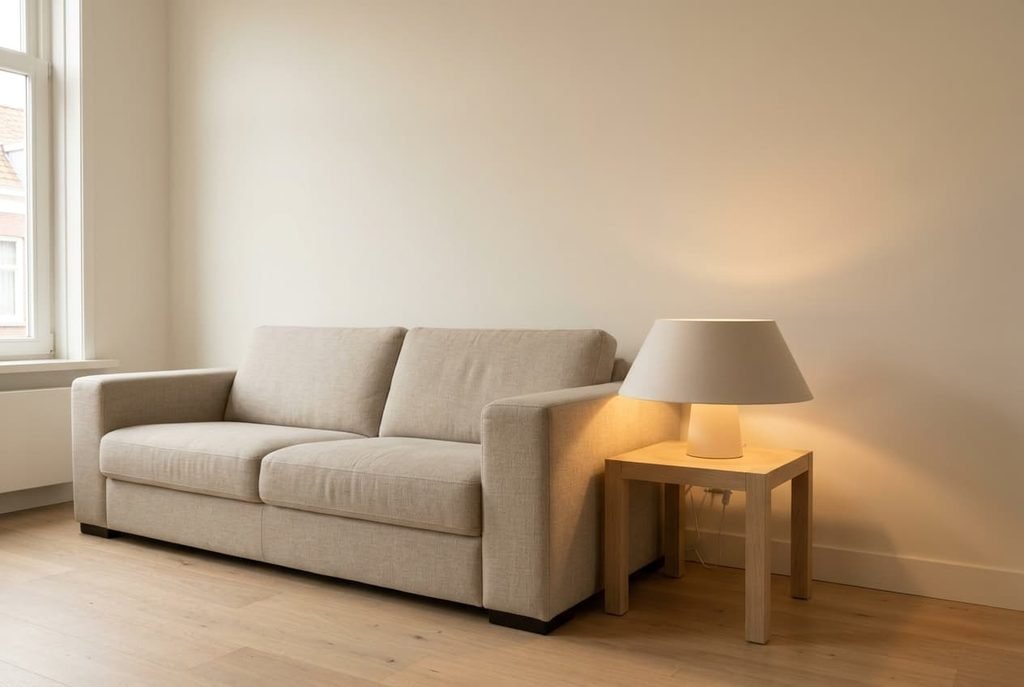
Fitting a much wider shade on the same short base feels like the generous answer. A shade 38 cm wide on a 40 cm lamp turns a tidy shape into a mushroom, and the larger drum lifts the top by about 4 cm. The lamp still stands 12 cm below the target and now nearly fills the 45 cm tabletop. The fault remains, and the mushroom is a new one. A wider shade also puts its edge only 3 cm from the sofa arm, which crowds the pair.
A second small lamp beside the first goes wrong in the same way. Two lamps of 40 cm give 80 cm of lamp, yet each keeps the same 5 cm of clearance over the back.
Buying twice would teach you nothing.
Table lamps look too small when their tops clear the sofa back by too little. That one number costs less to correct than any shade. Measure the clearance, then shift the table. After that, raise the lamp on books and look again at dusk, lamps lit. Once a shop page is open, you’ll already know the height you need, and only a few listings will qualify. Write down your own sofa-back height and target top. Add the gap to the arm. The next lamp then starts from facts rather than from a photograph of somebody else’s room, and the return form stays unused.
Questions readers keep asking
What is the most common cause of a lamp that reads small?
Height against the sofa back. Most lamps are chosen for the table and not for the sofa. A top that clears the back by under about 15 cm gets swallowed, whatever the shade looks like. Measure the back first, then add the lamp’s full height to the table’s.
Is there a quick fix I can try tonight?
Yes. Slide the side table until it touches the arm, and lift the lamp on a pile of books to test the extra height. Both take a minute and cost nothing. Judge the result after dark with the lamps switched on, because daylight hides the glow.
Do I have to replace the lamps?
Often not. Placement costs nothing to change and so does the choice of shade, and between them they handle two of the faults. Only a wrong height calls for a taller lamp, and the stand-in shows you the right size before you spend.