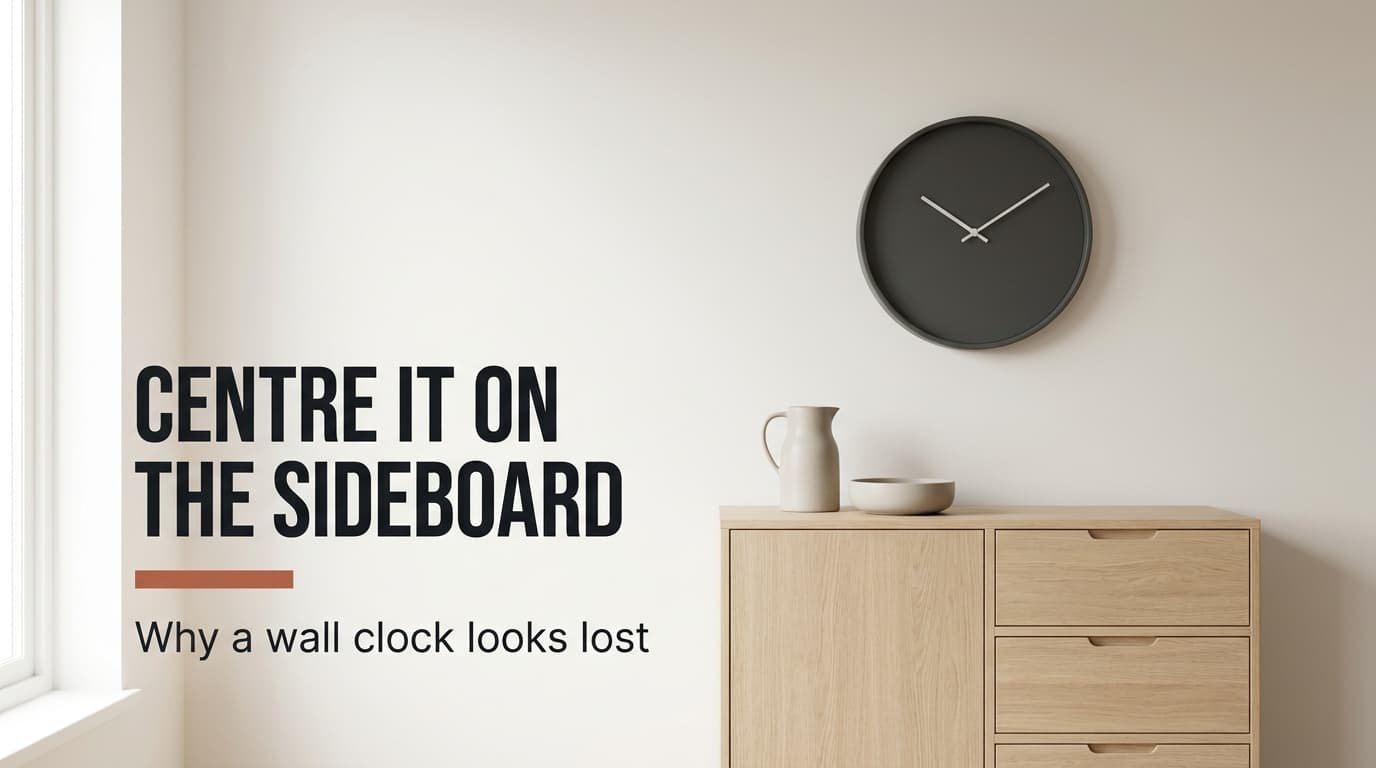
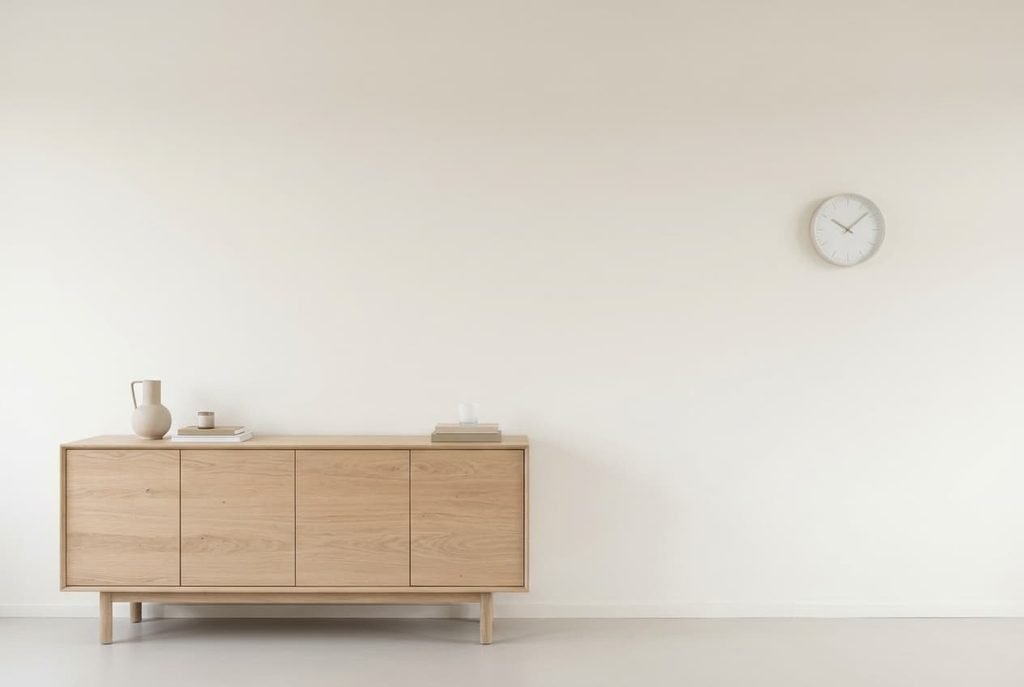
A clock keeps perfect time, yet people still ask what makes a wall clock look lost when everything about it works. The answer is rarely taste. The eye judges a clock as part of whatever stands under it, so a small round face on a broad pale wall reads as an afterthought. Only three faults ever lie behind that feeling. The room is a rented flat in Utrecht. Its main wall runs 380 cm across, and the ceiling reaches 250 cm. The clock measures 30 cm across, and below it stands a sideboard 160 cm long and 80 cm tall.
What Makes a Wall Clock Look Lost Above a Sideboard
Whoever looks at the clock compares it with the furniture underneath. The sideboard is 160 cm long, so the two form one group, and the eye tests that group on three counts unprompted. Each count has a measurement of its own.
Alignment comes first. Measure along the wall from its left end. The clock’s centre sits at 190 cm, the middle of the wall, while the sideboard’s centre sits at only 120 cm, because the window pushes the sideboard to the left. After that comes vertical distance, meaning the stretch from sideboard top to the clock’s lower edge, here 55 cm. The last is size, and 30 cm against 160 cm is 19%.
Looking at the clock alone hides all of this, because a 30 cm face is perfectly ordinary in a hallway. Against a sideboard that wide it has to stand in for 160 cm of furniture, and the empty wall between the two does the rest of the damage. Repairing one relation seldom settles the matter, which is why a single good measurement can sit beside a wall that still feels wrong.
Wall Clock Lost: A Checklist From the Sofa
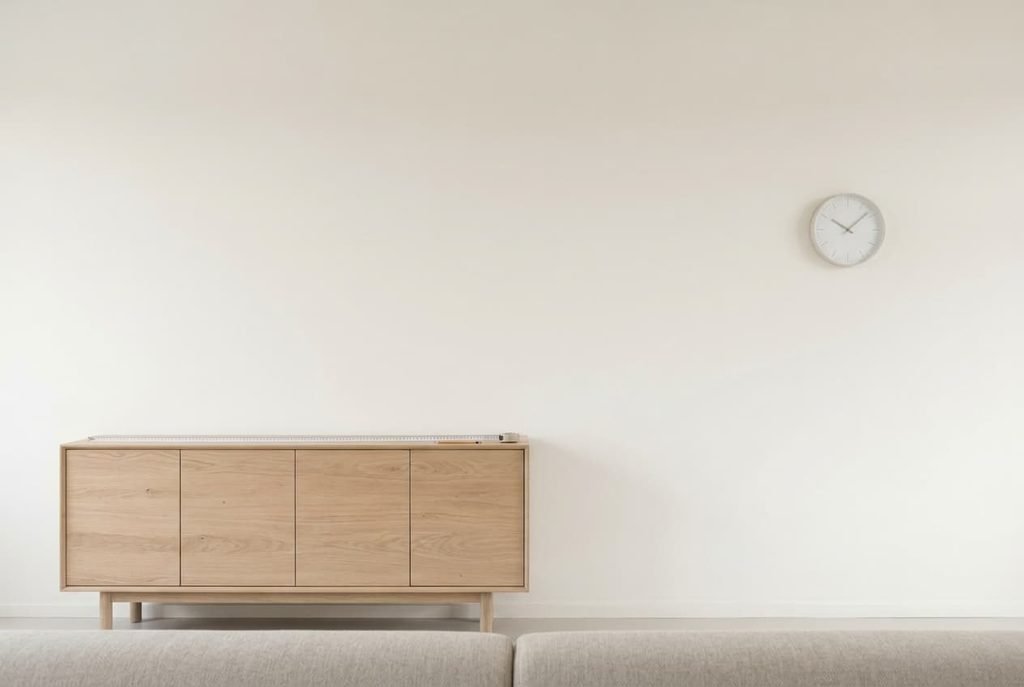
Take your regular seat, which sits 340 cm from the wall in our room, and keep a tape measure close. Each question below takes a minute. Whatever makes a wall clock look lost to you will show up in one of these answers.
1. Measure from the clock’s centre to the sideboard’s centre. More than 10 cm apart means the clock drifts. Ours is 70 cm off, and its right edge overhangs the sideboard’s end.
2. Measure from the sideboard top to the clock’s lower edge. Above 30 cm, the clock floats free of the furniture, and ours stands at 55 cm.
3. Photograph the wall and turn the picture black and white. If the rim of the face melts into the paint, the tone step is too small. Ours vanishes.
4. Divide the clock’s diameter by the sideboard’s width. Under 25% reads as small, and ours scores 19%.
5. Try to read the time from your seat in one glance. Thin hands 4 mm wide fade at 340 cm, so ours is borderline.
Our wall fails the first four checks and nearly fails the fifth.
Three Faults, in the Order to Fix Them
Hang the clock over the middle of the sideboard, not the middle of the wall, because the eye reads furniture and clock as one object. Fill the old hole with a dab of filler and drill a new one at 120 cm along the wall. Set the hook at a height of 115 cm, and the gap to the sideboard top becomes 20 cm. A drill and ten minutes are all it takes, and the outlay is zero. The patch shows in low evening light, so touch it up with leftover wall paint. The sideboard’s own length sets the limit here: a 160 cm piece lets the clock sit anywhere over it, but a narrow chest of 60 cm would leave you just one correct spot, with no room to adjust.
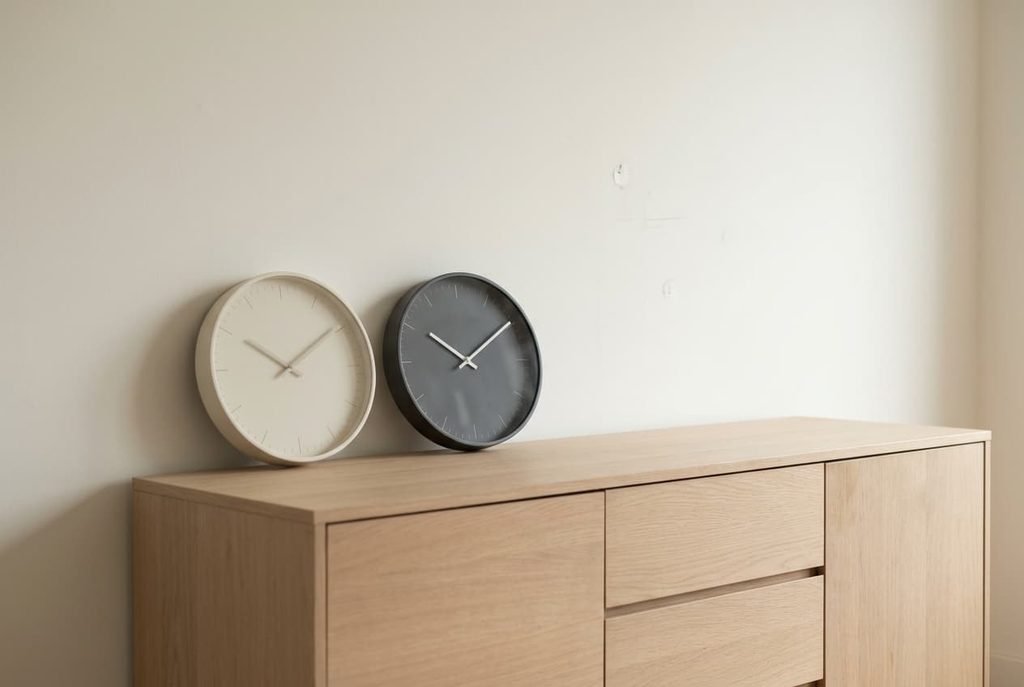
Swap the pale clock for the dark-faced one from the hallway, which turns a thin rim into a strong shape. Call the wall’s reflectance 80 on a scale of 100 and the white face 85, so the step is just 5 points. A charcoal face scores perhaps 15, and the step jumps to 65 points. Treat these as round figures, because only the gap between them matters. White hands on a dark face also read from 340 cm, which the old black hands never managed. The hallway gives up its clock, and the bare nail shows within a day.
The hallway wall stays empty until the new clock arrives.
Buy a clock 45 cm across, because a clock looks right when its diameter lies between a quarter and a third of the furniture’s length. On 160 cm that range runs from 40 to 53 cm, and 45 cm is 28%. Choose a dark face so the contrast fix carries over to the new one, then move the hallway clock back where it came from. The hook goes up 7.5 cm, to 122.5 cm, to keep the 20 cm gap. Of the three, this last one alone costs money. The sideboard sets the limit: a clock wider than 53 cm starts to compete with it, and the face then dominates the wall instead of finishing it.
Checks Before You Buy a Bigger Clock
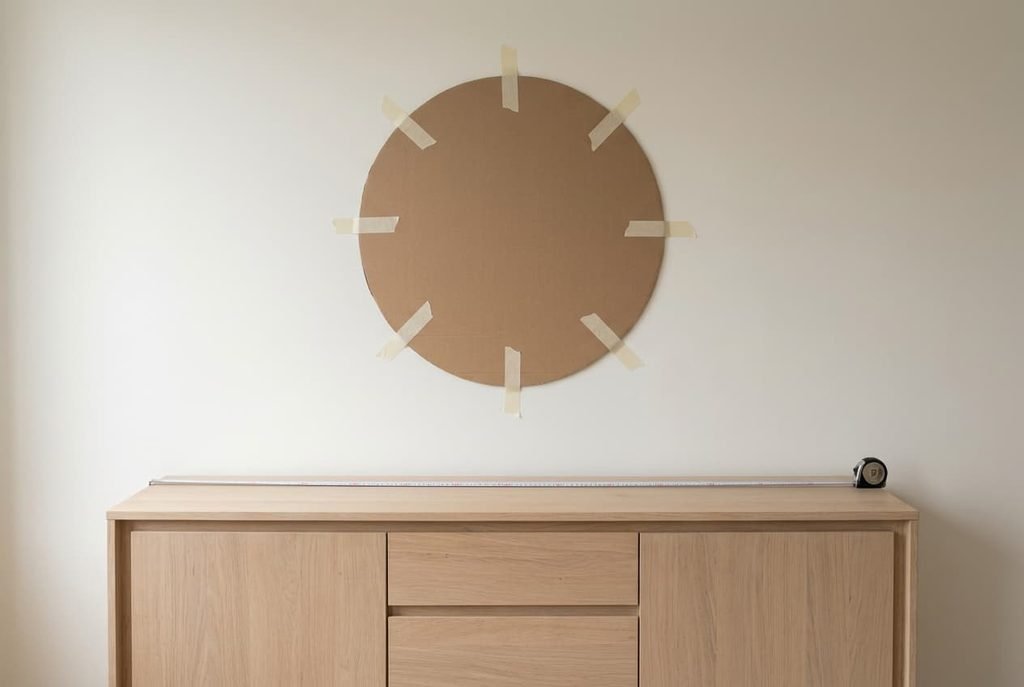
Cut a disc of cardboard 45 cm across and stick it with painter’s tape where the clock will hang. Leave it there for a full day. Walk in through the door, sit down at 340 cm, then stand beside the sideboard. If the disc seems too assertive, try 40 cm. Nothing else shows you so cheaply what makes a wall clock look lost at this size.
Shop listings often quote the outer diameter with the rim, so ask for the face width and the hand length. A minute hand about 15 cm long on a face of 40 cm reads at your seat, while a hand half that length won’t.
Save the cardboard. It marks the hook position for the day the real clock turns up.
The Fix That Isn’t Worth Doing
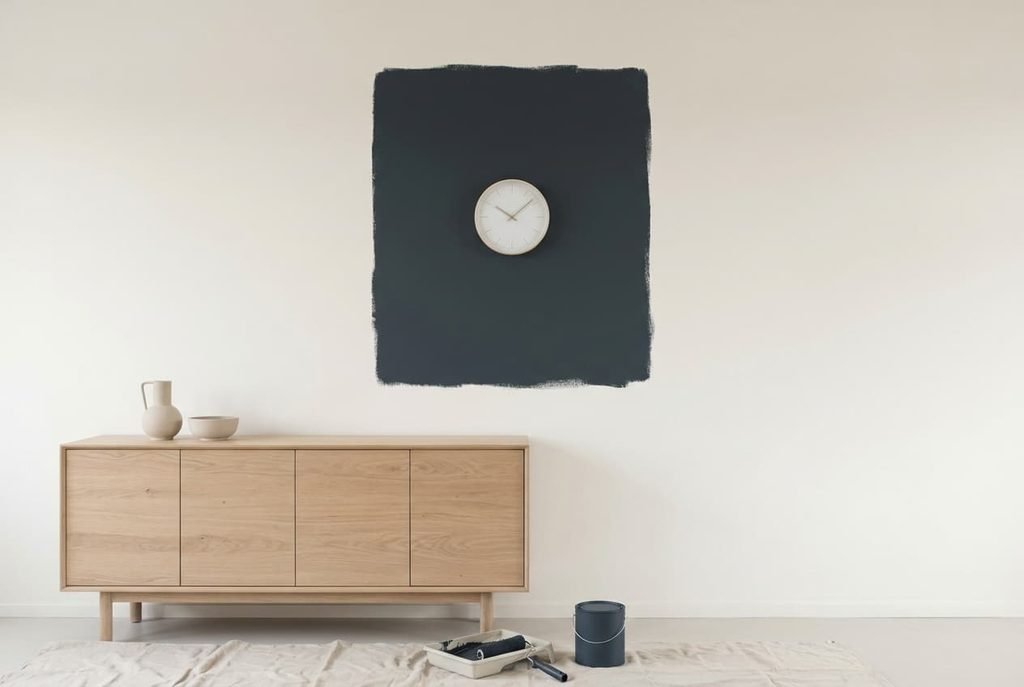
Painting the wall behind the clock a dark colour solves the tone step in one move, but the cost is out of proportion. The wall measures 380 by 250 cm, a surface of 9.5 m² to cover with two coats of paint. It also leaves a room that feels smaller by evening, and the sofa stays pulled into the middle for a week of drying and airing. Alignment and size stay wrong, and the new clock still has to be bought. Dark paint also removes the pale backdrop that the sideboard’s objects rely on. The jug and the bowl lose their outline, and you commit to a colour long after this clock has been replaced. A hallway clock fixes the tone for nothing, and a spare weekend stays yours.
Each fault breaks a different relation. Whatever makes a wall clock look lost in your room, a single repaint won’t settle all of them. Fix the position first, borrow the contrast from the hallway, and let the cardboard disc approve the size. Each step is reversible, so nothing here locks you in before the last decision. Then note your own sideboard length and the hook height on a card. Every clock you look at afterwards has to meet those two figures, while any that miss them can be ruled out from the shop page alone. A card like that takes one minute to write and spares the trip back with a return form.
Questions Readers Keep Asking
What is the most common cause of a clock that looks lost?
Placement against the furniture below. Most clocks get hung at the middle of the wall instead of over the middle of the sideboard. A centre more than 10 cm off, or a gap above 30 cm, makes the clock drift. Measure those two figures first, since both fixes are free.
Is there a quick fix I can try tonight?
Yes. Take the clock down, move the hook to the sideboard’s centre, and lower it until the gap is about 20 cm. Fifteen minutes is the most it takes. Look again once it’s dark, with every light in the room switched on, because daylight flattens the tone and hides the difference.
Do I have to buy a bigger clock?
Often not. Position and contrast cost nothing to correct, so two faults out of three go away without a purchase. Only a clock under a quarter of the sideboard’s length calls for a bigger one, and a cardboard disc shows you the target diameter first.