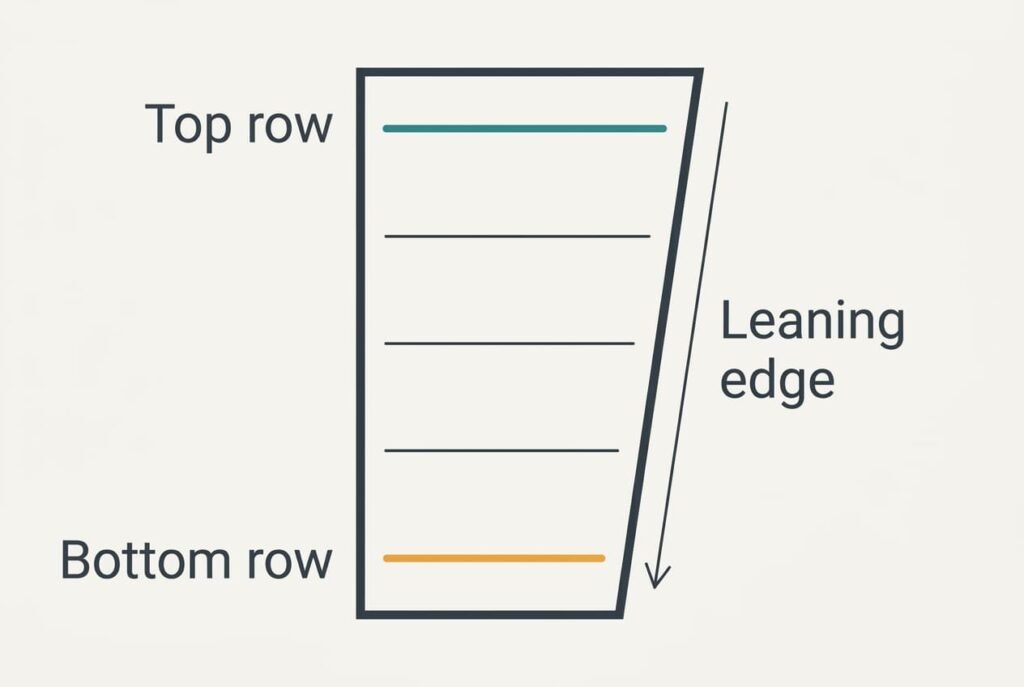
A rolling shutter reads a camera’s picture in sequence, beginning with the top row. Neither the lens nor the file has a fault. A fast subject keeps travelling while the rows are read, and that’s why fast things look bent in video. In our example a phone reads 1080 rows in 20 ms, and an express train crossing the frame at 30 m/s moves 0.6 m before the last row is done. Its upright door edges then lean by about 7.6 degrees. All these figures are samples chosen for illustration, for a phone held on a platform in Newcastle, and your own camera will differ.
Why Fast Things Look Bent: The Short Answer and Its Gaps
A sensor is a grid of light-sensitive cells, and it can’t empty them all in one instant. A shared circuit visits the rows in order, working down from the top edge to the bottom edge. That gap from first row to last is the readout time, and the scene keeps moving throughout it. A sensor that reads in sequence is simpler to build and tends to draw less power, which is why phones use one. The camera therefore gives every row its own moment in time and catches a moving object in a slightly different place on each row. Stack the rows together and a straight edge slants.
That summary leaves gaps. It doesn’t say how long each row collects light, which runs on a separate clock. It also leaves out vibration and flickering lamps. Video shows the effect most, because the sensor keeps reading frame after frame without a pause. A global shutter captures every row together and removes the lean, although the chip behind it is more complex. A still scene reads cleanly on either design.
Following One Train Past a Phone Camera
Take Sam, who films from a platform in Newcastle with a steady phone. The clip is 1080 rows high and 1920 pixels wide, and the sensor needs 20 ms to read all rows. That’s 20 ÷ 1080 = 0.0185 ms for each row. Both figures are assumed.
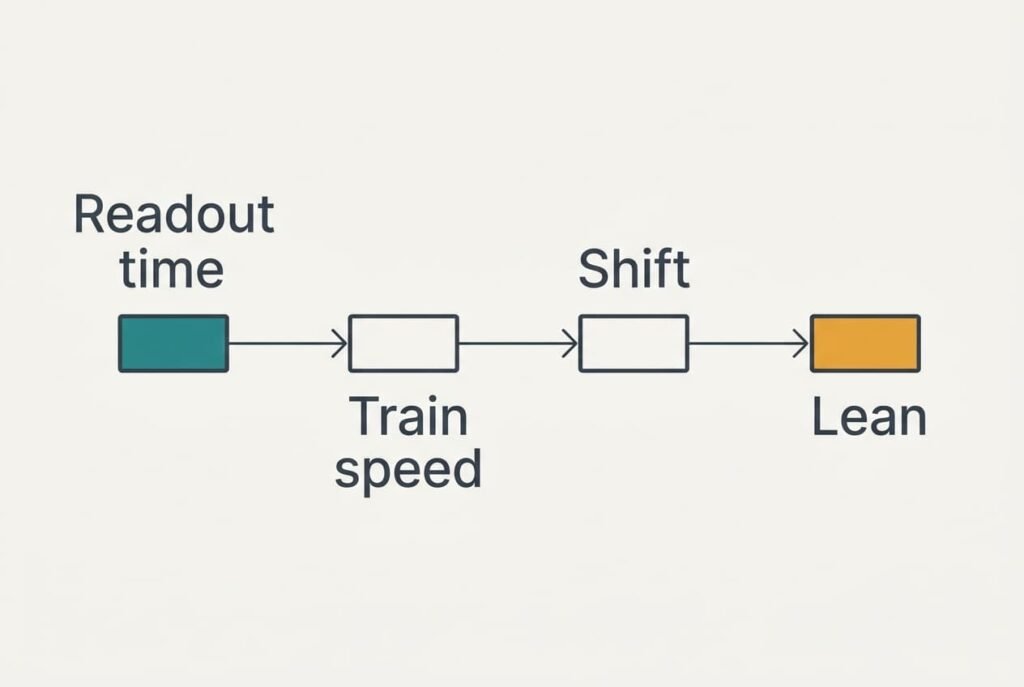
An express passes at 30 m/s, or 108 km/h. During one row’s turn it moves only 0.55 mm. Over the whole frame those steps total 30 × 0.020 = 0.6 m. Sam stands 25 m back and the frame spans 4.5 m from top to bottom. One pixel therefore covers 4500 ÷ 1080 = 4.17 mm, and the 0.6 m shift becomes 600 ÷ 4.17 = 144 pixels. That sideways gap is why fast things look bent inside a single frame.
Follow one door edge on a carriage. The top row records it at one position. By the time the reader reaches the bottom row, the edge has travelled 144 pixels further. An edge that should stand upright across 1080 pixels now leans at atan(144 ÷ 1080), which is 7.6 degrees. On playback the slant looks like a property of the train itself. Rectangular windows become parallelograms, and the next door edge along the carriage leans by exactly the same amount. The platform behind stays upright, because it never moved.
Next, alter one value. Halve the readout to 10 ms and the shift drops to 72 pixels, a lean of 3.8 degrees. Halve the train’s speed to 15 m/s and the lean halves too. A parked train gives zero. Shift equals speed times readout time, and that formula predicts the lean for any subject.
Direction follows from the read order. The train travels left across the frame while rows are read downwards, which means the lower rows see it later and further left. Each upright edge therefore leans left at its bottom.
Every row obeyed the same simple rule.

One Analogy: A Flatbed Scanner
Compare the sensor with a flatbed scanner. A lit bar glides beneath the glass and records the page one line at a time. Slide the page sideways while the bar travels, and every line lands a little further along than the previous one. The printed text slants. A rolling-shutter sensor does the same thing, with its rows standing in for scanned lines.
The scanner picture falls short in two ways. A scanner lights only the line it’s reading, whereas each sensor row collects light for its full exposure, and those exposures overlap. A scanner’s sweep also comes from a motor you can hear, while a sensor’s readout speed is built into the chip. Vertical motion marks a third gap: it stretches or squashes shapes, and the scanner picture predicts only a lean.
Limits of the Effect
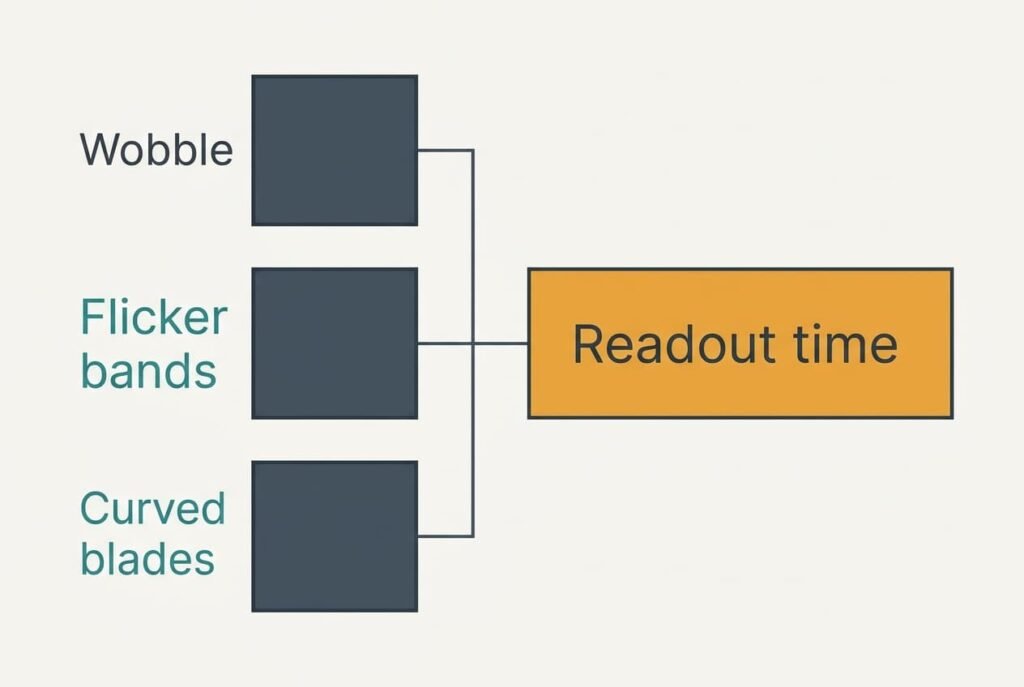
Rolling shutter acts only on motion that happens during the readout. A still scene looks right, however slowly the chip reads. Shaking shows up as wobble, because each row catches the shake at a different instant, and a handheld clip through a bus window is a good example. Flickering lamps paint dark bands across a frame when the rows meet the light at different points of its flicker. Spinning blades curve into hooks, and that curving is why fast things look bent so dramatically in propeller footage.
The most misunderstood limit is this: how far the picture leans is set by the readout time, and no exposure setting changes that time. Exposure controls blur, and readout controls lean. Some video modes read fewer rows and finish sooner, but only a test clip shows whether yours does. A smaller lean is therefore the realistic goal on a phone.
Three Beliefs About Why Fast Things Look So Bent
The first belief blames the lens. It formed because bent lines resemble lens distortion. Film a doorframe at rest through the same lens and it stays straight, which clears the glass. Wide and narrow lenses show the same lean, which points at the sensor.
The second says a quicker shutter speed fixes the lean. It sounds right because a quicker shutter does cure blur. At 1/1000 s our train moves only 30 mm during a row’s exposure, about 7 pixels, against 72 pixels at 1/100 s. The lean remains 144 pixels, since exposure time and readout time are separate clocks.
The third blames video compression. That belief formed because streaming glitches also arrive in bursts. A clip saved straight from the camera carries the same slant, which shows it was recorded that way. Step through the clip frame by frame and the slant sits in every single frame.
Ten seconds of testing settles each of these.
A Rule for Deciding What to Do About It
Choose by whether straight edges matter in the finished clip: film from further away when they do, and leave the clip alone when they don’t. Following the train with the camera also removes its shift between rows, though the platform behind it then bends. Knowing why fast things look bent lets you plan the shot instead of mending it later.
Run a ten-second test. Hold a pencil upright and sweep it sideways in front of the lens while recording. On playback, note how far the pencil leans, then sweep at half the speed and compare. The lean should roughly halve.
Keep both lean angles in a note. Those two numbers let you compare any future phone on the same footing, and they show whether a newer model reads faster. When a clip must show true shapes, such as a sports analysis or a fast machine, a global-shutter camera removes the effect at source. For family films, planning the shot is a simpler fix, and you’ll rarely need more. The same pencil test works on any camera you borrow.
Questions and Answers
Does a rolling shutter affect still photos?
Rarely. A photo of a static scene reads cleanly, because nothing moves during the readout. A fast subject, a passing train for example, can still lean in a photo, and an electronic shutter makes that likelier than a mechanical one does.
Do I need to worry about it for family videos?
Usually not. Walking children and garden games move far too slowly to lean noticeably. Worry begins only with fast sideways motion, such as a quick pan. Even then, standing further back removes most of the effect with no new equipment.
Is a global shutter always better?
For true shapes, yes, since every row records the same instant. The chip costs more to build and often has less room for light. Low-light footage can then look noisier. A fast-reading rolling-shutter sensor is a sensible compromise for most everyday filming.