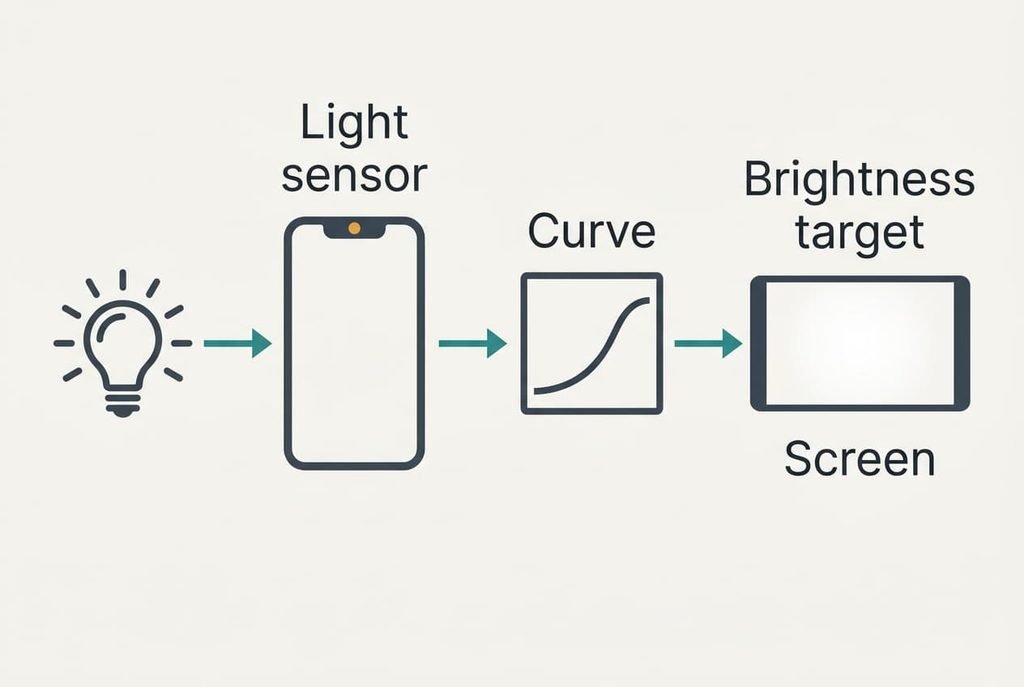
How does a handset decide how bright your screen should be? A tiny light sensor measures the room. Software turns that reading into a target level through a fixed curve, and a short delay keeps the screen from twitching. That is all of the mechanism. It matters because a screen that’s too bright in a dark room is harsh. One that’s too dim beside a window is unreadable. The setting makes that call for you all day without asking. This page traces one walk from a hallway to a sunny window, using assumed numbers you can replace with your own.
How Bright Your Screen Should Be: The Short Answer and Its Gaps
Light falling on a surface is measured in lux, and the sensor reports that figure many times a second. Readings span an enormous range, from about 80 lux in a hallway to 8,000 beside a window. In short, the phone converts one light reading into a brightness target and eases the screen towards it.
Nothing more clever than that is happening underneath.
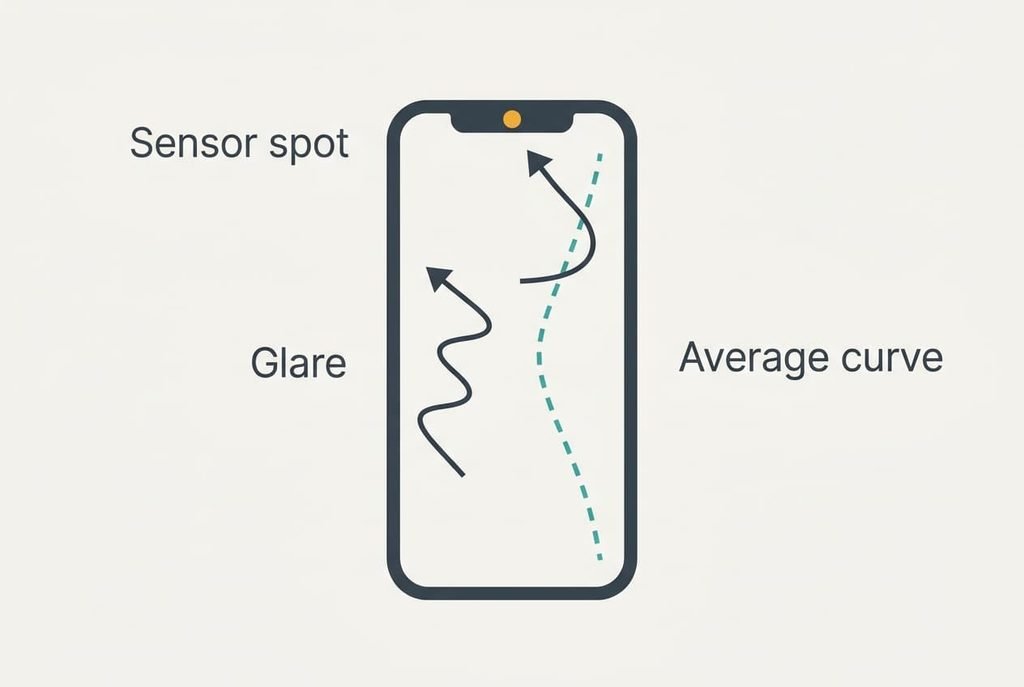
The answer leaves out a good deal. The sensor reads the light at one small spot, usually beside the front camera. It can’t tell whether you’re reading a page of text or watching a dark film. It has no view of glare across the screen glass or of the angle you hold the phone. Your eyes also adapt over several minutes, and the curve has no idea how far along that adaptation is. The target is therefore an average guess about a typical person. The gaps between that guess and your own taste are where most complaints come from.
How Bright Should Your Screen Be on a Walk to the Window
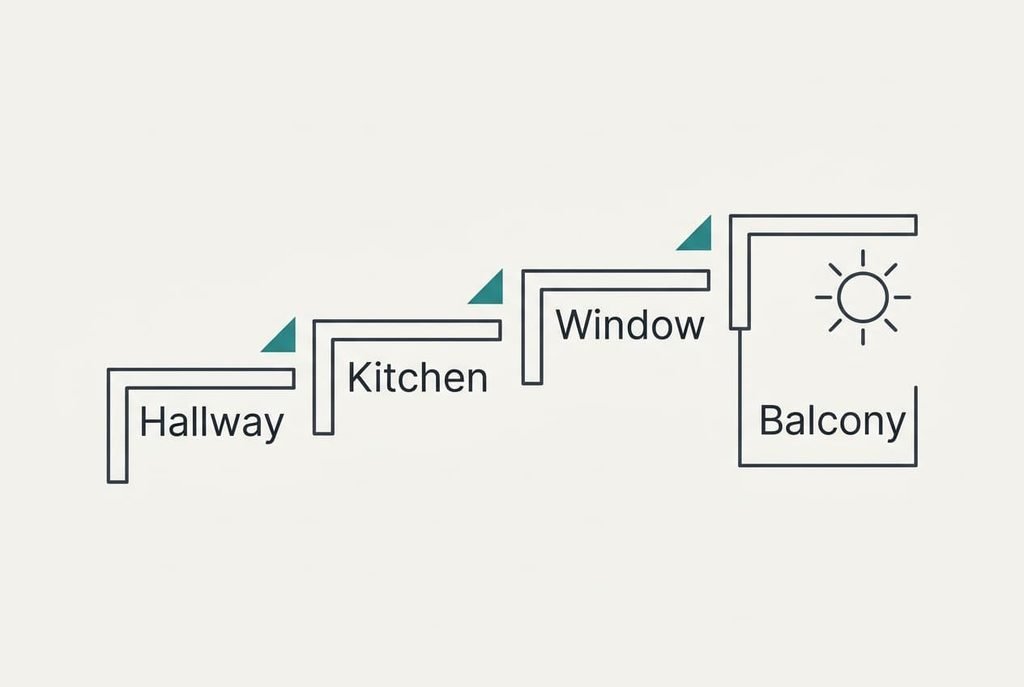
Follow Maya through a flat in Bristol. The phone starts in the hallway, where the sensor reads 80 lux and the screen sits at 20 per cent. Assume the curve adds 25 percentage points for every tenfold increase in light. Assume too that the phone samples the sensor about ten times a second.
She steps into the kitchen, and the reading rises to 400 lux, five times the hallway figure. The target is 20 + 25 × log₁₀(5), which comes to about 37 per cent. The phone waits until the new reading has held for about 1 second. Then it ramps over about 2 seconds, which lets the change arrive smoothly.
At the window the sensor reads 8,000 lux, a hundred times the hallway figure. The target is 20 + 25 × 2 = 70 per cent. Another 2-second ramp carries the screen up.
Now her hand sweeps across the sensor for 0.4 seconds and the reading drops to 5 lux. Nothing happens, because the dip lasted less than the 1-second hold. That’s the delay doing its job. A passing shadow shouldn’t change the screen.
On the balcony the reading reaches 40,000 lux, five times the window figure. The target is 20 + 25 × log₁₀(500), about 88 per cent.
Finally she slips the phone into a coat pocket for 3 seconds and the reading stays at 5 lux. This time the hold is exceeded. The formula gives 20 + 25 × log₁₀(5 ÷ 80), about −10 per cent. The phone clamps the target to its floor, assumed here at 5 per cent.
Notice the logarithm. Each tenfold step adds the same 25 points. That’s why the screen barely moves between 400 and 800 lux, a gain of only 7.5 points, yet travels a long way between 80 and 8,000. Across the walk the target climbed from 20 to 88 per cent, then fell to 5.
A Lens That Darkens, and Where the Comparison Fails
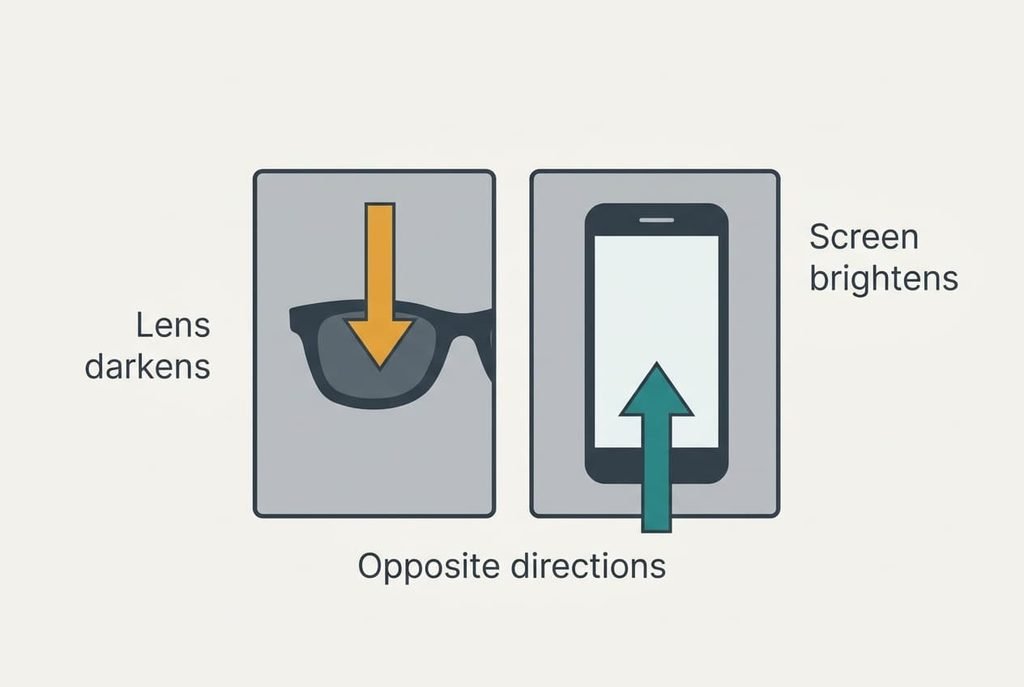
Glasses with lenses that darken outdoors make a handy comparison. Both respond to the light around you and both change gradually. Neither needs a button press. Neither of them decides to look after you; each only tries to stay legible.
In both cases you simply notice the result.
The comparison breaks on direction. Lenses darken as the light grows, to protect your eyes from glare. A screen brightens as the light grows, to stay readable against it. One goes darker in the sun and the other goes brighter. Lenses also follow a single chemical response and often take minutes to clear indoors. A screen follows a curve that software can reshape in about 3 seconds and that you can nudge by hand.
What the Sensor Cannot See
Three limits matter. The sensor reads only the light reaching its own spot. A window behind your shoulder can raise the target while a reflection washes out the glass in front of you. The curve is a single average, and your preference at 400 lux might be 50 per cent against the curve’s 37, a gap of 13 points that you’ll feel every evening. The highest level is capped as well. On this curve the target reaches 100 per cent at roughly 127,000 lux, which only the brightest sunlight approaches, and beyond that the screen stops climbing. A heavy case or a film over the sensor window can also skew the reading and shift every target.
The misunderstood limit is this: the curve is an average guess about people, and your eyes may want a different level. Many devices take your slider corrections into account over time, but a correction made at 400 lux says little about 8,000. How bright your screen should be in the sun remains something you’ll sometimes settle by hand.
Three Beliefs About Auto Brightness That Need Correcting
One belief says it drains the battery. It formed because screens visibly brighten outdoors, and bright screens use more power. Indoors the opposite often holds. How bright your screen should be in the hallway is 20 per cent by the curve. A phone left at a manual 70 per cent there would use more.
Another says the front camera measures the light. It formed because the sensor sits right beside the lens. On many phones, the sensor is a separate light meter and the camera is never involved. That’s why it keeps working when no app has the camera open.
A third says a slow change means a fault. It formed because the 1-second hold and 2-second ramp feel like lag. They’re deliberate, and without them every passing shadow would make the screen pulse.
A Decision Rule You Can Apply Today
Deciding how bright your screen should be is easier once you look at how much light your day covers. Leave it on when your light changes tenfold or more in a day, because no single manual level suits both 80 lux and 8,000. If your light stays within a factor of three, say 300 to 900 lux, one manual level gives equal results and spares you the delay.
Check yourself against Maya’s day. Hallway to window is a factor of 100, so she should leave it on. A person who works at one desk under one lamp all day can set a level and forget it.
Nudge the slider whenever the screen feels wrong, and give it a few days to adapt, because many devices fold your corrections into the curve over time. A rule built on the spread of light beats a feeling about battery. It needs only a rough guess about your own rooms, plus a glance at the screen after each change of room. Revisit the choice after a fortnight, because habits shift with the seasons.
Questions Readers Keep Asking
Why does it sometimes pick a level that feels too dim or too bright?
The curve is an average, and your preference differs from it. At 400 lux the curve gave 37 per cent while this reader wanted 50. Nudging the slider a few times in that room teaches many devices to shift the curve there, though it rarely generalises to other rooms.
Do I actually need it switched on?
If your light changes tenfold or more across a day, yes, because a single manual level can’t suit both a dim hallway and a bright window. If you sit under steady light all day, a manual level gives equal results and spares you the delay.
How does it compare with setting brightness by hand?
Manual setting is exact for one room and wrong for every other, while the curve is approximate everywhere. The curve costs you a 1-second hold and a 2-second ramp on every change. Manual costs a slider move each time the light shifts, which most people stop bothering with.