A drawer that sticks and scrapes is rarely broken. In most rented kitchens it is a wooden box that has swollen slightly in humid air and now rubs against its own runners. The cure varies with which of three versions you have, and you can identify yours in about two minutes using a ruler plus a candle. Our example is one drawer in a Utrecht flat, 45 cm wide across the front and 40 cm deep, and its millimetre values are working assumptions. Four remedies follow, cheapest first. The page also says plainly when a drawer isn’t worth the trouble.
Why a Drawer That Sticks and Scrapes Binds in Summer
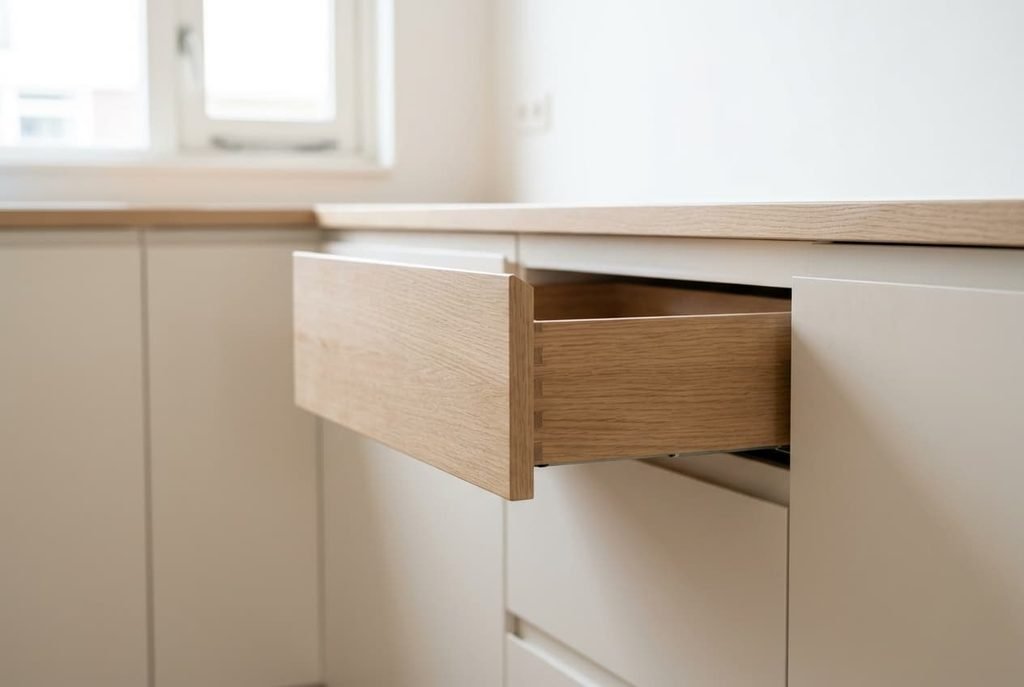
Wood swells across its grain when the air turns humid, and it shrinks again when winter heating dries it. Across the gap between a drawer and its cabinet sit four wooden parts: two drawer sides and two runners. Assume each swells by 0.8% of its thickness between a dry February and a humid August. With sides 16 mm thick and runners 20 mm thick, that is 0.008 × 72 mm, or about 0.6 mm.
Now count the room it has. A well-fitted drawer leaves about 0.5 mm of play at either side, 1 mm in all. After 0.6 mm of swelling only 0.4 mm remains. Any slight twist in the box then closes the last of the gap, and the sides scrape.
The pull gets heavier too. A drawer holding 8 kg presses on its runners with 78 N, and wood on wood has a friction factor near 0.4. The pull is therefore about 31 N. A drawer that binds adds sideways pressure on top of that, which is why a pull that was easy in spring feels like a fight in summer. The three versions below differ in where the pressure arises.
A Drawer That Sticks and Rubs: Finding Your Pattern
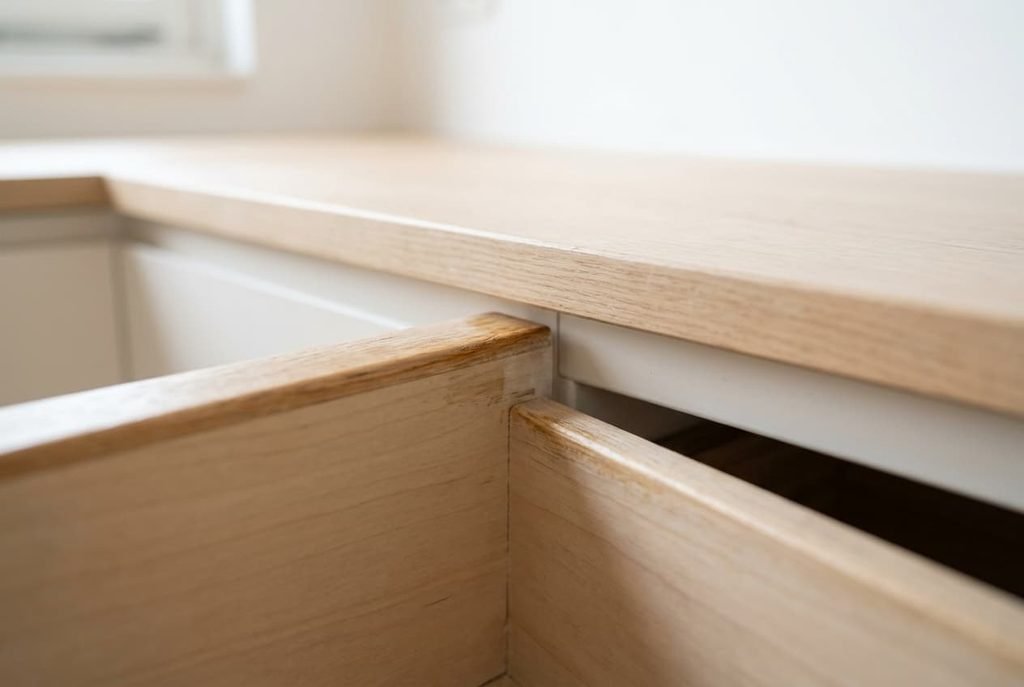
Version one sticks along the whole travel. The sides touch their runners from the first centimetre to the last, which points to swelling. Version two catches at the same spot every time. That points to a loose screw head or a bent runner, or sometimes a stray object. Version three scrapes only at the top edge and sags when pulled out, which points to worn runners.
Run the check in this order. Pull the drawer out 10 cm at a time and note where it first binds. Slide a playing card down each side at the front. If it jams on one side only, the box is shifting sideways. Then measure the two diagonals of the empty box from corner to corner. On Sanne’s drawer both should be 60.2 cm, because the square root of 45² plus 40² is 60.2. Hers read 60.4 cm and 60.1 cm. A 3 mm difference means the top edge has slid about 2 mm sideways against the bottom.
A racked box needs 2 mm of extra room across the opening, and the fitted gap is only 1 mm.
Four Remedies, Ranked by Cost
Take the remedies top to bottom and finish once one frees a drawer that sticks and scrapes, because each targets a different cause.
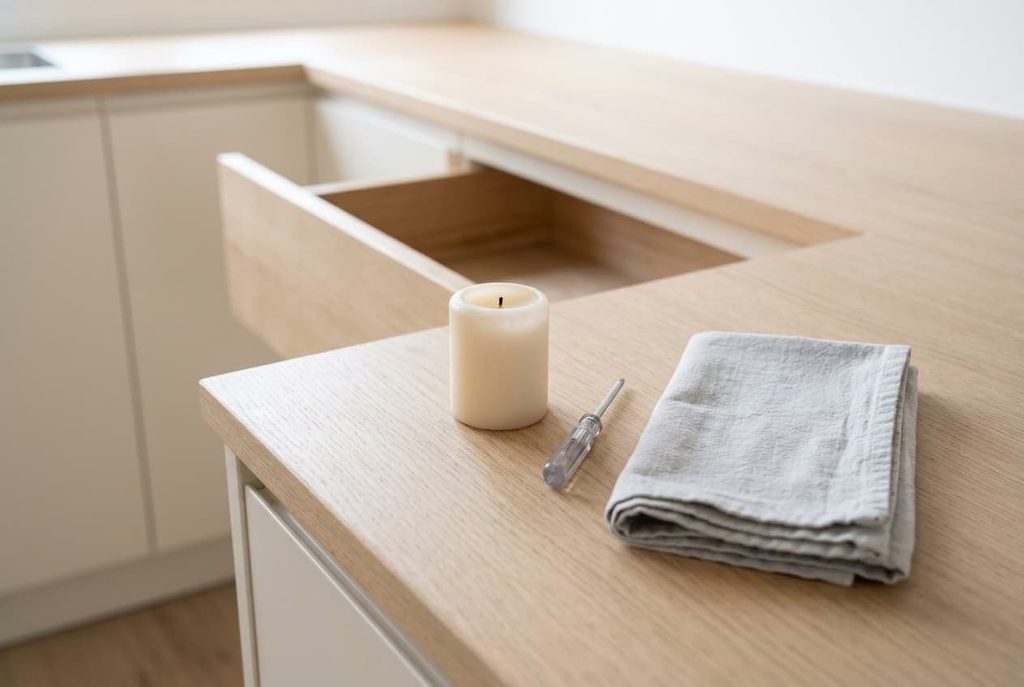
Wax the runners. Rub a plain candle along the runners and the lower edges of both sides. Wax cuts the friction factor from about 0.4 to about 0.2, which halves the pull from 31 N to roughly 16 N. Nothing is bought and the whole job is three minutes long, which makes version one the natural place to begin. Do it in late spring, and again in summer if the drag returns. The limit is that wax makes no room. A drawer with 0.4 mm of clearance still binds at its tightest points, and you’ll feel those as a dragging patch.
Re-seat the runners. Loosen the runner screws, move each runner about 0.5 mm outwards, check the gap with a playing card as a feeler gauge and retighten them. The pair gains 1 mm of play, 2.5 times the 0.4 mm that swelling left. Versions one and two respond best, and a screwdriver is the only tool. The limit is the screw holes. Where they are stripped the runner drifts back, and you’ll need a longer screw or a wooden matchstick glued into the hole. Test the result by pulling the drawer out 10 cm at a time again. A spot that still drags means the runner is bent rather than misplaced.
Fit a new slide set. Metal slides replace wood rubbing on wood with rolling contact, and metal doesn’t swell with the air. Version three is the case for them, since worn runners can’t be mended. Check the side gap the slides need before buying, since an old wooden drawer may be too tight for it. Fitting is an hour’s work with a drill, plus a pencil for marking. The limit is the frame around the drawer. Slides can’t straighten a twisted carcass, and a racked box binds on them as well.
Have a carpenter re-square the box. A short visit can pull the corners back until both diagonals read 60.2 cm, which cures a drawer that rubs on one side only. It pays off for solid wood with sound joints, and you should ask for the diagonals to be checked again once the glue has cured. A cheap chipboard box is better replaced than rebuilt, since glue rarely holds a second time.
What the Kitchen Won’t Let You Change
In a rented kitchen the carcass belongs to the landlord, and a drawer that sticks and scrapes lives inside a frame you can’t alter. Neither the cabinet nor the floor is yours to move, and the building’s humidity isn’t yours to change either.
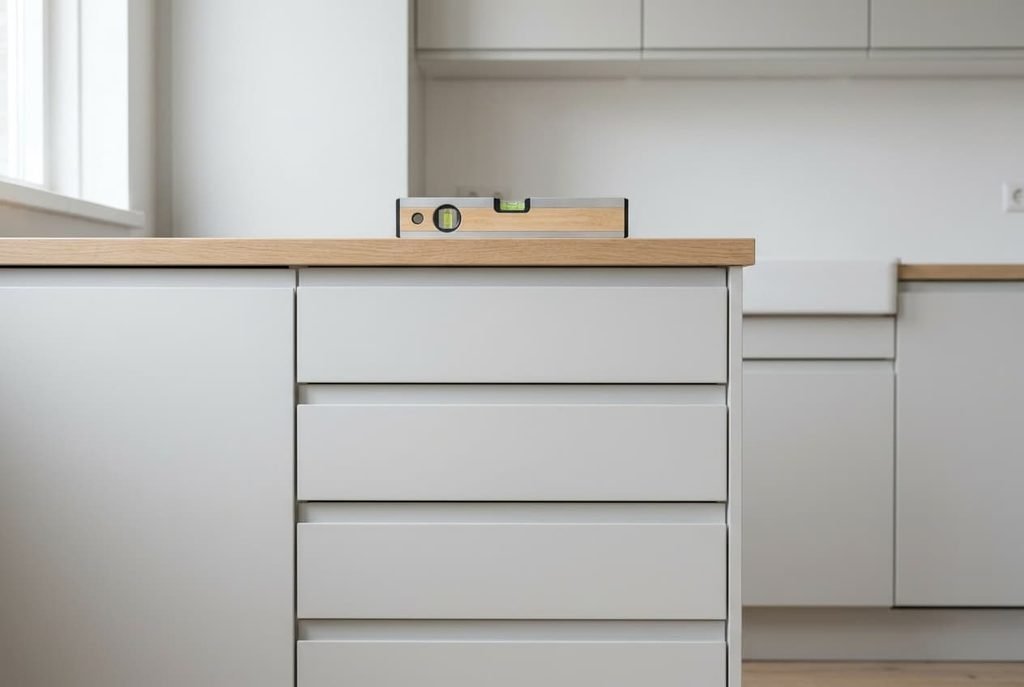
Start with the level. A base unit that leans loads one runner more than the other, and many units have adjustable feet. Lay a level across the drawer opening and read it. A lean of 2 mm over the unit’s 60 cm width tilts the opening by about 0.2 degrees. That is hard to see, yet it moves the load onto a single runner.
Humidity is the other fixed part of the room. A kitchen that stays humid brings version one back every summer. Plan a yearly wax in May, before the air turns humid. It’s a three-minute habit that saves a month of tugging.
The Fix That Backfires in Winter
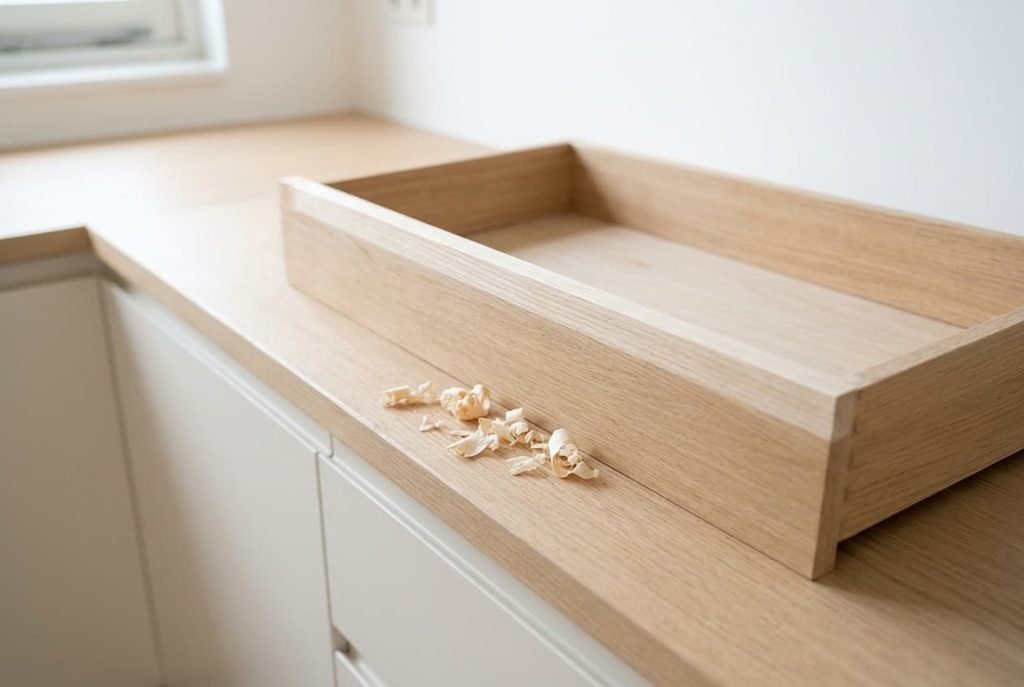
A drawer that sticks and scrapes tempts you to take a plane to it, and shaving the sides in the middle of summer is the fix that backfires. It works the same day, because a sanded drawer glides in August. Then winter arrives and the wood shrinks back by the 0.6 mm it gained. Shave a full 1 mm from each side to be safe and the 1 mm fitted gap becomes 3 mm in a dry February. Wood moves most across the grain, so the planed sides are exactly the surfaces that shrink. Planing also removes the finish there, which leaves bare wood to take up even more moisture next summer.
At 3 mm of play the box can twist freely in its opening, and a racked box catches on its own corners. A drawer that was merely tight in August turns clumsy in February.
The shaving trap is common because the reward is instant and the penalty arrives months later, looking unrelated. Sanne’s drawer would have been loose by November, and the carpenter would have been called for a rack that planing made worse. If your drawer needs wood removed, take no more than 0.3 mm from each side, half the summer swelling, then wax the cut edges. Everything else is a runner fault.
Questions Readers Keep Asking
Can this kind of sticking be fixed at all?
Almost always. Every version has a cure you can do at home, and each remedy above targets one cause. The one exception is a badly racked cheap box, where a replacement drawer costs less than a carpenter’s visit. Check the two diagonals before you decide, and wax first.
What does it cost to fix?
Waxing and re-seating cost nothing beyond a candle and a screwdriver. New slides cost more, and a carpenter’s visit costs most of all. Begin with the free remedies and finish once the drawer glides on a pull of about 16 N, which feels like a light tug on the handle.
What is the most common specific cause?
Seasonal swelling combined with a slight rack. The wooden parts across the gap swell by about 0.6 mm in humid air, which uses up most of a 1 mm fitted gap, and any twist closes the rest. Measure the diagonals first and wax the runners next. Pick up a screwdriver only if the drag remains.