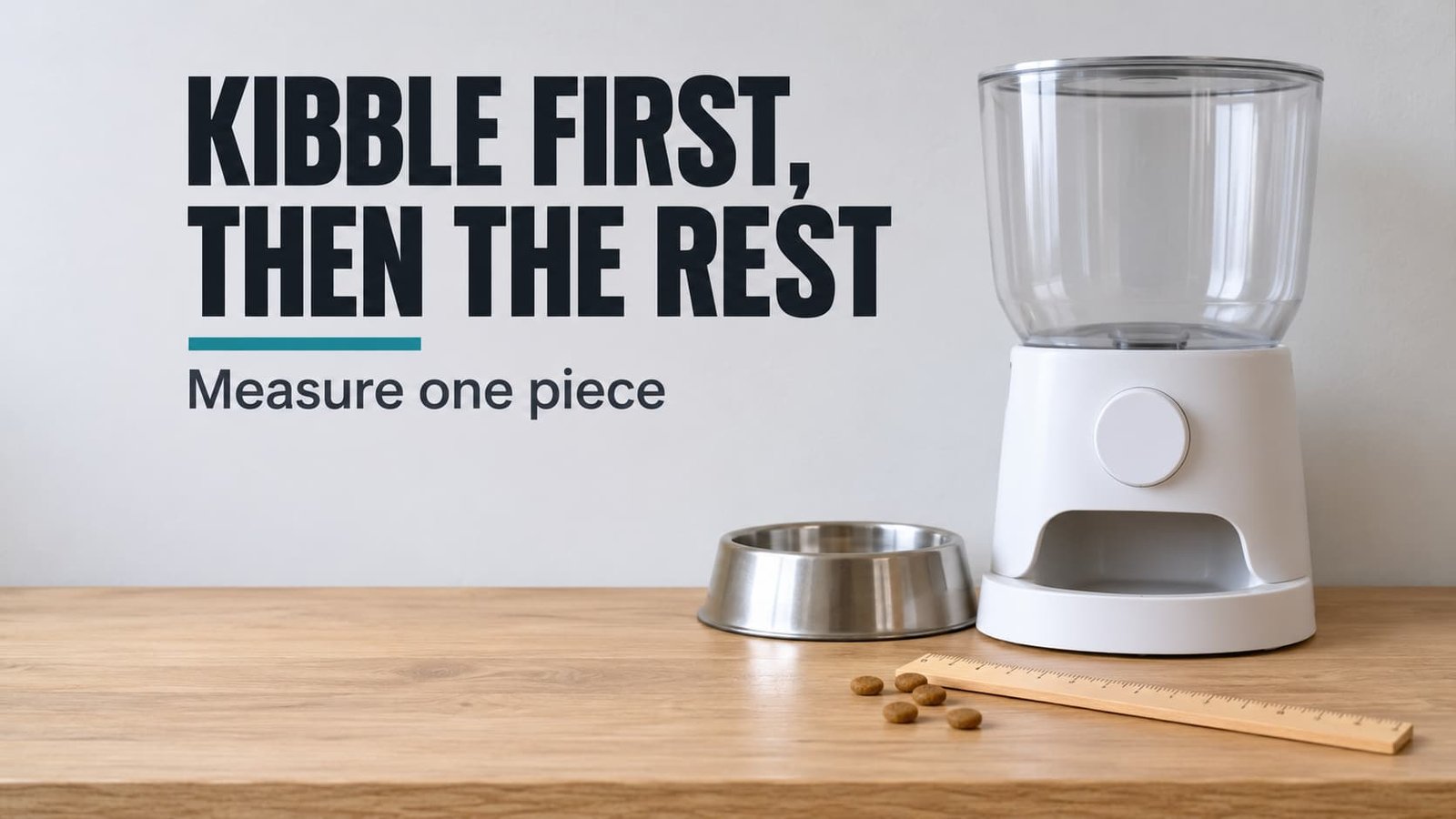
Whether the portion mechanism can pass the exact kibble your cat eats decides this purchase more than any other detail. A wheel turns inside a narrow gap, and one piece wedged there stops every later meal. Hannah, a bookkeeper in Leeds, leaves on Friday at 7:30 and returns on Sunday at 18:00, having fed her cat by hand at breakfast. When buying an automatic pet feeder for that stretch, you need four ordered checks, then the claims that sound grander than they are. The numbers here are samples I invented. No maker or amount of money is named.
What Matters Most When Buying an Automatic Pet Feeder
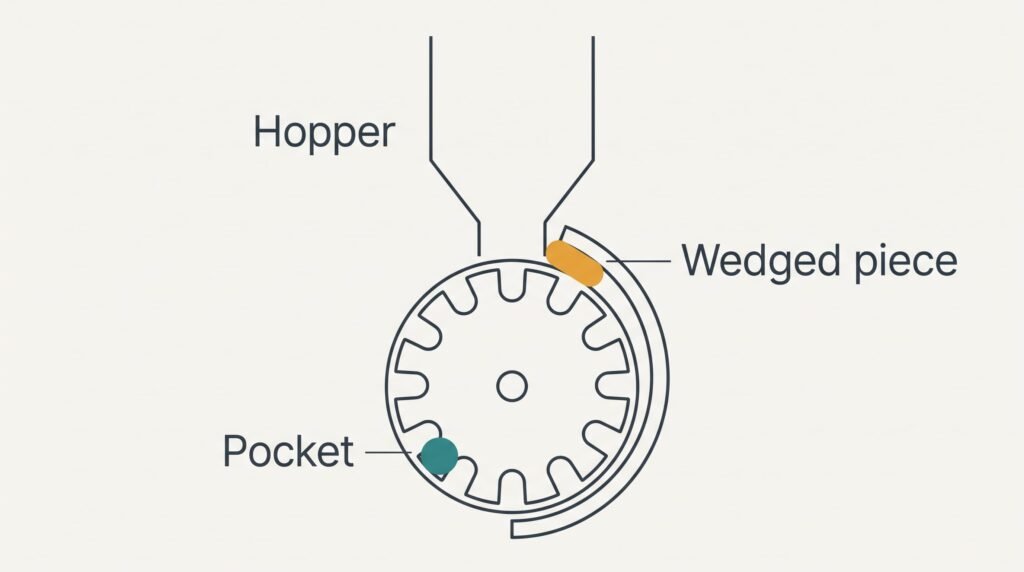
A feeder releases food by turning a wheel or a screw that carries a fixed amount round to the outlet. That carrier has pockets, and every piece of kibble must sit inside one without being pinched against the wall as it turns. Hannah laid a ruler beside her cat’s food and found the widest piece is 11 mm across. Bags differ a little from batch to batch. She therefore measured three pieces from the upper layer of the bag rather than the best-looking one.
A pocket 14 mm wide leaves 3 mm of room, which is 27% to spare. One 12 mm wide leaves 1 mm, about 9%, and a single piece lying crosswise can wedge there. She feeds 20 g three times a day. Seven of those meals fall while she’s away, and they come to 140 g. A wedge at the first one strands every gram. The cat would then go about 59 hours after her last hand-fed breakfast. Nothing outranks the widest piece of kibble set against the width of the pocket when buying an automatic pet feeder.
Take that measurement before you read any listing.
Four Checks in Priority Order, Starting With the Jam Risk
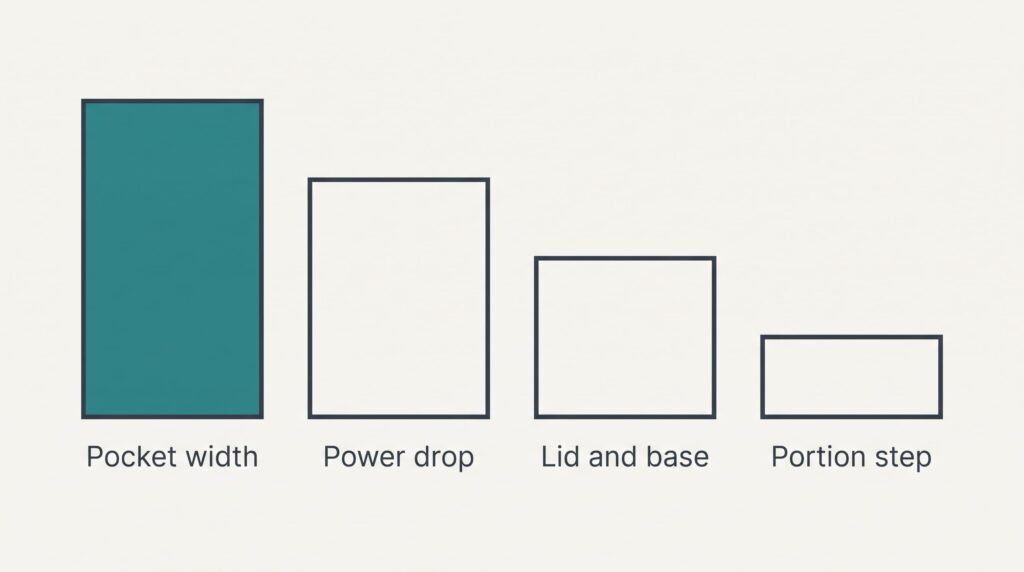
Hannah sorted the checks by how badly each one can fail, and she kept her notes while buying an automatic pet feeder. Each entry says what the check sets and how it shows daily. It also gives the test and what failure looks like.
1. Pocket width against your kibble sits first. It decides whether any meal is delivered, and on an ordinary day nobody notices it, because a feeder that works looks identical to one that’s about to stop. Measure your widest piece, then look for a food size range in the listing and a pocket width that leaves a margin near Hannah’s 27%. A miss means one wedged piece, 140 g left in the hopper and a cat waiting by the bowl.
2. Behaviour when the power drops comes next, and it’s the check almost nobody makes. It decides whether the schedule survives a tripped socket or a plug nudged loose by the vacuum cleaner. Day to day nothing changes, until the one afternoon it matters. Look for a sentence saying how the clock and meal times are held without mains, then pull the plug for one minute during your first week and see whether they’re still there. A miss means a blank clock and seven meals that never move.
3. The lid and base come third. They decide whether a determined cat can open the hopper or tip it. A cat nudges the lid at every meal, which tests any weakness about three times a day. Read how the lid locks, and lift the empty unit to feel whether a head-butt could slide it along the shelf. A miss means a spilled hopper: loaded with 200 g, it hands the cat ten meals at once, and the Sunday meals are already gone.
4. The portion step is fourth. It decides how close each meal lands to the 20 g she wants. Divide the meal by the listed step: a 10 g step gives exactly 20 g, whereas a 12 g step can only offer 12 g or 24 g. Seven meals at 24 g come to 168 g, which is 28 g over. A miss here is mild, a feeder that quietly overfeeds by a fifth at every meal.
Which Specs Look Bigger on an Automatic Pet Feeder Than They Are
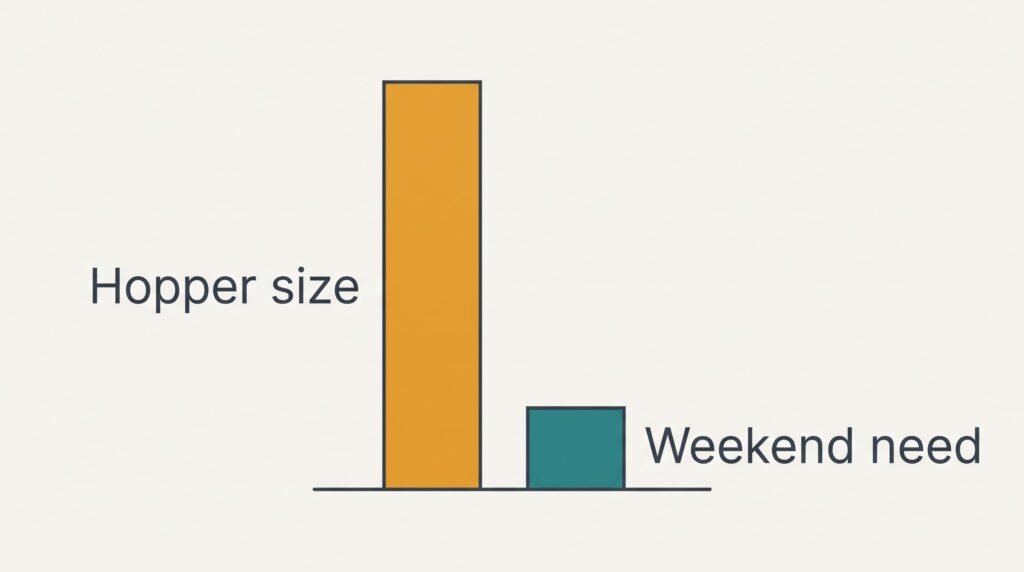
Some features win attention they haven’t earned. A hopper that holds many kilograms heads the list, because capacity is the largest figure a maker can print on the front. Hannah’s longest trip needs 200 g with three spare meals, and a listed 600 g is three times that. The extra food does nothing for a weekend, and it waits in an open hopper, going stale between refills.
App control is promoted as peace of mind. For two nights it adds little, since the schedule that counts is the one stored inside the feeder itself. Ask whether meal times live in the unit or rely on your home connection staying up while you’re out, because a router that restarts at 3:00 on Saturday shouldn’t decide whether the cat eats.
A recorded voice that calls the cat is the last extra. It changes nothing about whether food leaves the pocket.
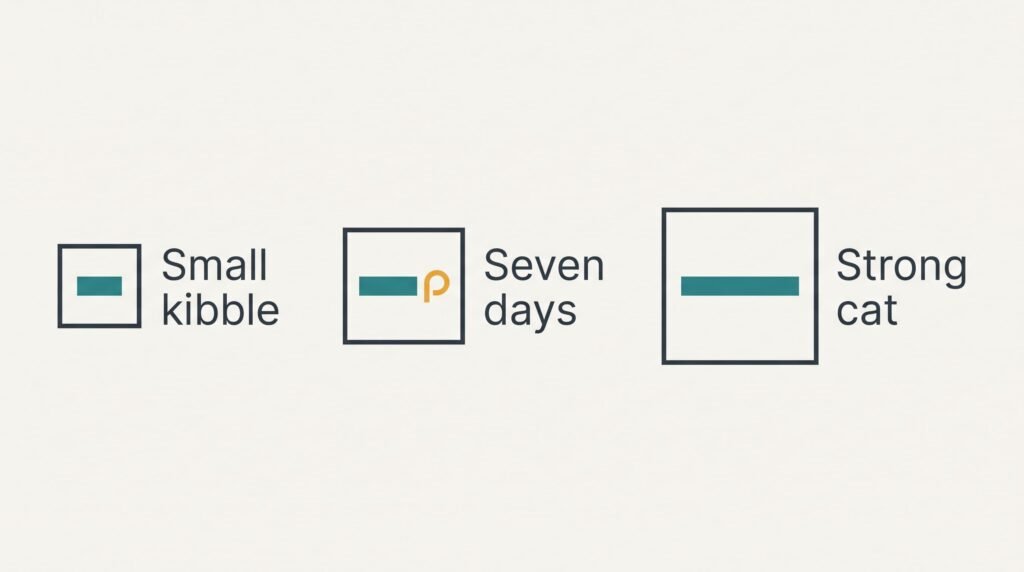
How the Checks Move for Three Different Readers
A cat that eats small 7 mm pieces relaxes the first check, since the same 14 mm pocket now leaves 7 mm of room, as much as the piece itself. Power behaviour and the portion step then come first.
A reader who is away for seven days needs 420 g at 60 g a day, or 480 g with three spare meals. Against a 600 g hopper that’s 80%. Capacity finally counts. The power check also carries more weight over such a long stretch, because one outage on day two has five days to do its damage.
A household with a strong, curious cat moves the lid and base to the top. A single tipped hopper turns the entire trip into one evening of eating, followed by two empty days.
When to Leave a Feeder on the Shelf
If the listing gives no range for food size, leave it. The maker hasn’t said what the pockets were designed for, and Hannah’s 11 mm piece would be a gamble. Run a full day of meals at home with the real kibble before you travel. Any jam then appears while you are still at home.
A unit that says nothing about what happens when the power fails also stays behind. You can’t judge a restart that nobody has described, and a silent listing leaves you no promise to rely on. Walk away from a lid that opens with one press.
A cat that learns the trick will open it by Saturday morning.
A pocket within 1 mm of your widest piece is a poor candidate as well, however good the rest looks. Kibble from the next bag may come out a little larger.
A Two-Minute Check Before You Order
Start with the food in your cupboard, because buying an automatic pet feeder is a matching job rather than a ranking job. Measure the widest piece of kibble with a ruler and note the figure. Read the pocket width or food size range next to it, then subtract one from the other to see the margin. Anything near Hannah’s 27% gives room for a larger piece in the next bag, whereas under 10% leaves very little. Find the sentence describing a power cut. Divide your cat’s meal by the portion step. Last, note how the lid locks and how heavy the empty base feels.
Six answers fit on six short lines. The first removes any unit with too little room for your kibble, and the power line takes out most of what remains. Keep the page open while you browse, because the figures blur once several tabs are open, and a wrong guess about a jam only shows itself on Saturday morning.
Questions Readers Keep Asking
What portion step should I look for?
Pick a step that divides your cat’s meal evenly, or comes within two grams of it. A 20 g meal works with 10 g or 5 g steps. A 12 g step can only give 12 g or 24 g. Every meal then comes out either short or over by a fifth.
How much should I spend compared with a visit from a sitter?
Think in relative terms. A feeder that jams leaves the cat unfed, which a sitter would have prevented. The sum worth paying is whatever buys a stated food size range and a described power-loss behaviour. Extras such as lights or recordings can wait until those two lines are answered.
Will it keep working for years, and what do owners regret?
The motor and wheel usually outlast the plastic around them. Crumbs and food oil do build up inside the pocket over time and narrow it. Owners most often regret a pocket only 1 mm wider than the kibble, or a lid that opens with one press. Both show themselves within the first week.