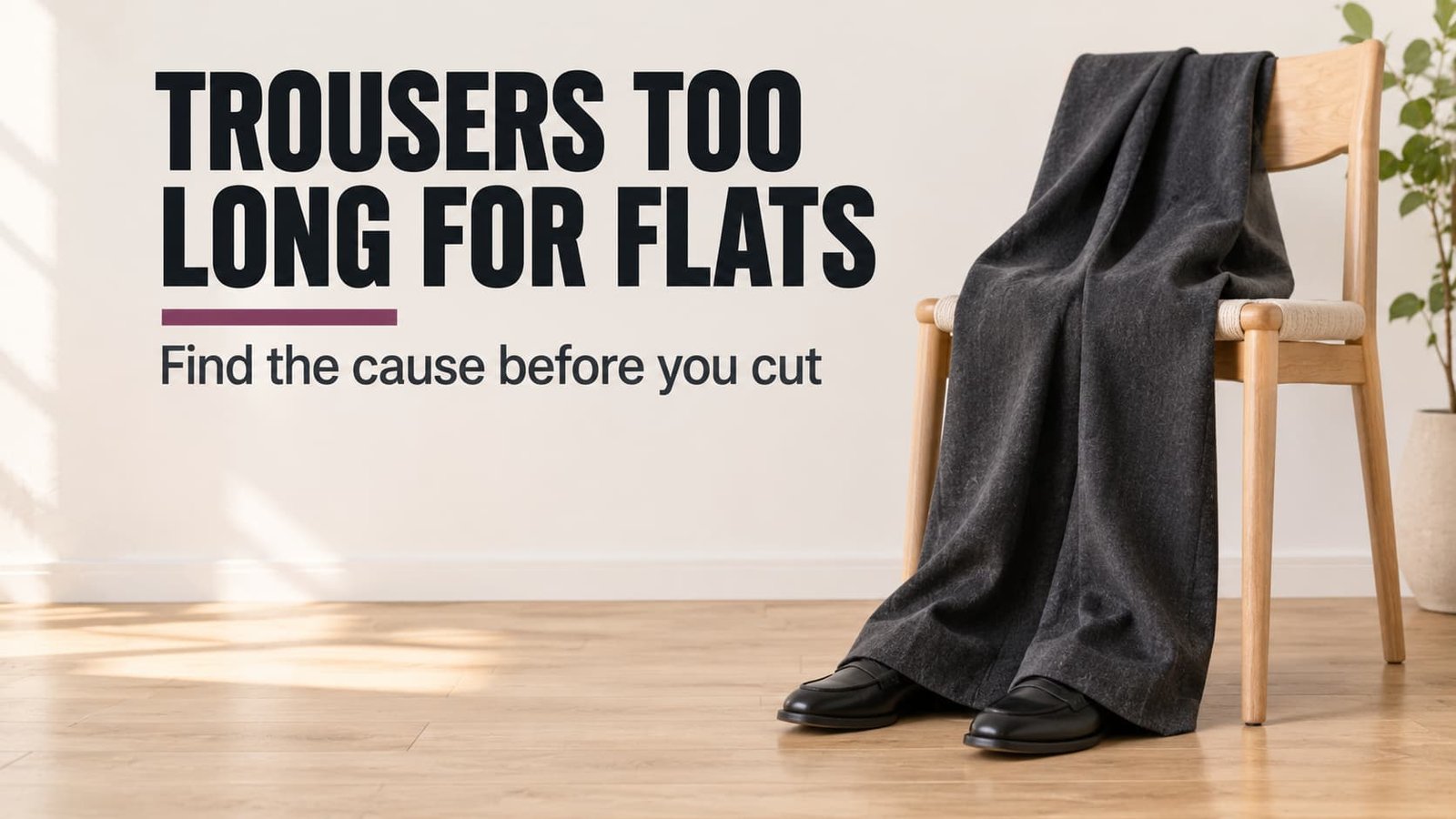
The fitting-room mirror is the worst place to judge trouser length. You tried them on in the heeled boots you wore into town and the hem looked right, then at home, in your flats, the back scraped the pavement. If you’ve ended up with trousers too long for flat shoes, there are four possible causes, and only one needs scissors.
So don’t book a tailor yet. A one-minute test in your flats tells you which cause you’ve got. The fixes below then run from free to fully altered, in that order.
Why the Hem Drops When You Change Shoes
A trouser hem doesn’t hang at a fixed height. It falls from your leg until the floor or your shoe stops it. So if you stand lower, or the waistband slips, the hem drops by the same amount.
Shoes are the obvious lever. A heel lifts the back of your foot, and the back of the hem rises by close to the heel’s own height. Swap a 5 cm block heel for a flat loafer and that hem sinks by roughly 5 cm, straight onto the ground. Standard lengths are often cut generously, which makes sense: a hem is easy to take up, while the allowance folded inside is usually only a few centimetres deep. That’s how you end up with trousers too long for flat shoes but right for boots.
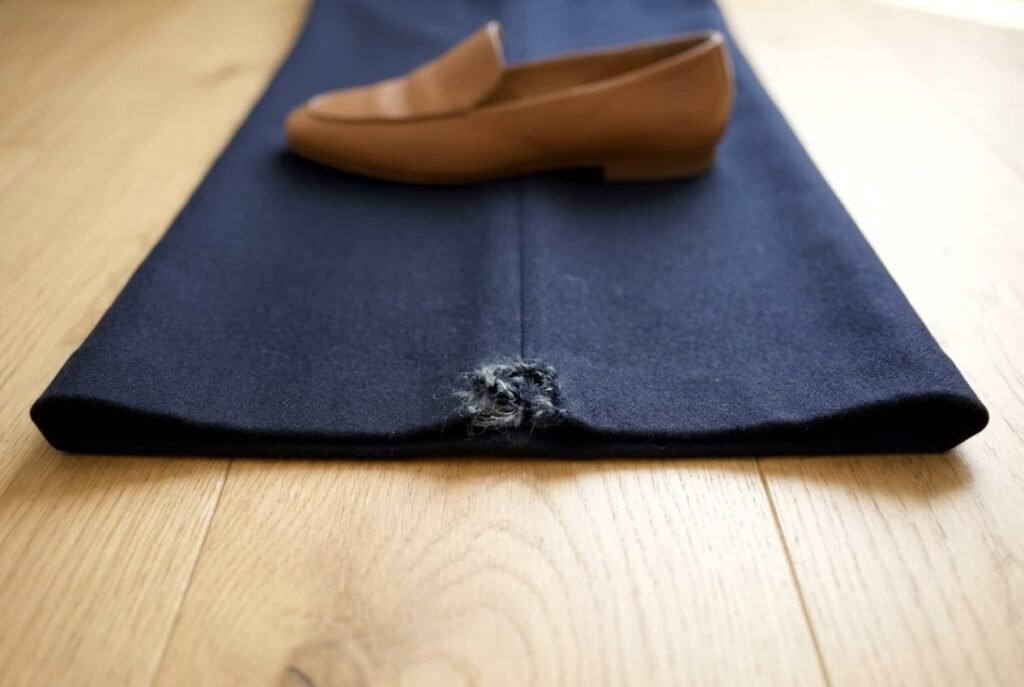
Where the spare fabric goes comes down to the leg. A straight or slim leg has no room to spread, so the extra length stacks into a horizontal fold above the shoe. Tailors call that fold a break. A wide leg has room to fall, so the surplus slides under your heel instead. You’ll see the damage there first: a greyish, fuzzy patch at the centre back of the hem, where it’s been trodden on.
That frayed patch is the clearest sign the length doesn’t suit the shoes you wear most.
The One-Minute Test: How Much Is Too Much?
Put on the trousers with the flats you’ll wear them with most. Fasten the waistband where its seams say it should sit, with the belt loops level. Then stand on a hard floor side-on to a mirror, or prop your phone at ankle height and take a photo.
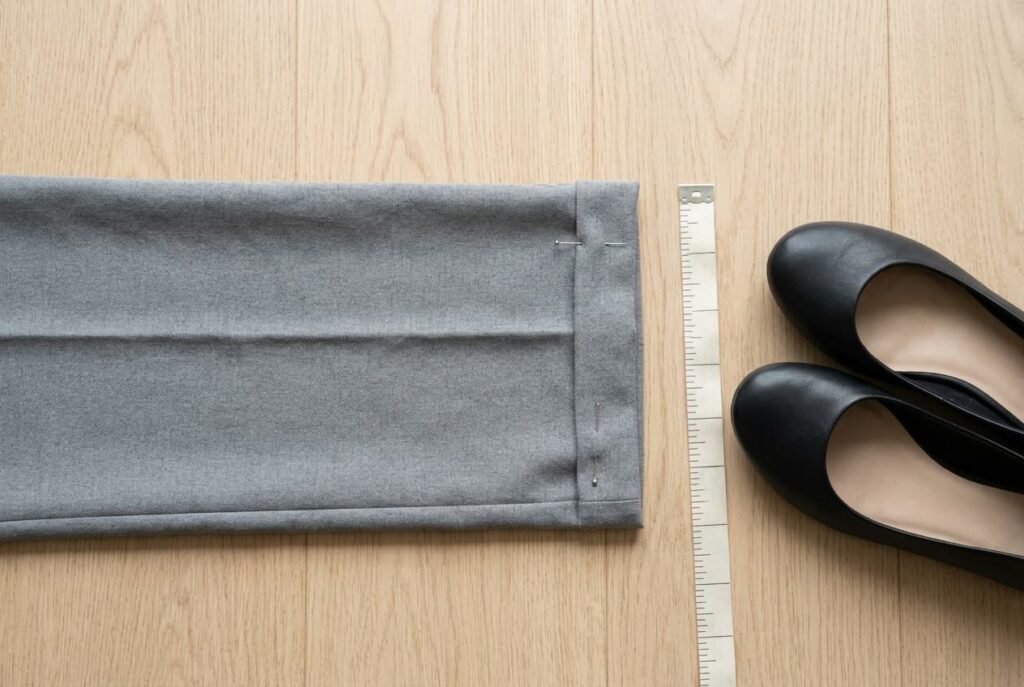
Pinch the hem at the centre back and fold it up inside until it clears the floor by about 1 cm. Measure the fold. That number is your surplus, and it sorts the problem quickly:
- Under 2 cm: leave a wide leg alone, and accept a soft single break on a straight leg.
- 2 to 6 cm: genuine surplus, fixable with any of the methods below.
- Over 6 cm on a tapered or flared leg: read the section on when to stop first.
- Gone once the waistband sits at its proper height: the cause is the waist, and the length can stay.
These bands are a working rule built from how cloth folds, so treat the edges loosely. Most trousers too long for flat shoes land in the middle band. Take an example that runs through the rest of this guide. The label gives an inside leg of 81 cm and your fold measures 5 cm, so for your flats the trousers want to be about 76 cm.
If you only remember one check, make it this one. Stand in your flats and look at the back of the hem. If it touches the ground, it needs to come up; if there’s about a centimetre of air beneath it, leave it alone.
Trousers Too Long for Flat Shoes: Four Causes and Their Fixes
Start at the top. Each fix takes more effort than the one before it, so stop as soon as the hem clears the floor.
The waistband slides down during the day
Every centimetre the waistband drops lands straight on the hem. Say your trousers measure right at 9 am and drag by lunchtime. In that case the waist is cut a little loose for you, and gravity does the rest. A belt solves it for nothing. For a permanent fix, a tailor can take in the centre-back seam on many smart trousers, since that seam usually carries spare allowance. Jeans with a shaped yoke are fiddlier, so expect a bigger alteration there.
They’re right with boots and wrong with flats
Here a heel set the length. It may be the brand’s assumption, or the boots you happened to wear in the shop. Pick the shoe the trousers belong to, and hem for that one. My view, which some readers won’t like, is simple. If you wear flats four days out of five, hem every pair to your flats and let them sit a little high with heels. On a straight or slim leg, the higher hem simply reads as ankle length. A very wide leg can look short, so keep one longer pair for heels if you wear them often.
Soft fabric that lengthens as you wear it
Viscose and some jersey blends stretch lengthways under their own weight. They can drop a little further across a day of wear, or after a week on a clip hanger. Store them folded over a hanger bar rather than clipped by the waistband. Before hemming, let them hang for a day. Then leave roughly an extra centimetre of clearance, as a working rule, so the length still clears the floor once the fabric has relaxed.
Real surplus on a straight or slim leg
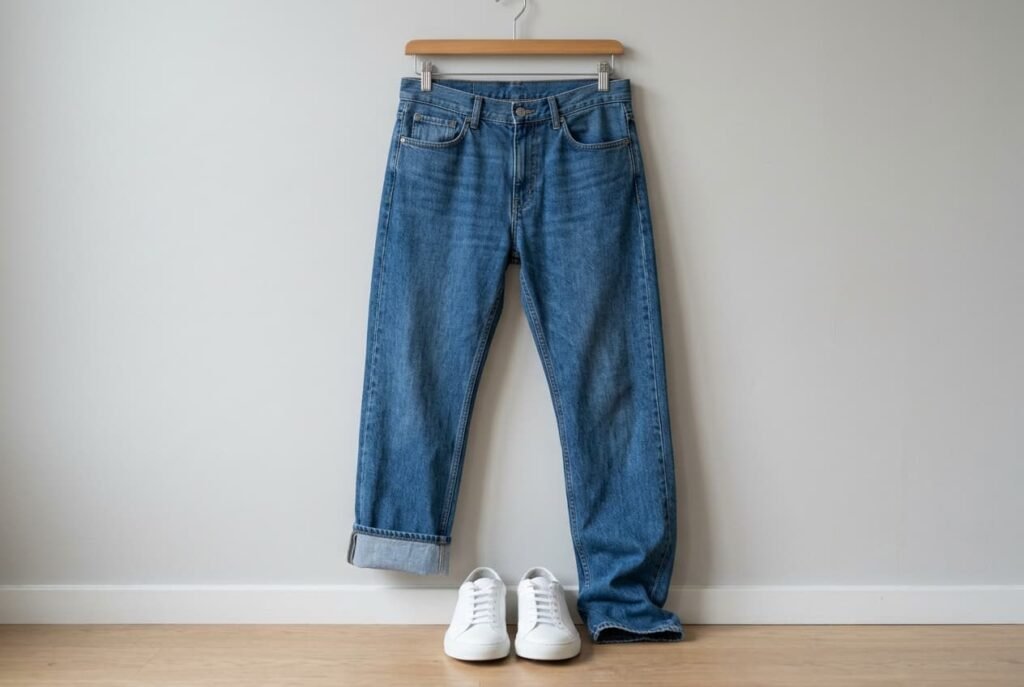
This is the one that needs folding or cutting, and you choose how permanent to go. For up to about 4 cm, turn the hem inside and fix it with iron-on hemming tape. It’s quick and reversible, though it can lift after repeated washes and may leave a faint ridge on fine fabric. Jeans and chinos take a single turn-up of about 4 cm well, because thick cloth holds a crisp edge. For anything you’ll wear weekly, pay for a proper hem. With jeans, ask for an original hem. The tailor removes length above the factory hem and sews it back on, so the faded edge survives. In our example, that’s 5 cm off, taking 81 cm down to 76 cm.
When Shortening Trousers Too Long for Your Flat Shoes Isn’t Worth It
Rolling up a wide leg is the fix to skip. The leg has too much width to fold neatly, so the roll flares outwards and sits at a different height on each side. It also creeps down as you walk, and by mid-morning it’s dragging again. Hem a wide leg or leave it, because a roll only buys you an hour.
Big changes on shaped legs are the second trap. A tapered leg narrows towards the ankle, so cutting off 6 cm or more moves the hem up into a wider part of the leg, and the opening grows. Keeping the original line means re-tapering the inside seam, a far bigger job than a hem. A flare works the other way round. Its widest point sits at the bottom, so a deep cut removes exactly the width that made it a flare. With trousers too long for flat shoes by that much, compare the tailor’s quote with what you paid.
If the alteration costs more than the trousers did, let them go and buy a shorter leg length.
Questions People Ask About Trouser Length
How far should trousers sit above the floor with flats?
Aim for the back of a straight or wide leg to clear the floor by about 1 cm. The front should rest lightly on the shoe. Slim and tapered legs usually look cleaner a little higher, at or just below the ankle bone, so they don’t fold. Treat this as a working rule and check it side-on in a mirror.
Can one hem work with both heels and flats?
Only within a small range. Hem for a low heel of about 2 cm and the trousers will brush the floor in flats. In a 5 cm heel they’ll sit slightly high, which suits straight legs better than wide ones. If you wear both often, two pairs at two lengths work better than one compromise.
Is iron-on hemming tape strong enough for work trousers?
It holds for a few weeks of wear and gentle washing. That makes it useful while you settle on a final length. On wool suiting it can leave a visible ridge, and it may let go after dry cleaning or hot pressing. For trousers you’ll keep for years, use tape to test the length, then have them hemmed properly.