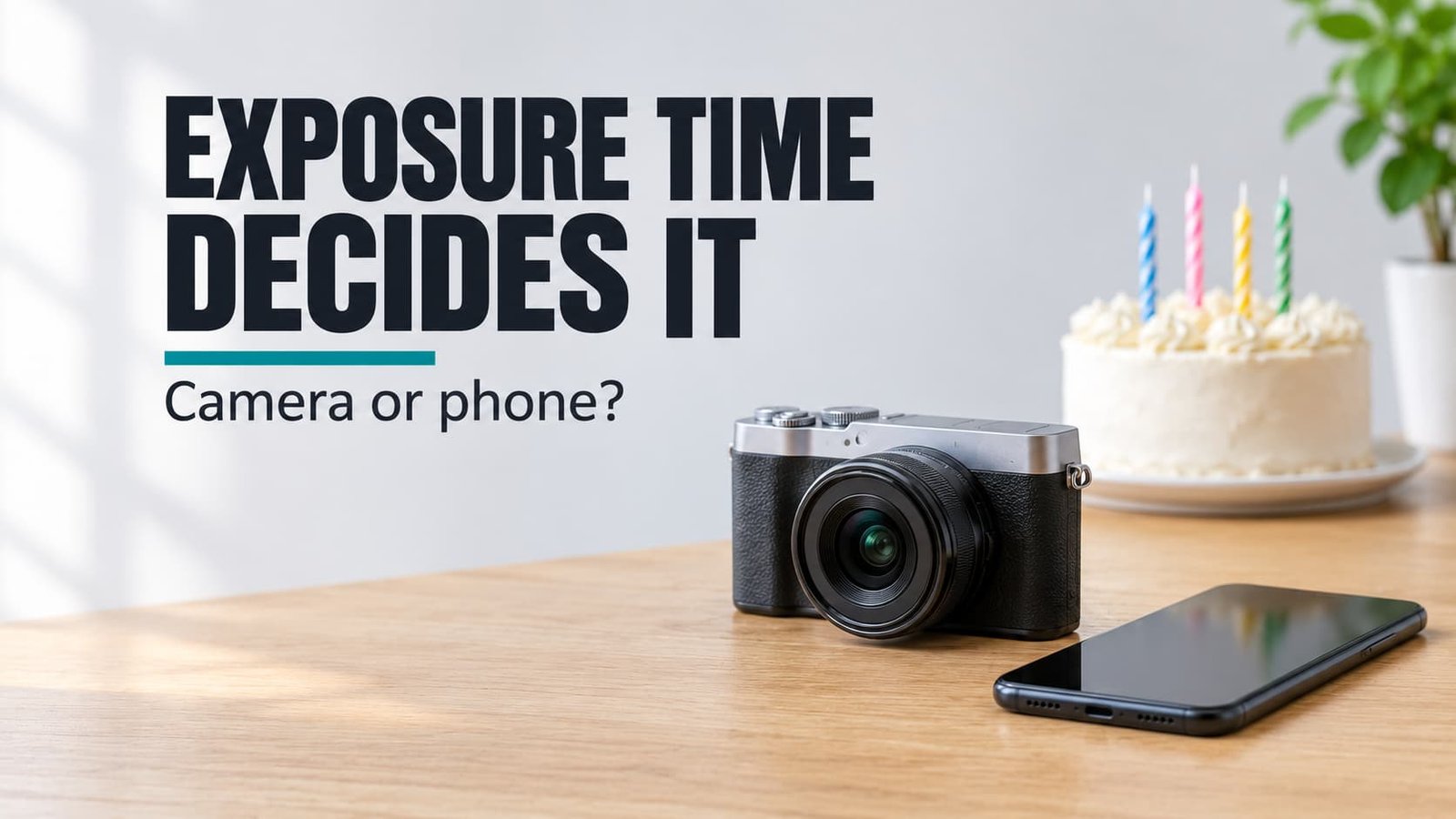
Why do party photos turn running children into smears? Dim light and a quick child do it. A phone is the right camera for a party while the light is bright, and a compact camera takes over once the room darkens and the children run. It comes down to how short an exposure your room’s light allows. The figures below assume a UK living room at 120 lux, a child running at 1.5 m/s and made-up sensor sizes that you’ll want to check against your own gear. Choosing a compact camera or a phone takes one test shot and about five minutes.
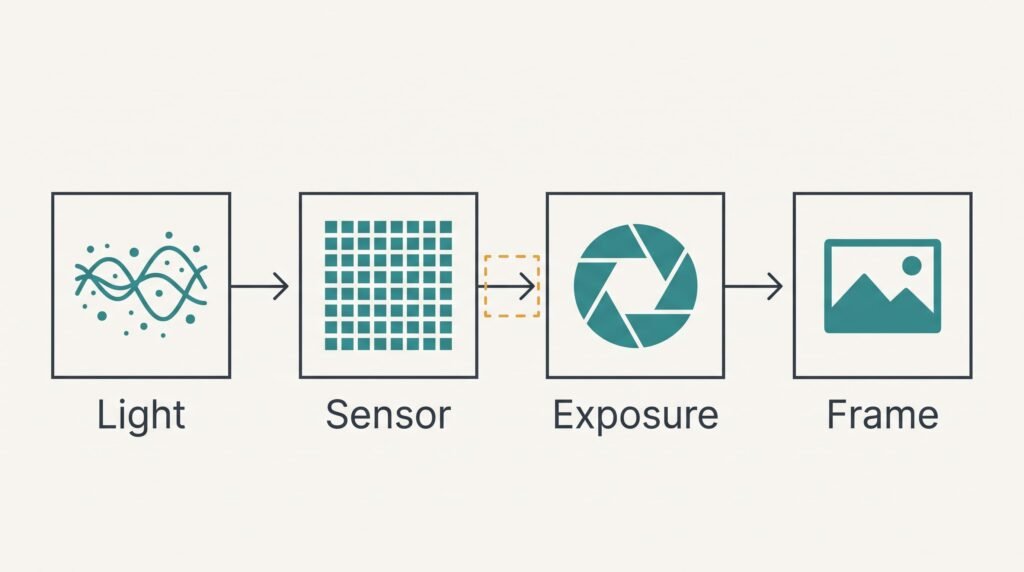
Why the Exposure Time Decides Between a Compact Camera and a Phone
Ignore the specification sheet, because the exposure time that the room’s light allows decides it. A camera collects light while the shutter stays open, and a child who moves during that time turns into a smear.
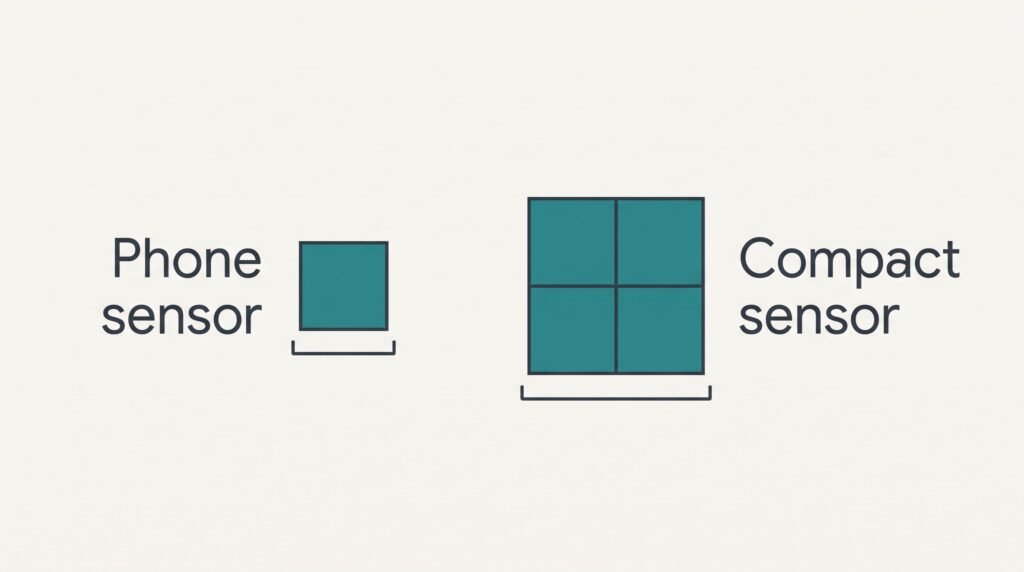
The light in one frame is the brightness of the scene, multiplied by the area of the sensor, multiplied by the time the shutter stays open. Give the phone a sensor area of 1 unit and the compact camera 4 units, with a similar lens opening on both. At the same brightness, the compact camera needs a quarter of the time.
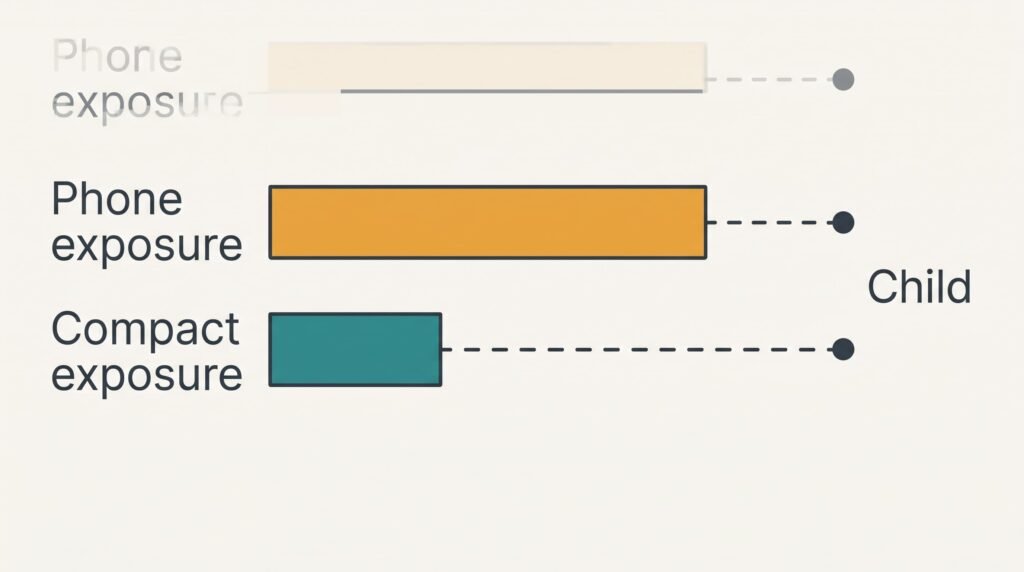
Now put numbers on it. Assume the phone needs 1/60 s at 120 lux for a clean picture. A child at 1.5 m/s moves 1.5 ÷ 60 = 2.5 cm during that exposure. If a frame 3 m wide spans 4,000 pixels, each pixel covers 0.75 mm. The smear is about 33 pixels long. For the compact camera, 1/240 s is enough, and the child then moves only 0.6 cm, about 8 pixels.
Phones fight dim light by combining several frames into one. That works for a table of seated children, but a moving child appears in each frame at a different spot and comes out ghosted.
Light is the only input you can change on the day, since doubling it halves the exposure time.
A Compact Camera or a Phone Side by Side
The rows below come from the same assumed room and the same assumed sensor areas. Nothing here relies on a make or a model, which means each row holds for any pair you compare. Two rows deserve a closer look: the exposure time, because it drives the smear, and the group row, because it shows where a larger sensor gains nothing. Treat the three numeric rows as one worked sample and not as a measurement of any particular device, because your own gear will differ and a test shot settles it.
| Point | Phone | Compact camera |
|---|---|---|
| Light gathered per frame | 1 unit | 4 units |
| Exposure time at 120 lux | 1/60 s | 1/240 s |
| Smear on a child at 1.5 m/s | 2.5 cm, about 33 pixels | 0.6 cm, about 8 pixels |
| Seated group at a table | Sharp, with frames combined | Sharp |
| Sending a photo | One tap | After a cable or card step |
| Always with you | Yes | One more object |
The seated group row surprises people. With nothing moving, the phone’s combined frames produce a bright, sharp picture that the compact camera’s larger sensor can’t beat by a margin you’d notice. That edge appears only once somebody runs, and from that moment every row above it starts to count.
Where the Phone Wins
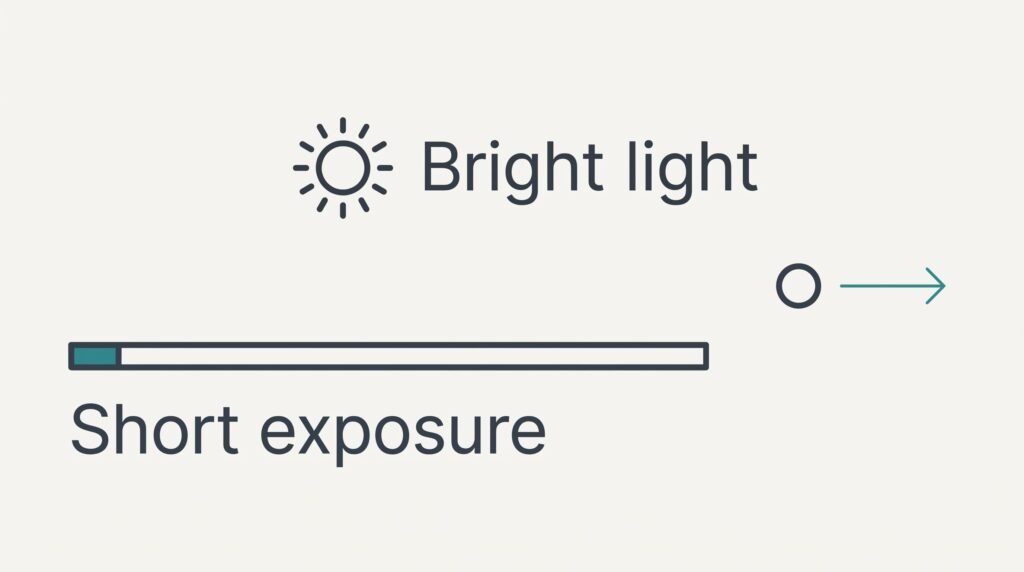
The phone wins whenever the light is strong or the subjects sit still. A garden on a bright day gives roughly 10,000 lux, about 80 times the living room. The phone’s exposure then drops far below 1/1000 s, and a running child is sharp in either camera.
It also wins the posed picture. Eight children behind a cake can hold still for a moment, which is all that combined frames need. Whether you hold a compact camera or a phone at a seated party, the picture stays sharp.
Take three shots and keep the one where nobody blinks.
Sharing is the second strength. Within a minute the phone can put a picture in the grandparents’ hands, and nothing else has to be found or charged. You’re carrying it anyway, and the camera is open in two seconds.
The cost is the dim room with movement. A game of musical statues or a race down the hallway puts motion into 120 lux. The phone then has to choose between a longer exposure that smears the child and a short one that leaves the picture grainy.
Where the Compact Camera Wins
The compact camera wins once the light drops and the action is quick. Anyone weighing a compact camera or a phone for party games should start here. With 4 units of sensor it can use 1/240 s where the phone needs 1/60 s. A running child is then a clean figure with about 8 pixels of blur and not a smear of 33. That gap is the whole argument.
It also reaches across the room. A zoom lens changes the framing without cropping the picture. You can stand by the wall and still fill the frame with one face. A phone without a second lens must crop in software, which throws pixels away.
Held in two hands, a camera is steadier than a phone, and it leaves the phone free for calls. Its battery is separate, which means a long party never drains the thing you need to book a taxi.
These costs bite. The compact camera adds one more object to charge and carry, and its pictures reach the grandparents only after a cable or a card. If you hate that extra step, you won’t use it.
When Neither Camera Fixes the Room
A very dark room beats both. Before you buy a compact camera or a phone for a dim hall, look at the lamps. Raise the light before you change the camera, because every doubling of light halves the exposure time for either device. Open the curtains and switch on every lamp, then move the cake to the window.
Take the sums further. At 240 lux the phone needs 1/120 s, and the child’s smear falls from 2.5 cm to 1.25 cm, about 17 pixels. At 480 lux it is 0.6 cm and the phone matches the compact camera in the dim room. Moving the game closer to the window helps more than any purchase, and it costs nothing. Daylight at a window is usually stronger than a ceiling lamp.
Light that comes from one side also adds shadows on the faces. Bounce it off a white wall, and the shadows soften at no cost. Never use a lamp right behind a child, because the face goes dark.
Which One to Pick
Two situations settle the choice. If most of your party photos are posed or taken in daylight, use the phone, because the combined frames give a sharp picture, and sharing is instant. Carry nothing extra, and wipe the lens with a soft cloth beforehand, since a greasy lens smears every shot.
If you want pictures of games and dances in a dim room, use the compact camera, because its larger sensor allows an exposure four times shorter. Charge it the night before and check the card has space. Rest it on a table pointing down the room. You can then lift it in one move when the game starts.
Try both on one moving subject in your own living room. Ask a child to run past the lamp, take three shots with each device and look at the smear at full size. If the phone’s pictures are already sharp, you’ve saved yourself a purchase. If they smear, you have your answer. Write the result down beside the room’s light level, and next year’s party starts from a known figure.
Questions Readers Keep Asking
Is a compact camera worth the extra effort?
Only if you photograph movement in dim rooms often. Charging it and carrying it, plus moving the pictures across, adds about ten minutes to each party. For posed pictures and daylight, the phone matches it without that effort. Test before you buy, and purchase only if your own shots smear.
Do phone night modes cope with moving children?
Not well. They combine several frames, and a child who moves between frames appears as a ghost or a smear. Night modes suit still scenes, such as the cake on the table. For a game, raise the room’s light instead.
Which suits a small flat with a party in one room?
The phone suits a room where you can switch on every light and the children stay near the table. A compact camera suits a larger dim room where you stand back and the children run. Test it with one child and one lamp.