Coats pile onto small hooks until the strip sags, and that’s where peg rails taking over from hook strips begins. This article follows the change in centimetres, then the reasons households give and what the switch costs. A warning about the extreme version comes near the end, and a short test closes the article. The figures below all belong to a sample hallway in Amersfoort that measures 100 by 300 cm and has one plastered side wall. Compare them with your own hallway before any drilling, and ask your landlord first if the wall isn’t yours. The article also says plainly when the older strip is the better choice.
Peg Rails Taking Over From Hook Strips: The Short Version
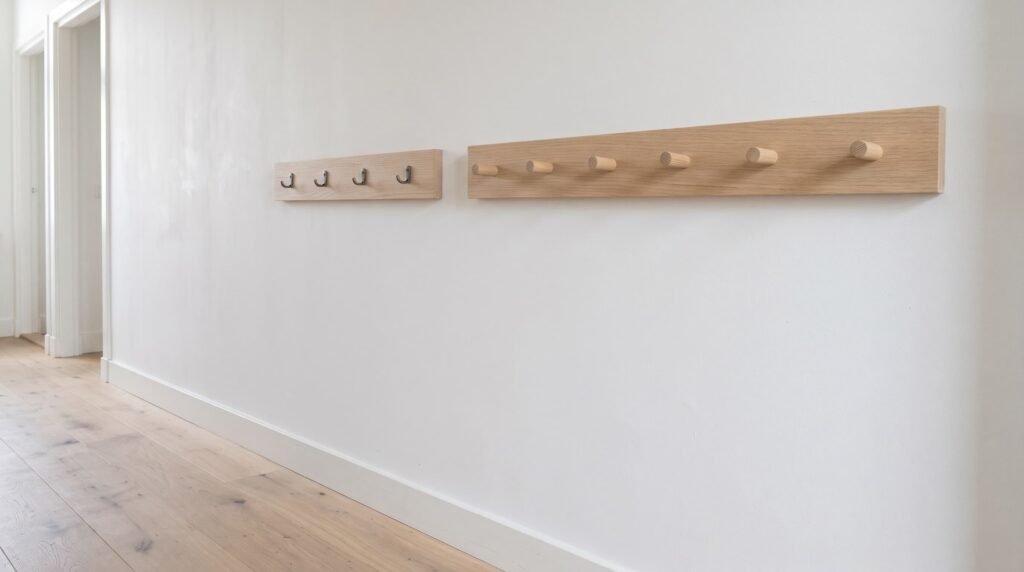
A hook strip is a short board, about 60 cm long, with four small metal hooks screwed to it. The rail is a longer board, around 120 cm, with six round wooden pegs that stick out about 10 cm. Both keep coats off the floor. What separates them is the load each can take per centimetre of wall and the strain it puts on the screws. In the sample hallway both sit on the long wall with the top edge at 160 cm. The strip leaves 240 cm of the long wall free, while the rail leaves 180 cm.
Two pressures drive the shift. Winter bulk is the first. A padded coat folds over a small hook and drags its neighbour, whereas a longer peg lets two coats hang apart. Clutter is the second. Bags and hats have nowhere to go on a short hook. They land on the floor or the stair. A peg takes a loop or a strap without slipping.
The change leaves the wall below the rail free and the front door untouched.
What Changed on the Wall, in Numbers
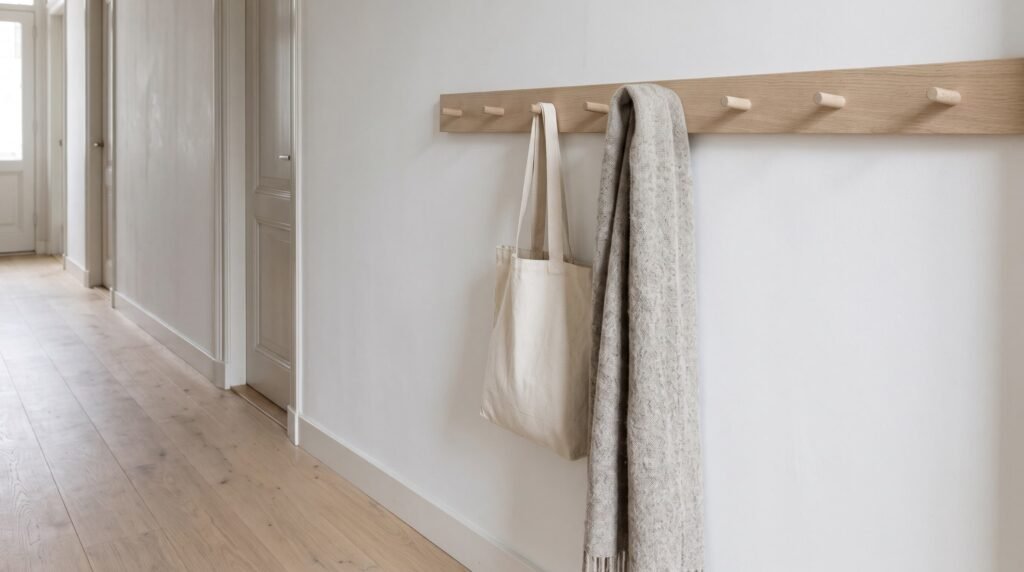
In numbers, the board grows from 60 cm to 120 cm while coat places rise from 4 to 12. Count it from the hooks. A strip carries 4 hooks at 15 cm spacing, which is 4 × 15 = 60 cm of wall, and each hook takes one coat. A rail carries 6 pegs at 20 cm spacing with a 10 cm margin at each end, which is 5 × 20 + 2 × 10 = 120 cm, and each peg takes two coats. That gives 6 × 2 = 12 places.
Per metre of wall the gain is smaller. The strip offers 4 ÷ 0.6 = 6.7 places, and the rail offers 12 ÷ 1.2 = 10. The rail therefore packs 1.5 times as many places into each metre, which is the real measure of peg rails taking over from hook strips in a narrow hall.
Load changes with it. Take a winter coat at 1.2 kg. Four coats on the strip weigh 4.8 kg, carried by 2 screws at 2.4 kg each. Twelve coats on the rail weigh 14.4 kg, carried by 3 screws at 4.8 kg each. The load on each screw doubles, which makes the fixings matter more than the pegs.
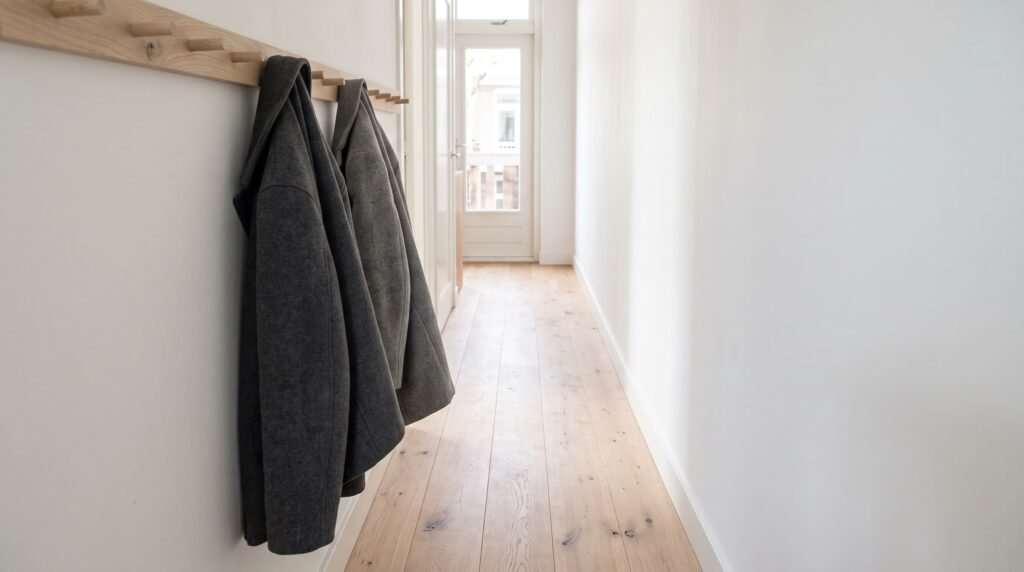
Depth changes too. A hook coat hangs about 15 cm out, which leaves 85 cm of clear passage in the 100 cm width. Two coats on a peg reach about 25 cm, and 75 cm remains.
Why Pegs Are Taking Hallways Over From Hook Strips
Capacity comes first. A household with school bags and winter jackets outgrows four hooks in a single winter. Six pegs give each person a place, and two people can still stand at the wall together because the places sit 20 cm apart.
Fixings are the second reason. A strip has two screws, and when someone yanks a heavy coat off it, the board twists on them. A rail has three screws spread over 120 cm, each 40 cm from the next, and a pull is shared between them. That matters on older walls, where plaster crumbles close to a hole. A strip fails slowly, twisting a little more each winter.
Looks are the third. One plain board with round pegs hides uneven plaster and old screw holes, and it looks chosen rather than improvised. A strip of small metal hooks reads as a stopgap.
Habit is the fourth. A peg invites a loop or a strap. Bags then hang on the wall rather than sit on the floor. In the sample hallway that frees a patch of 100 × 30 = 3,000 cm² beside the door, which is 0.3 m² of floor you can walk on or sweep.
Fitting is the fifth reason. A rail goes up in about twenty minutes, and the pegs arrive at a spacing that’s already right.
What You Give Up
Floor width is the first loss. Two coats on a peg reach 25 cm, which cuts the clear passage from 85 cm to 75 cm, and anyone carrying a wide bag now brushes the coats on the way in. Choosing peg rails taking over from hook strips means accepting that narrower lane every day. That’s a trade some households tolerate and others won’t.
Holes are the second loss. A rail needs three screws where a strip needed two, each hole about 6 mm wide, and every one needs filling when you leave. Tenants need the landlord’s consent before any of them go in.
Tidiness is the third. Pegs invite stacking, and six pegs with two coats each plus a few bags make a heap that hides the board. Wet coats stacked two deep dry slowly. A short strip at least forced restraint.

The Extreme Version
At its limit, the rail runs along the whole 300 cm wall with a peg every 10 cm. That’s 30 pegs and, at two coats each, 60 places, which is five times the 12 places of the standard rail. The load is the problem: 60 coats at 1.2 kg is 72 kg of coats hanging from one plaster wall. Screws every 40 cm need 8 of them, at 9 kg each. Old plaster often fails at far less, and every extra coat shoves three others along.
Pegs only 10 cm apart let the coats overlap. Real capacity is about half the paper figure. The clear passage stays at 75 cm, yet the whole wall becomes a curtain of fabric. By then the rail has stopped being a hook alternative and turned into a storage wall that needs a plan and a survey of the plaster. Don’t copy it.
Three screws and six pegs do the job.
Who It Suits
Peg rails taking over from hook strips suit those households that count more than four coats and bags hanging in the hall on a cold weekday evening. Tally them on three evenings in a notebook. Four or fewer means the strip is coping. Five or more each evening means the extra capacity will be used, and the rail repays its three holes. Pick midweek evenings, because weekdays show real use, while weekends mislead when visitors bring extra coats. Mark each tally beside the front door so the whole household sees it. Count each bag as one item, and count only what hangs there at six o’clock.
Fix the rail with three screws into solid wall. Put the top edge near 160 cm so adults reach the pegs without stretching. A short note of each count on your phone helps you decide next autumn. It pays off where the hallway is busy and the wall is sound. Where plaster crumbles, mend it before touching the pegs, because a rail holds only as much as the wall behind it.
Questions and Answers
Should I replace a hook strip that still works?
Only if the tally shows more than four items hanging on most evenings, or the strip twists when you pull a coat off. A strip that copes is free to keep. Add one extra hook beside it if you need a single place, rather than a whole new rail.
Which households gain most?
Families with several winter coats and school bags gain most, and so do hallways where the wall is plain and sound. Single occupants with two coats gain little. A rail also suits a hall where you can spare a 25 cm depth, because that’s what two coats on a peg take.
How long does a peg rail last?
The board and pegs usually outlast the paint and the coats. The wall behind the screws is the weak spot. Check for movement each autumn, and if the rail shifts, refit the screws into solid wall. Wooden pegs take knocks well, and any loose peg can be reglued.