Everything in the lounge is in place and the walls are pale, yet the space reads shorter than it measures. Floorboards running across a narrow room are a likely reason, since each board edge works like a tick mark that the eye tallies as it travels. Three faults cover nearly every case, and the cures run from a free rearrangement to a single rug. The sample here is a rented lounge in Amersfoort, 3.0 m by 5.2 m, with its window on the narrow end and boards 14 cm wide. Treat the numbers as samples; your tape measure supplies the real ones.
Why Floorboards Running Across a Narrow Room Shorten It
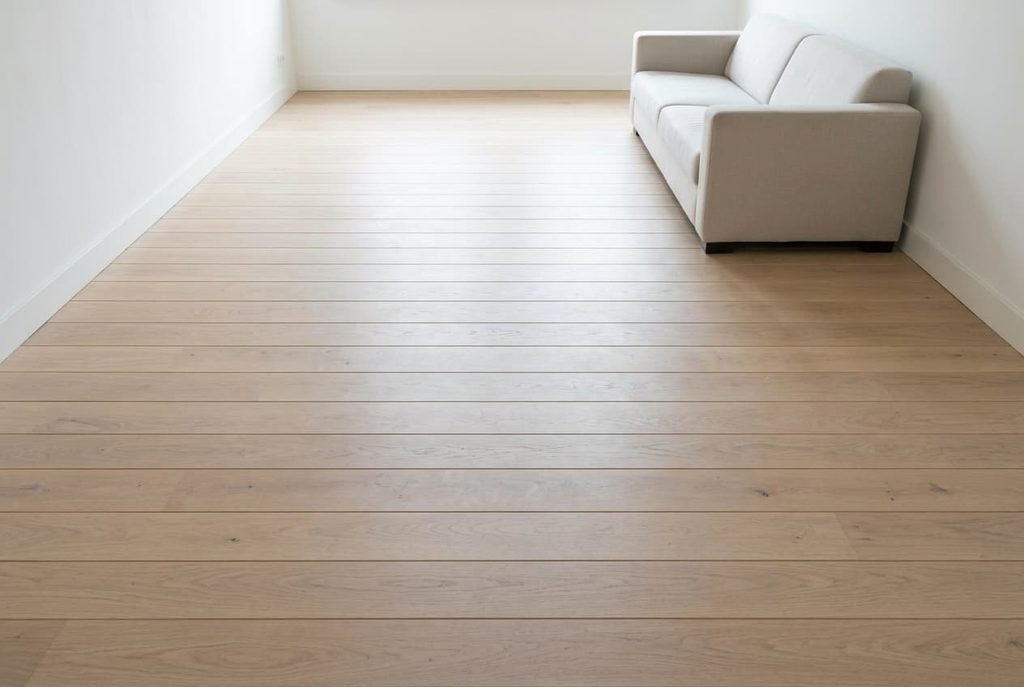
A floor is read through its lines. Lines that point away from you draw the gaze towards the far wall, while lines that cross your view chop the distance into steps. Boards laid across the width of a narrow room do the second job along its entire length. The effect is geometric, and it holds whichever colour the boards happen to be.
Tally the steps in the sample. Boards 14 cm wide leave 520 ÷ 14, roughly 37 joints between door and far wall. Rotate the identical boards and you’d see 300 ÷ 14, about 21 lines, each aimed at the room’s far end.
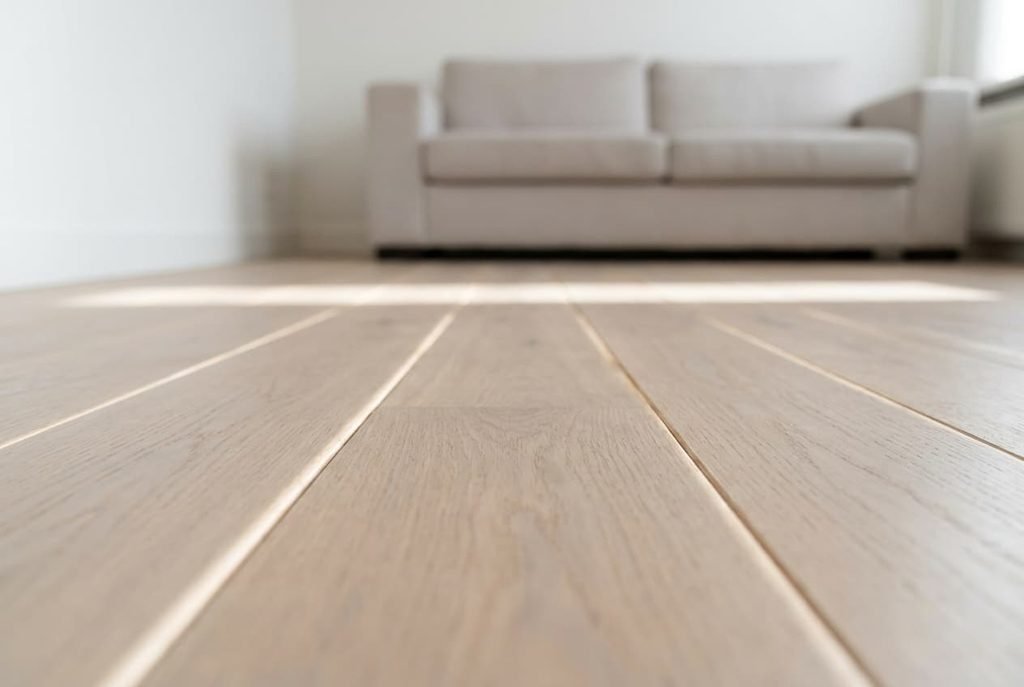
Light sharpens the effect. Low morning sun comes through the window at roughly 15° above the floor. A 0.5 mm step at a board edge casts a shadow 0.5 ÷ tan 15°, close to 1.9 mm wide, and that shadow recurs at all 37 joints. These edges are physical features, which is why a photograph of the room shows them as plainly as the eye does.
Blaming the stain or the furniture is the usual misdiagnosis. A paler finish would still carry the same 37 ticks, and no sofa shifts them.
How to Check Floorboards Running Across Your Narrow Room
Take your tape to the doorway for five quick checks. Each takes under a minute.
1. Tally the joints between your feet and the far wall. The sample gives 37, and beyond about 25 the floor begins to look like a ladder (a rough working threshold).
2. Measure both walls. The ratio of 520 to 300 is 1.73, a long enough room for line direction to matter, since it passes about 1.5 in this sample.
3. Crouch near the window in morning light and look along the boards. Thin bright seams at the joints show a raking effect, and the sample room has one at every joint.
4. Note how the sofa faces. A 210 cm sofa set against the narrow end adds one heavy cross line to the 37.
5. Walk into the neighbouring room. Boards that turn at the threshold draw a line that splits the view. Here they run on unbroken into the hall, so that check passes.
This room trips four of the five.
Three Faults Behind a Shortened Room
Work through the faults from cheapest to dearest, and halt as soon as floorboards running across a narrow room stop dragging your eye sideways. Each fault has its own cure, which means a calm result after step one makes the rest unnecessary.
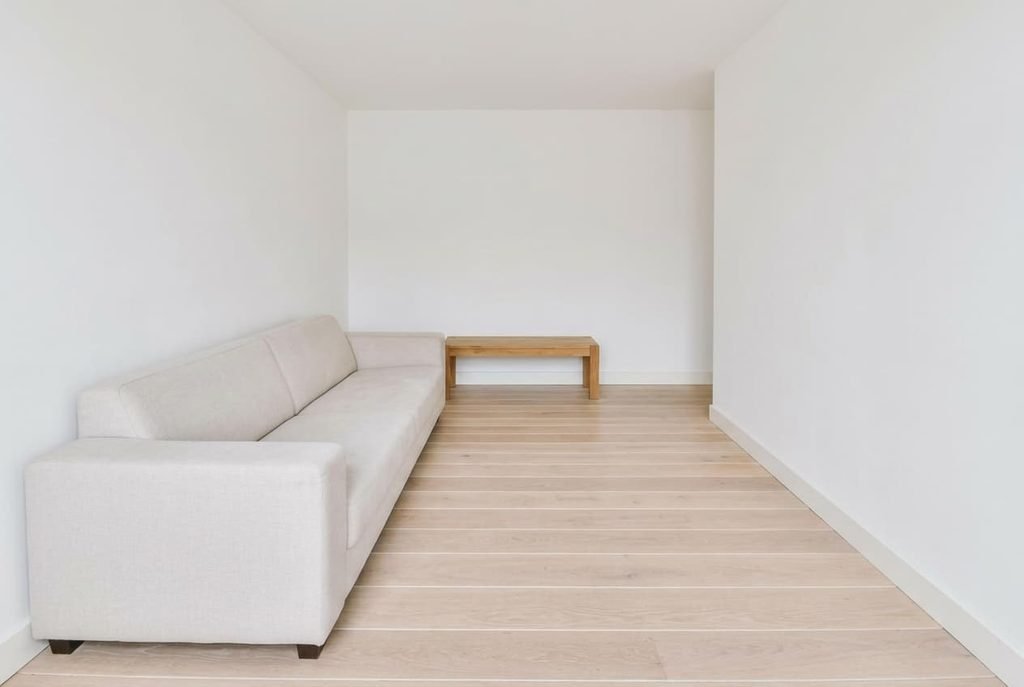
When every piece of furniture lines up across the room, the sofa is the fault. At 210 cm it sits against the narrow end with its back parallel to the boards, and it restates the 37 ticks as one thick line. Swing it onto a long wall so its length points down the 520 cm, and set the low table in line with it. Two strong lines now follow the room, and the boards between them fade. Judge it from the door: the right spot is where the sofa’s back and the nearest board edge seem to point the same way. Ten minutes covers the move, and nothing needs buying. A radiator or TV point on the narrow wall may pin the sofa’s position, in which case move on to the lamp.
When thin bright seams flicker along the boards, glare is the fault. Your corner lamp holds its bulb 40 cm over the boards, so light reaches a point 300 cm away at about 7.6°, and a 0.5 mm step casts a shadow near 3.8 mm, about twice the 1.9 mm of the morning sun. Raise the lamp to a sideboard at 80 cm and the angle becomes 14.9°, which narrows the shadow to 1.9 mm. Tilt the shade towards the wall and draw the sheer curtain until mid-morning. Both adjustments are free, though you’ll want an evening or two to judge the result.
When the stripes are still countable from the door, scale is the fault. Boards of 14 cm give 37 lines, and a rug 170 × 240 cm laid lengthways hides 240 ÷ 14, about 17 of them, which is 46%. That leaves 65 cm of floor showing beside it, and the rug’s edges point down the room as well. Pick a plain weave with its long side parallel to the long wall. The rug is the one purchase in the whole sequence.
What to Settle Before Choosing or Laying Boards
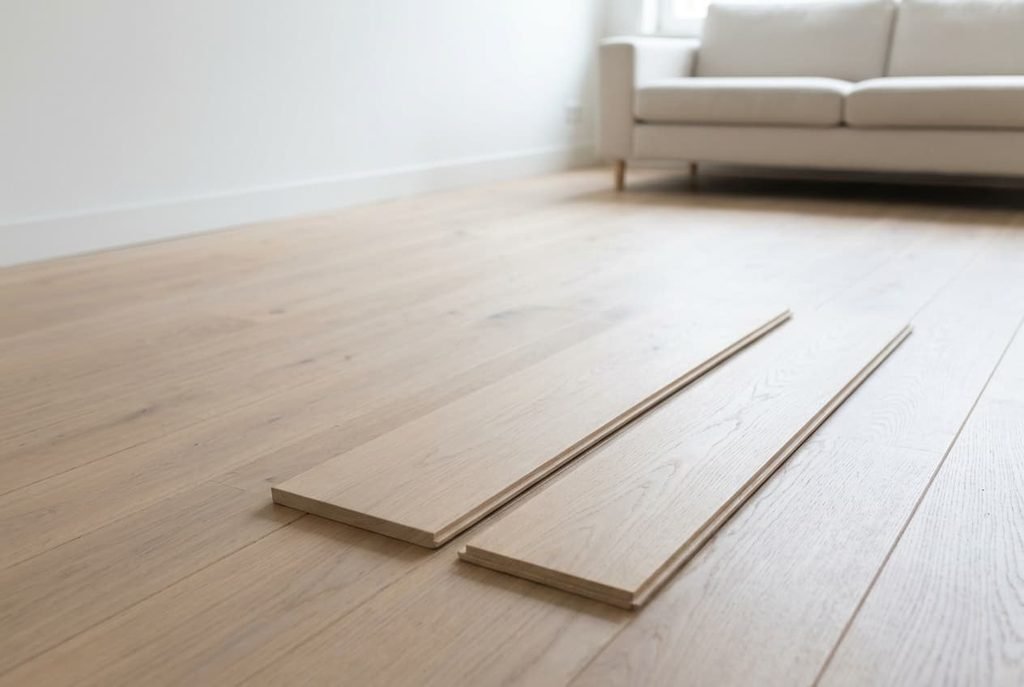
Floorboards running across a narrow room are easiest to avoid before the floor goes down. Sketch the room and mark its longest axis. Then ask for the boards to run along it or towards the main window.
Wider boards help too. At 19 cm the sample would show 520 ÷ 19, about 27 joints, which is 27% fewer than 37. Ask the fitter to lay two sample boards at the window, and look at them at nine in the morning. A sample is cheap and answers the question before a single board is cut. Keep one direction through connected rooms as well, because a change at a doorway adds a line of its own.
Tenants usually inherit the floor and work with the three faults above.
The Fix That Costs More Than It Saves
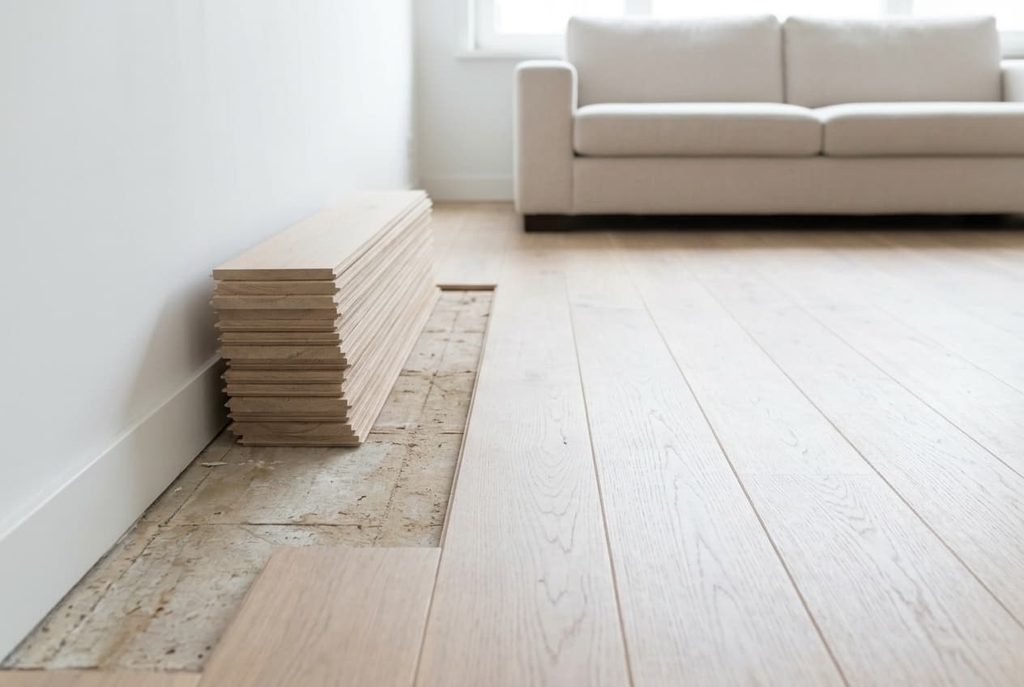
Re-laying the whole floor in the opposite direction sounds thorough and tidy, yet floorboards running across a narrow room need far less than that. The job covers 15.6 m² of floor. It lifts the skirting, takes a couple of days (an assumption) and needs a landlord’s consent. The best outcome is 21 lines in place of 37 joints, and the rug from the third fault already hides 46% of the ticks.
A big mirror on the far wall tempts people as well. It reflects the same 37 joints, so the eye counts 74. A long runner laid across the room does no better, as it adds a fresh line to the 37. A coat of paint alters the colour of the ticks while leaving each one in place.
Make the changes in sequence and give each a few days to settle. Turn the sofa first, because that adjustment is free and frequently achieves the most. Move the lamp second. Buy a rug last, and only when stripes remain visible from the door. Jot down your own numbers for later: the joint count and the shadow width. They tell you whether the room has truly changed, and they give you a brief for the day the floor needs replacing. If you rent, send the landlord those measurements before you ask for anything bigger than a rug, because numbers get a quicker answer than adjectives.
Questions Readers Keep Asking
Why does the room look shorter than it measures?
Board edges that cross the long axis. Each one acts as a tick, and 14 cm boards give about 37 of them along 520 cm. Tally the joints from the door first. It’s the stain that gets blamed, yet the edges decide, so arrange furniture so its lines run with the room.
What can I try this evening?
Swing the sofa onto the long wall and raise the lamp to the sideboard. Spend an hour at the far end, then look back from the door. A longer-looking room means the furniture was repeating the board lines, and you can stop there.
Can I improve it without touching the floor?
Usually. Furniture position and lamp height, plus a lengthways rug, cover all three faults while the boards stay put. Only a new floor changes their direction, and a landlord rarely agrees to one. Try the three steps in sequence and judge after each.