Within a month the bike usually becomes a coat rack, and that is the complaint we hear most. An exercise bike in your living room fails far less often through size than through missing plans for the person on top of it. So plan the rider first and the machine second. The frame takes half a square metre, but the rider needs several times that. Our flat is Dutch, an upper floor in Zwolle, with 330 by 450 cm of floor under a ceiling 250 cm high. The bike measures 100 × 50 cm. Replace each figure with yours.
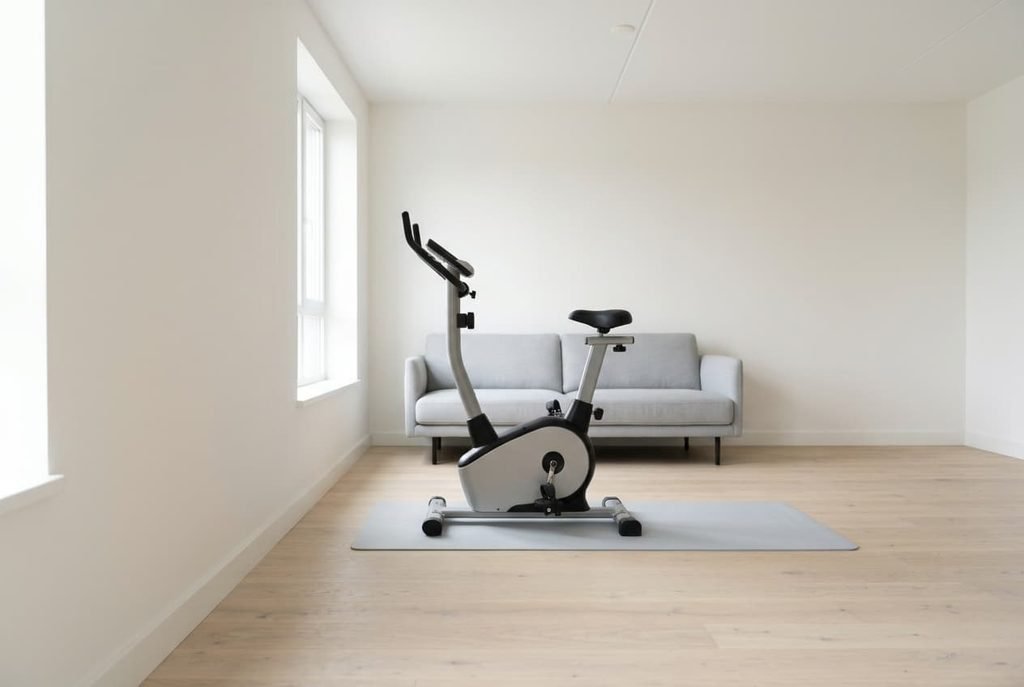
Why an Exercise Bike in Your Living Room Needs a Rider Zone
Nobody pedals while pressed against furniture. You climb on from one side, you reach for a towel and your elbows swing wider than the handlebars do. Add 50 cm along each long side and 40 cm at each end. The working zone grows to 150 cm by 180 cm.
That is 2.7 m² against 0.5 m² for the frame, so the bike claims 5.4 times the area it appears to. Our floor measures 14.85 m², which makes the zone 18% of it. What looked like a modest purchase takes nearly a fifth of your floor, and that is the number to plan with. Hardly anyone budgets for it before delivery day.
Height deserves a check as well. A rider of 185 cm standing on the pedals reaches roughly 210 cm. Under our ceiling that leaves 40 cm, yet a pendant lamp hanging 20 cm down has its lowest point at 230 cm, and only 20 cm then separates glass from head.
Standing on the pedals is the moment this matters.
Sound travels too. In an upper-floor flat the flywheel’s whirr passes into the floor, which means the neighbours below hear your zone as clearly as you feel it. A thick rubber mat softens the sound but won’t remove it.
Checks Before the Bike Gets a Permanent Spot
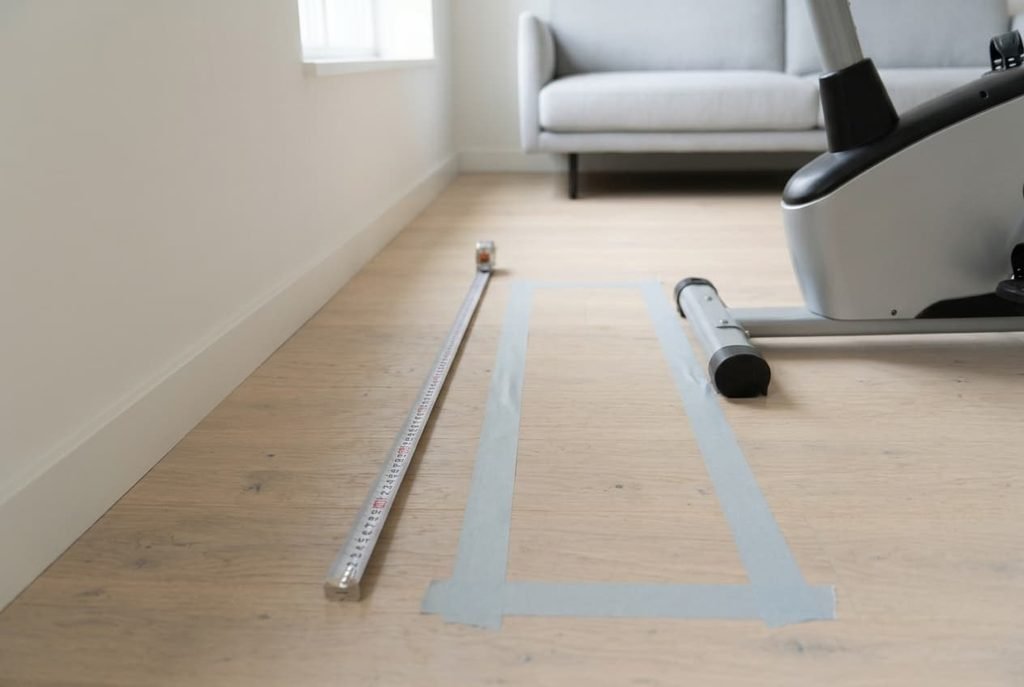
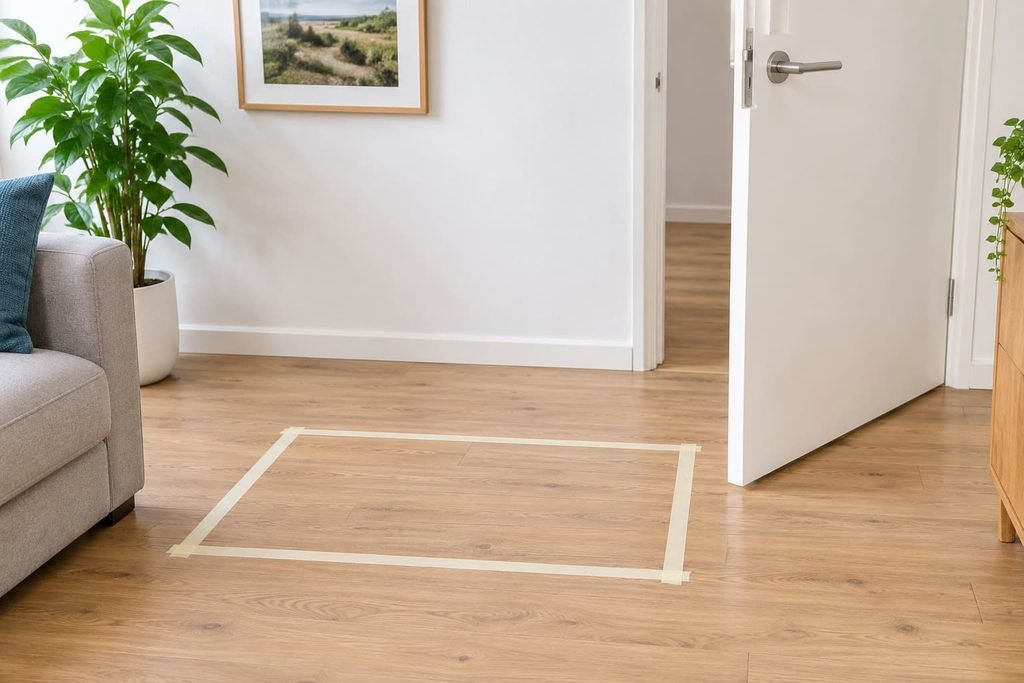
Tape the 150 × 180 cm rectangle on the boards before you wheel anything in. Then run each of these checks. They’ll take an evening.
– Door arc: an 83 cm door sweeps about 0.54 m² as it opens, which is more floor than the frame itself covers. Keep that sweep outside the tape or a guest will catch the pedals.
– Ceiling: find the lowest fixture above the zone. It should sit at least 20 cm over a standing rider’s 210 cm, so a lamp must start above 230 cm.
– Walkway: you need an 80 cm clear path to the sofa once the tape is down. Our 330 − 150 = 180 cm of width beside the zone passes with room to spare.
– Socket: a console powered from the wall needs a lead that doesn’t cross the path. Ours stands 120 cm away from the zone, so a 180 cm lead reaches.
– Wall gap: leave 10 cm behind the frame so a towel can drop without catching the flywheel guard.
– Mat: the bike should stand on rubber at least 120 × 60 cm, which also catches scuffs from the pedals.
Our example fails none of them. The lamp check passes with exactly 20 cm in hand, so repeat it with the real fixture before an exercise bike in your living room becomes permanent.
A Living Room Exercise Bike Plan, Cheapest First
Three placements cover most rooms. We rank them by cost and name the price of each.
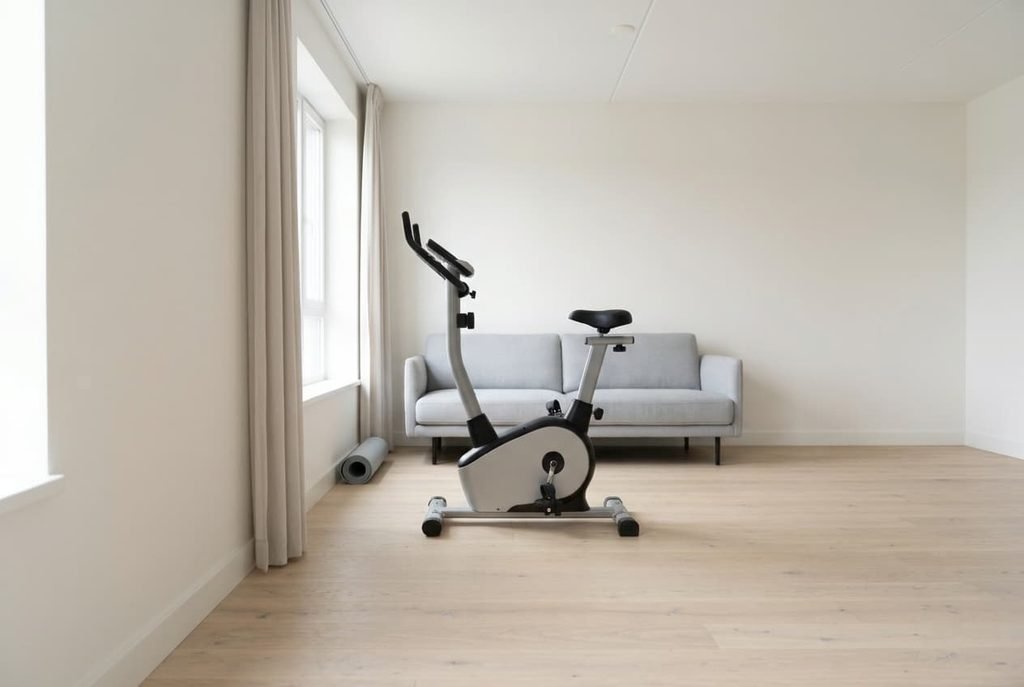
Park it on the window wall, with the zone’s 150 cm side along the glass. The remaining wall measures 330 − 150 = 180 cm, and you face daylight while you pedal. It costs nothing. In return the curtains can’t stay open at dusk, and on winter evenings the black glass shows you your own reflection.
Use the sofa as a screen, with the zone beyond it. The zone takes 180 cm of the 450 cm length, so 270 cm remains for seating, an area of 270 × 330 = 8.9 m². A 200 cm sofa fits with 70 cm to spare. Shifting furniture costs you an hour. The price is a sofa floating mid-room, and the machine stays in view from the doorway.
Choose a bike with transport wheels, then stand it upright in a cupboard. A cupboard 60 cm deep holds the frame on end, so the zone disappears by day. Suppose you ride four times a week. That makes 208 sessions a year, and two moves of 30 seconds each add up to 208 minutes. That is a little under three and a half hours. Money goes on the wheels or the cupboard, and only a light bike can be rolled by one person. The plan fails when the cupboard door opens into the zone. Whichever you pick, an exercise bike in your living room works only if the tape stays down for the first fortnight.
Keeping the Bike From Becoming a Coat Rack
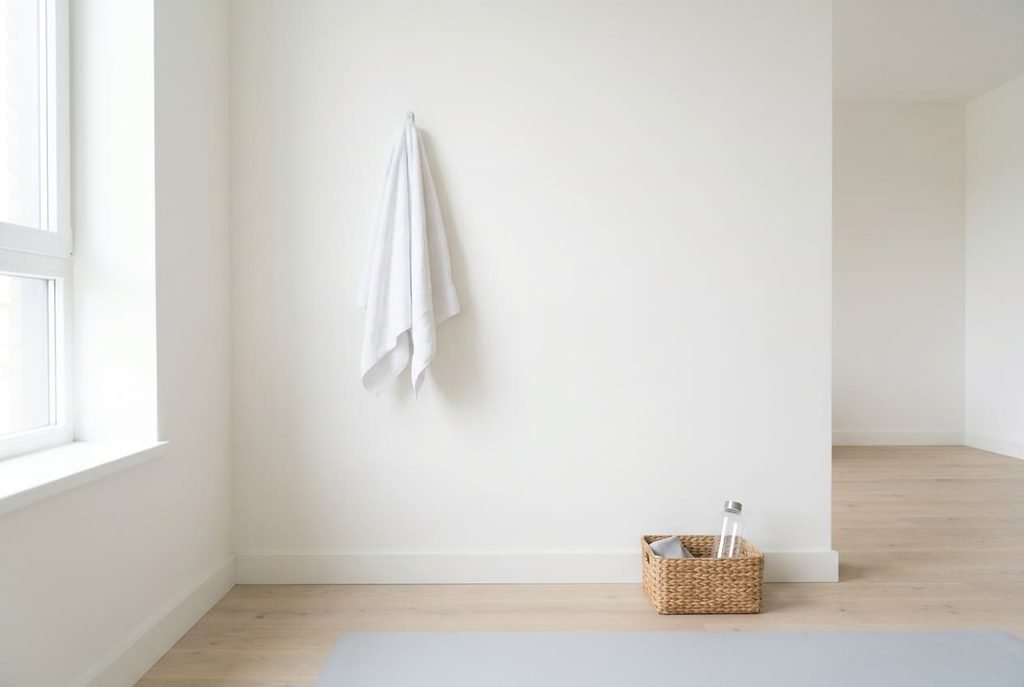
A bike turns into a hanger when it faces a bare wall and nothing else offers a place for jackets. Rotate it so the side profile faces the room, and fit a wall hook at shoulder height next to the zone so towels and coats have another home. The hook should be within arm’s reach of the saddle, otherwise you’ll drape things over the handlebars out of laziness.
Pick a mat close to your floor colour. A pale grey mat on pale oak looks planned, while a black mat with white stripes pulls the eye across the room. Leave everything else in the zone bare. A small basket at its edge holds a water bottle and a remote control, which keeps clutter off the console.
Light helps too. A lamp beside the zone, mounted above the 210 cm head height, lets you ride after dark without switching on the main ceiling light. Fix it to the wall so nobody trips over its lead when crossing to the sofa.
The zone should never double as the place where laundry waits to dry.
A Six-Step Order for Taping and Testing
1. Tape the 150 × 180 cm rectangle on the boards and leave it there for two days, so every member of the household walks around it.
2. Walk to the sofa three times and measure the clear path each time. It must stay at 80 cm or more, even with a bag in your hand.
3. Swing the door fully open and confirm that its sweep misses the tape.
4. Measure the lowest fixture above the zone and compare it with 230 cm, using a ruler held at the rider’s head height.
5. Choose one placement, then move the sofa before the bike arrives, because a delivered frame is awkward to shift.
6. Lay the mat and fit the hook. Then photograph the finished layout from the doorway, so you have a record.
If anything still crosses the tape, move it first. Two days with a taped rectangle shows how the room behaves while you cook or work, and it costs nothing. An exercise bike in your living room then stops being a guess. Don’t forget the neighbours below: ride at a sensible hour for the first week and ask whether they hear a hum, since they’ll give you better evidence than a rule of thumb can.
Questions Readers Keep Asking
How much floor does the bike really need?
Plan on 150 × 180 cm, which is 2.7 m², for a 100 × 50 cm frame. The extra 50 cm either side covers climbing on and reaching for a towel. Knees and handlebars stay clear of walls thanks to the 40 cm kept free beyond each end. In a compact room that comes to roughly 18% of the floor.
Where in the room works best?
On the window wall, where the rider faces daylight. The door sweep and the walkway must still clear the zone, but the placement suits most layouts. When the glass stands too near the sofa, place the zone beyond the sofa and let the sofa serve as the screen.
Should the mat match the floor?
Usually, yes. A mat in a tone close to your boards fades into the room and looks like part of the flooring. A bold colour turns the zone into the target of every glance. Choose a contrast only when you want the bike to look like a deliberate feature.