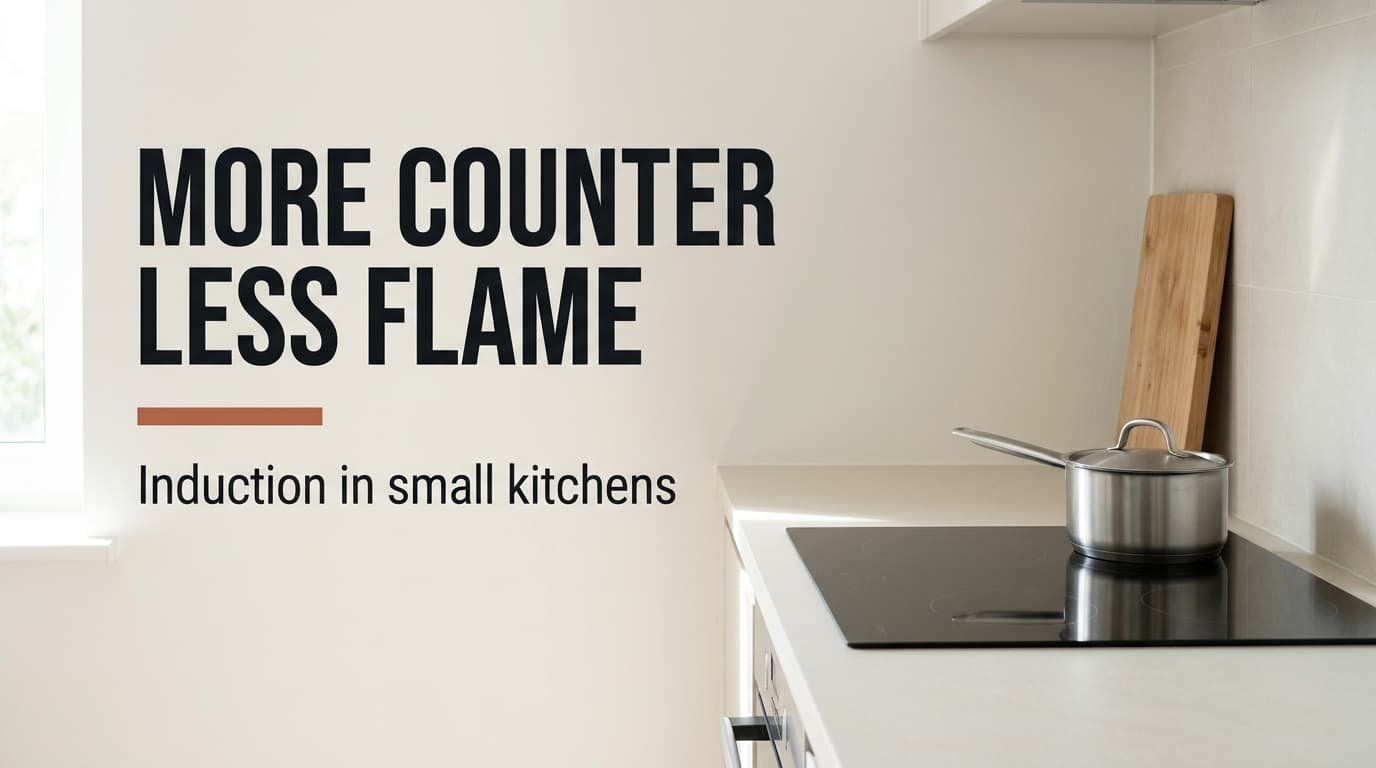
You stand at the stove with a pan of soup, and the worktop beside you holds nothing, because the hob has taken a fifth of your counter. Induction hobs are replacing gas hobs in small Dutch kitchens since they warm the pan and hardly anything around it, and the flat top gives the space back once dinner is done. Every number here comes from an invented kitchen, one whose worktop runs 240 cm along the wall, with a hob 60 cm wide in it. Take each figure as a sample, then repeat the tests in your own kitchen. This piece names no brands and quotes no prices.
Where the gas hob came from
Gas rings replaced the coal range because a flame lights at once and goes out completely. A cook could turn it down to a whisper and walk away. For generations that was the best control a kitchen had, and it earned its place on every counter.
The flame has one flaw. It heats the air around the pan as eagerly as the pan itself, so a good share of the energy escapes up the sides and into the room. Assume that only about half of it reaches the water in a pan.
Induction solves the flaw with a different idea. A coil sits under a sheet of glass-ceramic and sets up a fast-changing magnetic field. The base of an iron or steel pan picks that field up and warms itself, which makes the pan the heater. Early models asked for thick, heavy pans. Newer ones work with ordinary steel bases. The glass on top is a single flat pane that you can wipe in one stroke.
What changes as induction hobs are replacing gas hobs in your kitchen
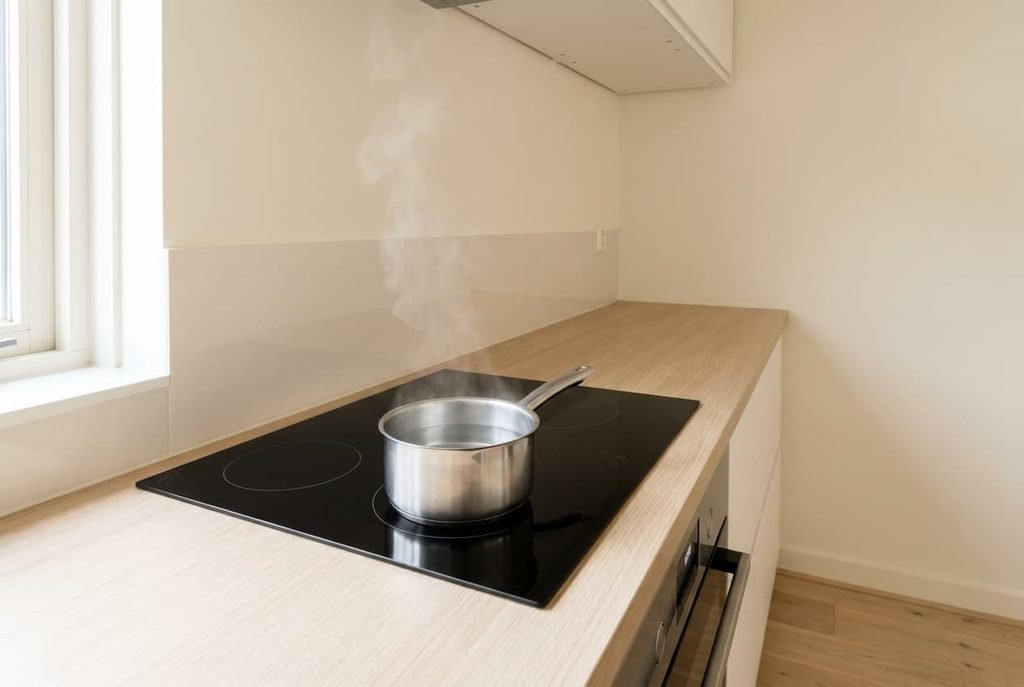
Three things change when an induction top replaces a gas one in the same 60 cm gap. Speed comes first. Heating 1.5 litres of water from 15 °C to 100 °C takes 1.5 × 4.18 × 85 = 533 kJ. Give both hobs a 2.0 kW ring. The gas ring delivers about half, so 1.0 kW reaches the water and the boil takes 533 seconds. The induction ring delivers about 85%, so 1.7 kW reaches the water and the boil takes 313 seconds. A litre-and-a-half boil falls from nearly 9 minutes to just over 5, and the heat left in the kitchen shrinks from 533 kJ to 93 kJ.
The pan warms and the glass beside it stays far cooler.
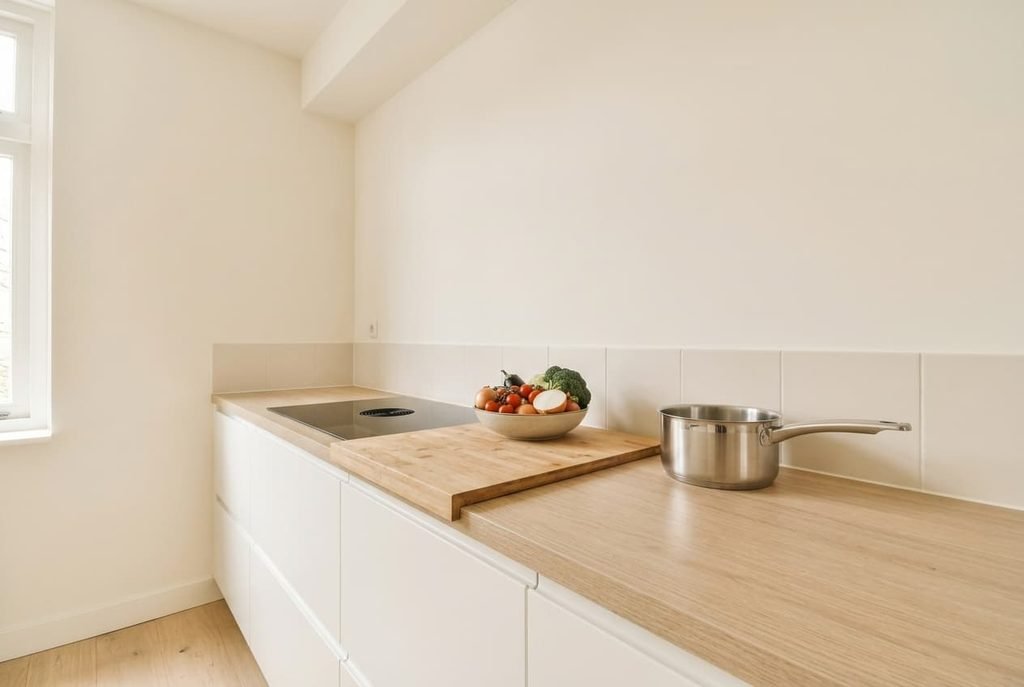
Surface comes second. A 240 × 60 cm worktop gives 1.44 m². The hob covers 60 × 52 = 0.31 m² of it. A gas hob has its grates in place all day, so you can only prep on 1.13 m². A flat top accepts a chopping board when the rings are off, and the working surface grows by 27% to the full 1.44 m².
Cleaning is third. A gas hob here comes apart into about ten loose pieces, with two grates sitting over eight small burner parts. Assume wiping them takes 6 minutes after each meal. One pane takes about 1.5. Over 260 meals in a year that saves 4.5 × 260 = 1,170 minutes, or nearly 20 hours.
Who an induction hob suits, and who it doesn’t
It suits a flat with no gas connection, which is where the switch is easiest. No pipe has to be moved, so a fitter only needs a power supply that can carry the load. Short bursts of cooking fit well, since a ring responds almost at once and a pan comes off the boil in seconds. So does a kitchen where prep and cooking share the same few square metres, because the board trick returns 0.31 m² of counter.
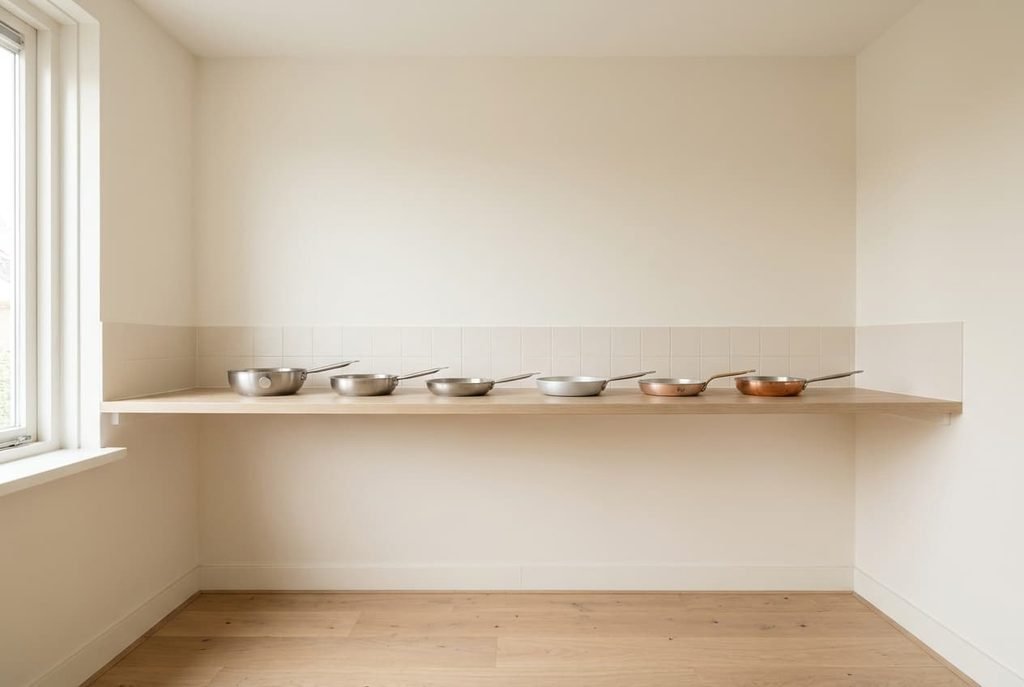
A cook whose pans are aluminium, or copper with no iron in the base, fares worse. Those pans won’t warm at all. Lay a magnet on the base of each one. A magnet that clings means the pan works, and one that slides off means it doesn’t. In an invented set of eight pans, assume three fail. That’s 37.5% of the cupboard needing a replacement or a retirement.
A wok with a rounded bottom fares badly too, since it needs a flat base to touch the glass. Induction hobs are replacing gas hobs fastest in flats where cooking means flat-bottomed pans and quick meals, and slowest in kitchens built around a flame under a curved pan.
A power cut stops an induction hob, whereas a gas ring still lights with a match. Where cuts are rare, that seldom changes a decision.
Are induction hobs replacing gas hobs, and is it worth adopting
Weigh the three changes together. Speed improves by roughly 40%, because 313 seconds is 41% shorter than 533. Counter space rises by 27% on days when the hob is covered. The loss is the pans: 37.5% of the set may not work, and a round-bottomed wok loses its place.
Our verdict: switch once at least six of your eight pans pass the magnet test, and wait if most of them fail. In our kitchen five pass, so the move works only after one steel pan joins the set. The first boil then takes 5 minutes where it once took 9. The counter gets its board as well.
A kitchen with a good gas hob and a full set of aluminium pans loses more than it gains. Keep the flame there, and come back to the question once the pans wear out.
The version that will date fastest
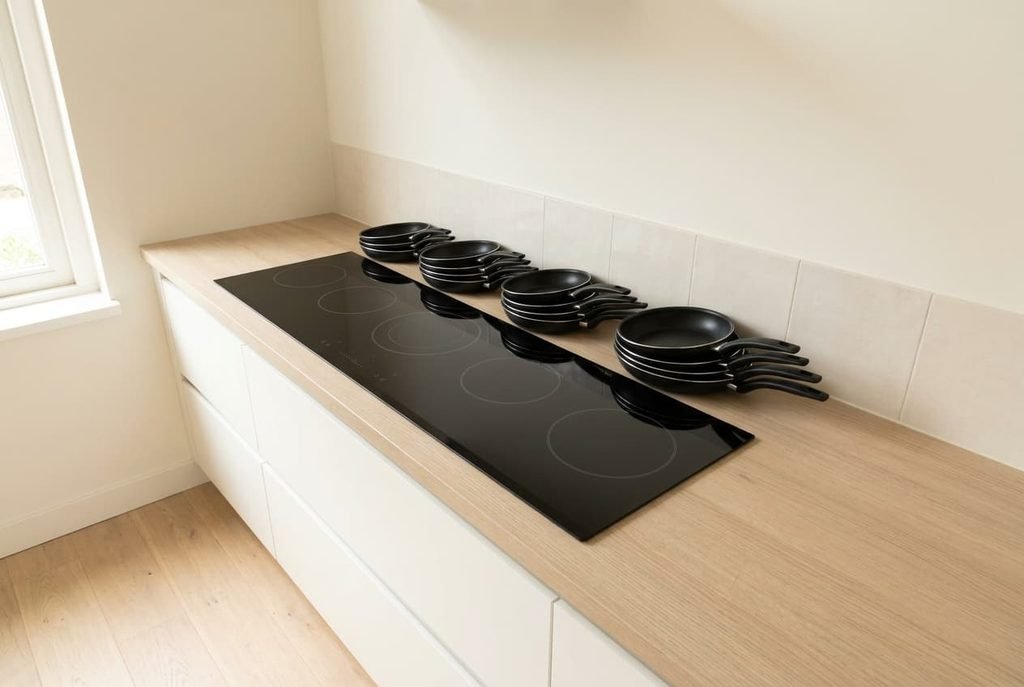
The extreme version is a 90 cm hob with five zones, every pan replaced in one week, and the old gas pipe capped behind a tile. Spot it by its signs: a matching set of eight new pans, a boost mode nobody asked for, and a worktop with only 150 cm left beside the hob. Such a hob covers 90 × 52 = 0.47 m² of counter. The 60 cm one covers 0.31 m². Induction hobs are replacing gas hobs at their loudest in this form, and it’s the form that dates.
That is the version that ages worst.
It ties you to one cooking style just as the fashion peaks, which is a poor moment to commit. The glass to wipe grows to 4,680 cm², up from 3,120 cm². Few kitchens of this size run more than two rings at once.
A gentler route keeps the 60 cm hob with four zones and uses the pans that already pass the magnet test. You replace the rest only as they wear out. That takes little effort and reverses easily.
How to try it without committing
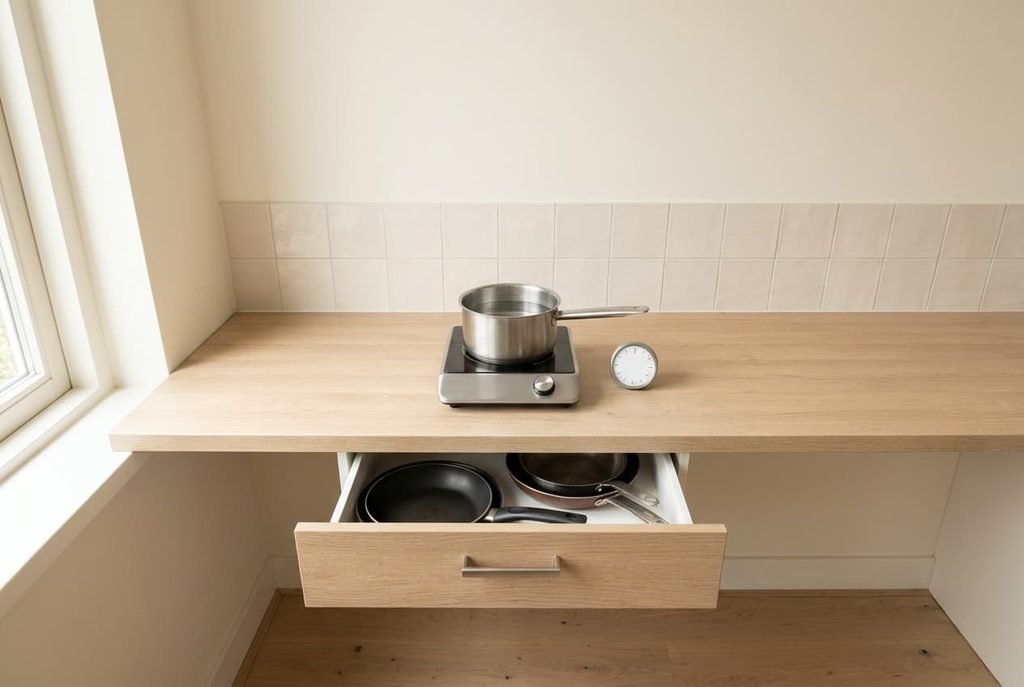
Run a timed boil on your gas ring first. Fill a pan with 1.5 litres of tap water and start a stopwatch. Record the minutes to a full rolling boil. Do it twice and take the average. That number is your baseline, and the induction figure of 5 minutes only means something against it.
Then test every pan with a magnet from the drawer. Write each pan’s result on a list taped inside the cupboard door. Count the passes before anything is ordered. A borrowed single-zone plate gives you the real boil time in your own kitchen. Nothing needs committing to.
Induction hobs are replacing gas hobs because the pan is the only thing worth heating, and the counter is worth more as a counter. Start with the timed boil and the magnet test. If the pans pass and the boil drops towards 5 minutes, the switch has earned its place. If they don’t, the flame can stay a while longer.
Questions readers keep asking
Should I swap a working gas hob for induction?
Only when the pans pass the magnet test and the extra counter space would change how you cook. A working gas hob does its job, so it doesn’t need rushing. Swap it when you refit the kitchen anyway, because the worktop is cut once.
Does an induction hob suit a family kitchen?
Often, yes. It heats fast and wipes clean in one stroke, so busy evenings go quicker. Cookware is the limit: if half the pans fail the magnet, you’ll spend the first month replacing them, so test the set before you commit.
How long will an induction hob stay in fashion?
A sealed glass top has no grates or caps to wear out, so the hardware isn’t the weak point. Only the extreme version, a 90 cm hob with five zones and a boost mode, carries a dated look. A modest 60 cm hob suits a small kitchen in any decade, and it comes out cleanly when you move.