Daylight shows a flat, calm wall. At eight in the evening five thin dark lines run down it from skirting to ceiling, and wallpaper seams show in the evening although nobody touched the wall. It’s tempting to blame the hanging or the paper, yet neither is the usual culprit. Three faults produce this effect, and each has a different fix, from zero cost to a small tub of adhesive. The sample is a living-room wall in Leiden, 3.2 m wide and 2.5 m high, covered in strips 53 cm wide. The measurements are example values. Use your own values instead.

Why Wallpaper Seams Show in the Evening Light
No seam is ever truly flat. Two strips meet with a tiny step, which we’ll take as 0.2 mm. The angle between light and wall decides whether that step is visible. A step of height h throws a shadow of length h divided by tan θ, where θ is the angle between the ray and the wall.
By day the wall gets broad light from the window at about 60°, and the shadow is 0.12 mm. The sky also fills in what little shadow remains. In the evening a wall lamp’s shade sits 15 cm off the paper. A point 1 m along the wall sees its light at 8.5°, and the same step throws a shadow 1.33 mm long, eleven times longer. That’s the gap between invisible and a drawn line.
The paper stayed as it was at dusk. The light moved, and when wallpaper seams show in the evening it is the same seam under a different light. Blaming the hanging sends people to chase a fault that doesn’t exist. Three faults produce the effect, and the next sections separate them.
A Visual Check for Seams That Show Up Once the Evening Begins

Do these checks once night has fallen, with the lights you normally use. Switch each lamp off in turn and watch the wall. Lines that fade when one lamp goes off point to light angle. Stand 2 m back and compare the lines. In our sample they run the full 2.5 m height and look equally dark, which is how shadows behave. A line that looks pale or white is something else, a gap showing the lining behind the paper.
Crouch beside one end of the wall and look along it. A shadow line sharpens as your eye nears the plane of the wall, while a pale line looks the same from every angle.
Draw a fingertip across each seam. A lifted edge catches the nail and a flat joint glides past. One seam in our sample catches, at 0.8 mm.
Last, lay a torch beam flat along the wall from about 10 cm out and sweep it. Seams that light up under the torch but vanish under the ceiling light confirm the raking-light effect.
Three Faults Behind Lines That Appear at Night
Dark lines that appear only when one lamp is on come from placement, the commonest reason wallpaper seams show in the evening. The lamp’s shade sits 15 cm off the paper. Its light skims along the surface, and every 0.2 mm step throws a shadow 1.33 mm long. Daylight reaches the same wall at about 60° and shortens that to 0.12 mm. Turn the near lamp off and light the room from across it or from the ceiling. Both reach the wall at steeper angles, and the shadows shrink at once. That costs nothing and works within a minute. Its limit is that the lamp may be your only reading light. In that case bring another lamp in first.
Lines that look darkest when the room is otherwise dim come from missing fill. With one lamp as the only source, nothing lights the shadow side. The 1.33 mm shadow then looks like a dark thread. Light bounced off a pale ceiling lands softly on every surface and lifts those shadows to grey. Rearrange two lamps so that one points upward, and place it where its beam passes over the centre of the ceiling. Test it by lighting that lamp alone: if the lines turn from black to grey, fill was the missing ingredient. This costs only the effort of moving furniture. The effect fades under a low or dark ceiling, which reflects less light. A lamp with a closed shade can’t throw light upward at all.
Thick lines or pale gaps that show even by day come from the step itself. A lifted edge of 0.8 mm throws a 5.3 mm shadow under the lamp and still 0.46 mm in daylight. A seam roller and a thin line of seam adhesive press it back to 0.2 mm, which returns the lamp shadow to 1.33 mm. Work outward from the strip’s centre towards the edge so the adhesive doesn’t squeeze out onto the face. The tools cost little. Old vinyl paper that has shrunk can’t be pressed back, and a gap needs a colour-matched filler pencil instead. Wipe away adhesive that escapes at once, because it leaves a sheen that catches the lamp.

Preventing the Same Lines on the Next Wall
Plan the lighting before the first strip goes up. Lay a torch beam flat along the bare wall and sweep it. That shows you where raking light will fall. Keep lamps at least 60 cm away from any papered wall, which turns the 1.33 mm shadow into 0.33 mm, four times shorter. Choose a matt, mid-tone paper, because gloss mirrors a lamp along every lifted edge.
Press each seam with a roller while the adhesive is still workable, since a seam left to dry lifted will stay lifted. Plan the joins so that no seam lands in the line of a fixed wall light you can’t move later. Do that and wallpaper seams show in the evening far less on the new wall, whatever furniture ends up beside it.
A fixed wall light decides where the joins can go.
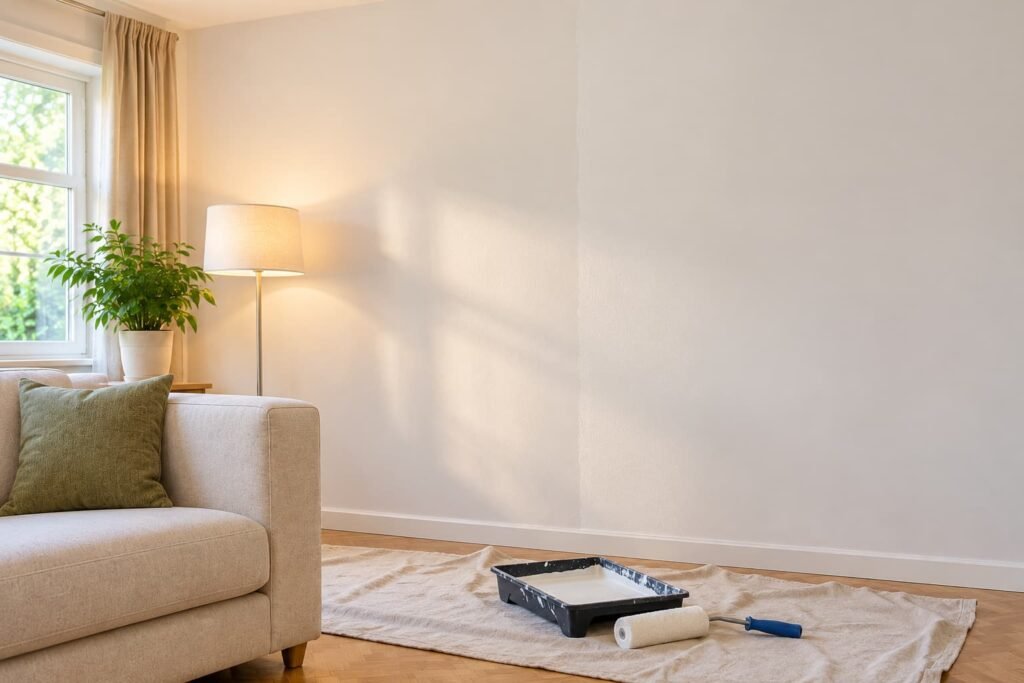
The Fix That Isn’t Worth Doing
Many owners reach for painting over the wallpaper to hide the seams, and it rarely works. Paint hides a colour difference. A difference in height stays. Assume a coat adds 0.05 mm. Three coats leave the 0.2 mm step standing, and the lamp still throws its 1.33 mm shadow. The moisture in the paint can also lift the edges you wanted to calm, which pushes a 0.2 mm step towards 0.8 mm. A roller leaves a sheen on painted paper, and that sheen mirrors the lamp along every edge. The paper also becomes much harder to remove when you want a different wall in a few years.
Filling every seam with a skim of filler adds a ridge about 0.3 mm tall, which is simply a new step.
Work through the three fixes in order and look at the wall the next evening. Switch off the near lamp, then rearrange the fill, then press the edge that catches. After each step the shadow shrinks, and you can stop when the lines have faded to a level you can live with. A 0.2 mm step will always cast a faint line under skimming light. Aim for faint lines rather than none. The cause is geometry. Geometry responds to a tape and a lamp, whatever the paper cost. Photograph the wall each evening under the same lighting. The pictures show progress more honestly than memory does.
Questions Readers Keep Asking
What is the most common cause?
A lamp close to the wall. A wall light or a reading lamp 15 cm away lights the paper at a skimming angle, and every small step throws a long shadow. Daylight arrives at a steeper angle from the window, and the same seam disappears by day.
What is the quickest fix tonight?
Switch off the lamp nearest the wall and light the room from across it. If the lines fade within a minute, you’ve found the cause with one flick of a switch. Then move that lamp 60 cm from the wall, or point it at the ceiling.
Can this be fixed without stripping the wall?
Yes. All three faults can be fixed with the paper in place. Only paper that has shrunk apart across the whole wall needs more than a roller, and even then a filler pencil comes first. Stripping is rarely the answer.