If it is hard to get up from a sofa, the cushion alone is rarely to blame. Standing needs your hips to travel forward until they sit above your feet, and then your legs lift you from there. Each stage can fail for a different reason, and a tape shows which one has failed. This page needs a helper and ten minutes. Treat the numbers as rounded guesses about a typical two-seater in a Haarlem flat. Measure your own sofa and use those readings before buying a single thing. The usual advice to buy a firmer sofa often misses the stage that actually fails.
What Makes It Hard to Get Up From a Sofa
Standing up has two stages, and a sofa can spoil either one.
The shift comes first. Sit back against a deep cushion and your hips lie about 50 cm behind your feet. They must come within roughly 10 cm before your legs can take the load, which makes a slide of 40 cm. The lift follows, where your legs raise your hips from the seat to standing height. We’ll take that as 90 cm.
Seat height changes the lift. A seat level with the back of your knee, say 42 cm, asks for 48 cm of lifting. A sofa that sits at 34 cm once you’re on it asks for 56 cm, which means 17% more work for your legs. Depth changes the shift. Foam that gives way hurts both stages, because it lowers the seat and tips you backwards at the same moment. That combination is why it is hard to get up from a sofa that looked right at the retailer and felt right for the first month.
What you’re fighting is a seat that sits lower and deeper under load than it looks in the room. Every cause below feeds one of the two stages. The measurements in the next section tell you which.
Four Checks for Why It Is Hard to Get Up From Any Sofa
Ask a helper to hold the tape, and sit the way you normally do with your shoes off. Seat height comes first. Rest the tape’s end on the floor and read up to the cushion under your thigh, right at its lip. Then read up to the back of your knee. Our example reads 34 cm against 42 cm, a shortfall of 8 cm.
Seat depth. With your back against the cushion, how far does the seat extend past the back of your knee? A deck 62 cm deep and a thigh 50 cm long leave an overhang of 12 cm. Assume that anything over 10 cm lengthens the shift.
Sink. Measure the seat height at the same spot with nobody on it. Ours reads 40 cm unloaded and 34 cm under you, a sink of 6 cm. Without that sink the shortfall would be only 2 cm. Anything beyond 5 cm means the foam or the webbing is giving way.
Rebound. Press a fist into the seat for ten seconds and let go. A dent that takes longer than five seconds to fill tells you the foam is tired.
Four Fixes From Free to Professional
Shuffle toward the lip of the seat, because that shortens the shift and leaves the lift alone. Slide forward by 15 cm and bring your heels back beneath your knees before you push. The slide drops from 40 cm to 25 cm, and the shift is the stage a deep seat inflates. There’s no outlay, and tonight is soon enough to test it. A low seat stays low with this one, and a soft front edge rolls you backwards if you perch there. Treat it as the free answer when it is hard to get up from a sofa on some evenings and not others, since tired legs show the fault up.
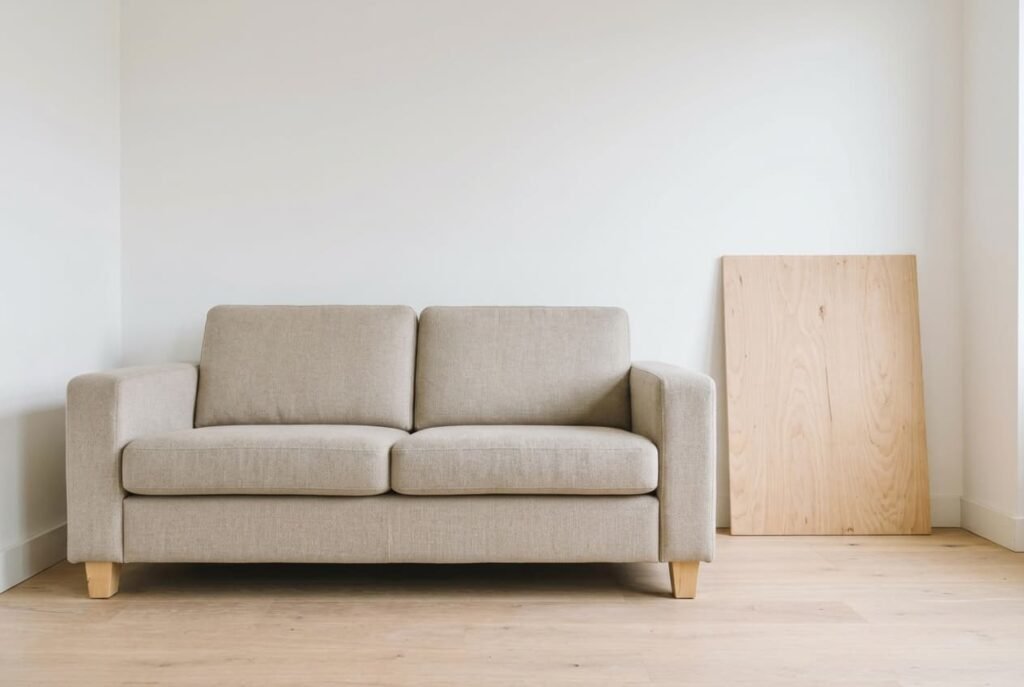
Slide a plywood board under the seat cushions, because it takes up the sag in the webbing. A sheet 12 mm thick, cut to rest on both side rails, stops the deck dropping when you sit. We’ll assume the webbing accounts for 2 cm of the 6 cm sink, which lifts the loaded seat to 36 cm. A board costs little, and a timber shop will cut it to size. It leaves foam compression untouched, and a thin cover may show the board’s edge as a ridge along the front.
Fit feet 5 cm tall under the sofa, because they lift the whole seat. A set of four lifts the loaded seat from 34 cm to 39 cm. The shortfall falls from 8 cm to 3 cm. It’s a small outlay and ten minutes with a spanner. The back rises with the seat. Check what stands behind it. Read the load rating on the feet before you trust them with two adults and a visitor.
Have an upholsterer fit a firmer foam core, because the cushion then keeps its height under you. In our example the foam accounts for 4 cm of the 6 cm sink, and a core that compresses half as much gives 2 cm back. Of the four this is the dearest. It suits a sofa with a sound frame that you want to keep for years. The cover usually needs re-cutting, and a firm seat feels different from the soft one you chose in the shop.

What This Room’s Window Sill Decides
The architecture caps how high the seat can go. Say the sofa stands against a wall below a window whose sill is 85 cm up, while the sofa back stands 78 cm tall. Feet of 5 cm lift the back to 83 cm, which clears the sill by 2 cm. Feet of 8 cm would push it to 86 cm, past the sill, where the back rubs the window handle and stops the casement opening.
In this flat it is hard to get up from a sofa partly because the window leaves so little room to raise anything. Feet of 6 cm are the ceiling, with 1 cm to spare. Add the board and the loaded seat reaches 42 cm, level with the knee line. That closes the gap and allows nothing beyond it.
The sill sets the limit before the sofa does.
The Fix That Doesn’t Work
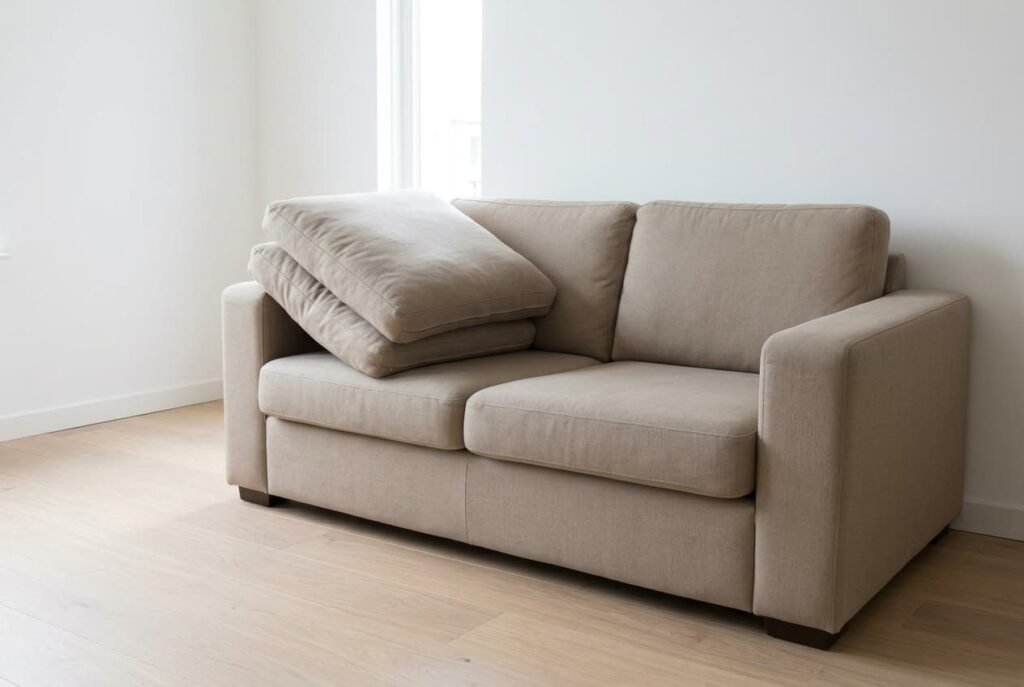
The tempting answer is a thick extra cushion stacked on the seat, and it only moves the problem. Say it adds 8 cm. Under your weight it compresses by 5 cm, leaving a net gain of 3 cm. The soft top layer also wobbles during the shift, and the loose stack rolls forward as you push.
It hides the fault too. While the stack stays on, the seat feels higher for a week and you stop measuring. Then the foam below settles under the extra load and the sink grows by a centimetre or two. Compare that with the feet, which close 5 cm of the shortfall with a firm part that doesn’t compress. The stack costs you stability for a gain that the solid fixes beat, and it leaves your hips sitting on a surface that shifts every time you move.
Take the readings before any repair, then treat the stage that fails. A tape and a helper settle in ten minutes what a month of guessing never will. Choose the lowest-cost fix that closes the gap and measure again once it’s in. Quit once the seat reaches the line under your knee, because anything beyond that only adds cost. A sofa that is right for your legs is worth keeping.
Questions Readers Keep Asking
Can this problem be fixed at all?
Usually, yes. The tape tells you which stage fails, and each stage has a separate remedy. A typical sofa needs only one fix, and two at most. A replacement is for the worn-out frame where the webbing is finished and the foam is beyond help.
How much does it cost to fix?
Sitting forward costs nothing, and the board is cheap. Feet are a light outlay. A new foam core is the heavy item and comes last. Try the lower-cost fixes and re-measure. Ask an upholsterer for a quote on the frame and the foam only after that.
What is the most common cause?
In an older sofa, sink is the usual culprit. Foam and webbing both soften with years of use. A seat that drops more than 5 cm under you pushes the lift well beyond what your legs expect. Run the sink check ahead of the others, since it takes two minutes.