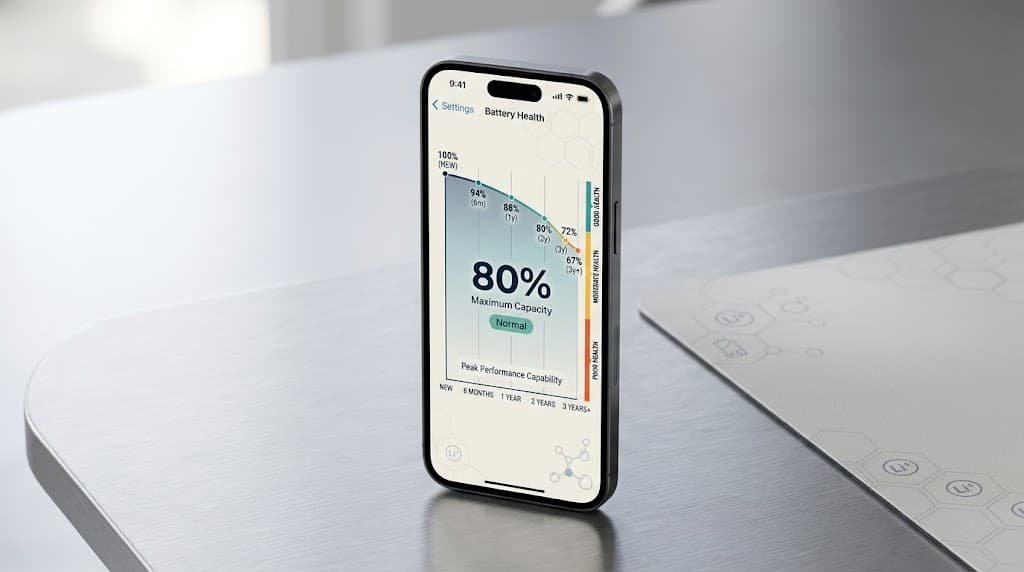
That “battery health” percentage in your phone’s settings isn’t a quality score or a warning label – it’s a straightforward comparison between how much charge your battery can currently hold versus how much it could hold when it was brand new. An 85% reading means the battery now holds roughly 85% of its original capacity, nothing more mysterious than that.
What that simple definition leaves out is why the number drops at all, and that comes down to a specific chemical process happening inside the battery every time you charge and discharge it, regardless of how carefully you treat the phone day to day.
The short answer, and what it leaves out
The percentage is a capacity comparison: current maximum charge capacity divided by original maximum charge capacity, shown as a rounded figure.
What that leaves out is that this number isn’t static or purely time-based – it’s driven by usage, specifically by how many charge cycles the battery has been through, not by how many months or years you’ve owned the phone. Two phones bought on the same day can show meaningfully different health percentages a year later, purely because one was used more heavily.
How it actually works, step by step
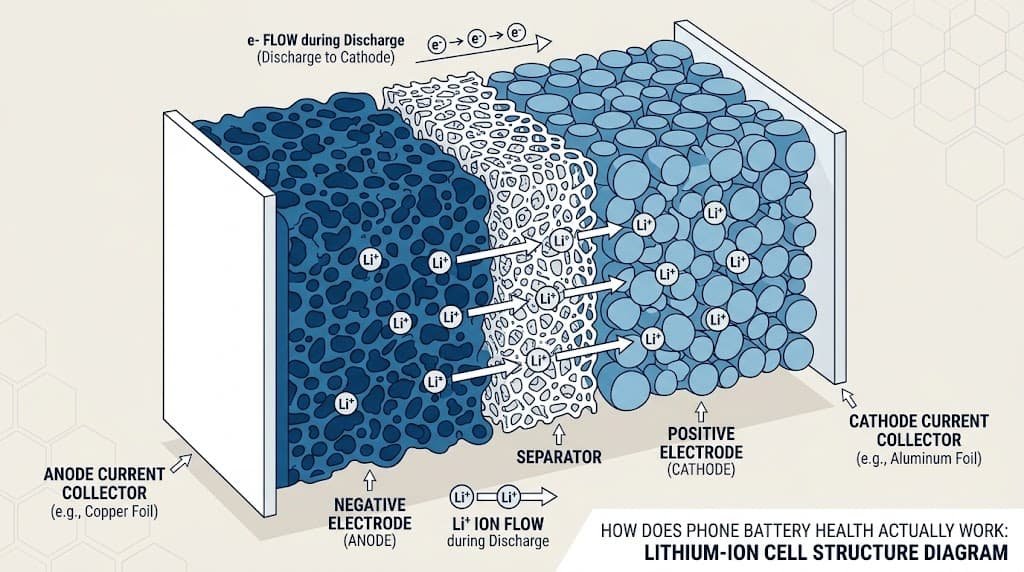
Picture a lithium-ion battery as millions of microscopic sites where lithium ions move back and forth between two electrodes – discharging as ions flow one direction to power your phone, charging as they flow back the other way. Each full cycle of this movement causes tiny, permanent structural changes at those sites, a process battery engineers call capacity fade.
A “charge cycle” doesn’t mean one full charge from 0 to 100% – it means the cumulative equivalent of a full cycle, so charging from 50% to 100% twice counts as one full cycle, not two partial ones. This distinction matters because it explains why the percentage drops gradually across many small top-up charges throughout a day, rather than in sudden steps tied to any single charging session you’d actually notice happening.
As cycles accumulate, more of those microscopic sites gradually lose their ability to hold lithium ions efficiently. The battery still functions completely normally in every other respect throughout this process – it charges at the expected speed, it powers the phone through a normal day, nothing feels broken or faulty in daily use. It simply can’t store as much total energy as it once could when new, which is exactly the gap the health percentage is designed to measure and report back to you.
This is also why the process is genuinely irreversible through software alone – no setting, calibration, or reset restores lost capacity, because the change has already happened at the physical, chemical level inside the cell itself, not in how the phone’s software tracks or displays the number.
The analogy, and where it breaks
Battery degradation is sometimes compared to a sponge losing absorbency after repeated wringing – it still soaks up water every time, just measurably less with each use.
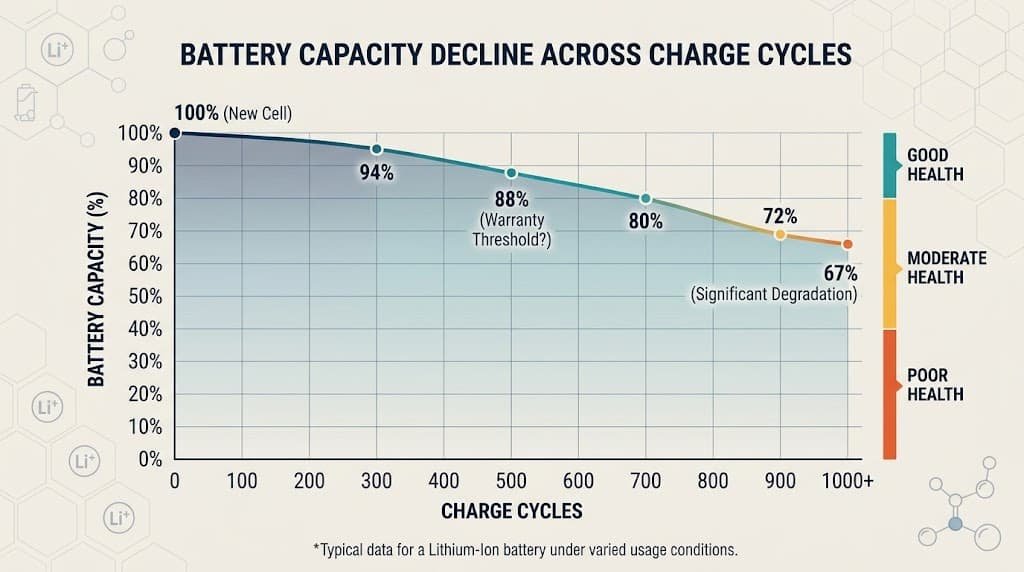
The analogy holds for the gradual, cumulative nature of the decline; neither a sponge nor a battery fails suddenly from normal use. It breaks on the rate of decline specifically: a sponge’s absorbency loss tends to be roughly linear over repeated use, while battery capacity fade typically accelerates somewhat as cycle count climbs higher – the same hundred cycles cause noticeably less fade early in a battery’s life than they do later on.
What this does not explain
The cycle-based degradation mechanism explains the general downward trend everyone experiences, but it doesn’t explain or predict exactly which cycle number produces which specific percentage for your particular phone – manufacturing variation between individual battery units means two identical phone models can show meaningfully different readings at the exact same cycle count, even when used in near-identical ways.
It also doesn’t explain sudden, sharp drops in the displayed percentage, which usually point to something other than normal cycle-based fade entirely. A software update recalibrating how the figure is measured or displayed is a far more common explanation for an abrupt drop than the battery itself suddenly degrading overnight – the underlying chemistry rarely changes that fast on its own.
Temperature exposure sits outside this mechanism too. A battery left in a hot car repeatedly ages faster than the cycle count alone would predict, because sustained heat accelerates the same chemical breakdown independently of how often the battery is actually charged and discharged.
What people get wrong about it
The belief that battery health drops mainly from the passage of time itself. This forms naturally because people track their phone’s age in months or years, not in charge cycles they can’t easily see. But a phone used heavily for one year can show more degradation than an identical phone used lightly for two years, because cycles – not calendar time – drive the underlying chemistry.
The belief that charging overnight specifically damages battery health. This seems intuitive since the phone stays connected long after reaching 100% charge. But modern phones stop actively charging once full and only trickle-charge occasionally to maintain the level, which causes negligible additional cycle wear compared to a normal daytime charging session.
How to tell whether it applies to you
The mechanism applies to every lithium-ion phone battery ever made, but how quickly you personally notice its effects depends on your cycle count specifically, not your phone’s age in years. As a general guide, batteries showing several hundred cycles typically show noticeably reduced health, while a much lower cycle count usually shows minimal fade regardless of how long you’ve owned the phone.
A phone charged fully once daily accumulates roughly one cycle per day; one charged in smaller top-ups throughout the day accumulates cycles more slowly in cycle-count terms, even though it’s connected to power more frequently in absolute terms across the day.
Where the popular version of this idea goes too far
Advice claiming a specific charging habit will “prevent” degradation entirely overstates what’s chemically possible – cycle-based capacity fade is an inherent property of how lithium-ion batteries work, not a flaw that careful habits can fully avoid.
Habits can genuinely slow the rate of fade at the margins – avoiding extreme heat, for instance, has a real if modest effect – but claims promising to eliminate degradation altogether are describing a battery chemistry that doesn’t currently exist, regardless of which specific habit is being sold as the solution.
The percentage reflects accumulated charge cycles causing permanent, gradual changes at a chemical level – not a warning about imminent failure, and not something calendar time alone explains. Understanding it as a cycle-driven capacity comparison, rather than a quality grade, is the detail most explanations skip entirely, and it’s the one that actually tells you what to expect as your phone ages.
None of this means the number is something to watch anxiously day to day – a percentage dropping by a point or two over several months is entirely expected behaviour, not an early sign of anything going wrong with the device.
Questions readers keep asking
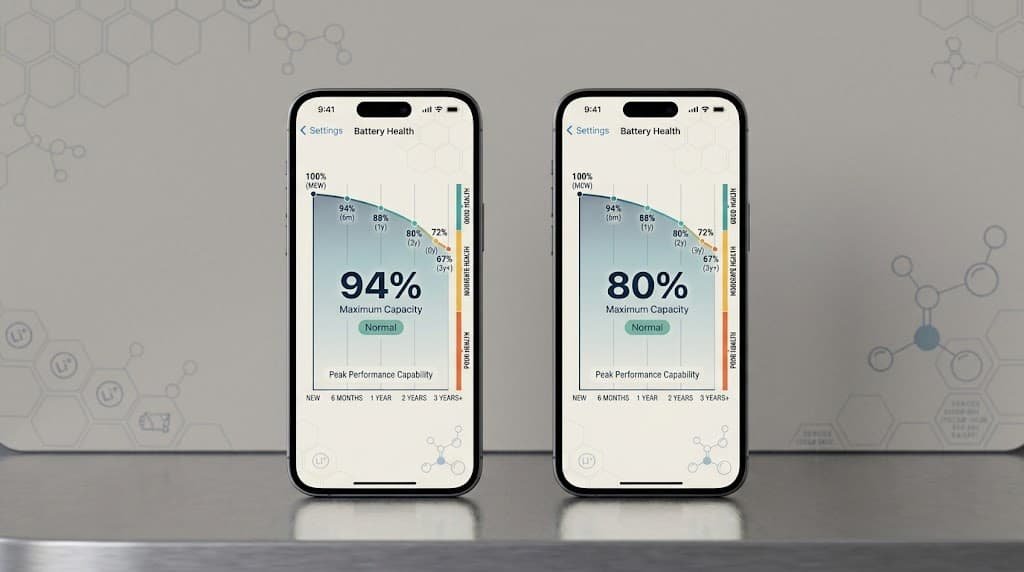
Is 80% battery health considered bad?
Not inherently – it simply means the battery holds about 80% of its original capacity, which many people don’t notice in daily use unless they were already pushing their phone’s battery life to its limit each day. It becomes a more noticeable practical issue once a phone struggles to comfortably last a full day.
Does fast charging damage battery health faster than slow charging?
Fast charging does generate somewhat more heat, which can modestly accelerate degradation, but the effect is generally smaller than popular belief suggests for occasional use. Consistently fast-charging in already-hot conditions has a more measurable impact than doing so occasionally at normal room temperature.
Why did my percentage drop suddenly instead of gradually?
Sudden drops usually indicate something other than normal cycle-based fade – often a software update that recalibrates how the health figure is measured or displayed, rather than the battery itself degrading abruptly overnight. Gradual decline over time is the normal expected pattern; a sharp drop is worth checking against your recent update history first.

