Choosing streaming services that genuinely work for a family comes down to a handful of criteria you can evaluate on any service in front of you, not simply which one has the most impressive total content library. A service chosen purely for content volume often falls apart once multiple family members, each with different content needs and technical comfort levels, actually try sharing it together.
What actually decides this
The deciding factor is how well a service supports genuinely simple, appropriate access for every family member, not simply how many total titles it offers on paper. A family genuinely needs a service that works predictably for the least technically confident household member just as reliably as for the most enthusiastic one, and that appropriately manages content access across different ages within the household.
This matters because most streaming service marketing emphasises total content volume, while a family’s actual daily use pattern – multiple users, varying content appropriateness needs, shared devices – behaves meaningfully differently from a single-viewer assumption most reviews are built around.

The criteria that actually matter, in order
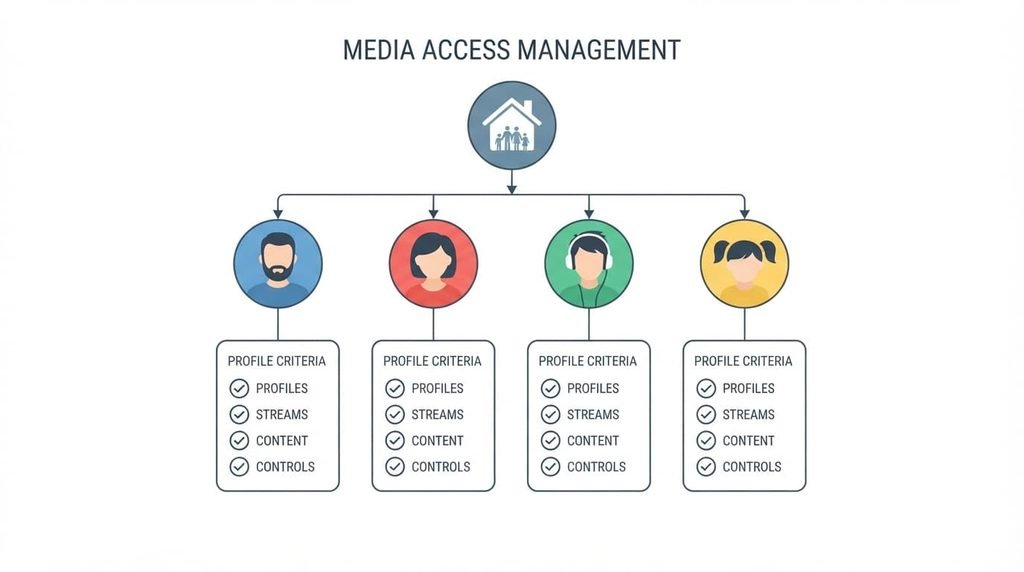
1. Genuine profile separation with appropriate content controls. Look specifically for a service that supports genuinely separate profiles per family member, with content restrictions that actually work reliably for younger viewers, since a service where content controls are easily bypassed or poorly enforced doesn’t genuinely serve a family’s actual needs regardless of its content library size.
2. Simultaneous viewing capacity that matches your household’s actual size. A family genuinely needs enough simultaneous stream capacity for how many people actually want to watch different things at the same time, not simply the capacity a single-viewer household would need – undershooting this specific number creates genuine daily friction.
3. Content genuinely relevant to every family member’s actual interests. A service with an enormous total library provides little practical value if it doesn’t specifically include content your actual family members want to watch – checking for your household’s specific genuine interests matters more than raw total title count.
4. Reasonably simple navigation for less tech-confident family members. A family member less comfortable with technology benefits from a service with straightforward, predictable navigation, since a confusing interface becomes a genuine barrier to independently finding and watching content, regardless of how much content is technically available.
5. Pricing that genuinely reflects your household’s actual simultaneous and content needs. A family shouldn’t pay for premium capacity or features they don’t actually use, nor should they undershoot a tier that leaves genuine daily friction – matching the specific tier to your actual household size and needs matters more than defaulting to either the cheapest or most expensive option.
What doesn’t matter as much as it’s made out to
The single largest total content library is oversold for family use specifically, and it’s the specification many comparisons lead with. A service with an enormous library that doesn’t specifically include what your family actually wants to watch provides little practical daily value compared to one with a smaller but genuinely well-matched selection for your household’s actual interests.
Original or exclusive content gets more marketing attention than it deserves relative to the basic-usability criteria above for typical family use. Impressive exclusive titles matter less day to day than whether every family member can reliably find age-appropriate content and navigate the service independently and confidently.
Matching the choice to your situation
If your family includes young children specifically, prioritise genuine content control reliability most heavily, since this specific factor determines whether the service is actually safe and appropriate for your household, mattering more than content volume or exclusive titles for this particular situation.
If your family members have genuinely diverse, individual content interests, prioritise simultaneous viewing capacity and content breadth more heavily, since your main practical need is likely supporting several different viewing preferences at once rather than everyone consistently watching the same content together.

What to walk away from
Any service where content restriction settings are inconsistently enforced across different devices or apps within your household, despite appearing to work correctly during initial setup, should end your interest immediately regardless of how appealing its content library otherwise appears.
Inconsistent content control enforcement means a restriction that works on one device might not reliably work on another, creating a genuine reliability gap for a family specifically depending on these controls functioning correctly and consistently across every device your household actually uses.

The check before you commit
Before finalising any service choice, test its actual content restriction settings on every device type your household genuinely uses – not just the one you tested initially – to confirm this fallback genuinely works consistently as expected across your actual full setup.
This single check reveals genuine reliability far more accurately than reading marketing claims does, since a control that works well on one specific device or app version can behave differently on another, undermining the actual protection a family specifically needs this feature to provide consistently.
Does the order in which I add family members’ profiles affect anything?
Generally not functionally, though setting up the primary account holder’s profile with full access first, then configuring restricted profiles for younger family members afterward, tends to be the more straightforward setup order most services are actually designed around, reducing the chance of a setting being misconfigured along the way.

What people get wrong about choosing for a family
The most common mistake is choosing based on which service one particularly vocal family member prefers, without genuinely considering the full household’s actual combined needs. A service perfectly suited to one person’s specific taste can still poorly serve a family overall if it doesn’t support the profile, control, or capacity needs the rest of the household genuinely requires.
A second common mistake is assuming a service’s advertised parental control features work identically across every app version and device type without actually testing this directly. Marketing materials describe intended functionality, but actual real-world reliability across your household’s specific mix of devices is worth confirming directly rather than assuming universal consistency.
Questions readers keep asking
How many simultaneous streams does a typical family genuinely need?
This varies by household size and viewing habits specifically, but counting how many people in your household actually want to watch different content simultaneously during peak times, rather than assuming a generic number, gives a more accurate sense of your genuine requirement.
Do all streaming services offer genuinely reliable parental controls?
No, this varies considerably by specific service, so testing a service’s actual controls directly on your household’s specific devices, rather than assuming this is a universal standard feature, is worth confirming before committing specifically for family use with younger viewers.
Is it worth involving the whole family in the decision, or should one person choose for everyone?
Involving at least a brief check with each family member about their genuine content interests tends to produce a more satisfying overall choice than one person deciding unilaterally, since a service chosen without input from other household members risks poorly matching interests you weren’t fully aware of when making the decision alone.
Is it worth subscribing to multiple services rather than consolidating into one for a family?
This depends on whether one single service genuinely covers your family’s full range of content interests – if it doesn’t, multiple more targeted services can sometimes serve a family’s actual diverse needs better than one broad service that satisfies no one member particularly well.