A hinged lid and a pedal say a lot about how a kitchen sorts its rubbish, and so does a bag that never quite fits. Choosing two small bins or one divided bin for an under-sink cupboard comes down to one question about the household. How unevenly do its two streams fill? This example kitchen is Dutch, with a cupboard opening of 56 cm and a depth of 50 cm, used by three people. Each figure is invented, so swap in a week of your own tallies. I’d decide by the ratio and ignore the catalogue photos, and the sums below show why. Nobody needs special equipment for this, only a clear count.
Two Bins or One Divided Bin: What Decides the Choice
Here, sorting at home covers two streams: one for recyclables, plus one for everything left over. Your municipality may split them further, yet two streams are enough to show the logic.
Each stream needs a container that fills at its own pace. In our house the recyclables run at 9 L a day and the general rubbish at 4 L a day. That’s a ratio of 2.25. The deciding factor is that the two streams rarely fill at the same speed. A divided bin gives each side the same volume, while separate bins can be matched to the pace.
Say the divided bin has 20 L on each side. The recyclables side is full after 2.2 days, so you’ll empty it on the second day at 18 L. The general side would take 5 days to fill. You make the trip for the busy side, and the other side rides along half used. Over a year that pattern adds up, since the busy side sets the pace for the whole bin.
Separate bins break that link. A 27 L bin for recyclables lasts exactly 3 days, and a 12 L bin for everything else also lasts 3 days. Both go out in the same trip, which is why matching sizes to the pace pays off.
Two Small Bins or One Divided Bin Compared Across a Week
Each row below draws on the arithmetic earlier, and a ruler plus a bucket will let you check every one in your own kitchen. Rows about trips assume you empty a bin on the last day before it would overflow, which is what most people do.
| Measure | Two small bins | One divided bin |
|---|---|---|
| Compartment sizes | 27 L and 12 L | 20 L and 20 L |
| Floor used in the 2,800 cm² cupboard | 1,512 cm² (54%) | 1,748 cm² (62%) |
| Width used of the 56 cm | 44 cm | 46 cm |
| Days until the busier stream is full | 3 | 2.2 |
| Emptying trips per week | 2.33 | 3.5 |
| Emptying trips per year | 121 | 182 |
| Lids to open | 2 | 1 |
Floor space barely separates them, because the pair uses only 236 cm² less than the single unit, and a cupboard with a spare 10 cm can host either. Trips tell a different story. The gap of 61 a year comes entirely from the 2.25 ratio between the streams, which makes the cupboard layout matter far less than the rubbish itself. That’s the number worth measuring before you shop, and counting it once means you won’t need to guess.
When Two Small Bins Win
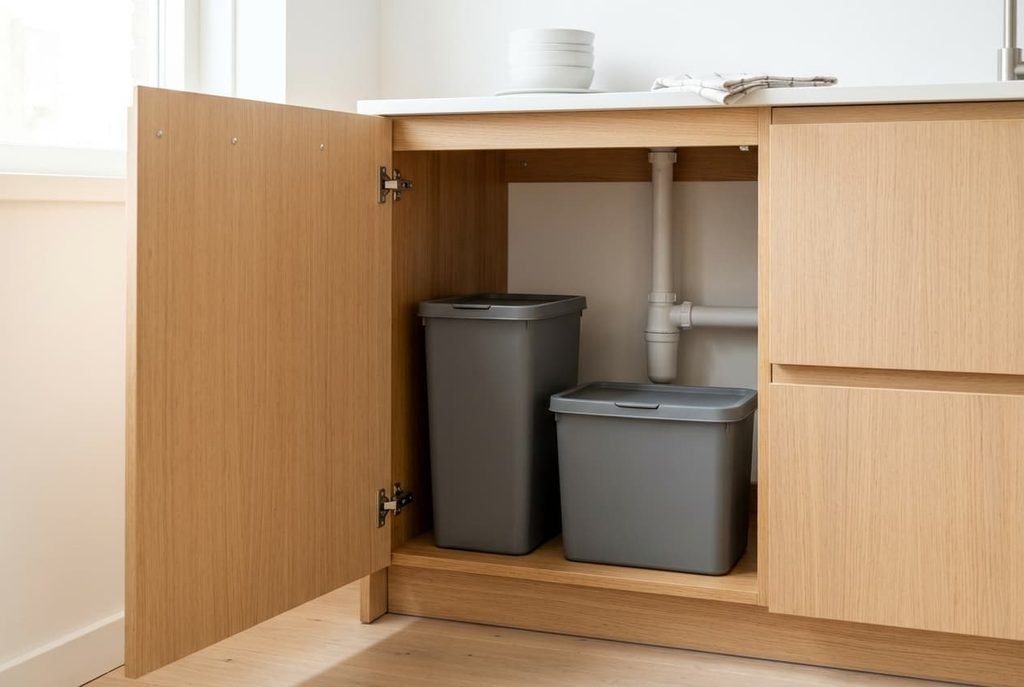
This pair fits a home where one stream is clearly the bigger one. Sizes follow the sums. The 27 L bin reaches roughly 30 cm in height on a 24 by 38 cm base, and the 12 L bin reaches 20 cm on 20 by 30 cm. Their total of 44 cm leaves 12 cm beside them for the waste pipe. A divided bin often leaves no room for it.
Freedom of position is the second gain. With two small bins or one divided bin in the same cupboard, only the pair can be split up. The 12 L bin can live in the next cupboard along or on a door-mounted frame, and the big bin keeps the best spot.
Washing is simpler as well, because you can rinse one bin while the other stays in use.
The costs are real. You lift two lids, and odd sizes mean liners cut to fit. A visitor doesn’t know the second location either, so a label inside the door helps.
When One Divided Bin Wins
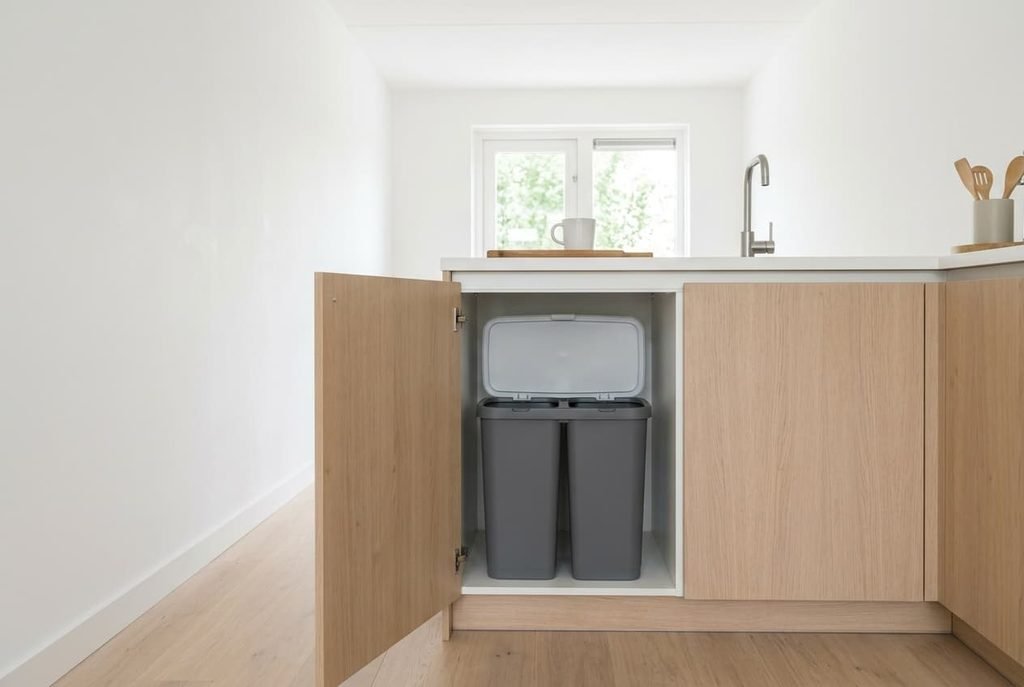
A divided bin earns its place where both streams grow at a similar rate. Say recyclables run at 7 L a day and general rubbish at 6 L, a ratio of 1.2. A pair of 22 L sides then lasts 3.1 days on the busy side, which fits a three-day schedule. Both bags go out together, and the matched pair gains nothing on trips.
The single unit has real virtues. One lid opens with one hand, and one handle lifts it out. The shared wall saves a few centimetres, and nothing wanders across the cupboard floor when the door closes. Guests find it quickly, since the two openings sit side by side.
It also suits a cupboard of awkward shape. A single block of 46 by 38 cm slots into a clear rectangle, while two bins need the pipe to bend around them.
The weakness is the fixed split. Equal sides suit an even household and punish an uneven one. When the single hinge breaks, both streams lose their lid, and that’s a nuisance you won’t have with two bins.
A Third Way That Skips the Sink Cupboard
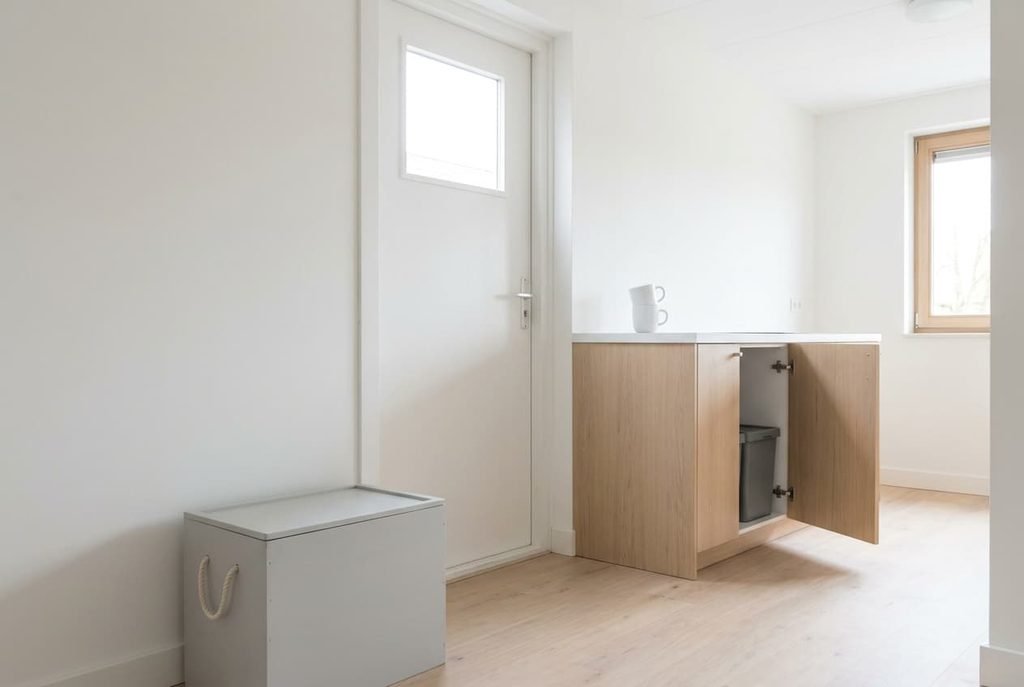
Before you buy two small bins or one divided bin, look at where the sorting actually happens. Many households sort at the door, because the recyclables leave the kitchen anyway. A single bin for general rubbish plus a lidded crate by the back door for recyclables moves the bulky stream out of the cupboard.
The crate takes the 9 L a day straight from the worktop in one carry. The cupboard then holds only the 4 L stream, so a 12 L bin fits with 36 cm of width spare. That cuts the floor used to 600 cm², or 21% of the cupboard.
It has limits. A crate in the hall collects dust and adds a visible object, so it works best where the back door is tucked away. Rinsing a container before it goes in also happens at the sink, and the crate is only a short walk from the tap. Keeping your present bin is a fair choice too, if it empties every three days and rarely overflows.
Choosing Between Them in Thirty Seconds
Spend a week writing down how many bags of each stream leave the kitchen, or use a bucket to measure litres. Divide the busier figure by the quieter one, then apply the rule when you weigh two small bins or one divided bin.
If the ratio is above 1.8, choose two small bins sized to the daily volume, and give the busier one a 3-day capacity. Our ratio of 2.25 sits there.
If the ratio is 1.4 or lower, choose the divided bin with each side holding three days of the busier stream. Anything between 1.4 and 1.8 is a tie, so pick whichever fits the cupboard.
A ratio changes after a baby or a student leaves home, so repeat the week once a year.
Bins are small objects with big effects on a kitchen’s rhythm. The decision rests on one division and one tape measure. Check the ratio first, then pick the bins. The trip to the outdoor containers then shrinks to what your household really needs, and the cupboard stops overflowing on the busiest days. It’s a small change, yet it removes a chore you’d otherwise repeat about 60 times a year.
Questions Readers Keep Asking
How long does a bin of this kind last?
A rigid plastic bin with a metal hinge typically lasts years, and the hinge is the part that fails first. A divided bin has one hinge for its shared lid, so a failure costs you both streams. Two separate bins fail singly, and replacing a single lid is cheap.
How do I keep either type from smelling?
Empty the food-heavy side every three days, wash the inside with warm soapy water, and dry it before a new liner goes in. A divided bin is lifted out whole, while a separate bin can be washed alone. Leave the lid open for an hour after washing.
Which suits a very narrow kitchen?
Neither wins on floor space, since our pair takes 44 cm of width against 46 cm for the divided bin. A cupboard narrower than 46 cm rules out the divided unit. The pair or the crate then makes sense. Two small cupboards also favour separate bins, because the busy stream can sit beside the door.