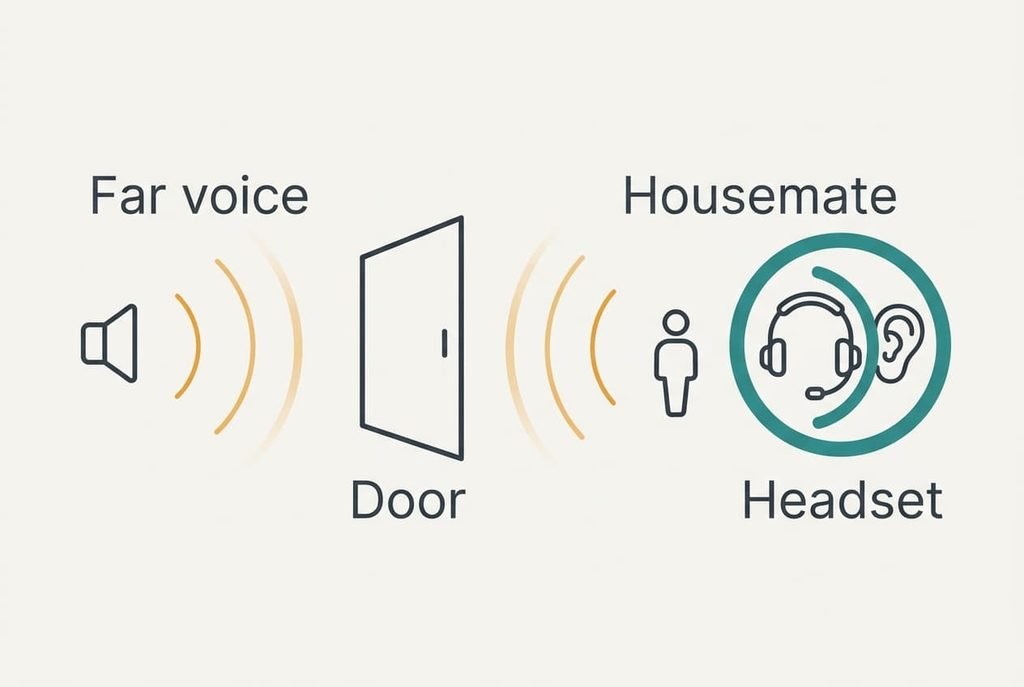
The audience decides this choice long before comfort comes into it. A speakerphone plays the other person’s voice into the whole flat, while a headset keeps it at your ears. Pick a headset when anyone else sits within 3 m and the door is open. Pick a speakerphone when you’re alone behind a shut door or sharing the call. That settles a headset or a speakerphone for most flats, and the thing to watch is where the far voice travels. Our sums use a flat in Manchester with a desk in the living room and a housemate in the kitchen 3 m away. Every level is an assumed round figure.
What Decides a Headset or a Speakerphone in a Shared Flat
Sound fades by roughly 6 dB with every doubling of distance. Rooms reflect it, so real flats lose a little less, and our figures are best read as a floor for the spill.
Say the speakerphone is set so you hear the far voice at 55 dB from your seat 60 cm away. Your housemate is five times farther off, which is 2.3 doublings and a drop of 14 dB. They hear 41 dB. A quiet flat sits near 30 dB, so the call stands 11 dB above the background and can be followed.
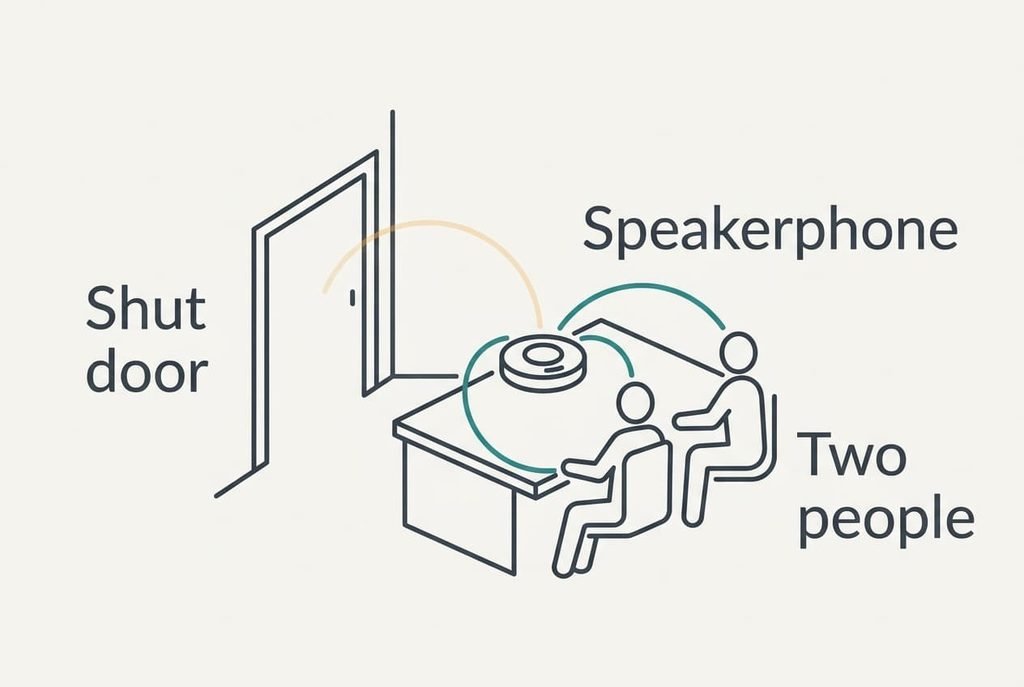
Shut the door and assume it removes 20 dB. The call reaches the kitchen at 21 dB, 9 dB under the background, and nobody hears a word. A closed headset leaks so little that we’ll assume 15 dB at the same spot, whatever the door does.
Put together, the far voice reaches your housemate at 41 dB from a speakerphone and 15 dB from a headset, a gap of 26 dB. Comfort and battery life both matter, yet each is smaller than that gap and easier to live with. Spill is the only property that affects other people, and a setting can’t repair it later. Weigh spill first. Everything else is a tie-breaker.
How the Two Compare on Spill and Pickup
| Property | Headset | Speakerphone |
|---|---|---|
| Far voice at 3 m, door open | 15 dB | 41 dB |
| Far voice at 3 m, door shut | 15 dB | 21 dB |
| Mouth to microphone | 3 cm | 60 cm |
| Housemate at 3 m, against your voice | 40 dB down | 14 dB down |
| People who can share one call | One | Several around the desk |
| After two hours of calls | Pressure from the band | Nothing on your head |
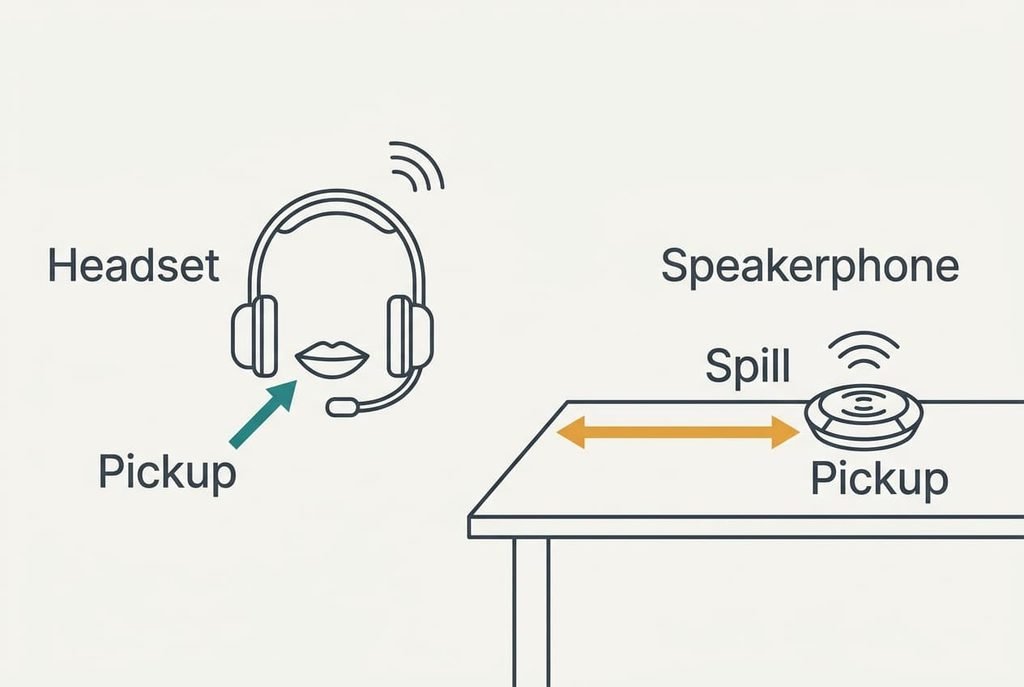
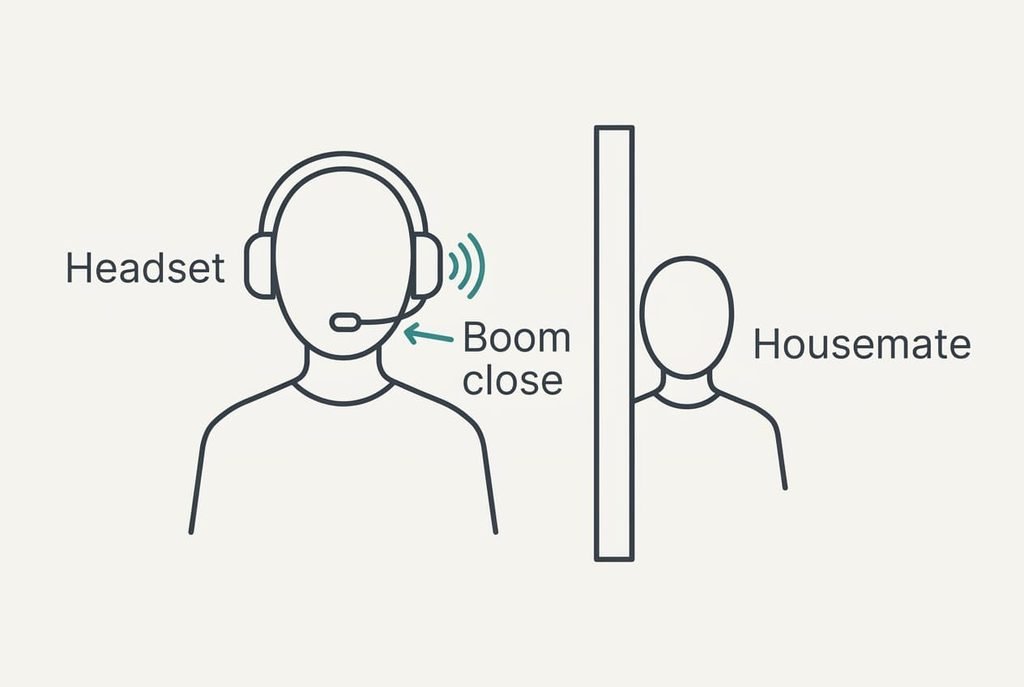
Row four is the surprising one, because a headset also shields your call from the flat. With the boom at 3 cm, a housemate 3 m away arrives 40 dB below your voice. A microphone at 60 cm leaves them only 14 dB down, and that’s why callers hear the kettle.
The two devices differ on six properties, all measured in the same flat from the same desk. Rows one and two carry the spill from the last section. Rows three and four carry the pickup. The table scores a headset or a speakerphone with no row for cost or speed, because those change between models while distances and doors don’t.
A different flat moves the numbers but keeps the order.
Where the Headset Wins
It wins whenever the call has an audience you didn’t invite. Open-plan living rooms and thin partition walls both put a housemate inside the 11 dB zone from earlier. So does a kitchen that shares a doorway with the desk.
A speakerphone call at 41 dB would fade into the background only at 3 × 10^(11 ÷ 20), which is about 10.6 m. No flat offers that distance, so everyone in it hears the call.
It wins on privacy as well. A client’s name or a salary figure becomes audible to the kitchen on a speakerphone. On a headset the kitchen hears only your half of the conversation.
It wins in noisy flats. The boom keeps the microphone 3 cm from you. The washing machine and a housemate’s music sit 40 dB below your voice, and most of that never reaches the call.
You pay in comfort and tether. The band presses on your ears after two hours. A lead or battery also limits how far you can walk.
Where the Speakerphone Wins
It wins when nobody else is in earshot. Behind a shut door both options fall under the 30 dB background. The levels are 15 and 21 dB. A headset or a speakerphone then comes down to comfort.
It wins when the call has more than one person at your end. A colleague can sit at the same desk and both of you are heard, which a single headset can’t do without passing it back and forth.
It wins on long days. Four calls of 45 minutes add up to three hours with a band on your head. A speakerphone asks nothing of your ears and lets you stand up and stretch between speakers.
It wins when hands and head need to be free. Taking notes, checking a document across the room or walking about within 2 m of the desk all work without a lead.
You pay in privacy and pickup. The microphone sits 60 cm away, so it hears the flat as well as you.
When Neither a Headset nor a Speakerphone Fits
Neither device helps when your own voice is the problem. A speaking voice of 60 dB at 1 m reaches a housemate 3 m away at about 50 dB with the door open. A headset keeps the far voice private, yet it can’t hide what you say.
Look for the signs. Your housemate asks you to keep it down, or they close their own door as you start. They may start wearing earplugs for your calls.
Move the call behind a shut door or into another time slot, and the same voice drops to roughly 30 dB, level with the background. A room with a door, a phone booth at work or a quieter hour all do what no device can.
A foam panel or a rug changes little here. They soak up the room’s reflections and leave the direct path to the kitchen as loud as before.
Choose the device second, once the place is settled.
Two Branches to Settle It
If anyone else is within earshot with the door open, choose the headset. The 26 dB gap protects them, and the 3 cm boom protects your call from the flat. Wear it for the whole call, because one earcup off lets the far voice into the room. You accept a band on your ears and a lead or battery in return.
If you’re alone behind a shut door, or two of you are sharing the call, choose the speakerphone. Nothing spills past 21 dB. Your ears and hands stay free. A headset or a speakerphone matters least in this branch, so go with whichever sits more comfortably. Set the volume once at a level you can follow from 60 cm, and leave it there.
Test before you decide. Place a call from your desk at your usual volume, and ask your housemate to stand where they usually sit. If they can follow a sentence, the speakerphone fails in your flat. A housemate who hears only murmur means it passes. Run it again with the door closed, since that one change often settles the question. Note what they heard, and the answer holds while the flat stays as it is.
Questions Readers Keep Asking
How much effort does a headset add to a day of calls?
Very little. It takes a few seconds to put on, and a quick morning check of the lead or battery covers the rest. The real effort is comfort. If calls run past two hours at a stretch, take a short break between calls to rest your ears.
What tends to fail first on each?
A headset usually fails at the plug or the boom hinge, or when the battery runs flat mid-call. Speakerphones rarely break. Hard bare walls hand your voice back late, That muddies the call. A rug helps. A shut door helps more.
Which suits two people on one call?
Choose the speakerphone, because both voices sit within reach of the same microphone at under 1 m. A single headset serves one person only. If each of you needs a headset, join the call as two separate attendees from two devices.