A pendant hung at 150 cm sits 71 cm from the page of a book, while a sconce at 120 cm sits 40 cm away. That gap decides a pendant light or wall sconce beside the bed in a small bedroom. At that distance the sconce needs less than a third of the lumens. Take the sconce if you read in bed, and the pendant if you don’t.
The example room is Dutch, 280 × 300 cm, with a 250 cm ceiling. The bed measures 160 × 200 cm, and its mattress top stands 50 cm high. Every position is an example, so run a tape to your own page before you drill anything.
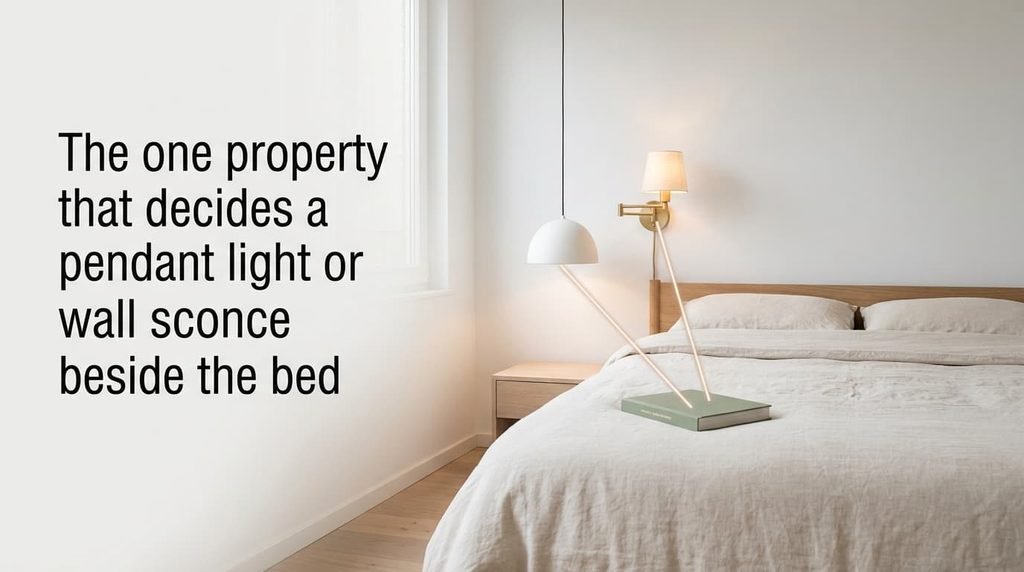
The one property that decides a pendant light or wall sconce beside the bed
Light spreads out as it travels, so the distance from lamp to page sets how many lumens you must buy. Illuminance is the light that lands on a surface. It falls with the square of the distance: lux = lumens ÷ (4π × d²) for a bulb that radiates evenly. Halve the distance and the page gets four times the light. The box lists lumens, but the page receives lux.
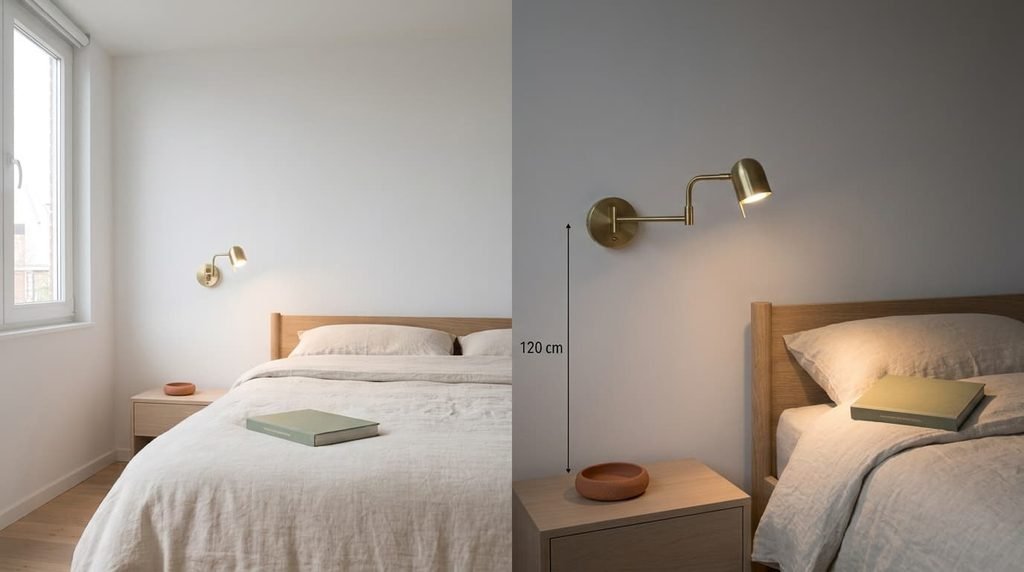
Here the reader sits against the headboard. The book is at 95 cm height, 30 cm from the wall and 45 cm to the side of the nightstand. A pendant hangs from a ceiling hook 25 cm from the wall, with its bulb at 150 cm. That bulb sits 71 cm from the page. A sconce mounted at 120 cm projects 12 cm from the wall. Its bulb sits 25 cm to the side of the page and 40 cm away overall.
Aim for a round 200 lux on the page. The sconce reaches it with a 400 lumen bulb. The pendant needs 1,280 lumens, which is 3.2 times as much, and it lights the whole bed. A partner who isn’t reading gets the same flood. Shades and angles change the figures, but the square law stays. A 400 lumen bulb throws the same light whether it hangs or stands, so only the distance moves the result.
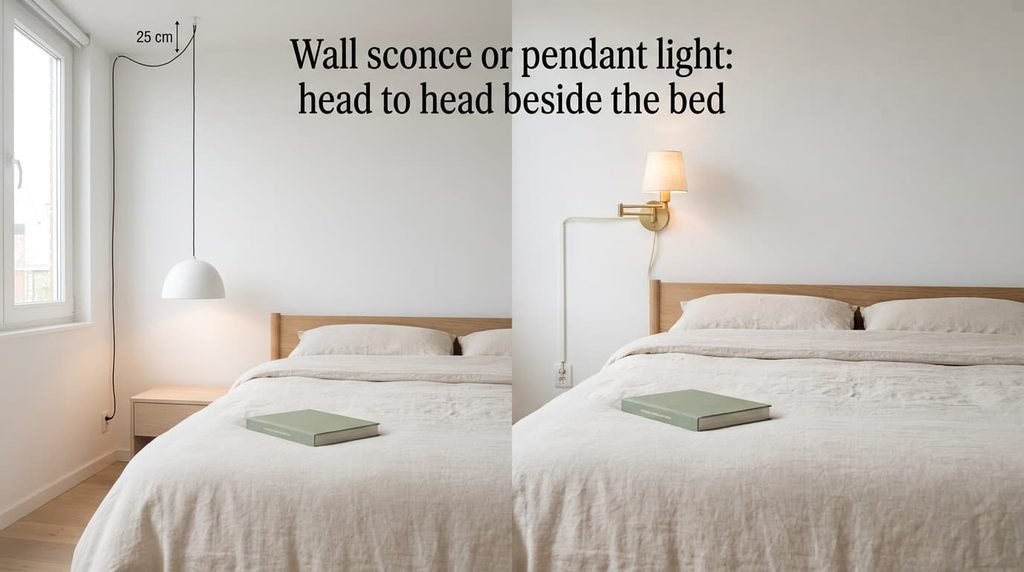
Wall sconce or pendant light: head to head beside the bed
| Question | Pendant light | Wall sconce |
|---|---|---|
| Distance to the page in the example | 71 cm | 40 cm |
| Lumens for about 200 lux on the page | About 1,280 lumens | About 400 lumens |
| What it uses up | One ceiling hook 25 cm from the wall and nothing on the wall, so the wall stays free for a headboard or a shelf | Two screws in the wall at 120 cm and the 40 cm of wall around them, which a tall headboard can cover |
| Cable to the socket at 30 cm | About 250 cm of swag over the ceiling edge and down the wall | About 100 cm of cord in a wall channel |
| Aiming the light | Hangs straight down, so the beam can’t turn and lights both sides of the bed | A swing arm turns the beam down onto the page and away from your partner |
| If you rearrange the room | The hook stays where it is, so the lamp is wrong the moment the bed moves | The holes stay where they are, so the sconce is wrong the moment the bed moves |
| Exit from a rented room | One hook hole of 6 mm in the ceiling and a dab of filler | Two holes of 6 mm and the glue marks of the channel |
Rows one and two come from the square law, and the rest is housekeeping. Weigh them in that order.
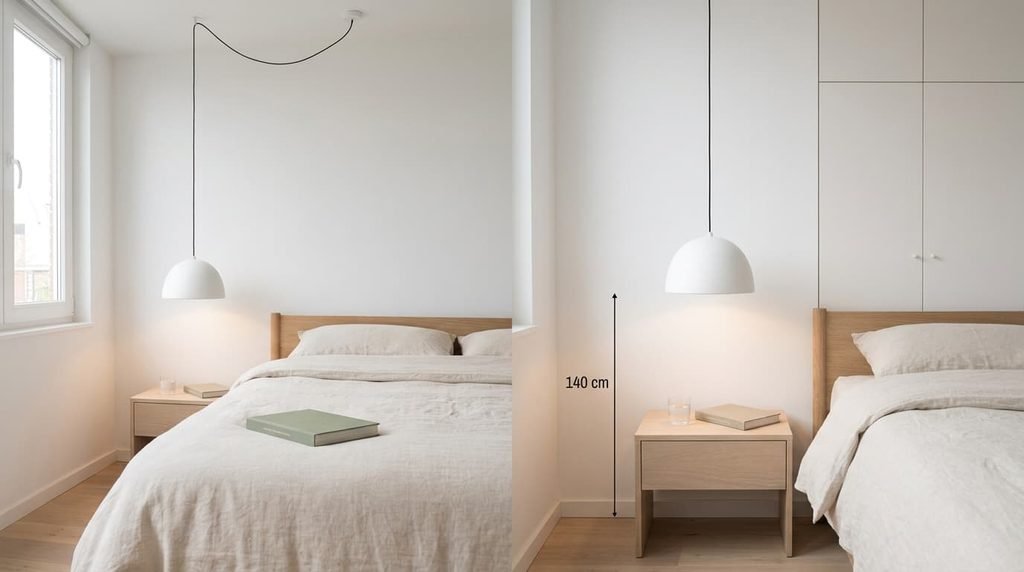
Where a pendant light wins beside the bed
A pendant light or wall sconce beside the bed can each leave the table free, but only the pendant spares the wall. It wins when nobody reads in bed. It only has to show you the room. A 400 lumen bulb at 71 cm gives about 63 lux, which is plenty for getting in and out. It also wins when the wall is spoken for. A window or a wardrobe, or a 30 cm gap beside the headboard, leaves no 40 cm of bare wall at 120 cm. The ceiling is then the one surface still free.
It leaves the wall untouched, and the exit bill shrinks to a single hook hole and a dab of filler. The table top stays free too, because the lamp hangs 25 cm from the wall rather than standing on it.
The limits are lumens and spill. Reading from it needs 1,280 lumens, and that much light reaches your partner’s side of the bed. The swagged cable also crosses the ceiling in plain sight, so plan its route before you buy.
Where a wall sconce wins beside the bed
A sconce wins when you read in bed, which is the night-to-night case for a pendant light or wall sconce beside the bed. At 40 cm from the page, a 400 lumen bulb gives 200 lux. That means a soft warm bulb that doesn’t flood the bed. A swing arm turns the beam down onto the page and away from your partner. It also keeps the nightstand clear, which matters when the table is only 40 cm wide.
Its cord runs down the wall, so it stays short: about 100 cm in a channel, against 250 cm of swag.
The limits are the wall and the bed. You need 40 cm of bare wall at 120 cm, and a headboard taller than 110 cm hides the sconce’s arm. Two 6 mm holes and the glue marks of the channel come off the deposit, so check the lease first. Move the bed and the sconce stays where it was, which may not suit the new position. Mount it 25 cm to the side of where the page will sit, not above the pillow.
When neither is right
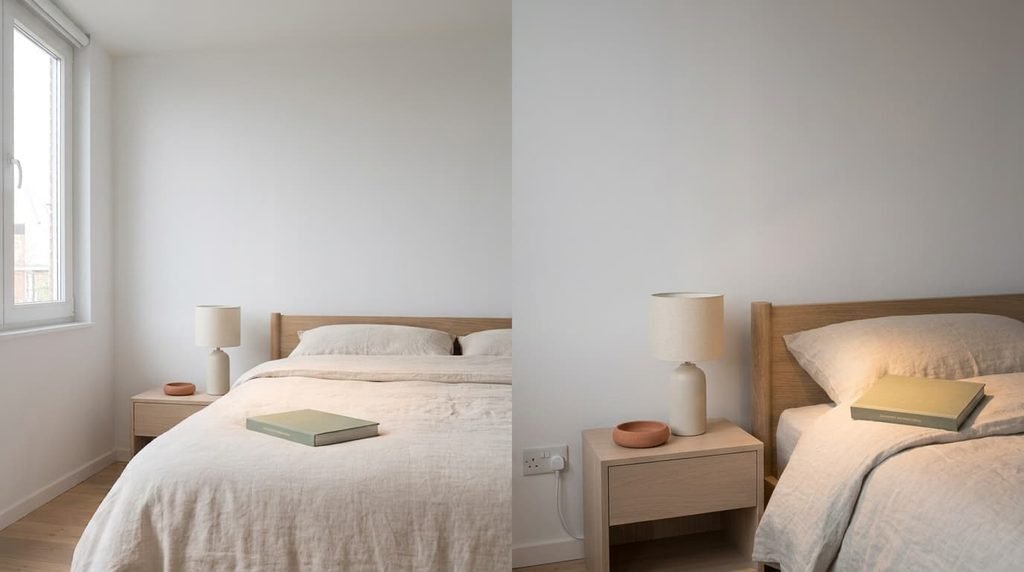
A table lamp you already own can replace both when your reading is occasional. It’s the third answer to a pendant light or wall sconce beside the bed. With its shade centre at 85 cm on a 55 cm nightstand, it sits 46 cm from the page. That needs only about 540 lumens for the same 200 lux, which a standard bedside bulb can supply. The cord runs only 30 cm to the socket at 30 cm height, so nothing crosses the room.
It needs no hole and no cable route.
The limit is the table. A base 15 cm across takes about an eighth of a nightstand 40 × 35 cm. A lamp in that spot gets knocked, so choose a base that outweighs the cord. Turn the shade so its opening faces the page and the seam faces the wall, which keeps the light where you read.
Keep it for the months before you decide. A lamp you have is cheaper than a hole you regret.
How to decide in thirty seconds
Hold a tape from the spot where a bulb could sit to your page, with a book open as you read. If you read in bed for over 20 minutes a night, take the wall sconce. Mount it so the tape reads 45 cm or less.
If you only switch the light on to get into bed, take the pendant and hang it over the nightstand. Count a lease that bans two wall holes as a vote for the pendant or the table lamp. A pendant also suits a room where the bed gets moved often, since one hook is easier to live with than two holes.
A pendant light or wall sconce beside the bed is judged by distance first and style second. The example sconce reached the page at 40 cm with 400 lumens, and the pendant needed 1,280. Measure your own distance before you shop, then check the lumens printed on the box. A shade that throws light down only will shift the numbers, and I can’t see your shade from here.
Questions readers keep asking
Does a pendant light or a wall sconce last longer?
Neither ages quickly in a bedroom, and the weak point is the fixing. Ceiling hooks carry a light fitting for years. Swing-arm joints loosen as they move, so tighten one once a year with a small screwdriver. Fixed wall sconces outlast both.
Which is easier to keep clean?
The sconce is easier, because dust settles on a small arm and shade you can wipe in a minute. Pendants collect dust on top of the shade, where it can’t be seen, and the swagged cable needs dusting too. Clean either twice a year.
Which suits a small bedroom better?
In a room under 300 cm wide, the sconce keeps the nightstand clear, which is the scarcest surface. A pendant suits the room only if nobody reads in bed. For occasional reading, a table lamp on a 40 cm table does the job with no holes.