Internal doors that slam shut whenever a window is open follow a pattern you can measure. Air pushes on the leaf, and a leaf that hangs a fraction out of true adds to the push. The test door measures 83 by 201 cm, in an Utrecht flat on the second floor with a hallway of 100 cm. Three quick checks name the culprit. Four remedies come next, starting with the free ones and ending with a handyman. Each tackles a different mechanism, and every figure belongs to this one flat, so measure yours. Nothing here needs special skill, and each remedy comes with its cost and its limit written out.
Why Internal Doors That Slam Shut When a Window Opens
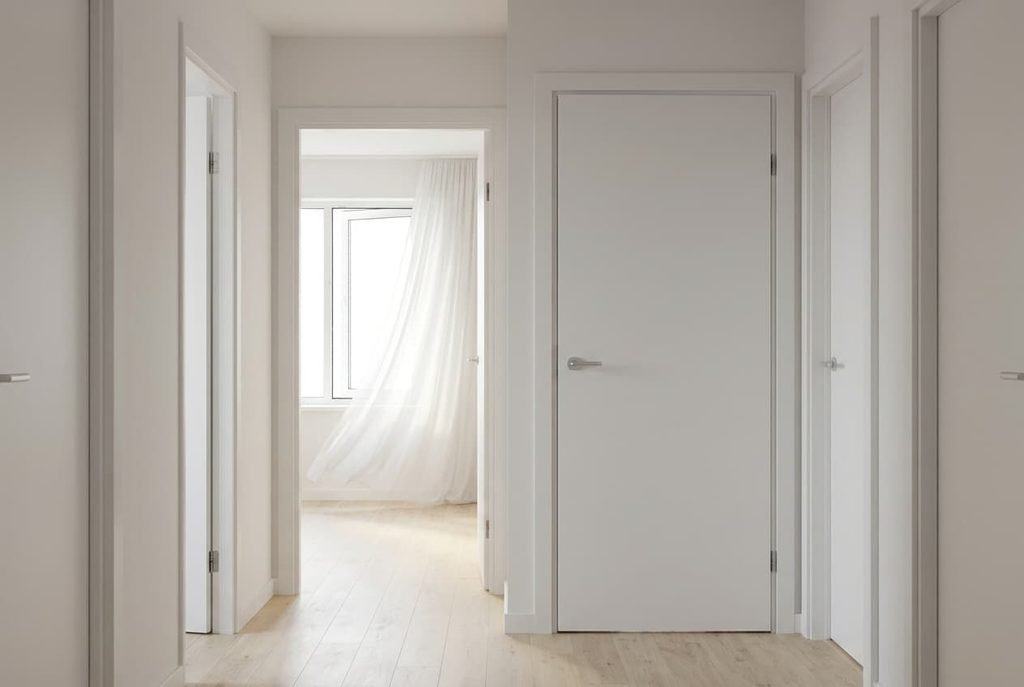
Open a window on the windward side and air starts to cross the flat. A breeze of 4 m/s carries a dynamic pressure of about 10 Pa, and a difference of that size can build up between the two faces of a door. A leaf of 83 by 201 cm has an area of 1.67 m², so 10 Pa pushes on it with roughly 17 N. That push acts about 41 cm from the hinges, which gives a turning force of 7 N·m, plenty to swing a door held only by a thin latch.
Weight adds a second effect. A door whose hinge line leans by 5 mm over its height carries a steady pull of 0.25 N·m towards one side, because gravity drags a 25 kg leaf round a tilted axis. That’s only 4% of the push from the breeze, yet it settles which way the door drifts when the air is almost still.
Momentum supplies the bang. A leaf closing at 1 m/s at its free edge arrives with about 4 J of energy, and every joule ends up in the latch and the frame. Cut the speed to a fifth and the energy falls to 0.16 J.
The signs differ for each cause, so a few cheap tests can tell the three apart.
Confirming Which Internal Doors Slam Shut and Why
Close every window before you start. Then run three tests and note what each one shows.
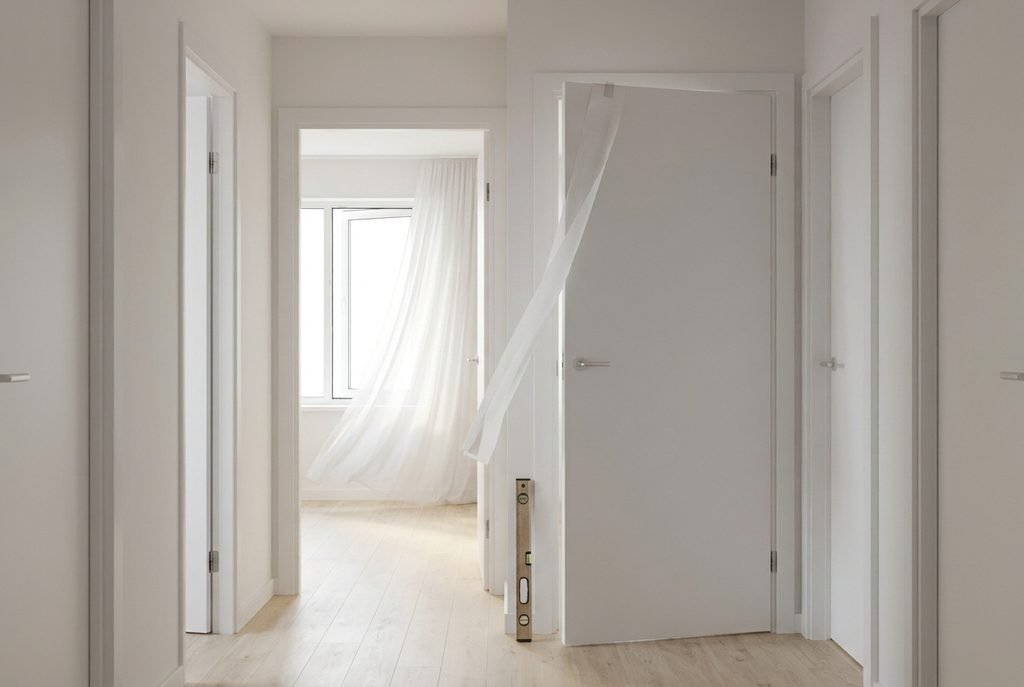
The first test uses a strip of tissue 2 cm wide. Tape it along the upper edge of the leaf so it hangs across the gap. Open the window and watch which way it points. A tissue that streams towards the hallway shows air leaving through the gap, which means the push from the last section is at work. The second test needs a spirit level. Hold it against the frame on the side where the hinges are and read the bubble. A bubble that sits clearly off centre shows a lean. The third test takes patience. With every window shut, open the door to 45° and let go. A door that closes by itself within a minute is drifting under its own weight.
Internal doors that slam shut often show more than one sign at once. Time the swing with the window open. Ours closes fully in 4 seconds.
Tissue streaming out of the gap points to remedy one, and a leaning frame points to remedy two.
Four Fixes When a Door Slams With the Window Open
Give the air another way through: this one removes the pressure difference, and it costs only a little warmth. Open a second window on the sheltered side by 2 cm. Air now crosses the flat without squeezing past the door, so the 17 N push drops to almost nothing. Confirm it with the tissue strip, which should hang straight. A window left open while you’re out invites trouble and lets in rain, and the sheltered side may face a busy street. Close it before you leave.
Set the hinges true: here the target is the lean. Loose hinge screws let the leaf sag, which tilts the axis, so tighten each one first. If the bubble still sits off centre, slip a strip of card behind the lower hinge and nudge the axis upright. Repeat the 45° test afterwards, because a leaf that stays put has lost its drift. The tools are a screwdriver and fifteen minutes. A frame more than a few millimetres out of plumb defeats the card, and then the lean returns whenever the weather calms.
Hold the door open against a magnet: this purchase answers the push with a restraint. A magnetic holder with an adhesive floor plate grips the leaf in its open position and resists about 20 N, a little more than the 17 N from the breeze. It’s a small purchase. It only works when you open the leaf all the way onto the plate, and a door that has been closed still depends on its latch. Fit the plate where the leaf lands, then lower the leaf onto it and feel the grip.
Fit a damper on the closing edge: this remedy goes after the bang instead of the push. A handyman fixes a hydraulic arm between the frame and the upper edge of the leaf, and it cuts the speed over the last 10 cm to roughly 20% of its old value. The impact energy then drops from 4 J to 0.16 J. Expect the highest bill of the four, plus a request to the landlord. The door still shuts in a gust. It does so slowly and quietly. Ask for a backing plate if the frame is thin.
What Your Own Hallway and Doors Allow
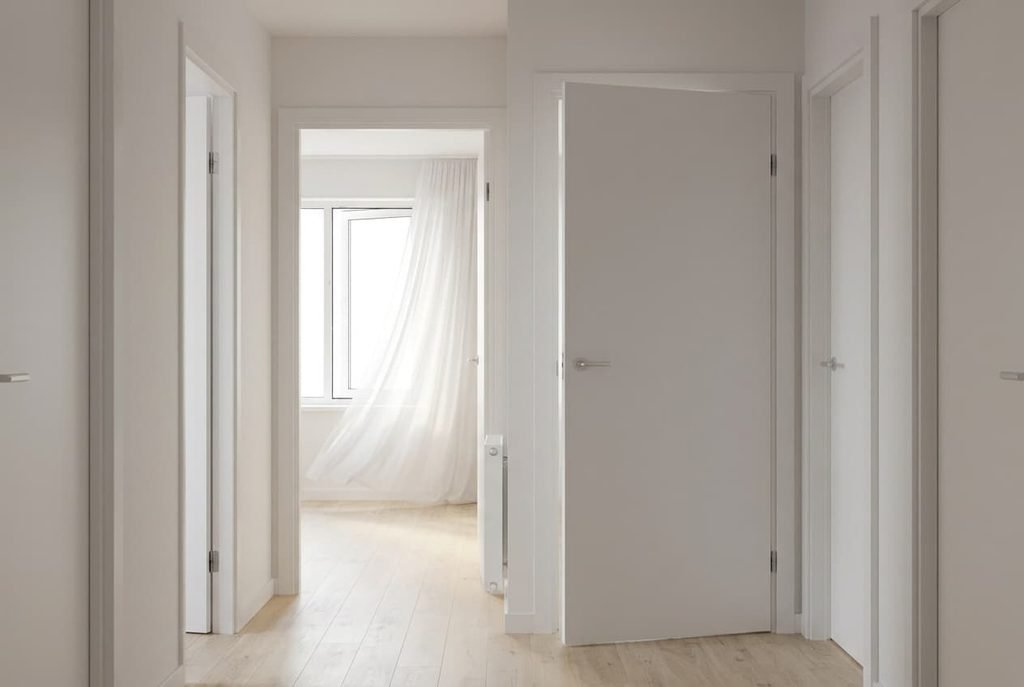
Our hallway is a metre wide, and the bedroom door swings into it. A radiator stands on the wall the open leaf swings towards, so the leaf can open only to about 80° before it meets the metal. A magnetic holder must catch it at that angle, not at 90°.
The frame is steel set in brick, and the tenancy forbids new screw holes. That rules out a damper unless the landlord agrees to two small holes. The frame and the radiator can’t be moved, so a tenant can try the first three remedies without asking anyone.
The space beneath the leaf sets a third limit. It’s 2 cm high and 83 cm wide, which gives 166 cm² of opening for air to leave through. In this flat internal doors that slam shut are partly the gap’s doing, and blocking it makes things worse, which the final section explains.
The Fix That Doesn’t Work
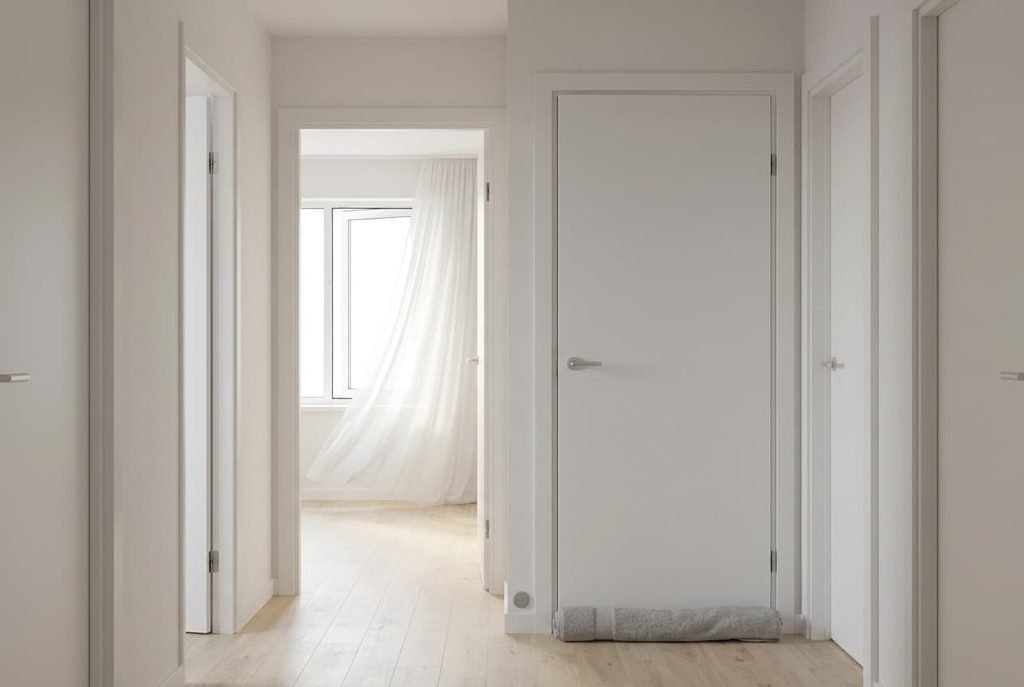
A rolled towel against the foot of the door is what most tenants grab first, and it makes matters worse. The towel closes the 2 cm gap that lets air leave. With no way out, the pressure difference grows, so the push on the leaf grows too, and the door slams harder than before.
Rubber dots on the frame fail for a different reason. They soften the sound of one hit, but the leaf still closes the moment the breeze builds, and the dots flatten within a month. A folded paper wedge under the leaf compresses on the first gust and slides out. String from the handle to a hook holds the leaf back for a while. The handle and the string then take all 17 N between them, and one of them gives way.
If internal doors that slam shut are wearing out your frame, spend five minutes on the tissue strip tonight. Whatever it shows tells you where to begin. Try one remedy. Then open the window and watch the door before adding the next. Note the swing time before and after each change to see the gain. Most flats calm down after the first two remedies. The magnet and the damper are for stubborn cases.
Questions Readers Keep Asking
Can a draught really slam a heavy door?
Yes. A light breeze can put about 17 N on a standard leaf, enough to turn it against a thin latch. A heavy door has more weight, but it also has a bigger area for the air to push on. That’s why a solid leaf in a draughty flat bangs just as hard as a hollow one.
What does each fix cost, in relative terms?
Two remedies cost only time and a screwdriver. The magnetic holder costs about as much as a couple of coffees. The damper costs noticeably more and needs permission in a rental, so it sits last for good reason: the cheaper steps usually do the work and leave the damper unneeded.
What is the most common cause?
A window opened on one side of the flat while every door and vent on the other side stays shut. The air has nowhere to go except through the door gaps, so the pressure difference builds. The tissue test finds this in a minute, and opening a second window by 2 cm usually cures it.