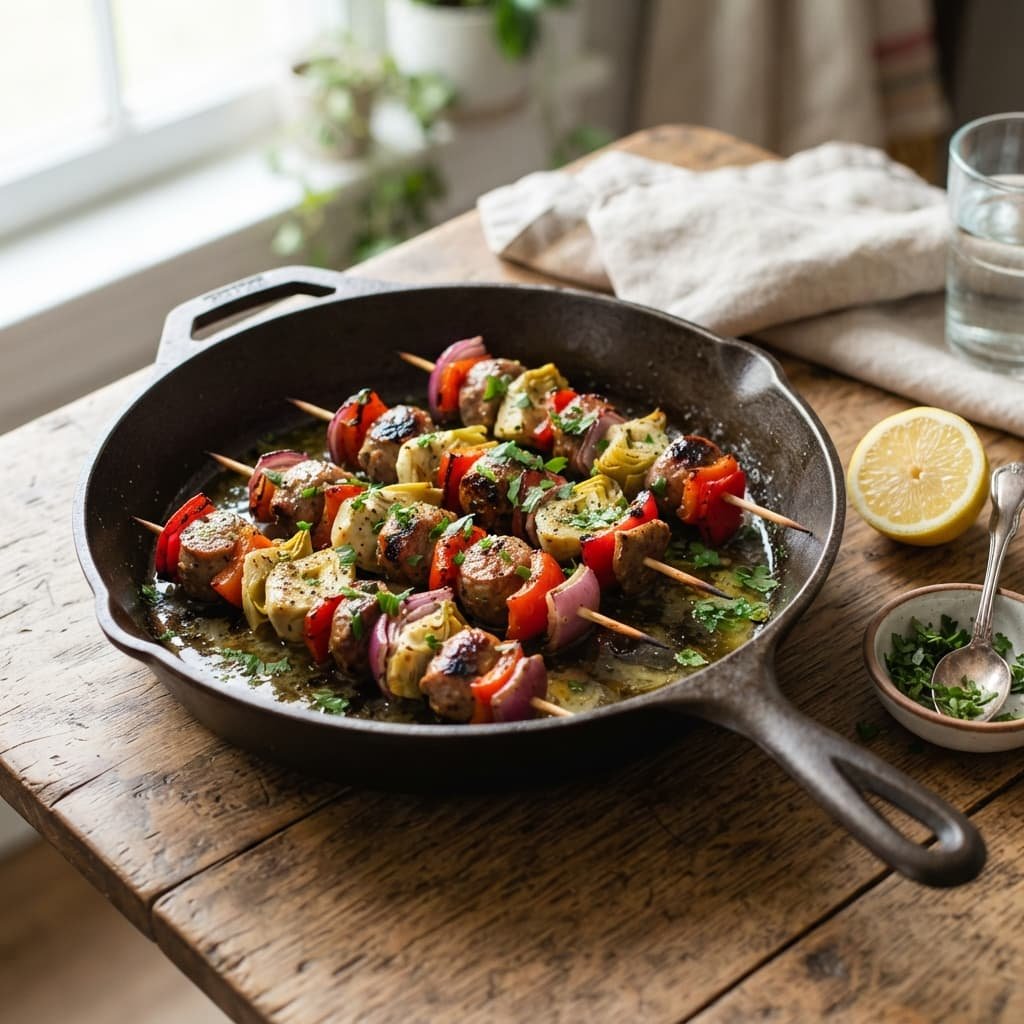
Searing is conduction: browning happens only where food touches hot metal, so a round or irregular piece browns on one small patch and stays pale everywhere else. The Skewered Artichoke and Sausage Skillet uses the skewer as a handling tool for that problem. Threaded pieces can be turned a quarter at a time, so each of the four sides gets its own stretch of direct contact with the pan, and the whole skewer ends up browned instead of just its bottom.
Sausage, artichoke hearts, and peppers on skewers is an established combination, usually grilled and sometimes seared in a skillet; recipes commonly pre-cook the sausage first so it is safe and firm by the time it reaches the heat. This version does that, sears the skewers in a skillet instead of on a grill, and turns the browned bits left behind into a quick lemon-garlic pan sauce.
| Prep Time | 20 minutes |
| Cook Time | 25 minutes |
| Total Time | 45 minutes |
| Servings | 4 (8 skewers) |
| Difficulty | Easy, with a little assembly |
Key Techniques for Skewers in a Skillet
The sausage poaches for 8 to 10 minutes and cools while you thread the skewers. Searing takes about 8 minutes in a large skillet, turning a quarter turn every 2 minutes, and the pan sauce needs only 4 more minutes, so the full meal takes about 45 minutes.
Poaching the sausage first does two jobs. It brings the meat to a safe internal temperature of 71°C (160°F) without needing a long time in the pan, and it firms the sausage so it holds a skewer without crumbling. The skillet then only has to brown, not cook through, which is why the pieces can stay juicy while the outside turns deep mahogany.
Canned artichoke hearts are the other technical point. They come packed in liquid, and any water left on them turns to steam when it hits the pan, which stops browning until it has evaporated. Draining, then pressing them dry between paper towels, is what allows their edges to caramelize.
Ingredients
This makes 8 skewers, serving 4.
For the Skewers
- 1 lb (450g) Italian sausage links, mild or hot (about 4 links)
- 1 can (14 oz / 400g) artichoke hearts in water, drained and quartered
- 1 red bell pepper (about 6 oz / 170g), cut into 1-inch (2.5cm) pieces
- 1 small red onion, cut into 1-inch (2.5cm) wedges, layers separated
- 2 tablespoons (30ml) olive oil, divided
- 1 teaspoon dried oregano
- Black pepper, to taste
- 8 skewers (metal, or wooden soaked in water for 30 minutes)
For the Lemon-Garlic Pan Sauce
- 2 garlic cloves, minced
- 1/2 cup (120ml) chicken broth
- 2 tablespoons (28g) butter
- 1 tablespoon (15ml) lemon juice
- 2 tablespoons (8g) fresh parsley, chopped
How to Make Artichoke and Sausage Skewers in a Skillet
- Place the sausage links in a wide pan and cover with cold water. Bring to a gentle simmer, not a hard boil, and cook for 8 to 10 minutes, until the links feel firm and the juices run clear when one is pierced. Drain and let cool for 10 minutes, then cut into 1-inch (2.5cm) pieces.
- Spread the artichoke quarters on paper towels and press firmly until no visible water remains. This is the step that lets them brown.
- Toss the artichokes, pepper, and onion with 1 tablespoon of the oil, the oregano, and black pepper.
- Thread the sausage, artichoke, pepper, and onion onto the skewers in an alternating pattern, packing them snugly but not tightly. Aim for about 3 sausage pieces per skewer.
- Heat the remaining oil in a large skillet over medium-high heat until it shimmers. Lay 4 skewers in a single layer, leaving space between them. Sear for 2 minutes without moving, until the underside is deep brown and you hear a steady sizzle, then turn a quarter turn. Repeat until all four sides are browned, about 8 minutes total. Transfer to a plate and cook the remaining skewers the same way.
- Reduce the heat to medium. Add the garlic to the empty skillet and stir for 30 seconds, until fragrant.
- Pour in the broth and scrape up the browned bits from the bottom. Simmer for 2 to 3 minutes, until reduced by about half.
- Take the skillet off the heat and swirl in the butter and lemon juice until the sauce is glossy. Return the skewers, roll them in the sauce for 30 seconds, and finish with parsley.
Good vs. Excellent: The Details That Matter
- Dry the artichokes. Every drop of surface water has to evaporate before browning can begin.
- Use a wide skillet and leave space. Crowded skewers trap steam under themselves and turn gray instead of brown.
- Turn by quarters, not randomly. Each side needs a few undisturbed minutes to form a crust.
- Protect wooden skewer ends. Soak them, or let the ends hang over the edge of the pan so they do not scorch.
- Add the butter off the heat. It thickens the sauce and gives it a gloss without breaking.
Troubleshooting Common Problems
Problem: The artichokes were pale and soggy. Cause: they went in wet, and the pan was too crowded. Solution: press them dry, cook in batches, and let each side sit undisturbed until it releases from the pan.
Problem: The sausage was dry. Cause: it was poached too long or seared too hard after cooking through. Solution: poach for 8 to 10 minutes only, and sear for just enough time to brown.
Problem: The pieces slid around and spun on the skewer. Cause: the skewers were too loosely packed or too thin. Solution: pack pieces snugly, and use two parallel skewers or flat metal skewers for stability.
Problem: The pan sauce tasted burnt. Cause: the browned bits were scorched, or the garlic burned. Solution: lower the heat before the garlic goes in, and deglaze with broth right away.
Mastering the Technique
The idea that carries over is treating a pan like a contact surface: browning follows contact, and the job of the cook is to maximize it. Skewers, flat cuts, and single layers all serve that goal. Once you think of searing this way, the fix for many pale results is obvious: dry the surface, give the food room, and leave it alone long enough to form a crust.
The other portable habit is the pan sauce. The brown film left behind after searing is concentrated flavor, and a splash of broth lifts it into a sauce in minutes. The same three moves, sear, deglaze, and finish with cold butter off the heat, work with chicken thighs, pork chops, and mushrooms.
Variations and Substitutions
Chicken or turkey sausage works with the same method; check that it reaches 74°C (165°F) if it is chicken. Marinated artichokes can be used but should be drained and dried even more carefully. Cherry tomatoes, zucchini rounds, or mushrooms can replace the pepper. Thick slices of fully cooked kielbasa or andouille can skip the poaching step.
Serving and Pairing
Serve over creamy polenta, buttered orzo, or crusty bread that can soak up the pan sauce. A green salad with a sharp dressing balances the richness. For a party, slide the pieces off the skewers into a bowl and serve with toothpicks.
Storage and Reheating
Store the skewers and sauce in an airtight container in the refrigerator for up to 3 days. Reheat in a skillet over medium heat for 4 to 5 minutes, turning once, and add a splash of broth to loosen the sauce. Microwaving softens the seared crust. The assembled, uncooked skewers can be prepared a day ahead and kept covered in the refrigerator.
Nutritional Information
Values below are estimates per serving and will vary depending on exact brands and quantities used.
| Calories | 430 kcal |
| Protein | 20 g |
| Carbohydrates | 14 g |
| Fat | 33 g |
| Fiber | 4 g |
Frequently Asked Questions
Do I have to pre-cook the sausage? It is strongly recommended. Raw sausage cut into pieces is fragile on a skewer and may not cook through before the outside burns. Poaching first solves both problems.
Can I cook these on a grill instead? Yes. Use medium-high heat, turn every couple of minutes, and skip the pan sauce or make it in a small pan on the side.
Should I use marinated or plain artichokes? Either works. Plain artichokes in water give you more control over seasoning, and marinated ones add flavor but need thorough drying to brown.
Skewered Artichoke and Sausage Skillet turns a few pantry items into a browned, glossy dinner with almost no equipment beyond a large pan. The skewers give you control, the poaching gives you safety, and the pan sauce turns the leftover brown bits into the best part of the plate.
Skewered Artichoke and Sausage Skillet
Ingredients
Method
- Place the sausage links in a wide pan and cover with cold water. Bring to a gentle simmer, not a hard boil, and cook for 8 to 10 minutes, until the links feel firm and the juices run clear when one is pierced. Drain and let cool for 10 minutes, then cut into 1-inch (2.5cm) pieces.
- Spread the artichoke quarters on paper towels and press firmly until no visible water remains. This is the step that lets them brown.
- Toss the artichokes, pepper, and onion with 1 tablespoon of the oil, the oregano, and black pepper.
- Thread the sausage, artichoke, pepper, and onion onto the skewers in an alternating pattern, packing them snugly but not tightly. Aim for about 3 sausage pieces per skewer.
- Heat the remaining oil in a large skillet over medium-high heat until it shimmers. Lay 4 skewers in a single layer, leaving space between them. Sear for 2 minutes without moving, until the underside is deep brown and you hear a steady sizzle, then turn a quarter turn. Repeat until all four sides are browned, about 8 minutes total. Transfer to a plate and cook the remaining skewers the same way.
- Reduce the heat to medium. Add the garlic to the empty skillet and stir for 30 seconds, until fragrant.
- Pour in the broth and scrape up the browned bits from the bottom. Simmer for 2 to 3 minutes, until reduced by about half.
- Take the skillet off the heat and swirl in the butter and lemon juice until the sauce is glossy. Return the skewers, roll them in the sauce for 30 seconds, and finish with parsley.