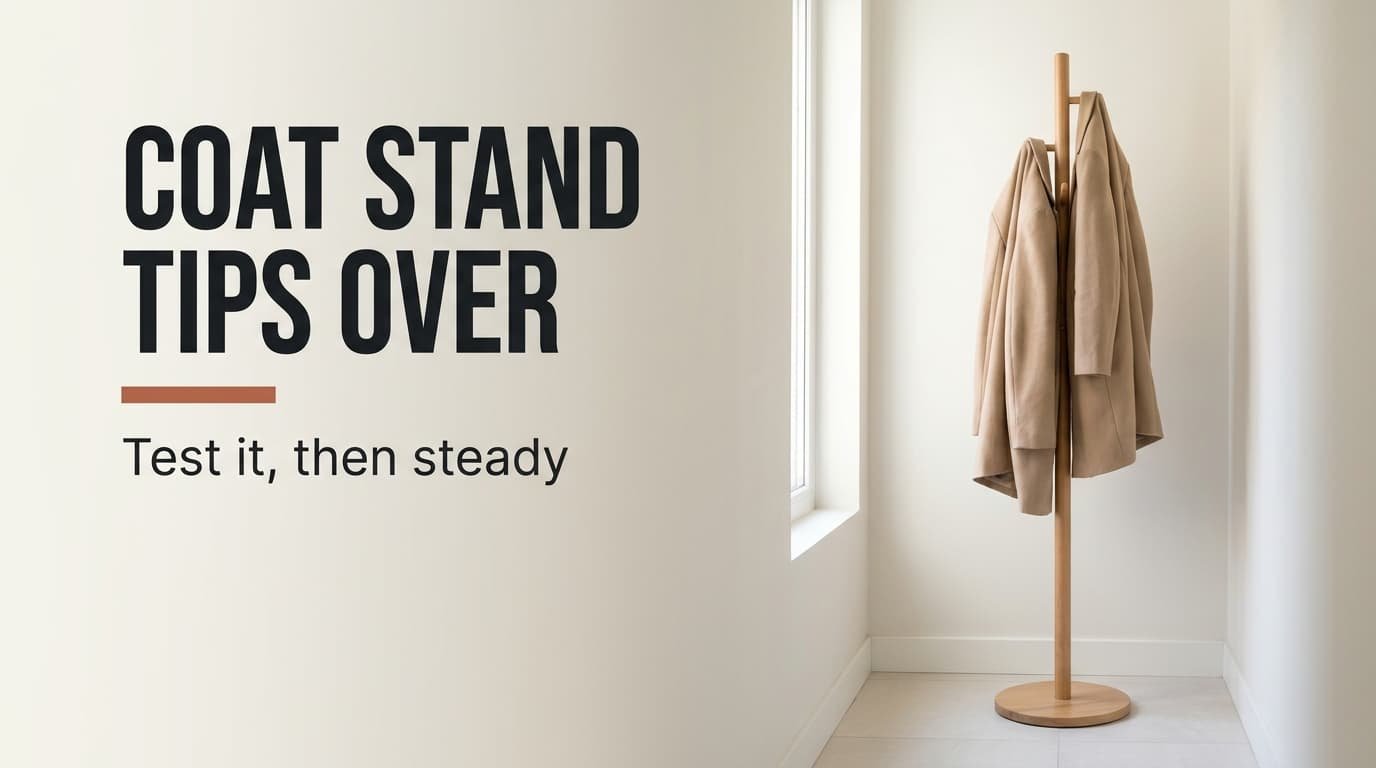
A stand usually goes over at one precise moment: a heavy bag settles on one hook and the opposite edge of the base lifts. The stand itself is sound; it simply carries less reserve than its hooks suggest. This page helps if you own a coat stand that tips over once loaded, in a narrow Dutch hallway. Our sample stand is 175 cm tall and weighs 4 kg. Its base spans 40 cm, and the hooks reach 30 cm from the pole. A quick paper test opens the guide, then four remedies run from the cheapest habit to a wall fixing. Measure your own stand, because the figures here are only samples.
Why a Coat Stand That Tips Over Gives Way at the Base Edge
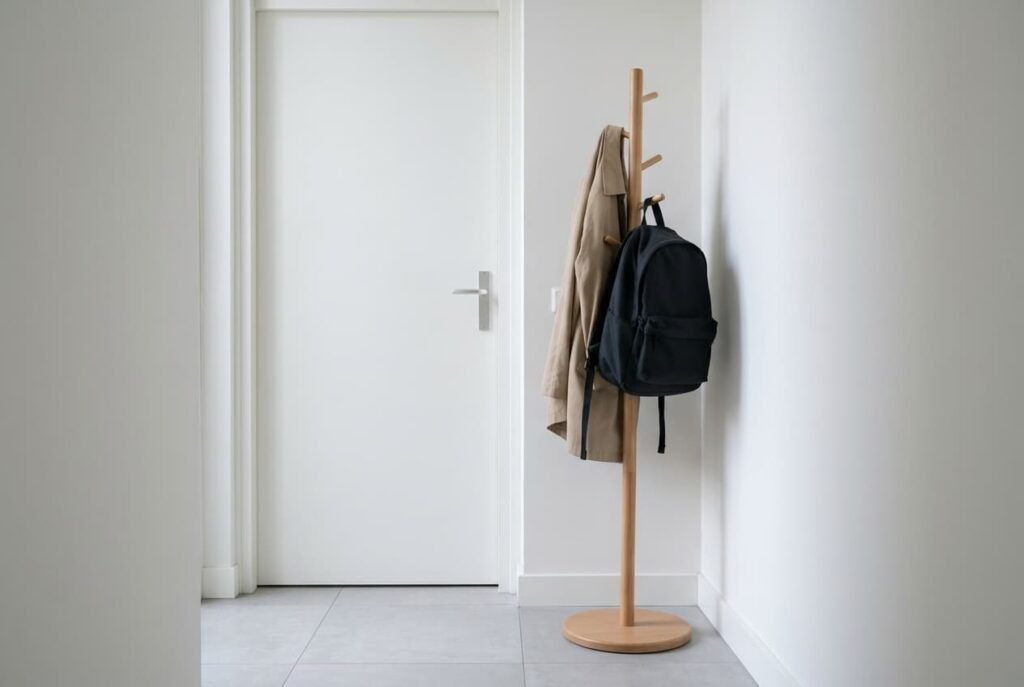
A loaded stand turns about the edge of its base. Its own weight pulls it back, while anything hung beyond that edge pulls it forward. Tipping starts once the load hangs further out than the base edge and outweighs the stand’s own pull back. Two lengths and two weights give you the whole answer.
Work it through for our stand. Its weight acts through the centre of the footplate, a fifth of a metre from the edge. The pull back is 4 kg × 0.20 m = 0.8 kilogram-metres. A hook that reaches 30 cm puts a bag 10 cm beyond the edge. Any load heavier than 0.8 ÷ 0.10 = 8 kg on one side will take the stand over.
Two coats at 1.5 kg each and a backpack at 6 kg weigh 9 kg, and 9 kg × 0.10 m = 0.9 kilogram-metres. That’s a hair over the limit. It explains why the stand stays upright all winter and falls the day the backpack joins the coats.
Height counts for less than most people assume. A higher hook doesn’t lower the threshold, but it does turn every knock and every swinging sleeve into a harder shove.
Confirm Which Version of the Tipping You Have
Three faults feel alike, and a paper test tells them apart. Begin with the stand empty and press the top gently from each side. A base that rocks even now points to an uneven floor or a loose foot, not to any load. Check the floor with a spirit level before you blame the stand. A tile that dips by 3 mm under one foot is enough to mimic the fault.
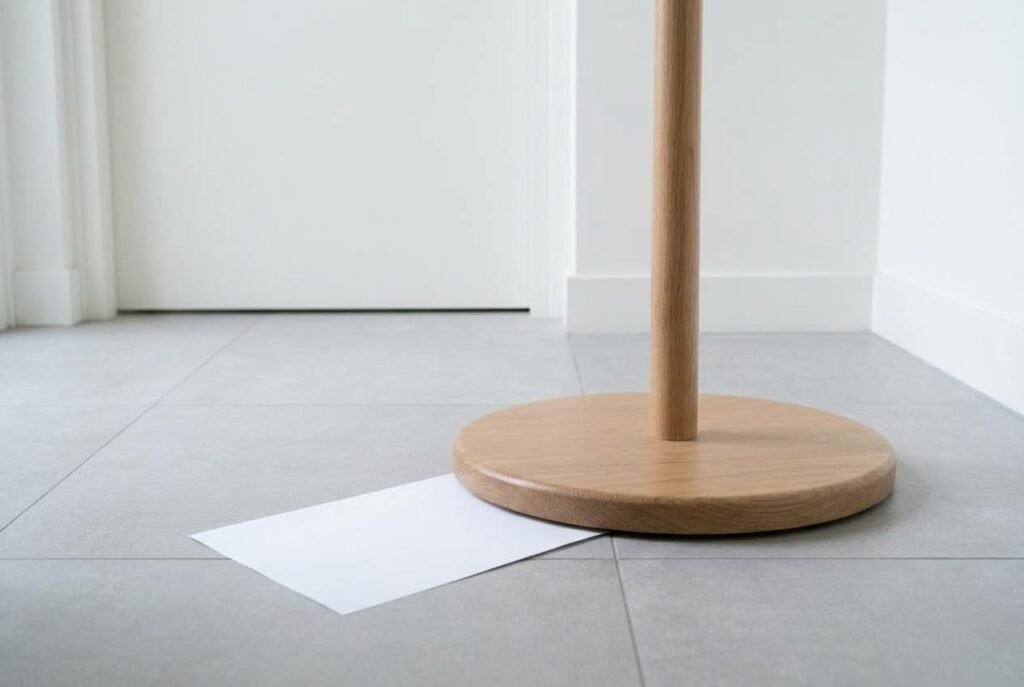
Next, hang a 2 kg bag on the outermost hook and slide a strip of printer paper beneath the far edge of the base. If the paper moves freely, that edge has lifted. A light bag that lifts it means the hooks reach too far for the base, which is a fault in the design.
When a coat stand that tips over copes with 2 kg yet lifts at 9 kg, the stand is sound but the weight is one-sided.
Ours passes the first two tests, and only the heavy one-sided load lifts it. The remedies below therefore suit a loaded stand, and each one works through a different mechanism.
Four Ways to Steady a Coat Stand That Tips Under a Heavy Bag
Sharing the load between both sides of the stand, because a weight on the far side adds to the pull back. Split our 9 kg into 4.5 kg per side. The tipping pull on one edge drops to 4.5 × 0.10 = 0.45, while the far load holds back with 4.5 × 0.50 = 2.25. This costs nothing, and the routine settles within days. Put the backpack on the hook that faces the wall and the lighter coats beside it. It stops working once everyone in the household hangs a coat on the door side.
Adding weight low in the base, because each kilogram at the bottom raises the pull back without moving the hooks. A 3 kg plate, or a tub of sand fixed in the foot, takes the stand to 7 kg. Then 7 × 0.20 = 1.4 kilogram-metres allows 14 kg on one hook. Expect a small outlay. A coat stand that tips over most often tips because it’s light, and this mechanism hits that cause directly. The limit is handling. At 7 kg the stand gets hard to drag out when you clean, and the plate needs a base with room for it.
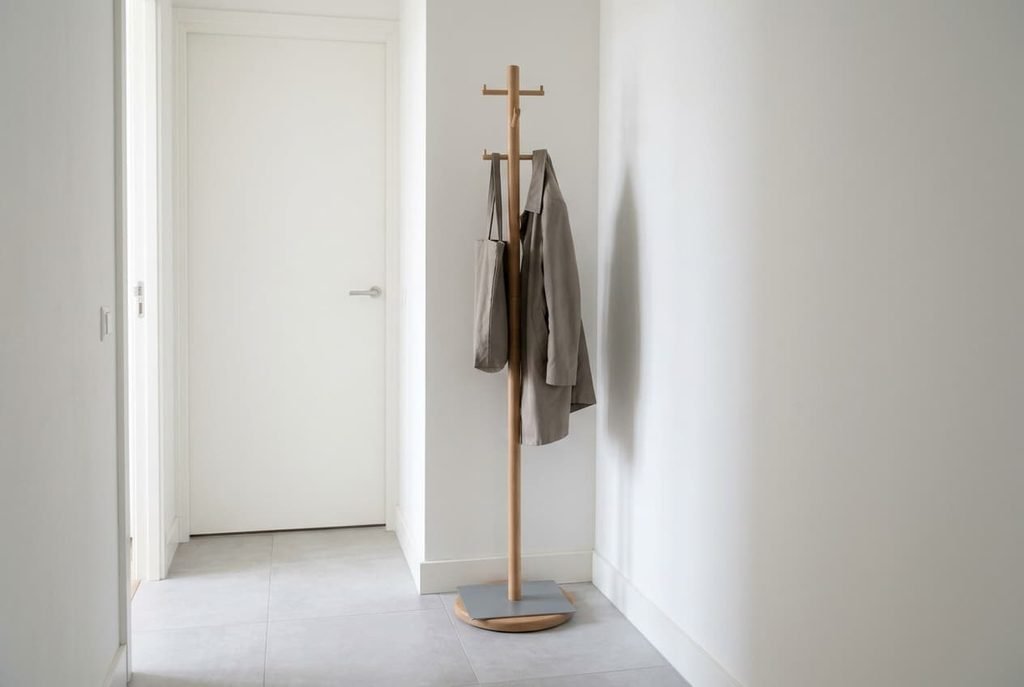
Widening the base until it meets the hooks, because an edge under the hook tips leaves no load beyond the pivot. A cross base spanning 60 cm puts the edge 30 cm from the pole, exactly where the hooks end. You pay for the part and spend an hour on assembly. The stand ends up very steady, but it claims floor space, and the hallway sums below show where that stops being acceptable. A cross base also catches toes, which matters in a passage where people walk past in the dark.
Tying the pole to the wall with a bracket and strap, because the wall then absorbs the pull and the base barely matters. A handyman can fit a small bracket at roughly 120 cm, in a spot where the screw bites into solid backing. It’s the costliest of the four, though still modest. Renting means the landlord has to approve beforehand. Once tied to the wall, the stand can’t be moved freely, which suits a hallway that never changes.
What This Hallway Decides
Picture a hall 110 cm across and 240 cm deep, with the front door opening inwards against the left wall. The corner behind the door is 45 cm deep, and the stand sits there because nothing else fits.
That corner rules out the widest remedy. A base 60 cm across can’t sit in 45 cm, and pulling it into the open leaves only 50 cm between stand and wall. Most people need about 60 cm to walk past with a bag. The hall would be too tight to use.
The wall adds a second limit. Hall walls in older Dutch flats are often plasterboard on timber battens, and a screw holds only when it reaches a batten.
Find one with a tap test before any drilling.
Two options survive: sharing the load, and adding the plate on top of it. The wall bracket stays in reserve for the day the landlord agrees.
The Fix That Doesn’t Work
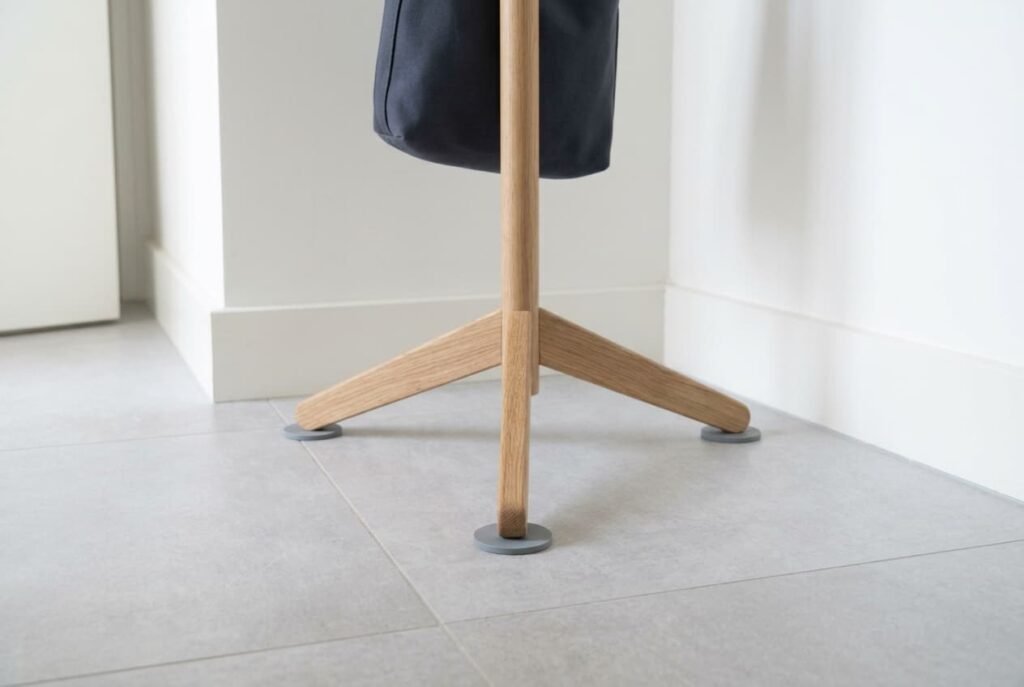
Many people reach for sticky grip pads beneath each foot. They stop the stand from sliding, yet sliding was never the real failure. A stand tips by turning over its edge, and a pad that grips the floor lets it pivot more cleanly.
The pad also lifts the base a few millimetres, which adds nothing to its stability on a rug. Extra friction can’t help a coat stand that tips over; a wider or heavier base can. If the stand has started to creep across the tiles, grip pads cure that single problem.
A better route starts from the version your test found. Share the load when the weight is one-sided and add ballast when the stand is simply light. Widen or tie it when the hooks reach past the base.
Repeat the paper test with your heaviest bag after any change, then again once a month. A stand rarely falls without warning, and the paper shows the lifting edge long before anything crashes down. Winter brings the heaviest coats and wet umbrellas. Test again in October. Keep the best remedy and drop the rest. A stand with three fixes and no test is still a guess.
Questions Readers Keep Asking
Can every coat stand be stopped from tipping?
Almost every one. If the base and hooks are sound, at least one of the remedies here will raise the margin. The exception is a stand with a cracked pole or a loose joint. Mend that first, because ballast cannot cure a frame that bends.
How much does it cost to stop a stand tipping?
Sharing the load costs nothing, and a weight for the base costs very little. A wider cross base is a small purchase in itself, while the wall fixing costs most because of the handyman’s time. Start with the cheapest and stop when the paper test passes.
Why does my stand only tip when a bag is on it?
Because the bag hangs past the base edge on a single side, while the stand’s own weight is too small to hold it back. The load then rotates the stand about that edge. Hang it near the pole, or on the side facing the wall, and the margin returns.