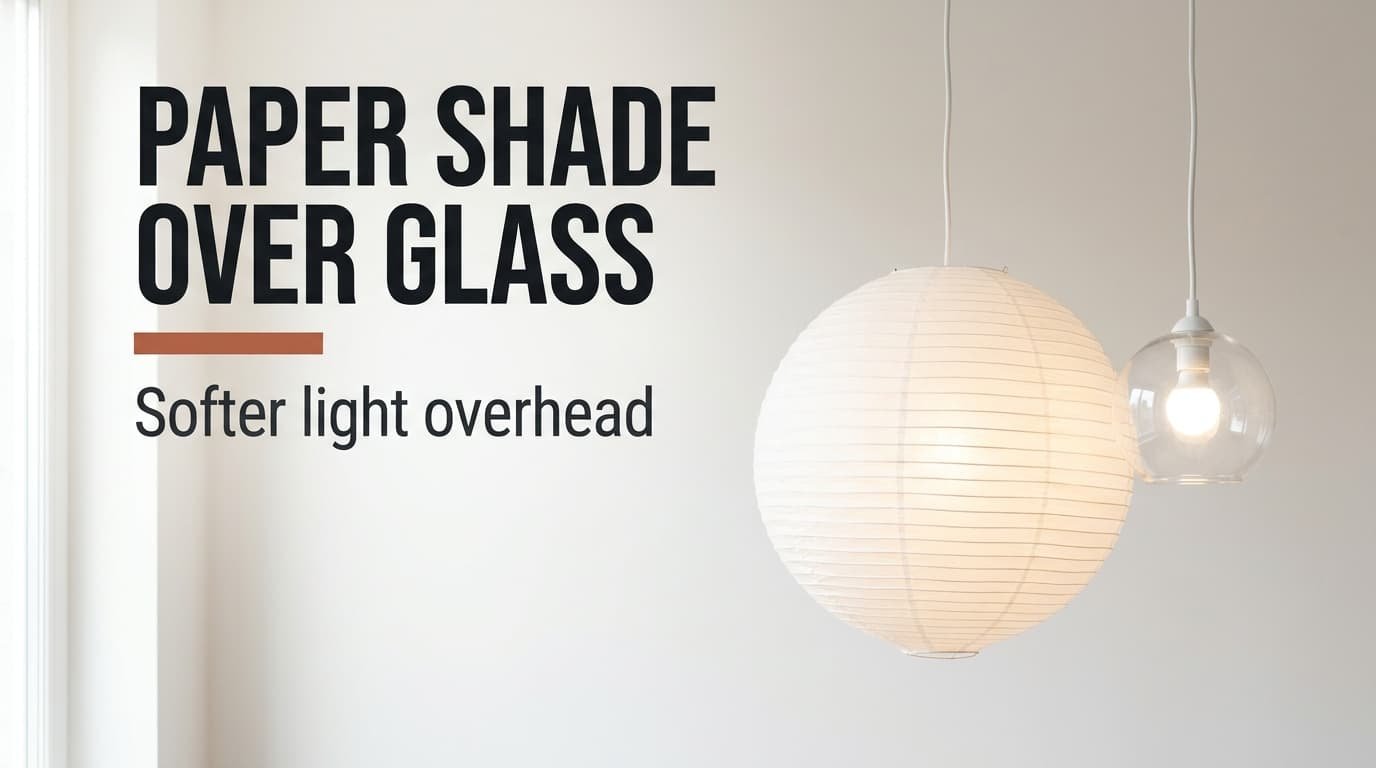
A bare bulb inside clear glass has become the harshest object in many Dutch living rooms, and that explains why households are choosing paper lantern shades. A paper globe spreads identical light across a surface about 44 times bigger, and it weighs a tenth as much. Brightness and upkeep are the cost. Below you’ll find the numbers behind the change and the reasons for it. After that come what you lose and the extreme version, and a closing rule helps you decide. The sample is a lounge 400 cm by 500 cm, 250 cm high, lit by one bulb of 470 lm. All figures are assumptions.
Choosing paper lantern shades: the short version
A pendant light used to serve as a showpiece. Glass or metal, it hung over the room and displayed its bulb. That suited the dim, warm bulbs of the past. A modern LED is small and intense, and looking straight at it becomes tiring after a short while.
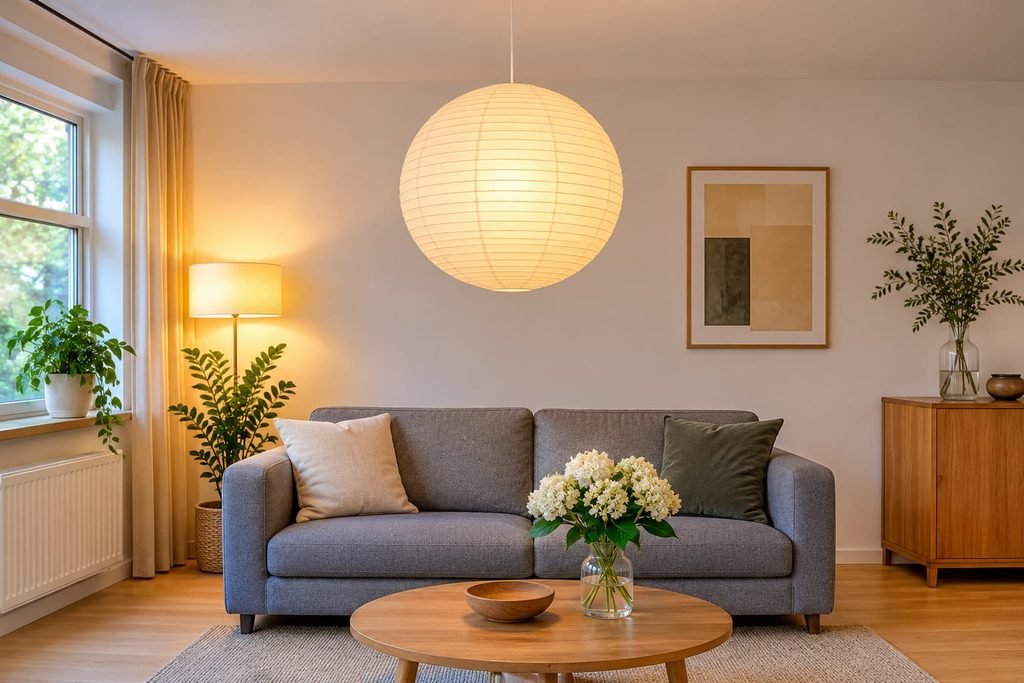
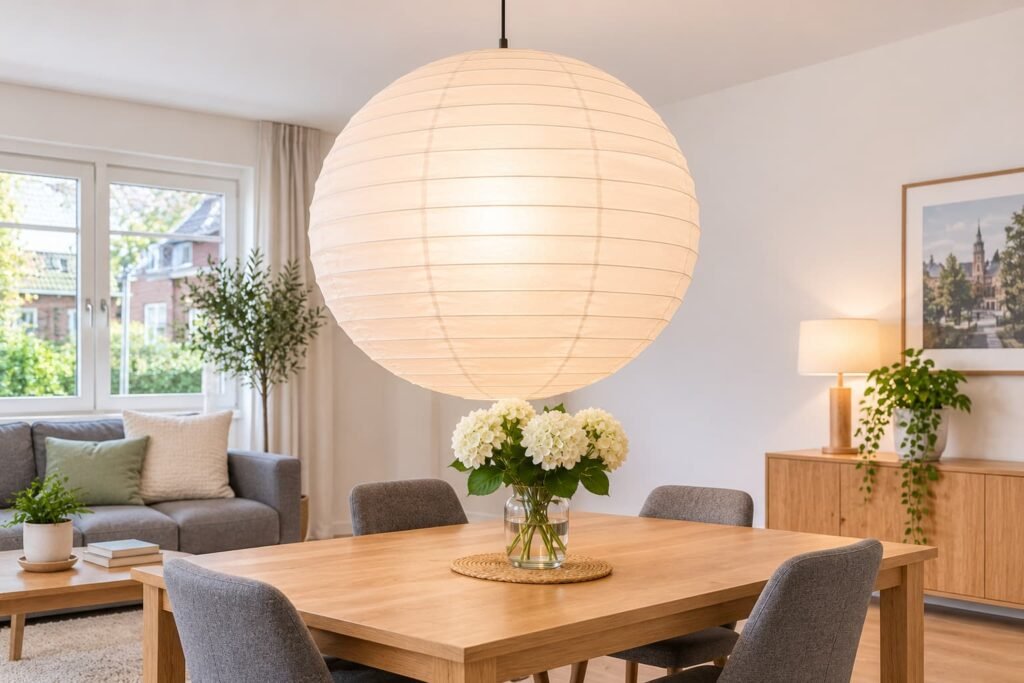
A paper lantern shade works in reverse. It wraps the bulb in a thin translucent skin. The source disappears and a glowing surface takes its place. Light travels through the paper and scatters. Shadows on faces and walls turn soft.
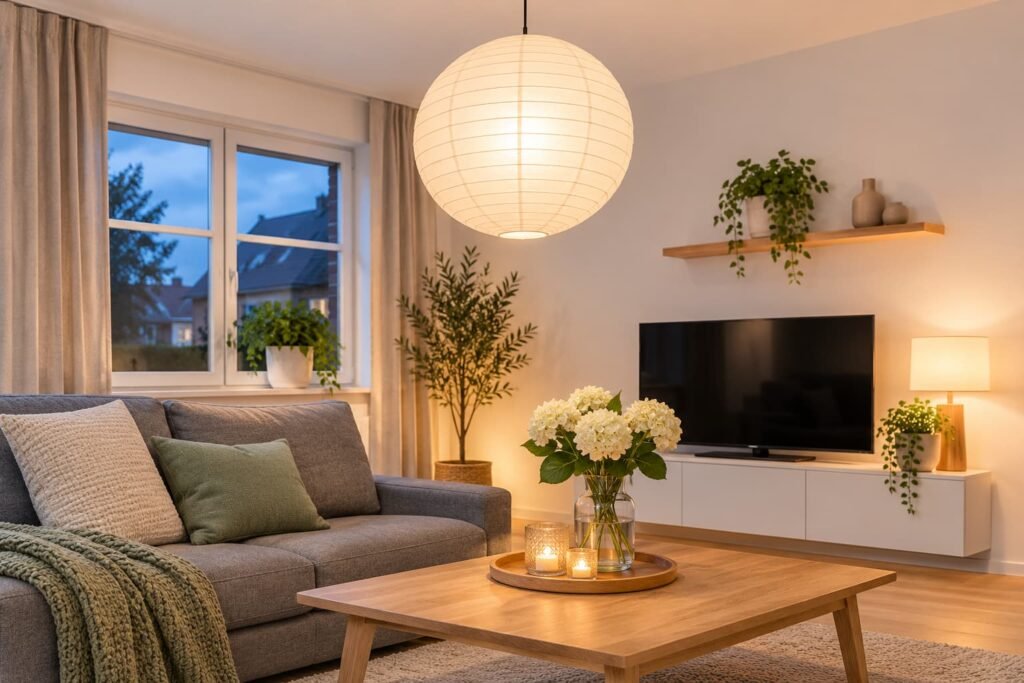
Evening matters most. By day the window fills a living room with soft light and the ceiling pendant does little. After dark it becomes the main source. Any harshness shows at once.
Rented ceilings add pressure. You can’t fix much to them, and a shade of 150 g hangs from the hook or fitting already in place. LED bulbs run far cooler than the filament bulbs they replaced, which also removed the old worry about paper beside a lamp.
Neither pressure fades as the years in one flat add up.
What changed, in measurable terms
In measurable terms, the glowing surface grows from about 113 cm² to about 5,000 cm², while the shade weighs 0.15 kg instead of 1.4 kg, which turns a heavy fitting into a light hook job. Picture both fittings hanging in the same spot. A clear LED bulb about 6 cm across sits inside a glass pendant 20 cm wide. The paper globe is 40 cm wide.
Brightness of the visible surface changes the most. The bare bulb spreads 470 lm over 113 cm², roughly 41,600 lm per square metre. Paper passes about 60% of the light. That leaves 282 lm spread over a surface of 0.50 m², roughly 560 lm per square metre. Your eye now meets a surface about 74 times gentler.
Hanging height shifts as well. With a 10 cm drop from the ceiling, the glass pendant’s lower edge sits at 250 − 10 − 20 = 220 cm. The paper globe’s edge sits at 200 cm, leaving 20 cm of room above someone 180 cm tall.
The total light falls from 470 lm to 282 lm, a loss of 188 lm. A bulb of 806 lm behind the paper brings it back, because 806 × 0.6 comes to 484 lm.
You can check the effect before buying anything. From your usual seat, switch on a lamp. Then raise a sheet of white baking paper in front of the bulb. The softness you see is the whole gain.
Why Dutch households keep choosing paper shades and lanterns
Glare is one cause. You sit in the evening, and a pendant about 110 cm above your eyes falls inside your field of view each time you glance up. A bright dot in that field makes everything around it look darker by contrast. The bare 470 lm bulb gives about 41,600 lm per square metre of visible surface, against roughly 560 for the paper globe. A large soft surface removes the dot. The room then feels calmer at the same lumens.
The rented ceiling is another. A glass pendant of 1.4 kg needs a fixing rated for more than that, and a tenant rarely knows what lies behind the plaster. A 150 g shade hangs from the existing hook or fitting and goes up in minutes. The lamp holder and flex stay untouched, and the shade packs flat when you move out. Any change to the wiring belongs to a qualified electrician.
Ease of changing your mind is the last cause. Paper comes flat in a box and costs little beside a glass pendant. When a household tires of it, the swap needs no patching and no repainting.
Where one pendant is the only ceiling light, glare is the real reason behind choosing paper lantern shades while hooks and cost merely ease the swap.
What you give up
Choosing paper lantern shades costs you light, because paper passes only about 60% of the bulb’s light and a 470 lm bulb therefore delivers 282 lm to the room. A reading corner that felt bright under glass can feel dim under paper. Fit a brighter bulb, within the maximum printed on the lamp holder, or add a lamp beside the sofa.
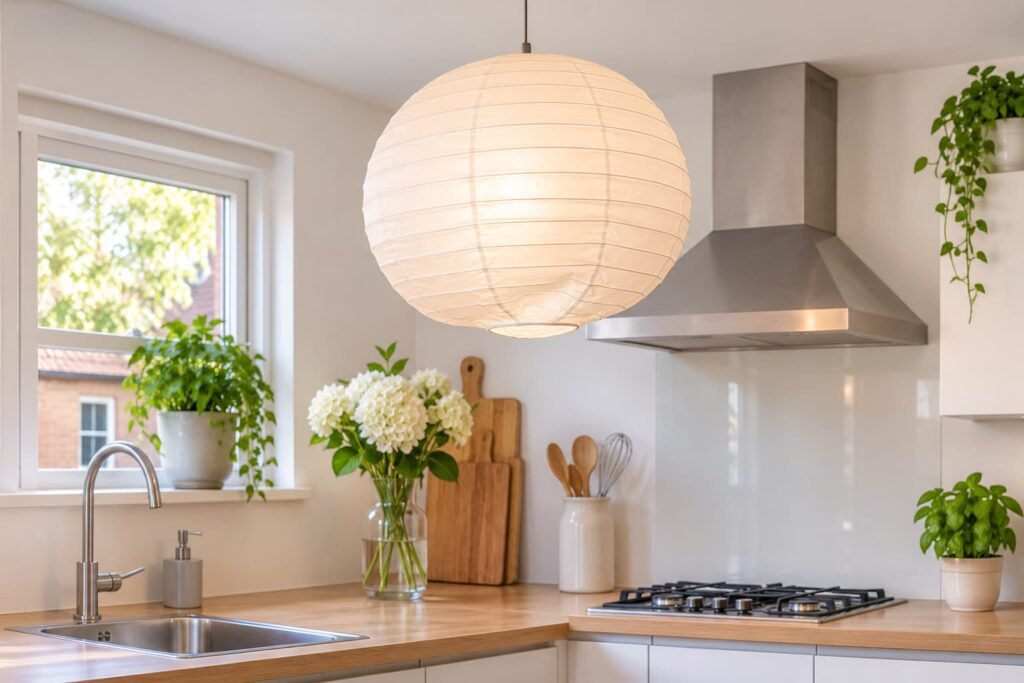
Paper dislikes steam. In a kitchen or a bathroom it can warp and sag within months, whereas glass wipes clean. Dust is the other cost. Paper can’t go under a tap. Brush it lightly with a soft brush instead. A tear can’t be mended invisibly.
The look changes too. A glowing globe now becomes the main feature of the room, and some people miss the sparkle that a glass fitting gave them.
The extreme version
In its extreme version the shade is an oversized paper globe of 80 cm, hung on a short drop to fill the room with one soft glow. Its surface covers about 20,100 cm², and the glare vanishes completely. The same bulb now lights it at only about 140 lm per square metre, which can leave the room looking dim. With a 10 cm drop the lower edge hangs at 250 − 10 − 80 = 160 cm, lower than the head of most adults. The globe only works over a table or in a corner nobody crosses.
Most rooms gain little from going that big. The surface is already about 74 times gentler at 40 cm, and the extra size costs headroom and adds a visual weight that dominates a room of 400 cm by 500 cm.
Before buying a large globe, cut a disc of card at the planned width and hold it at the planned height. If anyone ducks, the shade is too big.
Who it suits
Paper shades suit a living room where people sit in the evening and a bare bulb irritates. A rental whose ceiling takes little weight is another good match. Keep the glass pendant if the light hangs in a kitchen or bathroom, because steam shortens the life of paper. One question decides it: seated where you sit most, can you see the bulb directly? If you can, a shade will help. If you can’t, leave the fitting alone.
Choosing paper lantern shades helps only where the bulb was already in your line of sight. Count your evenings too, since a room you use mostly by daylight gains little.
A shade over a bulb you never see adds only dust. Measure the ceiling drop before ordering, then set it against how tall you are. Hold the receipt until you’ve lived with the shade. Borrow a shade for an evening if you can. Judge the glow from your own seat with the curtains drawn and the television off. That honest test beats any photograph, and it costs nothing.
Questions readers keep asking
Should I replace a glass pendant I already own?
Only if the glare bothers you. A glass pendant in good order is free to keep, and a swap brings no gain until the glare shows up. Try a paper shade in your most-used room and keep the glass one for the hall. Compare the two for a few evenings.
Who do paper shades suit best?
Anyone who sits under a single ceiling light in the evening, tenants most of all. Living rooms and bedrooms suit them. Kitchens and bathrooms suit them less, because steam softens paper. Anyone wanting a sparkling fitting may still prefer glass.
How long does a paper shade last?
Paper survives while it stays dry and unbroken. A shade in a dry living room can keep its shape for years. Dust gathers on it, and marks show. A knock tears it, and a tear is permanent. Replace it when the look starts to bother you.