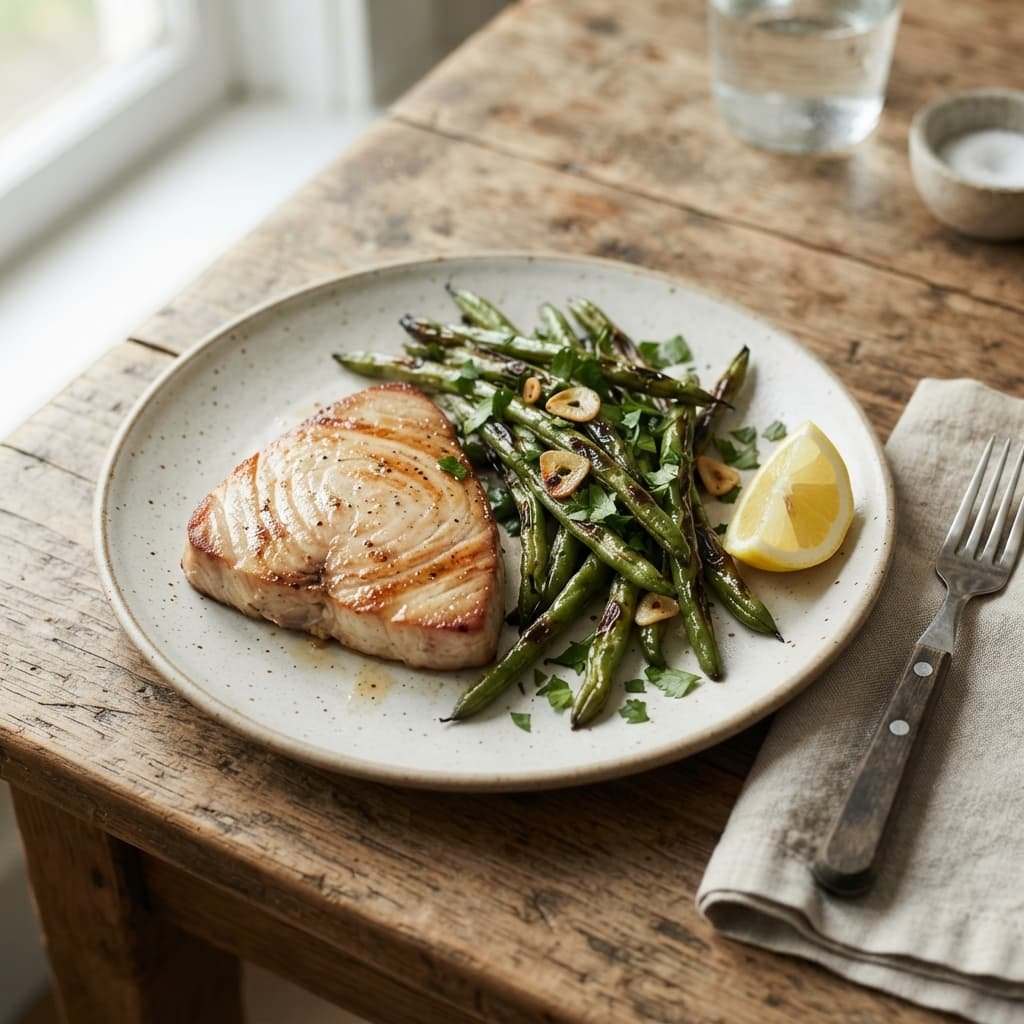
Swordfish is dense and meaty enough to cook almost like a steak, which is exactly why it’s so easy to overcook: its low fat content means the flesh has very little internal moisture to spare once it passes about 54-57°C (130-135°F). 30-Minute Crispy Swordfish with Green Beans depends on getting real Maillard browning on the crust in a hot, dry pan while pulling the fish the moment it crosses that internal temperature, not a minute later.
Pan-seared swordfish paired with green beans, whether blanched, charred, or sautéed with garlic, is a real and widely documented weeknight dish, showing up across independent recipe sources built around exactly this combination of a hard sear and a simple green vegetable side. This version keeps that same structure: a properly dry-seared swordfish steak and green beans cooked in the same pan, finished together in about 30 minutes.
| Prep Time | 10 minutes |
| Cook Time | 20 minutes |
| Total Time | 30 minutes |
| Servings | 4 |
| Difficulty | Moderate, one timing-sensitive step |
Key Techniques for Crispy Swordfish with Green Beans
The swordfish needs about 3 to 4 minutes per side in a hot, dry pan, while the green beans take 6 to 8 minutes to char and soften. Both can share the same skillet in sequence, so the whole meal comes together in about 30 minutes from start to finish.
A hot, dry pan matters more here than with a fattier fish like salmon, because swordfish has almost no marbled fat to protect it from drying out. High heat browns the surface quickly through the Maillard reaction, building real flavor in the crust before the dense flesh underneath has time to overcook straight through. Green beans work on a different principle: real char comes from direct, mostly undisturbed contact with a hot pan, not from constant stirring, which just steams them instead of blistering the skins.
Ingredients
This serves 4.
For the Swordfish
- 4 swordfish steaks (about 6 oz / 170g each), patted dry
- 2 tablespoons (30ml) olive oil
- Salt and black pepper, to taste
- 1 lemon, half juiced and half cut into wedges
For the Green Beans
- 1 lb (450g) green beans, trimmed
- 1 tablespoon (15ml) olive oil
- 2 garlic cloves, thinly sliced
- Salt and black pepper, to taste
- 2 tablespoons (5g) fresh parsley, chopped, for serving
How to Make Crispy Pan-Seared Swordfish with Green Beans
- Pat the swordfish steaks thoroughly dry with paper towels, then season both sides with salt and pepper.
- Heat 1 tablespoon of the olive oil in a large skillet over medium-high heat until shimmering, almost to the point of faint smoke.
- Add the swordfish and sear for 3 to 4 minutes per side, until a deep golden-brown crust forms and the fish releases easily from the pan. The center should read 54-57°C (130-135°F) on an instant-read thermometer, and the flesh should look opaque with just a faint blush at the very core. Transfer to a plate and tent loosely with foil.
- Wipe the skillet clean. Add the remaining olive oil and heat over medium-high until shimmering.
- Add the green beans in a single layer. Cook undisturbed for 3 to 4 minutes, until the skins blister and char in spots, then stir and cook 3 to 4 minutes more, until crisp-tender.
- Add the garlic and cook for 30 seconds, stirring, until fragrant but not browned. Season with salt and pepper.
- Squeeze the lemon juice over the swordfish. Plate the fish alongside the green beans, top with parsley, and serve with lemon wedges.
Good vs. Excellent: The Details That Matter
A good version of this dish is already satisfying. An excellent one comes down to a few specific calls.
- Dry the swordfish thoroughly before it hits the pan. Surface moisture steams the fish instead of searing it, and that browned crust is where most of the flavor actually comes from.
- Use a thermometer rather than guessing by time alone. Steak thickness varies enough between cuts that 130-135°F is a far more reliable target than a fixed number of minutes.
- Let the green beans sit undisturbed at first. Constant stirring keeps them from developing real char, since direct pan contact is what actually blisters the skins.
- Tent the fish loosely with foil while the beans cook. A few minutes of carryover resting lets the juices redistribute instead of running out the moment it’s sliced.
Troubleshooting Common Problems
Problem: The swordfish turned dry and tough instead of tender. Cause: it almost always means the fish cooked past 135°F, since swordfish has very little fat to buffer against overcooking. Solution: use an instant-read thermometer and pull the fish at 130-135°F, resting under foil to finish gently.
Problem: the crust never browned properly, even after several minutes. Cause: the pan likely wasn’t hot enough, or the fish wasn’t fully dried before searing. Solution: pat the steaks completely dry, and wait until the oil is visibly shimmering before adding the fish.
Problem: the green beans turned mushy and gray instead of charred. Cause: they were likely stirred too often, or the pan was overcrowded and steamed them instead of searing. Solution: use a single layer with real space between beans, and let them sit undisturbed for the first few minutes.
Mastering the Technique
The principle that carries over from this dish to other dense, lean fish is treating internal temperature as the real marker of doneness rather than cook time alone. Tuna steaks, halibut, and swordfish all share the same low-fat structure that leaves little margin for error once heat is applied, so a thermometer reading 54-57°C (130-135°F) is consistently more reliable than trusting a fixed number of minutes, which shifts with steak thickness and pan heat. That same habit, checking doneness by temperature rather than the clock, transfers directly to any other lean fish cooked hot and fast in a skillet.
Steak thickness matters more with swordfish than with most other proteins, since a 1-inch (2.5cm) steak and a 1.5-inch (4cm) steak can need noticeably different times to reach the same internal temperature despite looking similar in the pan. Measuring thickness before cooking, rather than relying on weight or visual guesswork, helps set realistic expectations for how long that first side actually needs before flipping.
Variations and Substitutions
Halibut or tuna steaks can replace swordfish using the same searing method and temperature target, though tuna is often served slightly less cooked in the center. Asparagus or broccolini can substitute for green beans using the same char-first technique, adjusting the timing slightly for thicker stalks.
For a brighter finish, a spoonful of capers added to the beans along with the garlic adds a briny contrast. A drizzle of good olive oil over the plated fish just before serving rounds out the dish if a little extra richness sounds appealing.
Serving and Pairing
This dish is light enough to stand on its own, though a simple grain like couscous or orzo rounds out the meal if something more filling is needed. Crusty bread works well for the pan juices left on the plate. Extra lemon wedges at the table let everyone adjust the acidity to their own taste.
Storage and Reheating
Store the swordfish and green beans separately in airtight containers in the refrigerator for up to 2 days. Reheat the fish gently in a low oven or covered skillet over low heat rather than the microwave, which tends to dry it out further and unevenly. This dish doesn’t freeze particularly well, since the swordfish loses its texture once thawed.
Nutritional Information
Values below are estimates per serving and will vary depending on exact brands and quantities used.
| Calories | 320 kcal |
| Protein | 34 g |
| Carbohydrates | 10 g |
| Fat | 17 g |
| Fiber | 4 g |
30-Minute Crispy Swordfish with Green Beans comes down to one real number worth remembering: 130-135°F. Everything else, the hot dry pan, the undisturbed beans, the brief rest under foil, exists to protect that narrow window between a properly seared, tender steak and a dry, overcooked one.
30-Minute Crispy Swordfish with Green Beans
Ingredients
Method
- Pat the swordfish steaks thoroughly dry, then season both sides with salt and pepper.
- Heat 1 tablespoon olive oil in a large skillet over medium-high heat until shimmering.
- Sear the swordfish 3 to 4 minutes per side, until deep golden-brown and 130-135°F (54-57°C) internally. Transfer to a plate and tent with foil.
- Wipe the skillet clean. Add remaining oil and heat over medium-high until shimmering.
- Add the green beans in a single layer. Cook undisturbed 3 to 4 minutes, until charred, then stir and cook 3 to 4 minutes more.
- Add the garlic and cook 30 seconds until fragrant. Season with salt and pepper.
- Squeeze lemon juice over the swordfish. Plate with the green beans, top with parsley, and serve with lemon wedges.