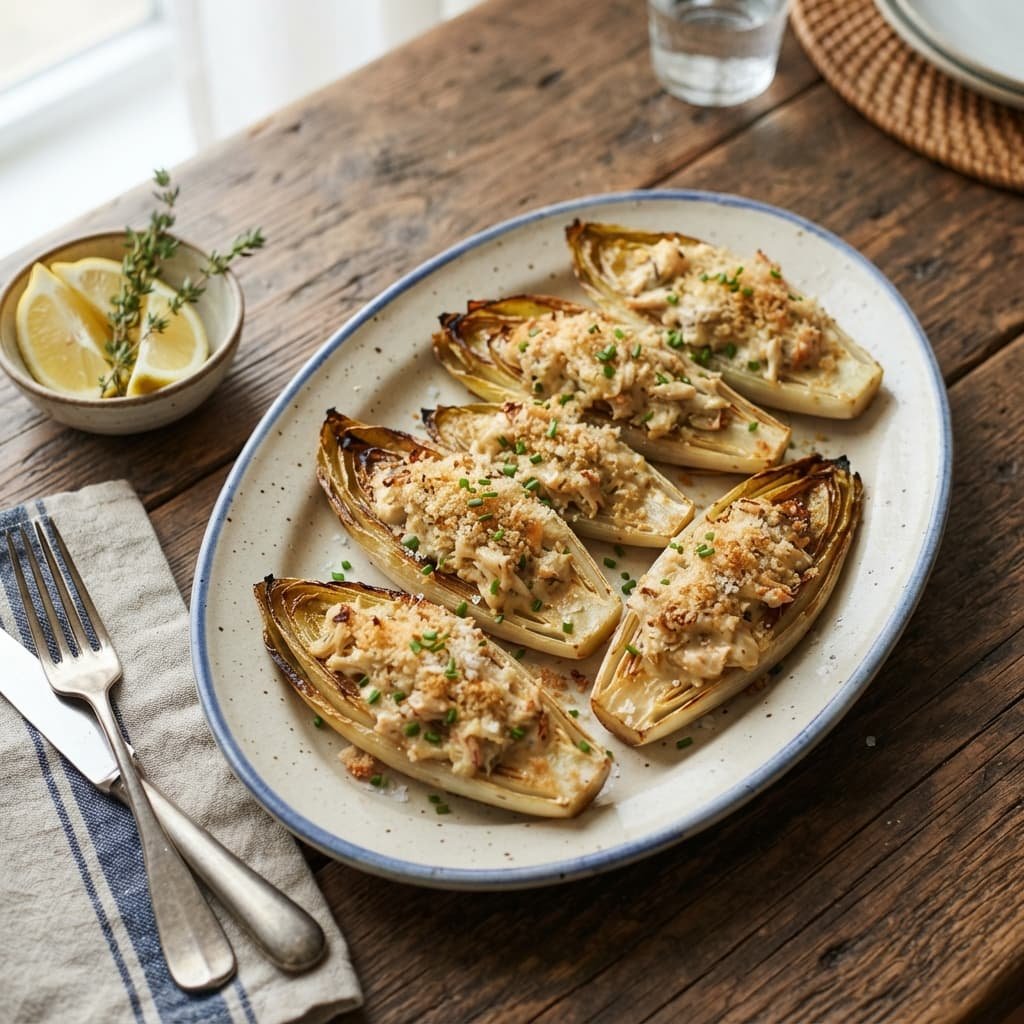
Belgian endive carries a clean bitterness that is delightful when it is cut with something rich and sweet, and a little sharp when it is not. Heat is the cook’s tool for managing it: a hot oven softens the leaves, mellows the bitter edge, and browns the cut surface so the natural sugars caramelize. Weeknight Baked Crab with Endive uses that effect, then fills the tender endive halves with sweet lump crab bound in a light, lemony cream and topped with buttery breadcrumbs, so each bite holds bitter, sweet, creamy, and crisp at once.
A note on what is documented and what is a variation. Endive stuffed with crab is a well-established dish, though most published versions are cold appetizers, with raw leaves filled with a mayonnaise-based crab salad. Baked stuffed crab is also a classic of Gulf and Chesapeake cooking. This recipe combines them into a warm main dish: endive halves are roasted until tender, filled with a crab mixture, and baked until golden.
| Prep Time | 20 minutes |
| Cook Time | 30 minutes |
| Total Time | 50 minutes |
| Servings | 4 (2 halves each) |
| Difficulty | Easy, with a two-stage bake |
Key Techniques for Baked Endive and Crab
The dish takes about 50 minutes. Roast the endive halves cut-side down for 15 minutes at 200°C (400°F) until browned and tender, then fill and bake for 10 to 12 minutes more until the topping is golden and the crab filling is hot at 74°C (165°F).
Endive is dense and layered, so raw halves filled and baked together would leave crisp, bitter centers by the time the topping browned. Roasting the halves first, cut-side down, does two jobs. The pan contact browns the cut surface, which adds sweetness through caramelization, and the trapped steam softens the inner layers. Then the filling goes on, and the second bake needs to heat the crab, not cook it.
Crab meat is sold already cooked, so a hot oven only warms it and sets the filling. Too long in the heat tightens the delicate meat and dries it. A binder of mayonnaise and crème fraîche keeps it moist, and fresh breadcrumbs toasted in butter beforehand mean the topping needs only a few minutes of heat to turn crisp.
Ingredients
This serves 4.
For the Endive
- 4 large Belgian endives (about 1 lb / 450g), halved lengthwise
- 2 tablespoons (30ml) olive oil
- 1/2 teaspoon kosher salt
- 1 teaspoon honey
For the Crab Filling
- 8 oz (225g) lump crab meat, picked over for shell and cartilage
- 2 tablespoons (30g) mayonnaise
- 2 tablespoons (30g) crème fraîche or Greek yogurt
- 1 small shallot (about 25g), minced
- 1 teaspoon Dijon mustard
- 1 teaspoon lemon zest and 1 tablespoon (15ml) lemon juice
- 2 tablespoons (8g) chopped parsley
- 1 tablespoon (3g) chopped chives
- 1/4 teaspoon white or black pepper
For the Buttery Topping
- 1/3 cup (20g) panko breadcrumbs
- 1 tablespoon (14g) butter
- 2 tablespoons (12g) grated Parmesan
How to Make Baked Crab with Endive
- Heat the oven to 200°C (400°F). Toss the endive halves with the olive oil, salt, and honey, and place them cut-side down on a rimmed baking sheet.
- Roast for 15 minutes, until the cut sides are golden brown and a knife slides easily into the thickest part.
- While the endive roasts, melt the butter in a small skillet over medium heat. Add the panko and stir for 2 to 3 minutes, until golden and fragrant. Stir in the Parmesan and set aside.
- In a bowl, mix the mayonnaise, crème fraîche, shallot, mustard, lemon zest and juice, parsley, chives, and pepper. Gently fold in the crab, trying not to break up the lumps.
- Turn the roasted endive halves cut-side up. Gently press the center of each with a spoon to make a shallow well.
- Mound the crab mixture into each half, then sprinkle with the buttered panko.
- Bake for 10 to 12 minutes, until the topping is golden brown and the filling is hot at 74°C (165°F), with a little bubbling at the edges.
- Rest for 2 minutes and serve warm, with lemon wedges.
Good vs. Excellent: The Details That Matter
- Choose firm, pale endives. Green tips mean more bitterness, and soft or browning leaves taste muddy.
- Roast cut-side down. It browns the surface and softens the layers evenly.
- Toast the panko separately. Raw crumbs on a wet filling stay pale and soft.
- Drain the crab well. Excess liquid turns the filling watery and the endive soggy.
- Keep the bake short. The crab only needs to warm through.
Troubleshooting Common Problems
Problem: The endive was too bitter. Cause: it was undercooked, or the endive was very green and mature. Solution: roast until deeply golden, keep the honey, and use the lemon and creamy filling to balance.
Problem: The endive was soggy and watery. Cause: it was covered or crowded on the sheet, so it steamed. Solution: use a rimmed sheet with space between the halves, and drain any liquid before filling.
Problem: The crab was dry. Cause: it baked too long, or the binder was too thin. Solution: bake only until hot, and add a spoonful of crème fraîche if the mix looks dry.
Problem: The topping did not brown. Cause: the panko was not pre-toasted, or the oven was too cool. Solution: toast it in butter first, and finish under the broiler for 1 minute, watching closely.
Mastering the Technique
The principle that carries over is cooking in stages by what each component needs. Dense, bitter vegetables need heat and time, delicate cooked proteins need only warming, and crisp toppings need pre-toasting. The same approach works for baked stuffed mushrooms, stuffed zucchini, and stuffed peppers.
One visual cue is the color of the roasted cut side. It should be a deep golden brown, not pale and not black. If the edges look glassy and tender when you press a knife into the thickest part, the endive is ready to fill.
Variations, Substitutions, and Serving
Cooked shrimp or lobster can replace crab with the same method. Radicchio or baby romaine halves can stand in for endive, but the bitterness and the cooking time will differ. A spoonful of capers or a little chopped tarragon brightens the filling, and a pinch of Old Bay gives a Chesapeake note. Serve with a simple green salad and crusty bread, or over a bed of lemony orzo, with lemon wedges on the side.
Storage and Reheating
Refrigerate leftovers in an airtight container for up to 2 days. Reheat in a 160°C (325°F) oven for 8 to 10 minutes, until hot at 74°C (165°F), and avoid the microwave, which softens the topping and toughens the crab. The unbaked filling keeps for a day in the refrigerator. The finished dish does not freeze well.
Nutritional Information
Values below are estimates per serving (2 halves) and will vary depending on exact brands and quantities used.
| Calories | 290 kcal |
| Protein | 17 g |
| Carbohydrates | 15 g |
| Fat | 18 g |
| Fiber | 5 g |
Frequently Asked Questions
Can I use canned crab? Yes. Drain it very well and press it between paper towels. Canned crab is softer and more shredded than fresh lump, so fold it in gently.
Can I serve this as an appetizer? Yes. Use the individual leaves of endive instead of halves, fill them with the same mixture, and bake for 6 to 8 minutes.
Why is endive bitter? Endive and its chicory relatives contain naturally bitter compounds, and cooking, a little sweetness, and acid all soften them.
Weeknight Baked Crab with Endive keeps its cooking simple and its contrasts clear: roasted, slightly bitter endive, sweet crab in a bright creamy filling, and a buttery crisp topping. It is a dish that looks like a restaurant starter and takes only a weeknight’s effort.
Weeknight Baked Crab with Endive
Ingredients
Method
- Heat the oven to 200°C (400°F). Toss the endive halves with the olive oil, salt, and honey, and place them cut-side down on a rimmed baking sheet.
- Roast for 15 minutes, until the cut sides are golden brown and a knife slides easily into the thickest part.
- While the endive roasts, melt the butter in a small skillet over medium heat. Add the panko and stir for 2 to 3 minutes, until golden and fragrant. Stir in the Parmesan and set aside.
- In a bowl, mix the mayonnaise, crème fraîche, shallot, mustard, lemon zest and juice, parsley, chives, and pepper. Gently fold in the crab, trying not to break up the lumps.
- Turn the roasted endive halves cut-side up. Gently press the center of each with a spoon to make a shallow well.
- Mound the crab mixture into each half, then sprinkle with the buttered panko.
- Bake for 10 to 12 minutes, until the topping is golden brown and the filling is hot at 74°C (165°F), with a little bubbling at the edges.
- Rest for 2 minutes and serve warm, with lemon wedges.