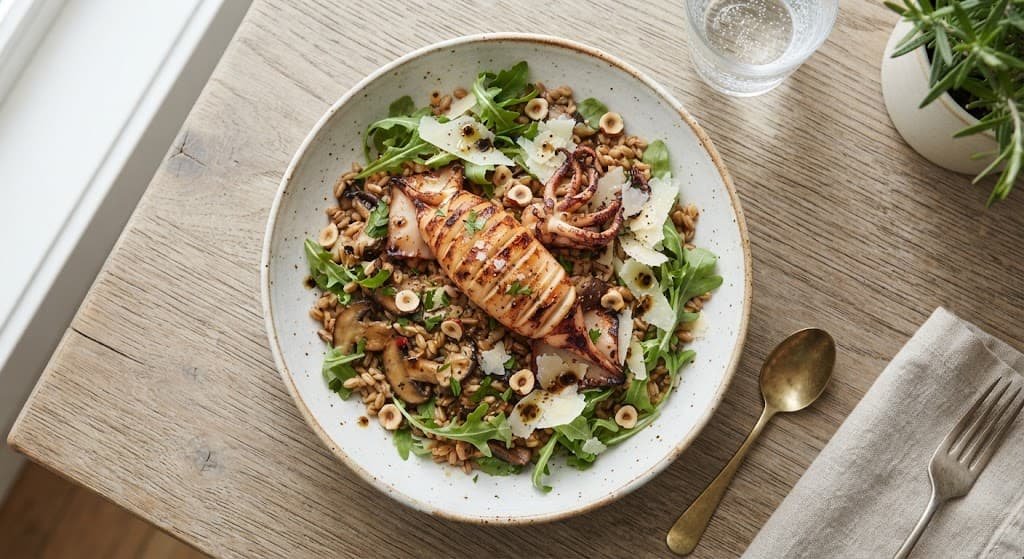
Squid muscle fibers are wound tightly around bands of collagen, and heat makes those fibers contract fast and hard within the first minute or two of cooking, squeezing out moisture and tightening the whole piece into something closer to rubber. That contraction is unavoidable. What’s avoidable is staying in that window long enough for it to matter, which is exactly the mistake most home cooks make with squid, and exactly the mistake this bowl is built to sidestep with a sear that’s over almost as soon as it starts, finished with truffle oil that never touches direct heat at all.
Why Squid Only Has Two Good Cooking Times
A truffle squid bowl comes together in about 30 minutes, most spent cooking the farro and mushrooms while the squid itself takes less than two minutes at the end. Squid only turns tender at two opposite extremes, a very fast sear or a long, slow braise, nothing good happens in between.
Here’s what’s actually happening: in the first 60 to 90 seconds of heat, the muscle proteins contract and squeeze out water, which is fine and even desirable, since it’s what gives seared squid its slight snap. Past that point, though, the collagen holding the muscle fibers together hasn’t had time to break down into gelatin yet, so the squid just sits in a tough, contracted state that gets worse the longer it cooks, all the way up to about 20 or 30 minutes, when the collagen finally starts to soften again the way it would in a long braise or stew. Anywhere in that middle stretch, roughly two to fifteen minutes of direct heat, is where rubbery squid comes from. This bowl avoids that entire window by staying in the fast-sear zone on purpose.
Truffle oil plays by different rules than the squid does. Its aromatic compounds are volatile, meaning they break down and largely disappear when exposed to sustained heat, which is why it’s added at the very end here, off the stove, rather than cooked into anything.
Ingredients
For the Bowl Base
- 1 cup farro, uncooked
- 8 oz cremini mushrooms, sliced
- 2 tbsp olive oil, divided
- 2 cloves garlic, minced
- 2 cups arugula
- Salt and black pepper, to taste
For the Squid
- 1 lb cleaned squid, tubes and tentacles, tubes sliced into rings
- 2 tbsp cornstarch
- 2 tbsp olive oil, for searing
- Salt and black pepper, to taste
To Finish
- 2 tbsp truffle oil
- 1 tbsp fresh lemon juice
- 1/4 cup shaved Parmesan
- Lemon wedges, for serving
Method
- Cook the farro according to package instructions. Drain any excess liquid and set aside.
- While the farro cooks, heat 1 tablespoon of olive oil in a skillet over medium-high heat. Add the mushrooms and cook for 6 to 8 minutes, stirring occasionally, until browned. Add the garlic in the last minute, season with salt and pepper, and set aside.
- Pat the squid completely dry with paper towels; any surface moisture will steam instead of sear. Season with salt and pepper, then toss lightly in the cornstarch, shaking off any excess.
- Heat the remaining olive oil in a large skillet over high heat until it’s nearly smoking. Add the squid in a single layer, without crowding the pan, and sear for 60 to 90 seconds per side, until just opaque with lightly golden edges. Work in batches if needed rather than overcrowding the pan. Remove immediately to a plate.
- Divide the farro between bowls and top with arugula, mushrooms, and the seared squid.
- Drizzle each bowl with truffle oil and a squeeze of lemon juice, then finish with shaved Parmesan. Serve immediately with extra lemon wedges on the side.
What Separates an Average Truffle Squid Bowl from a Great One
An average version has squid that’s edible but slightly chewy, cooked a beat too long out of caution. A great truffle squid bowl has squid with real bite and a faint char at the edges, still tender at the center, timed so precisely that pulling it from the pan feels almost premature. The other detail that separates the two is restraint with the truffle oil itself; a little goes further than most people expect, and pouring on more doesn’t intensify the flavor so much as make the dish taste like it’s trying too hard.
Troubleshooting
Why did my squid turn out rubbery even though I only cooked it a few minutes?
Cause: a few minutes is exactly the wrong amount of time, landing squarely in the window where proteins have contracted but collagen hasn’t broken down yet. Fix: cut the cook time down to 60 to 90 seconds per side over high heat, or commit to a much longer braise of 20 minutes or more if that’s the style you’re after.
Why won’t my squid get a golden sear, even in a hot pan?
Cause: leftover surface moisture is turning into steam the moment the squid hits the pan, which prevents browning. Fix: pat the squid thoroughly dry before seasoning and dredging, and don’t skip the light cornstarch coating, which helps absorb any remaining moisture and promotes browning.
Why does my truffle oil taste flat or barely noticeable?
Cause: it was added too early and cooked, which breaks down the aromatic compounds that carry most of its flavor. Fix: always add truffle oil at the very end, off the heat, drizzled directly over the finished bowl rather than into a hot pan.
Variations and Substitutes
Quinoa or brown rice both work in place of farro if that’s what’s on hand, though farro’s chewier texture holds up particularly well against the squid. Shrimp can stand in for squid using the same fast-sear approach, since it follows a similar overcooking pattern, though its timing runs slightly longer at 2 to 3 minutes per side. If truffle oil isn’t available, a small amount of truffle salt or truffle butter stirred in off the heat gets you part of the way there, though neither fully replaces the aroma a good truffle oil provides. For more greens, baby spinach wilted briefly in the mushroom pan works well folded into the base.
Serving and Pairing
This works well as a standalone light dinner, since the farro and mushrooms provide enough substance on their own. A simple side of crusty bread rounds it out if you want something more filling, and a crisp green salad with a sharp vinaigrette on the side echoes the arugula already in the bowl without repeating it exactly.
Storage and Reheating
Store the farro, mushrooms, and squid separately in airtight containers in the fridge for up to 2 days. Reheat the farro and mushrooms gently in a skillet or microwave, but eat the squid cold or at room temperature rather than reheating it; a second trip through heat pushes it straight back into that tough middle zone. Fresh truffle oil and lemon added just before eating keep leftovers tasting close to the original.
Nutrition (Per Serving, Serves 4)
These are estimated values per serving. Actual numbers will vary depending on the exact squid, farro, and truffle oil used.
| Calories | 385 kcal |
| Protein | 23 g |
| Carbohydrates | 36 g |
| Fat | 17 g |
| Fiber | 5 g |
This recipe was tested and refined in bebup.org’s kitchen before publishing, with several timed batches used to pin down the exact searing window described above.
A Bowl Built on Precise Timing
Most seafood forgives a little imprecision; squid genuinely doesn’t, and that’s part of what makes getting it right feel worthwhile rather than fussy. This truffle squid bowl asks for almost nothing in terms of skill, just attention at exactly the right sixty seconds, which turns out to be a fair trade for a dish that tastes like it took a lot more effort than it did.
Mastering Squid’s Two-Zone Cooking Window
The collagen in squid behaves differently from the collagen in something like beef chuck or pork shoulder, mostly in how much heat and time it takes to convert into gelatin. In a long braise, that conversion happens gradually over 20 to 45 minutes at a low simmer, which is why braised or stewed squid, common in dishes cooked at length in a rich tomato or wine-free braising liquid, comes out tender rather than tough despite the long cook time. A fast sear skips that conversion entirely and instead relies on stopping the cook before the muscle proteins have fully tightened, using intense, brief heat to brown the surface without giving the interior time to seize up. Neither approach is more correct than the other; they’re just two different solutions to the same problem, and the only real mistake is landing in the gap between them, where the proteins have already contracted but the collagen hasn’t yet had the time it needs to soften back down.
Truffle Squid Bowl
Ingredients
Method
- Cook the farro according to package instructions.
- Sauté mushrooms in 1 tbsp olive oil for 6 to 8 minutes until browned. Add garlic in the last minute, season, and set aside.
- Pat squid completely dry, season, and toss lightly in cornstarch.
- Sear squid in very hot oil for 60 to 90 seconds per side until just opaque. Remove immediately.
- Divide farro between bowls, top with arugula, mushrooms, and squid.
- Drizzle with truffle oil and lemon juice, finish with Parmesan, and serve immediately.