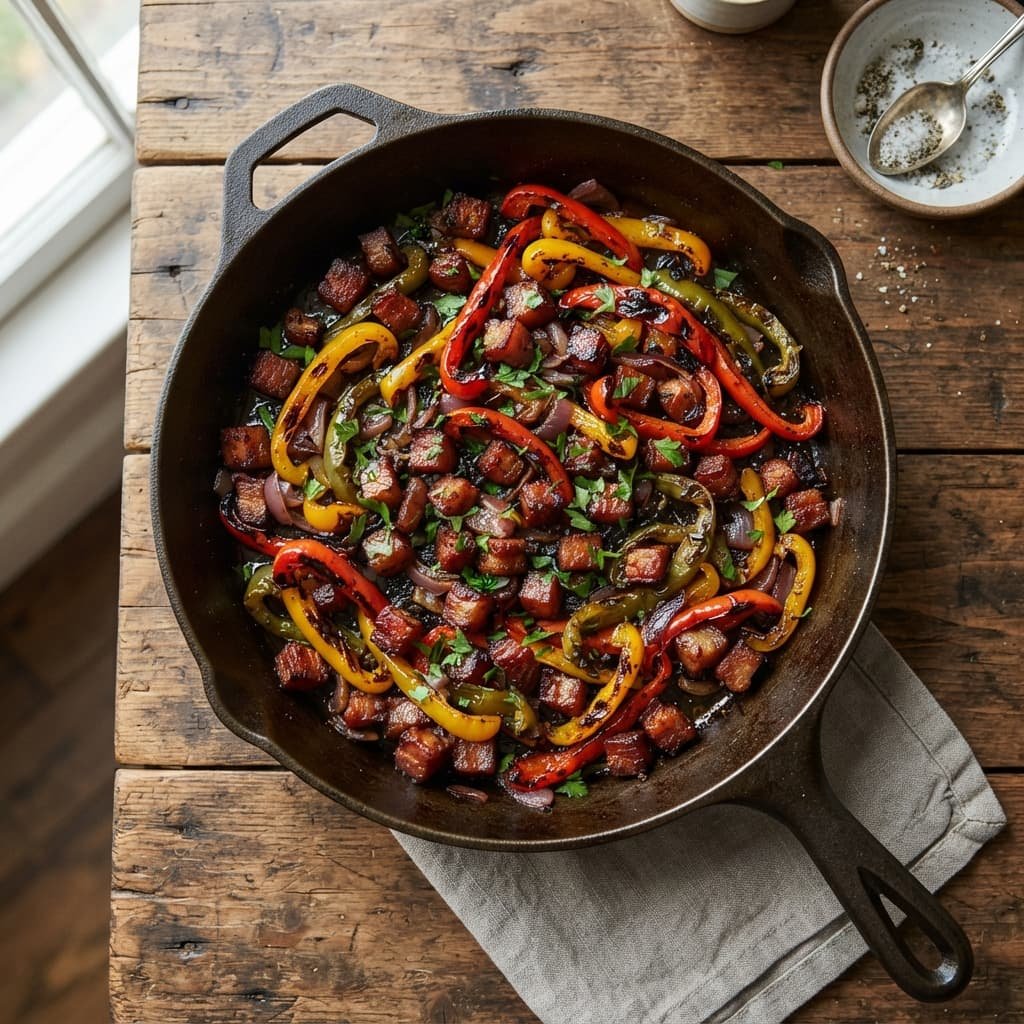
As long as a piece of meat still holds free water, its surface cannot climb much above 100°C (212°F), because that water keeps evaporating and cooling the surface. Browning through the Maillard reaction needs roughly 140°C (284°F), so a single fry has to spend its first minutes just drying the pancetta out. Weeknight Double-Fried Pancetta with Bell Peppers solves that by splitting the job in two: a gentle first fry renders fat and drives off moisture, a short rest lets steam escape, and a hotter second fry browns a surface that is finally dry enough to crisp.
Cooking pork belly twice is a well-established technique. Twice-cooked pork belly stir-fried with bell peppers is a classic in Sichuan cooking, and pancetta is simply salt-cured pork belly. This recipe applies the same cook, rest, and cook again logic to diced pancetta, then finishes it with charred peppers, garlic, and a splash of vinegar.
| Prep Time | 10 minutes |
| Cook Time | 25 minutes |
| Total Time | 35 minutes |
| Servings | 4 |
| Difficulty | Easy, with one heat change to manage |
Key Techniques for Double-Fried Pancetta
The whole dish takes about 35 minutes. The first fry needs 8 to 10 minutes over medium-low heat to render the fat, the peppers cook during the rest, and the second fry takes only 2 to 3 minutes over higher heat to turn the pancetta deep amber and crackling.
The first fry starts in a cold pan on purpose. Bringing the pan and the pancetta up together lets the fat melt slowly and collect in the pan, rather than seizing the outside before the inside has released anything. By the end of that stage the cubes should feel firm and look pale gold, not brown. The rest matters just as much: piled on a plate, the pieces let trapped steam escape instead of softening the crust, and the surface dries. The second fry is where color arrives, and it happens fast because the moisture that would have held the temperature down is already gone.
Pancetta is already cured, so it arrives salty. That is why this recipe seasons the peppers lightly and relies on vinegar at the end for balance, rather than adding salt to the pan.
Ingredients
This serves 4 as a main with bread or rice, or 6 as a side.
For the Pancetta
- 8 oz (225g) pancetta, cut into 1/2-inch (1.3cm) cubes
For the Peppers
- 3 bell peppers, mixed colors (about 1 lb / 450g), cut into 1-inch (2.5cm) strips
- 1 small onion (about 4 oz / 115g), sliced
- 3 garlic cloves, thinly sliced
- 1/2 teaspoon smoked paprika
- 1 tablespoon (15ml) red wine vinegar
- Black pepper, to taste
- 2 tablespoons (8g) fresh parsley, chopped, for serving
How to Make Double-Fried Pancetta with Bell Peppers
- Place the pancetta cubes in a large, cold skillet in a single layer. Set the heat to medium-low and cook for 8 to 10 minutes, stirring occasionally, until the fat has melted into the pan and the cubes look pale gold and feel firm when pressed with a spoon.
- Transfer the pancetta with a slotted spoon to a paper towel-lined plate. Spread it out and let it rest while you cook the peppers.
- Pour off all but 1 tablespoon of the rendered fat. Raise the heat to medium-high and add the peppers and onion. Cook for 6 to 7 minutes, stirring only every minute or so, until the edges are charred in spots and the peppers are crisp-tender.
- Push the peppers to one side and return the pancetta to the empty half of the pan. Cook over medium-high heat for 2 to 3 minutes, turning often, until the cubes are deep amber and you can hear a steady crackle.
- Add the garlic and smoked paprika and stir everything together for 30 seconds, until fragrant. Take care that the garlic does not turn brown.
- Remove the pan from the heat and splash in the vinegar, tossing to coat. Season with black pepper, taste, and add salt only if needed.
- Transfer to a serving dish and scatter with parsley. Serve right away, while the pancetta is still crisp.
Good vs. Excellent: The Details That Matter
- Start the pancetta in a cold pan. A pre-heated pan browns the outside before the fat has had time to render, and the cubes stay chewy.
- Keep the cubes in one layer. Crowded pieces trap steam against each other and simmer in their own fat instead of crisping.
- Do not skip the rest. Even five minutes on a plate is enough to let steam escape, and the second fry browns noticeably faster because of it.
- Leave the peppers alone between stirs. Charring needs steady contact with the hot pan, and constant stirring turns the peppers soft and watery instead.
- Add the vinegar off the heat. It keeps its sharpness and cuts the richness, where boiling it away leaves only a faint tang.
Troubleshooting Common Problems
Problem: The pancetta was chewy, not crisp. Cause: the first fry was too short or too hot, so the fat never fully rendered and moisture stayed inside. Solution: keep the first fry on medium-low until the cubes feel firm, and give the pan the full 8 to 10 minutes.
Problem: The pancetta burned before it turned crisp. Cause: the second fry ran too hot or too long, and the sugars in the cure scorched. Solution: watch color rather than the clock, and pull the pan off the heat the moment the cubes turn deep amber and smell toasty.
Problem: The dish tasted too salty. Cause: pancetta brings its own cure, and extra salt at the end stacked on top of it. Solution: season with black pepper and vinegar first, taste, and only then add salt if the peppers seem underseasoned.
Problem: The peppers turned soft and watery. Cause: the pan was crowded or the heat was too low, so the peppers steamed. Solution: use a large skillet, keep the heat at medium-high, and cook the peppers in two batches if your pan is small.
Mastering the Technique
The idea that carries over from this dish is treating crispness as a moisture problem before it is a heat problem. French fries, fried chicken, and crackling all follow the same pattern: a lower-temperature first cook removes water and cooks the interior, and a hotter second cook browns a surface that has been dried. When something refuses to crisp, the useful question is usually not how hot the pan is but how much water is still in the food.
Sound is a reliable cue during the second fry. Early on, the pan hisses and spits as the last moisture leaves. Once the cubes crackle steadily and the spitting fades, the surface has dried and is browning, which is the moment to pull the pan off the heat.
Variations and Substitutions
Thick-cut bacon can replace pancetta, though it is smokier and cooks faster, so shorten the first fry to about 5 minutes. Guanciale works with the same method and gives a richer, more pork-forward flavor. For a vegetarian-leaning side, the peppers and onion are good on their own with a little smoked paprika and vinegar.
Add a pinch of red chili flakes with the garlic for heat, or stir in a spoonful of capers at the end for a briny contrast. Poblano or Italian frying peppers can stand in for bell peppers if you want a slightly more savory flavor.
Serving and Pairing
Spoon this over polenta, rice, or soft scrambled eggs, or pile it onto toasted bread. A simple green salad with a sharp dressing balances the richness. It also works stirred through hot pasta with a little of the pasta water.
Storage and Reheating
Store leftovers in an airtight container in the refrigerator for up to 3 days. The pancetta softens as it sits, so reheat in a dry skillet over medium-high heat for 2 to 3 minutes to bring back some crispness. Avoid the microwave, which steams it. This dish does not freeze well, since the peppers turn mushy once thawed.
Nutritional Information
Values below are estimates per serving and will vary depending on exact brands and quantities used.
| Calories | 330 kcal |
| Protein | 13 g |
| Carbohydrates | 11 g |
| Fat | 26 g |
| Fiber | 2 g |
Weeknight Double-Fried Pancetta with Bell Peppers takes a familiar cured pork belly and treats it the way a good fry cook treats potatoes: cook it gently, let it rest, and finish it hot. The extra few minutes cost almost nothing on a weeknight, and they are the difference between chewy cubes and pancetta that crackles against soft, charred peppers.
Weeknight Double-Fried Pancetta with Bell Peppers
Ingredients
Method
- Place the pancetta cubes in a large, cold skillet in a single layer. Set the heat to medium-low and cook for 8 to 10 minutes, stirring occasionally, until the fat has melted into the pan and the cubes look pale gold and feel firm when pressed with a spoon.
- Transfer the pancetta with a slotted spoon to a paper towel-lined plate. Spread it out and let it rest while you cook the peppers.
- Pour off all but 1 tablespoon of the rendered fat. Raise the heat to medium-high and add the peppers and onion. Cook for 6 to 7 minutes, stirring only every minute or so, until the edges are charred in spots and the peppers are crisp-tender.
- Push the peppers to one side and return the pancetta to the empty half of the pan. Cook over medium-high heat for 2 to 3 minutes, turning often, until the cubes are deep amber and you can hear a steady crackle.
- Add the garlic and smoked paprika and stir everything together for 30 seconds, until fragrant. Take care that the garlic does not turn brown.
- Remove the pan from the heat and splash in the vinegar, tossing to coat. Season with black pepper, taste, and add salt only if needed.
- Transfer to a serving dish and scatter with parsley. Serve right away, while the pancetta is still crisp.