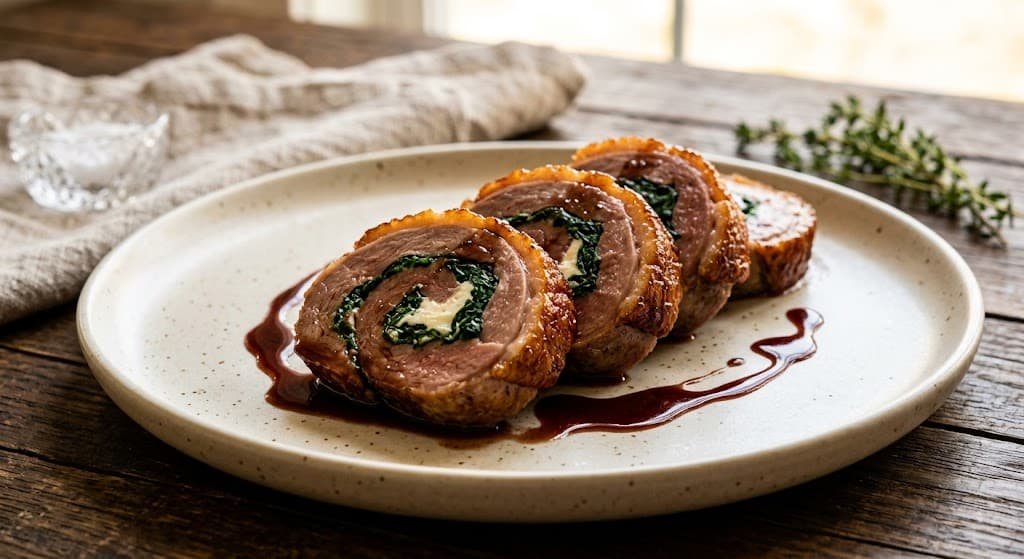
This dish sits at the intersection of two distinct techniques: the cold-pan rendering method that defines how duck breast is properly cooked, and the roulade — a piece of meat pounded thin, filled, and rolled around a stuffing. The Wrapped Spinach and Duck Skillet butterflies a duck breast, wraps it around a garlic-wilted spinach filling, and sears the whole roll skin-side down until the fat renders into the pan and the skin turns glass-crisp. Understanding why duck starts in a cold pan — the opposite of how most proteins are seared — is the key to getting this right.
The Technique Behind It
Duck breast carries a thick layer of subcutaneous fat directly beneath the skin, and that fat is the entire reason duck is cooked differently from chicken or beef. Starting duck skin-side down in a cold, dry pan and bringing the heat up gradually allows the fat layer to render — to slowly liquefy and drain out — before the surface has a chance to scorch. Sear duck the way you’d sear a steak, dropping it into an already-hot pan, and the fat layer seizes and browns on the outside before it’s had time to render, leaving you with a thick, chewy, half-melted layer between crisp skin and cooked meat.
The second technique at work is the roulade, which solves a structural problem: a butterflied duck breast is thin and irregular, and rolling it around a filling gives it a uniform shape that cooks evenly and holds its structure when sliced. The spinach filling also does functional work beyond flavor — wilted and well-drained, it compresses into a dense layer that helps the roll hold its shape through cooking and slicing, rather than unspooling on the cutting board.
Together, these techniques mean this dish is won or lost in two places: how patiently you render the fat, and how tightly and securely you roll the roulade before it hits the pan.
Ingredients
| Prep Time | 25 minutes |
| Cook Time | 25 minutes |
| Rest Time | 8 minutes |
| Servings | 2 people |
- 2 duck breasts (about 6–8 oz each), skin on — the skin-to-fat ratio is the entire point of this dish; skinless duck breast won’t render the way this method requires and isn’t a viable substitute here
- 5 oz baby spinach
- 2 cloves garlic, minced
- 2 oz goat cheese, softened — its acidity and moisture help bind the wilted spinach into a cohesive filling and add a tangy counterpoint to the rich duck fat
- 1 tablespoon olive oil
- 1/4 teaspoon ground nutmeg — a classic pairing with cooked spinach; it rounds out the vegetal, slightly mineral edge spinach carries once wilted
- Kosher salt and freshly cracked black pepper
- Kitchen twine or 4–6 toothpicks, for securing the roll
- 1/4 cup chicken or duck stock
- 1 teaspoon red wine vinegar — standing in for the splash of dry sherry or red wine a pan sauce like this traditionally deglazes with; the acidity performs the same function without the alcohol
Chicken breast can replace duck if you want a leaner version, but you lose the entire premise of this dish — chicken has almost no subcutaneous fat, so there’s no rendering step, and the skin will not crisp the same way. It becomes a different, simpler roulade rather than a variation on this one. If goat cheese isn’t to your taste, a soft, mild feta works similarly, though its higher salt content means you should season the filling more conservatively.
How to Make It
- Wilt the spinach. Heat the olive oil in a skillet over medium heat. Add the garlic and cook for 30 seconds, until fragrant, then add the spinach in batches, stirring until each addition wilts before adding more. Cook for 2–3 minutes total, until fully wilted and reduced in volume by roughly two-thirds. Transfer to a colander and press firmly with the back of a spoon to remove excess liquid — this step matters more than it looks like it should, since wet spinach will make the filling slide out of the roulade during cooking rather than staying put.
- Finish the filling. Once the spinach has cooled slightly, chop it roughly and combine it in a bowl with the goat cheese and nutmeg. Season with salt and pepper. The mixture should hold together in a loose clump when pressed, not run liquid.
- Butterfly the duck breasts. Place a duck breast skin-side down on a cutting board. Using a sharp knife held parallel to the board, slice horizontally into the thicker side of the breast, stopping about half an inch from the far edge so the two halves stay connected. Open it like a book. Repeat with the second breast. The goal is an even, roughly rectangular sheet of meat, thin enough to roll but not torn through.
- Fill and roll. Season the inside of each butterflied breast with salt and pepper. Divide the spinach filling between the two, spreading it in an even layer and leaving a half-inch border. Starting from one edge, roll each breast tightly into a log, keeping the skin on the outside of the roll. Secure with kitchen twine at 1-inch intervals, or pin closed with toothpicks.
- Render the fat in a cold pan. Place the rolled duck, skin-side down, in a dry, cold, oven-safe skillet — do not preheat the pan first. Set the burner to medium and let the duck cook undisturbed. Over the next 8–10 minutes, you should hear a gradual, quiet sizzle build slowly rather than an immediate aggressive hiss; that slow build is the fat rendering out, not scorching. Pour off excess rendered fat from the pan once or twice during this stage, reserving it if you’d like to use it for roasting potatoes another time.
- Finish in the oven. Once the skin is deep golden-brown and visibly crisp, preheat the oven to 400°F. Transfer the skillet directly to the oven and roast for 12–15 minutes, until an instant-read thermometer inserted into the thickest part of the roll reads 135°F (57°C) for medium, accounting for a few more degrees of carryover cooking during the rest.
- Rest, then make the pan sauce. Transfer the duck to a cutting board and let it rest for 8 minutes — resting allows the muscle fibers, which have tightened and pushed moisture toward the center under heat, time to relax and redistribute that moisture evenly, so it doesn’t all run out the moment you slice. While it rests, set the skillet over medium heat, add the stock and vinegar, and scrape up the browned bits stuck to the pan. Simmer for 2–3 minutes, until slightly reduced and glossy.
- Slice and serve. Remove the twine or toothpicks. Slice each roll into 1-inch medallions, revealing the spiral of spinach filling inside. Spoon the pan sauce over top.
Mastering the Key Technique
The cold-pan render is the single technique that determines whether this dish succeeds. Success looks like this: over the first several minutes, you’ll see a shallow, growing pool of clear-to-golden fat spreading out from beneath the duck, and the skin itself will gradually shift from pale and slightly rubbery-looking to a deep, even mahogany, with a texture that looks almost lacquered. If you lift a corner with tongs partway through, the skin should feel firm and slightly resistant, not soft and flabby.
Failure shows up in two opposite ways. If the pan was too hot from the start, the skin will darken unevenly, with dark patches next to pale ones, and the fat layer underneath stays thick and only partially rendered — you’ll see this if you slice into it and find a soft, gelatinous band between skin and meat instead of a thin, crisp one. If the heat was too low or the duck was moved around too much, the skin never develops real color and stays pale and soft, essentially poached in its own fat rather than crisped.
The instinct to get this right comes from resisting the urge to touch the pan. Every time you lift or shift the duck, you break contact between skin and hot surface at a moment when consistent, sustained contact is exactly what’s rendering the fat. Set a timer, walk away, and check only at the intervals given.
Troubleshooting
- The skin turned out soft, not crisp. This almost always means the pan started too hot, or the duck was flipped or moved before the fat had fully rendered. Start genuinely cold next time, and resist touching the duck during the initial render.
- The filling leaked out during cooking. Usually caused by spinach that wasn’t drained thoroughly enough, or a roll that wasn’t secured tightly. Press the wilted spinach hard against the colander — you should see visible liquid coming off — and tie the roll snugly enough that it holds its shape when you press it gently.
- The duck came out tough or dry. This is almost certainly overcooking. Duck breast, unlike chicken, is best served medium rather than well-done — pull it at 135°F and trust the rest to finish the job. Overshooting past 150°F tightens the muscle fibers past the point of tenderness.
- The roll fell apart when sliced. This points to a rest that was skipped or cut short. Cutting into meat immediately after cooking releases moisture in a rush and can cause a loosely structured roll to lose cohesion. Give it the full 8 minutes.
Variations Grounded in Culinary Logic
- Swap goat cheese for finely chopped toasted walnuts. Without the cheese’s moisture, the filling will be drier and less cohesive, so pulse the walnuts fine and bind them with a small amount of the rendered duck fat instead — the fat performs the same binding function the cheese did, while adding a nuttier, less tangy profile.
- Add orange zest to the pan sauce. Duck and citrus share a long culinary history because citrus’s acidity cuts directly through duck fat’s richness the same way the vinegar does here, just with a more aromatic, less sharp profile. Add the zest of half an orange to the sauce during the last minute of reduction.
- Use Swiss chard instead of spinach. Chard has a firmer structure and a slightly more mineral, bitter edge than spinach, so it holds up better inside the roll and provides a more distinct textural bite once sliced — cook it a minute or two longer to properly wilt the tougher stems.
- Finish the pan sauce with a small pat of cold butter. Whisking in cold butter off the heat (a technique called monter au beurre) emulsifies the sauce into something glossier and slightly thicker, giving it more body to cling to the sliced duck.
Serving and Pairing
Duck’s richness calls for something with real acidity or bitterness on the plate to cut through the fat — a simple salad of bitter greens like radicchio or arugula, dressed sharply with lemon, does that job without competing with the pan sauce. Starchy sides work well as a counterweight to the roulade’s textural contrast between crisp skin and soft filling: roasted fingerling potatoes, cooked in some of the reserved duck fat, tie the whole plate together through a shared flavor thread rather than sitting as an unrelated side.
Storage and Reheating
Duck continues cooking slightly from carryover heat during the rest, but once it’s rested and sliced, that process is finished — what changes from there is moisture loss during storage, not further cooking. Refrigerated in an airtight container, the roulade keeps for up to 3 days, though the crisp skin will soften noticeably as it sits, since the moisture from the meat and filling migrates outward and softens the exterior over time.
To reheat, use a dry skillet over medium-low heat rather than a microwave, which will overcook the exterior before the center warms through and won’t restore any crispness. A few minutes per side, covered loosely, brings the interior back to warm without pushing the duck past medium. The pan sauce reheats separately over low heat and can be whisked with a splash of water if it’s thickened too much in the fridge.
Approximate Nutrition Per Serving
Values are estimates for informational purposes only and will vary based on specific ingredients and portion sizes.
| Calories | 480 kcal |
| Protein | 36 g |
| Carbs | 3 g |
| Fat | 35 g |
| Fiber | 1 g |
Closing
What this dish teaches is patience with fat — the discipline to let a cold pan do slow, unglamorous work instead of forcing color with high heat. That single principle, the cold-start render, applies directly to pork belly, skin-on salmon, and bacon, making this roulade far more instructive than its ingredient list suggests. Master the render here, and duck stops being a special-occasion protein reserved for restaurants.