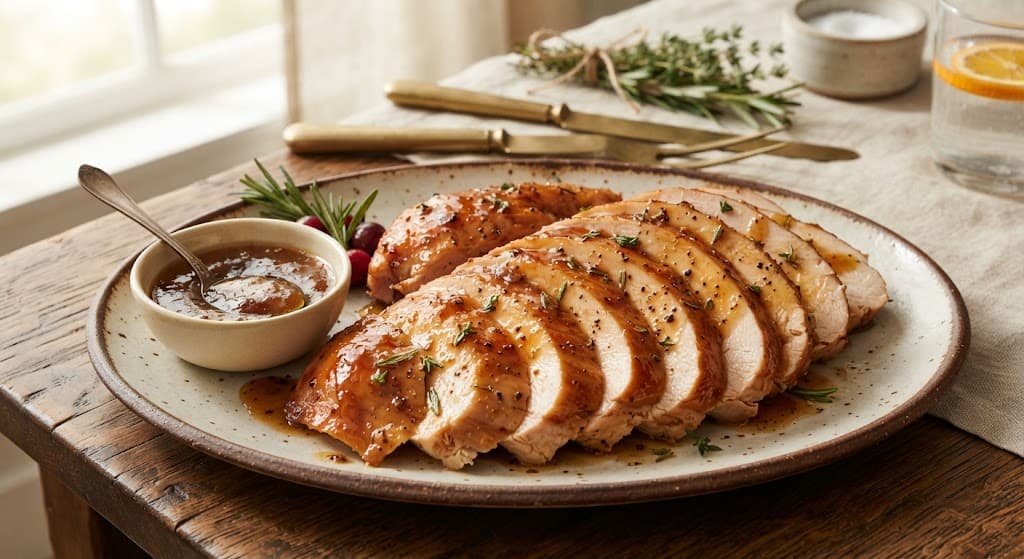
Low, moist heat does something to connective tissue that high, dry heat never manages: given enough time, the collagen running through turkey muscle slowly hydrolyzes into gelatin instead of seizing up and squeezing moisture out the way a hot oven does to lean meat. That’s the entire premise behind Slow Cooker Turkey with Bourbon Glaze — six to eight hours at a bare simmer lets the breast stay tender and moist without the constant basting a roasted turkey demands, while a glaze built on real orange juice, honey, and a non-alcoholic bourbon-flavor extract in place of the actual spirit does the flavor work that direct high heat would otherwise provide.
Why the Slow Cooker Changes the Chemistry Here
A covered slow cooker rarely climbs above roughly 200°F, well below the 280°F or so needed to trigger the Maillard reaction — the browning process that gives roasted turkey its crisp, golden skin and complex savory crust. That’s not a flaw to fix; it’s a trade being made on purpose. In exchange for giving up that crust, the low, steady heat and trapped moisture mean the turkey breast can cook for hours without drying out, since there’s no dry, hot air pulling water out of the meat the way an oven does. The gap this leaves is browning and caramelized flavor on the surface, and that’s exactly what the finishing step below is built to solve.
This is the detail most slow cooker turkey recipes skip entirely: they’ll tell you to pour the glaze over the turkey and walk away, then wonder why the finished bird looks pale and the glaze tastes thin instead of concentrated. Reducing the glaze separately on the stovetop and finishing the turkey briefly under a broiler closes that gap without needing the slow cooker to do a job it physically can’t.
What You’ll Need
For the Turkey
- 1 boneless turkey breast (3 to 4 pounds)
- 1 teaspoon smoked paprika
- 1 teaspoon salt
- 1 teaspoon garlic powder
- 1 teaspoon onion powder
- 1 teaspoon brown sugar
- 1/4 teaspoon cayenne pepper
- 1/2 teaspoon ground black pepper
For the Bourbon-Style Glaze
- 1/2 cup fresh orange juice
- 1 tablespoon orange zest
- 1/2 cup honey
- 1 teaspoon non-alcoholic bourbon-flavor extract
- 1 tablespoon apple cider vinegar
- 2 tablespoons unsalted butter
Non-alcoholic bourbon extract is sold alongside vanilla and other baking extracts at most grocery stores, and it delivers the same warm, caramel-and-oak character the original glaze relies on without any actual spirit — this recipe keeps its name but swaps that one ingredient. If you can’t find it, a mix of a few drops of vanilla extract and a small pinch of smoked paprika in the glaze gets close to the same smoky-sweet direction. Boneless turkey breast is easiest to fit in most slow cookers, but a bone-in breast works too if you trim it to fit, adding roughly 30 minutes to the cook time.
How to Make Slow Cooker Turkey with Bourbon Glaze
Slow Cooker Turkey with Bourbon Glaze needs about 15 minutes of prep, then 6 to 7 hours of mostly unattended cooking on low, plus a final 5 minutes under the broiler. It’s done when a thermometer in the thickest part reads 165°F — not by the clock, since slow cooker wattage varies between models.
- Combine the smoked paprika, salt, garlic powder, onion powder, brown sugar, cayenne, and black pepper in a small bowl. Rub the mixture evenly over the turkey breast.
- Place the turkey in the slow cooker. Whisk together the orange juice, orange zest, honey, bourbon-flavor extract, and vinegar, then pour over the turkey.
- Cover and cook on low for 6 to 7 hours, until a thermometer inserted into the thickest part reads 165°F.
- Carefully transfer the turkey to a baking sheet. Pour the cooking liquid into a small saucepan and add the butter. Simmer over medium heat for 8 to 10 minutes, until reduced by about half and thick enough to coat the back of a spoon.
- Brush the reduced glaze generously over the turkey. Broil on high for 3 to 5 minutes, watching closely, until the surface is deeply golden and slightly caramelized in spots.
- Rest for 10 minutes before slicing. Serve with the remaining glaze on the side.
The Details That Separate a Good Result From a Great One
Use a thermometer rather than trusting the clock — slow cookers vary enough in actual temperature that two identical recipes on two different machines can finish 45 minutes apart. If you’re wondering how to make turkey with bourbon glaze in a slow cooker taste rich instead of watery, the answer is almost always the reduction step, not the seasoning. Don’t skip the reduction step; pouring the thin, un-reduced cooking liquid straight over the turkey leaves a watery, barely-there glaze instead of the thick, clingy coating the dish is named for. And watch the broiler closely rather than walking away — the same sugars that make the glaze taste rich can go from caramelized to burnt in under a minute once they’re under direct high heat.
Troubleshooting
Why did the turkey turn out dry despite the slow cooker? It was almost certainly left in too long past 165°F. Lean turkey breast has less fat to buffer overcooking than a fattier cut, so pull it the moment it hits temperature rather than cooking “a little extra to be safe.”
Why does the glaze taste thin instead of rich? The cooking liquid was likely used straight from the slow cooker without reducing. Simmer it down on the stovetop until it visibly thickens — that concentration is where the flavor actually lives.
Why is the turkey pale even after broiling? The broiler may not have been hot enough, or the turkey was too far from the heat source. Position the rack so the turkey sits close to the broiler element and don’t skip preheating it fully first.
Variations and Swaps
Swap the orange juice for apple cider for a slightly deeper, less citrus-forward glaze that still pairs well with the bourbon-style extract. A tablespoon of Dijon mustard whisked into the glaze adds a sharper edge that cuts some of the sweetness. For a smokier turkey and bourbon glaze combination, add an extra half teaspoon of smoked paprika to the spice rub rather than relying on the glaze alone to carry that flavor.
Serving and Pairing
Slice against the grain into half-inch pieces and fan them out on a platter, spooning extra glaze over the top just before serving so a bourbon-glazed slow cooker turkey like this one stays glossy rather than soaking in and disappearing. Roasted root vegetables or a simple green salad with a sharp vinaigrette both balance the sweetness of the glaze well without competing with it.
Storing and Reheating
Store sliced turkey and any leftover glaze separately in airtight containers in the refrigerator for up to 4 days. Reheat gently in a covered skillet with a splash of the reserved glaze to keep the meat from drying out — a microwave tends to overcook the edges before the center is warm. This dish also freezes reasonably well for up to 2 months if the turkey is sliced and stored with a bit of glaze to keep it moist during thawing.
Nutrition (Approximate, Per Serving)
Note: These are estimated values per serving and will vary depending on turkey breast size, brand of extract, and exact glaze reduction.
| Calories | 360 kcal |
| Protein | 48 g |
| Carbohydrates | 26 g |
| Fat | 5 g |
| Fiber | 1 g |
Mastering the Core Technique
The reduction step deserves more attention than most recipes give it, because it’s doing real chemical work, not just thickening for the sake of texture. As the cooking liquid simmers uncovered, water evaporates while the sugars, proteins, and dissolved flavor compounds stay behind, concentrating in a smaller and smaller volume — the same liquid that tasted watery and thin straight out of the slow cooker becomes noticeably sweeter, glossier, and more clingy simply because there’s less water diluting everything else. Reducing it by roughly half is usually the point where the glaze coats a spoon rather than running off it, which is a more reliable indicator than a specific simmer time, since stovetop heat and pan width both affect how fast liquid evaporates.
Closing Thoughts
This recipe was tested and refined by bebup.org’s kitchen before publishing, with the broiler finishing time adjusted after an early batch went from golden to overly dark in the span of about ninety seconds.
What makes this dish work isn’t a single dramatic step — it’s two separate, deliberate compromises with heat: giving the slow cooker hours to work gently on the meat, then giving the broiler a few focused minutes to do the one job the slow cooker was never built to do. Understood that way, the recipe isn’t really a shortcut at all, just a different, more patient route to the same finished plate.