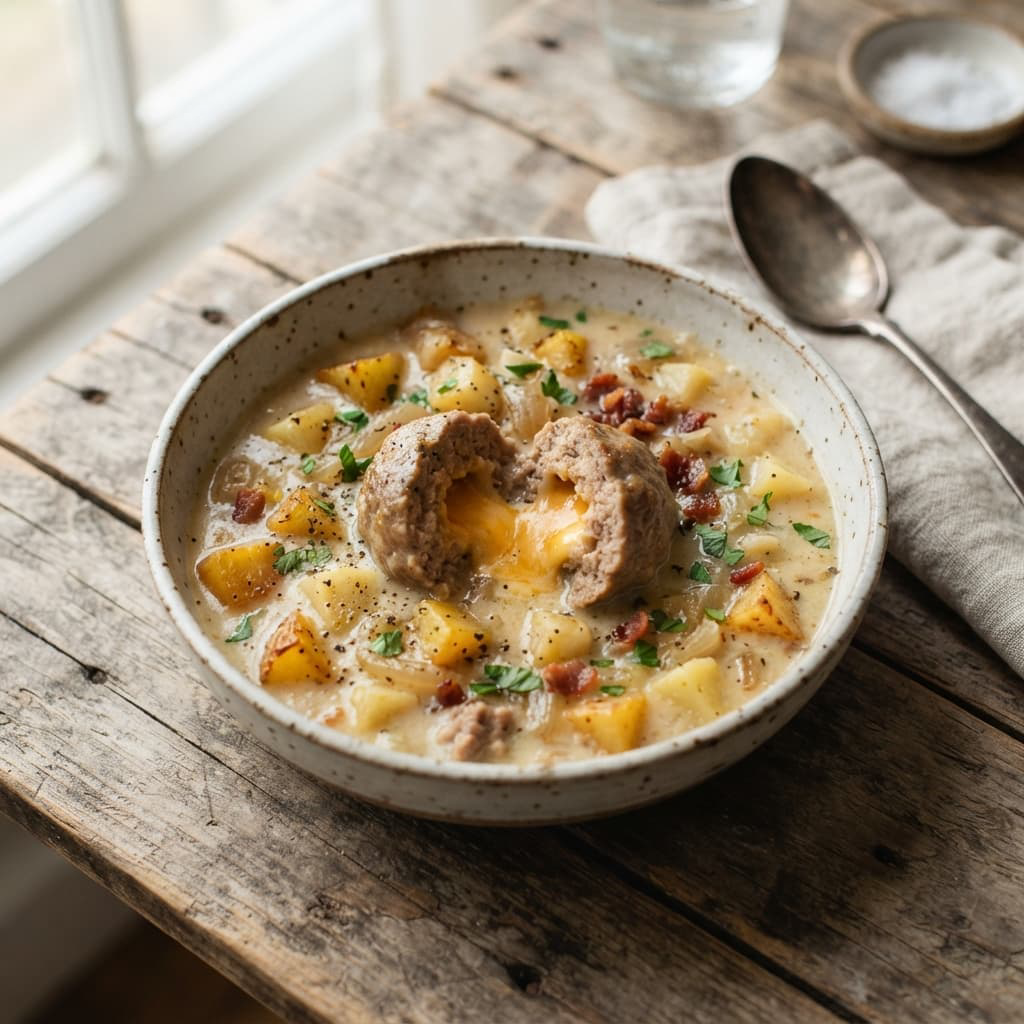
Salt does more to ground pork than season it. Mixed in and worked briefly, it dissolves myosin, a muscle protein, into a sticky film that glues the meat together as it heats. That film is the difference between a meatball that holds its shape in simmering liquid and one that crumbles into the pot. Stuffed Pork Chowder with Rutabaga depends on it: small pork meatballs, each hiding a cube of cheddar, are poached directly in a rutabaga and potato chowder, and they must stay whole while the cheese melts inside.
The pieces are all established. Ham and rutabaga chowders are published recipes, rutabaga is a classic partner for pork, and meatballs and dumplings simmered in soups and stews are common, including pork stews finished with stuffing-style dumplings. This recipe combines them: a creamy chowder of roasted rutabaga and potato, with sage-seasoned pork meatballs that hold a molten center.
| Prep Time | 30 minutes |
| Cook Time | 45 minutes |
| Total Time | 1 hour 15 minutes |
| Servings | 6 |
| Difficulty | Moderate, with a little hands-on shaping |
Key Techniques for Stuffed Pork Chowder
The chowder takes about 1 hour 15 minutes. Roast the rutabaga for 30 minutes at 220°C (425°F), build the base in 15 minutes, and poach the stuffed meatballs for 12 to 15 minutes until they reach 71°C (160°F) inside. Keep the liquid at a bare simmer, never a boil.
Three controls make the dish work. First, binding: a panade of breadcrumbs soaked in milk keeps the meat tender, and a short mix with salt develops enough myosin to hold the shape. Overmixing makes meatballs dense, so stop when the mixture turns sticky and uniform. Second, sealing: the cheese cube must sit in the center with no gap, because a crack lets it leak into the chowder as it melts. Third, temperature: a boil agitates the surface, tears seams open, and splits the dairy, while a bare simmer cooks the meatballs gently and evenly.
Rutabaga benefits from roasting. It is dense, slightly bitter, and mild raw, and dry heat concentrates its sugars and softens the bitterness that boiling tends to emphasize.
Ingredients
This serves 6.
For the Stuffed Meatballs
- 1 lb (450g) ground pork
- 1/3 cup (40g) fine breadcrumbs
- 3 tablespoons (45ml) whole milk
- 1 egg yolk
- 1 teaspoon dried sage (or 1 tablespoon fresh, chopped)
- 1 teaspoon salt
- 1/2 teaspoon black pepper
- 3 oz (85g) sharp cheddar, cut into 18 small cubes
For the Chowder
- 1 lb (450g) rutabaga, peeled and cut into 1/2-inch (1.3cm) cubes
- 12 oz (340g) Yukon Gold potatoes, peeled and cut into 1/2-inch (1.3cm) cubes
- 3 tablespoons (45ml) olive oil, divided
- 4 slices (4 oz / 115g) bacon, chopped
- 1 onion, diced
- 2 celery stalks, diced
- 3 tablespoons (24g) all-purpose flour
- 4 cups (960ml) chicken broth
- 1 cup (240ml) whole milk
- 1/2 cup (120ml) heavy cream
- 1 bay leaf
- Salt and black pepper, to taste
- 2 tablespoons (8g) fresh parsley, chopped, for serving
How to Make Stuffed Pork Chowder with Rutabaga
- Heat the oven to 220°C (425°F). Toss the rutabaga and potatoes with 2 tablespoons of the olive oil, salt, and pepper on a rimmed sheet. Roast for 30 minutes, stirring once, until the edges are golden and a knife slides in easily.
- Stir the breadcrumbs and milk together for the meatballs and let them sit for 5 minutes, until the crumbs form a paste.
- Add the pork, egg yolk, sage, salt, and pepper to the paste. Mix with your hands for about 30 seconds, only until the mixture turns sticky and cohesive.
- Divide into 18 portions. Flatten each in your palm, press a cheddar cube into the center, and roll closed so there is no seam or exposed cheese. Chill on a plate for 15 minutes.
- In a large pot, cook the bacon in the remaining oil over medium heat for 5 minutes, until crisp. Add the onion and celery and cook for 6 minutes, until soft and translucent.
- Sprinkle in the flour and stir for 1 minute until it smells nutty and no dry flour remains. Gradually whisk in the broth, then the milk, scraping up any browned bits.
- Add the bay leaf and half the roasted vegetables. Bring to a gentle simmer and cook for 8 minutes, until the broth thickens enough to coat a spoon.
- Reduce the heat to low. Lower the meatballs in one at a time, keeping the surface barely trembling. Poach for 12 to 15 minutes, turning once, until they are firm and reach 71°C (160°F) inside.
- Stir in the cream and the remaining roasted vegetables and warm for 2 minutes. Remove the bay leaf, season to taste, and serve with parsley.
Good vs. Excellent: The Details That Matter
- Chill the formed meatballs. Cold meat is firmer and holds the cheese in place during poaching.
- Keep the cheese cubes small. Large pieces break through the wall as they melt.
- Roast, do not boil, the rutabaga. Roasting gives sweetness and structure that stays intact in the soup.
- Add the cream last. Cooked briefly, it keeps the chowder smooth and avoids curdling.
- Mash a few roasted cubes into the base. Pressing a handful against the pot thickens the chowder with starch rather than more flour.
Troubleshooting Common Problems
Problem: The meatballs fell apart in the pot. Cause: the mixture was undermixed or the liquid was boiling. Solution: mix until sticky, chill before poaching, and hold the surface to a tremble.
Problem: The cheese leaked out. Cause: a seam or thin wall let it escape as it melted. Solution: use smaller cubes, roll until fully sealed, and let the meatballs set in the refrigerator first.
Problem: The meatballs were tough. Cause: the pork was overmixed or overcooked. Solution: stop mixing at the sticky stage and pull the meatballs at 71°C (160°F).
Problem: The chowder tasted pasty or thin. Cause: pasty means the flour was not cooked long enough; thin means the base was not simmered before the cream went in. Solution: cook the flour for a full minute, and simmer until the broth coats a spoon.
Mastering the Technique
The idea that carries over is that texture in ground meat is controlled by mixing and temperature. Light mixing with salt gives bind without toughness; chilling keeps fat solid until the exterior sets; gentle heat prevents seams from tearing. The same principles apply to meatloaf, burgers, sausage, and dumpling fillings.
A useful sensory test is to pinch a small piece of the mixed meat. If it clings to your fingers and holds together when you stretch it, it is bound. If it crumbles, it needs a few more seconds of mixing.
Variations and Substitutions
Turnip, parsnip, or celery root can replace some of the rutabaga, with slightly different sweetness. Ground chicken or turkey works for the meatballs, though they will be leaner and need an extra tablespoon of milk. Swap cheddar for Gruyère or smoked Gouda, or skip the stuffing and make plain sage meatballs. For a dairy-light version, replace the cream with more milk.
Serving and Pairing
Serve hot in wide bowls with three meatballs each, with crusty bread or buttered rye toast. A sharp, vinegary salad of cabbage or apple cuts the richness. A small spoonful of whole-grain mustard stirred into each bowl adds a pleasant tang.
Storage and Reheating
Refrigerate in an airtight container for up to 3 days. The chowder thickens as it sits, so loosen it with a splash of milk or broth and rewarm gently over low heat, stirring occasionally. Do not boil. The uncooked stuffed meatballs can be frozen on a tray, then bagged, for up to 2 months and poached from frozen for about 20 minutes. The finished chowder does not freeze well, since the dairy separates.
Nutritional Information
Values below are estimates per serving and will vary depending on exact brands and quantities used.
| Calories | 560 kcal |
| Protein | 28 g |
| Carbohydrates | 36 g |
| Fat | 34 g |
| Fiber | 5 g |
Frequently Asked Questions
Can I use a different root vegetable? Yes. Turnip, celery root, or parsnip work, though rutabaga gives the most characteristic sweet, earthy flavor.
Do I need to brown the meatballs first? No. Poaching directly keeps them tender and seals the cheese gently. Browning adds flavor but makes the seams more likely to split.
How do I know the meatballs are cooked? They should feel firm, with no pink at the center, and read 71°C (160°F) on an instant-read thermometer.
Stuffed Pork Chowder with Rutabaga rewards restraint: a light hand with the meat, a gentle simmer, and roasting the root vegetable first. Handled that way, each spoonful gives a tender meatball, a pocket of melted cheese, and a chowder with real depth.
Stuffed Pork Chowder with Rutabaga
Ingredients
Method
- Heat the oven to 220°C (425°F). Toss the rutabaga and potatoes with 2 tablespoons of the olive oil, salt, and pepper on a rimmed sheet. Roast for 30 minutes, stirring once, until the edges are golden and a knife slides in easily.
- Stir the breadcrumbs and milk together for the meatballs and let them sit for 5 minutes, until the crumbs form a paste.
- Add the pork, egg yolk, sage, salt, and pepper to the paste. Mix with your hands for about 30 seconds, only until the mixture turns sticky and cohesive.
- Divide into 18 portions. Flatten each in your palm, press a cheddar cube into the center, and roll closed so there is no seam or exposed cheese. Chill on a plate for 15 minutes.
- In a large pot, cook the bacon in the remaining oil over medium heat for 5 minutes, until crisp. Add the onion and celery and cook for 6 minutes, until soft and translucent.
- Sprinkle in the flour and stir for 1 minute until it smells nutty and no dry flour remains. Gradually whisk in the broth, then the milk, scraping up any browned bits.
- Add the bay leaf and half the roasted vegetables. Bring to a gentle simmer and cook for 8 minutes, until the broth thickens enough to coat a spoon.
- Reduce the heat to low. Lower the meatballs in one at a time, keeping the surface barely trembling. Poach for 12 to 15 minutes, turning once, until they are firm and reach 71°C (160°F) inside.
- Stir in the cream and the remaining roasted vegetables and warm for 2 minutes. Remove the bay leaf, season to taste, and serve with parsley.