Sugar molecules break down under sustained, gentle heat long before they burn, and that slow chemical shift, not a splash of wine or a fancy stock, is the entire secret behind a great bowl of French onion soup. Most kitchens rush this part. The onions go in, get a stir every so often, and come out pale gold after twenty minutes, tasting more like boiled onion than the deep, almost meaty sweetness this dish is known for. Done properly, this soup asks for patience in exactly one place, and once you understand why, the rest of the recipe is almost embarrassingly simple.
Onion Soup, Done the Slow and Proper Way
Classic French onion soup takes about two hours from start to finish, and most of that time is hands-off. The onions need 45 to 60 minutes of slow, unhurried cooking to fully caramelize, then the broth simmers for another 30 minutes before each bowl finishes under bubbling Gruyère for a few minutes in the broiler.
What’s happening in that window is a real chemical transformation. Raw onion is sharp and watery because of sulfur compounds and sugars locked inside rigid cell walls. Steady, low heat breaks those walls down, releasing the sugars into the Maillard reaction and caramelization side by side, two related but distinct browning processes that together build the hundreds of flavor compounds behind that roasted sweetness. Push the heat too high and you skip straight to scorching, which produces bitterness instead of depth. This is the single biggest gap between home versions of French onion soup and the kind worth remembering: not a secret ingredient, but a refusal to rush a process that cannot be sped up.
The second technique worth understanding is what a beef stock rich in collagen does for the finished broth. Collagen from bones and connective tissue slowly converts into gelatin during a long simmer, and gelatin is what gives good onion soup its slightly thick, coating texture instead of a thin, watery one. If your stock is thin store-bought broth with no body of its own, the soup will taste correct but feel wrong in the mouth.
Ingredients
For the Soup Base
- 2.5 lbs yellow onions (about 6 large), thinly sliced
- 4 tbsp unsalted butter
- 1 tbsp olive oil
- 1 tsp kosher salt, divided
- 1/2 tsp sugar (optional; speeds browning if you’re short on time, see Troubleshooting below)
- 2 cloves garlic, minced
- 2 tbsp all-purpose flour
- 8 cups beef stock, preferably a rich, gelatin-heavy homemade or bone stock
- 2 tbsp Worcestershire sauce
- 2 sprigs fresh thyme (or 1/2 tsp dried)
- 1 bay leaf
- 1/4 cup apple cider vinegar mixed with 2 tbsp water (a non-alcoholic stand-in for the dry sherry traditionally used to deglaze the pot; it supplies the same acidity and lift without any alcohol)
- Freshly ground black pepper, to taste
For the Cheese Toast
- 1 baguette, sliced into 1-inch rounds
- 8 oz Gruyère cheese, grated
- 2 tbsp grated Parmesan (optional, helps the top brown faster)
Method
- Slice the onions as uniformly as you can, about 1/8 inch thick. Uneven slices caramelize at different rates, and the thin ones will burn before the thick ones color.
- Melt the butter with the olive oil in a heavy pot or Dutch oven over medium heat. Add the onions and 1/2 tsp salt, stirring to coat every slice in fat.
- Cook uncovered for 45 to 60 minutes, stirring every 5 to 10 minutes and lowering the heat as they progress. They will wilt and release liquid first, then slowly turn golden, then a deep mahogany brown. A pale gold color is not done; you are looking for a color closer to strong tea, with a sticky, jammy texture and a layer of browned fond building on the bottom of the pot.
- Stir in the garlic and flour, and cook for 1 to 2 minutes, until the raw flour smell disappears.
- Pour in the vinegar-water mixture and scrape the bottom of the pot firmly with a wooden spoon, lifting all of that browned fond into the liquid. This step carries most of the soup’s flavor, so don’t skip it.
- Add the beef stock, Worcestershire sauce, thyme, bay leaf, remaining salt, and a generous grind of black pepper. Bring to a gentle simmer and cook uncovered for 30 minutes, letting the broth reduce slightly and the flavors merge.
- Remove the thyme stems and bay leaf, then taste and adjust the salt. The broth should taste fully seasoned on its own, since the cheese and bread on top add very little salt.
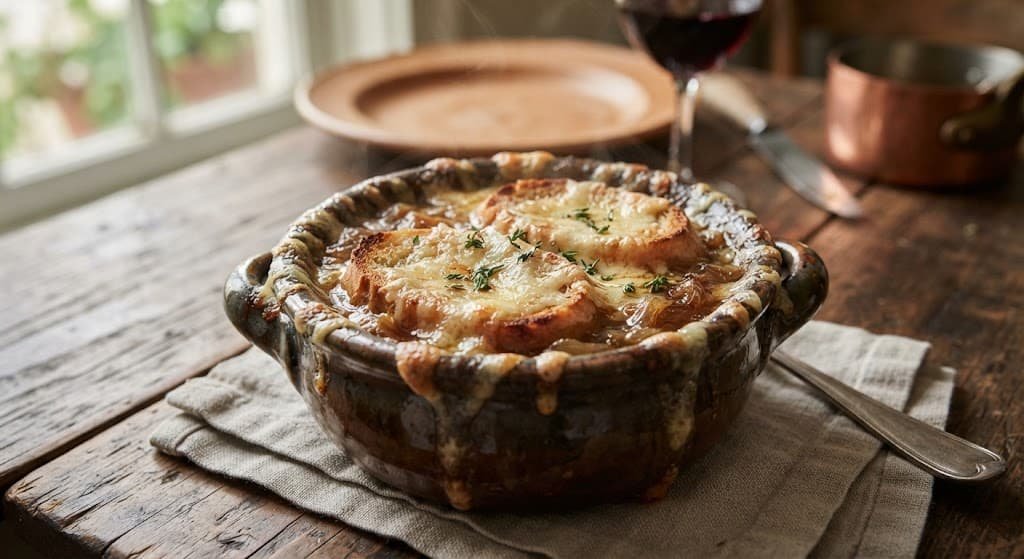
- Ladle the hot soup into oven-safe bowls, float a baguette round on top of each, and pile on the Gruyère, letting some cheese fall over the edges to anchor the bread. Broil 4 to 6 inches from the heat for 2 to 4 minutes, watching closely, until the cheese is fully melted, bubbling, and browned in spots.
- Let the bowls rest for 5 minutes before serving. This isn’t optional: the cheese needs a moment to firm up enough to eat, and the broth underneath continues to settle.
The Real Difference Between Bad and Great French Onion Soup
If you’ve ever wondered how to make onion soup that turns out deep and complex rather than just sweet, these are the three details that matter most. Onion color is the clearest tell. Pale gold onions make a soup that tastes pleasant but forgettable; deep mahogany onions, cooked slowly enough that they turn almost sticky, make the version people ask for the recipe after eating. Stock quality matters nearly as much: a homemade or bone-based stock with real body will coat a spoon slightly, while thin boxed broth leaves the soup tasting watery no matter how well the onions were cooked. Finally, resist the urge to crank the broiler to get faster browning on the cheese. A closer, shorter broil gives you an evenly bubbled, spotty-brown crust; a far, longer one risks a scorched top with a still-cool center.
Troubleshooting
Why did my onions turn bitter instead of sweet?
Cause: the heat was too high, so the sugars scorched instead of slowly caramelizing. Fix: lower the heat, add a small splash of water or stock to loosen any near-black fond stuck to the pot, and continue cooking gently until the color evens out.
Why is my broth thin and watery instead of rich?
Cause: either the onions didn’t caramelize deeply enough to build fond, or the stock itself lacked gelatin. Fix: cook the onions longer next time, and reinforce a thin store-bought stock with a spoonful of unflavored gelatin or a few beef bones simmered in during the broth stage.
Why does my cheese slide off instead of forming a crust?
Cause: the bread soaked through before broiling, or the cheese wasn’t distributed to the edges of the bowl to anchor it. Fix: use day-old, sturdier bread, and make sure cheese touches the rim of the bowl all the way around before broiling.
Variations and Substitutes
For a vegetarian version, swap the beef stock for a mushroom-vegetable stock reinforced with a spoonful of soy sauce or miso paste; you’ll lose some of the gelatin-driven body, but the umami keeps the broth from tasting flat. If Gruyère is unavailable or over budget, a mix of Swiss cheese and a little mozzarella gets close, though Gruyère’s slightly nutty flavor is hard to fully replace. A slow cooker adaptation works well too, as long as you still caramelize the onions on the stovetop first; that step cannot happen in a slow cooker, but once the onions are done, the stock and simmering stage can finish hands-off for 4 to 6 hours on low.
Serving and Pairing
This onion soup recipe is rich enough to stand as a full light meal alongside a simple green salad tossed in a sharp vinaigrette, which cuts through the cheese and browned butter nicely. Serve extra baguette on the side for the broth itself, and if you’re building a bigger dinner around it, a roast chicken or a simple pan-seared steak keeps the rest of the table from competing with the soup’s intensity.
Storage and Reheating
Store the soup base alone, without bread or cheese, in an airtight container in the fridge up to 4 days, or freeze up to 3 months; the broth deepens by the second day. Reheat gently on the stovetop until just simmering. Always add fresh bread and cheese at serving time and broil again rather than storing the soup already assembled, since soaked bread and reheated cheese never recover their texture.
Nutrition (Per Serving, Serves 6)
These are estimated values per serving. Actual numbers will vary depending on the exact stock, cheese, and bread brands used.
| Calories | 385 kcal |
| Protein | 16 g |
| Carbohydrates | 33 g |
| Fat | 20 g |
| Fiber | 3 g |
This recipe was tested and refined in bebup.org’s kitchen before publishing, with several batches used to pin down the exact caramelization window described above.
A Soup Built on Patience
There’s something worth sitting with in a dish this old and this simple still asking for the same thing it always has: enough time to let a humble vegetable become something else entirely. Nothing here is difficult. It just refuses to be hurried, and that’s exactly why it still holds up against every trend that has tried to reinvent it.
Mastering the Caramelization Technique
Caramelization and the Maillard reaction get lumped together, but they’re chemically distinct. Caramelization is sugar alone breaking down under heat; the Maillard reaction involves sugars reacting with amino acids from the onion’s proteins, and it’s responsible for most of the deep, savory notes rather than pure sweetness. In a pot, both reactions happen at once, at a gentler pace than in a dry pan, which is why the process takes closer to an hour rather than the fifteen minutes many recipes promise. Stirring too often slows browning, since it interrupts the brief contact between onions and hot pot surface where color builds; stirring too rarely risks scorching in one spot while the rest stays pale. A stir every 5 to 10 minutes, letting the onions sit undisturbed between each pass, works best.
French Onion Soup
Ingredients
Method
- Slice the onions uniformly, about 1/8 inch thick.
- Melt butter and olive oil in a heavy pot over medium heat; add onions and 1/2 tsp salt.
- Cook uncovered 45–60 minutes, stirring every 5–10 minutes, until deep mahogany brown.
- Stir in garlic and flour; cook 1–2 minutes.
- Deglaze with the vinegar-water mixture, scraping up all the browned fond.
- Add beef stock, Worcestershire, thyme, bay leaf, remaining salt, and pepper. Simmer uncovered 30 minutes.
- Remove thyme and bay leaf; taste and adjust salt.
- Ladle into oven-safe bowls, top with baguette and Gruyère, and broil 2–4 minutes until browned and bubbling.
- Rest 5 minutes before serving.