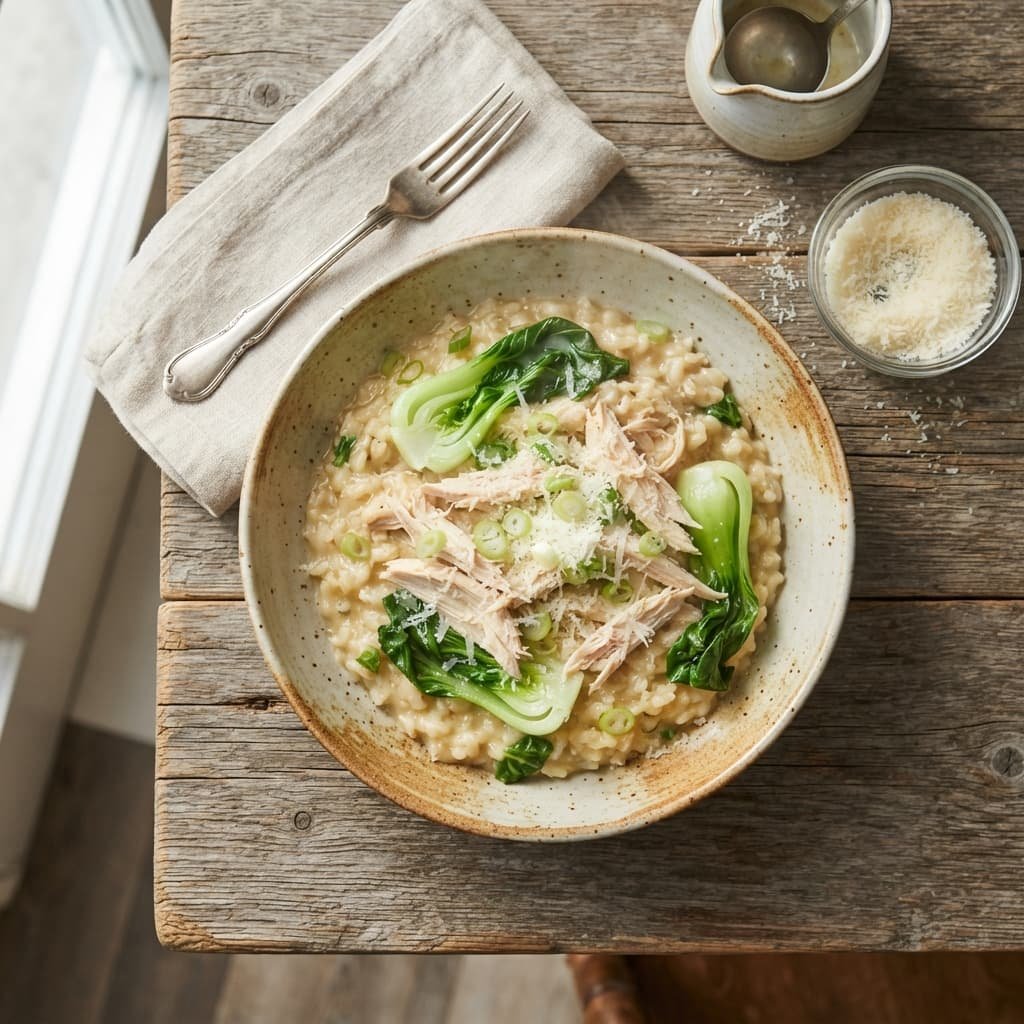
A bok choy stalk and its leaf are almost two different vegetables: the white stalk is dense, watery, and crunchy, while the leaf is thin and collapses in seconds. Cooked together for the same time, one is raw and the other is mush. Marinated Rotisserie Chicken and Bok Choy Risotto is built around that difference. The stalks go in partway through the rice’s cooking, the leaves go in at the very end, and a ginger-lemon marinade on the shredded chicken keeps the bird from tasting like an afterthought stirred into a creamy rice.
The parts are well documented. Bok choy risotto is a published recipe, with the stems added early and the leaves late. Chicken risotto, including versions that use rotisserie chicken or add pak choi with chicken, is also common. A note on the name: rotisserie chicken is sold already cooked, so here the “marinating” means steeping the shredded meat for 20 minutes in a lemon, ginger, garlic, and soy mixture for flavor and moisture, not tenderizing it.
| Prep Time | 20 minutes (plus 20 minutes marinating) |
| Cook Time | 30 minutes |
| Total Time | 1 hour 10 minutes |
| Servings | 4 |
| Difficulty | Moderate, with steady stirring |
Key Techniques for Bok Choy Risotto
The risotto takes about 30 minutes of cooking. Toast the rice for 2 minutes, add hot broth a ladle at a time for 18 to 20 minutes, stir in the bok choy stalks halfway, and fold in the leaves and chicken in the last 2 minutes so everything stays bright and tender.
Risotto gets its creaminess from starch. Arborio is a short-grain rice high in amylopectin, and as the grains rub against each other under constant stirring, their surfaces release starch into the broth, making it thick and silky without cream. Adding hot broth in small amounts keeps the temperature steady and gives the grains time to absorb liquid, whereas cold broth halts the cooking and a flood of liquid dilutes the starch.
Because the rice sets the schedule, everything else is timed against it: stalks about 8 to 10 minutes before the end, leaves and chicken last. The chicken is already cooked, so it needs only to warm to 74°C (165°F). The marinade’s acid is kept small so it brightens the chicken without curdling the finish of the risotto.
Ingredients
This serves 4.
For the Marinated Chicken
- 3 cups (about 400g) shredded rotisserie chicken, skin removed
- 2 tablespoons (30ml) lemon juice
- 1 tablespoon (15ml) soy sauce
- 1 tablespoon (15ml) olive oil
- 1 teaspoon fresh ginger, grated
- 1 garlic clove, grated
- 1/4 teaspoon black pepper
For the Risotto
- 5 1/2 cups (1.3L) low-sodium chicken broth
- 2 tablespoons (28g) butter, divided
- 1 tablespoon (15ml) olive oil
- 1 small onion (about 120g), finely diced
- 2 garlic cloves, minced
- 1 1/2 cups (300g) Arborio rice
- 1 lb (450g) baby bok choy (about 4 heads), stalks sliced 1/2-inch (1.3cm) thick, leaves cut into ribbons
- 1/2 cup (50g) grated Parmesan
- 1 tablespoon (15ml) lemon juice
- Salt and black pepper, to taste
- 2 scallions, thinly sliced, for serving
Many risotto recipes start with white wine; this one relies on broth and a finishing squeeze of lemon instead.
How to Make Rotisserie Chicken and Bok Choy Risotto
- Toss the shredded chicken with the lemon juice, soy sauce, olive oil, ginger, garlic, and pepper. Cover and refrigerate for 20 minutes, no longer than 1 hour.
- Bring the broth to a bare simmer in a saucepan and keep it hot over low heat.
- In a wide, heavy pot, melt 1 tablespoon butter with the oil over medium heat. Cook the onion for 4 to 5 minutes, until soft and translucent but not browned. Add the garlic and stir for 30 seconds.
- Add the rice and stir for 2 minutes, until the edges look translucent and the grains smell nutty, with a white dot still visible in the center.
- Add 1 cup (240ml) hot broth and stir until it is mostly absorbed. Continue adding broth a ladle at a time, stirring often, and waiting until the pot looks almost dry on the bottom when you drag the spoon through, before each addition.
- After about 10 minutes, stir in the bok choy stalks. Keep adding broth and stirring for another 8 to 10 minutes, until the rice is creamy and tender with a slight firmness at the center when bitten.
- Stir in the bok choy leaves and the marinated chicken with its juices. Cook for 1 to 2 minutes, until the leaves turn bright green and the chicken is hot at 74°C (165°F).
- Remove from the heat. Stir in the remaining butter, Parmesan, and lemon juice. The risotto should flow slowly and settle into a soft wave when the pot is tilted. Add a splash of broth if it is too thick, then season with salt and pepper and top with scallions.
Good vs. Excellent: The Details That Matter
- Keep the broth hot. Cold broth drops the pot temperature and stalls the rice.
- Do not rinse the rice. The surface starch is what makes risotto creamy.
- Cut stalks and leaves separately. They need different cooking times.
- Use low-sodium broth. It reduces as the rice absorbs it, and regular broth turns salty.
- Finish off the heat. Butter and Parmesan emulsify into the starch for the glossy finish.
Troubleshooting Common Problems
Problem: The risotto was gluey and stiff. Cause: it cooked too long or lost too much liquid. Solution: stir in hot broth a few tablespoons at a time until it flows, and serve immediately.
Problem: The rice was chalky in the center. Cause: the broth was added too quickly or the heat was too high. Solution: lower the heat and add more hot broth, tasting every few minutes until the center is tender.
Problem: The bok choy turned limp and gray-green. Cause: it went in too early. Solution: add stalks around the halfway point and leaves in the last 2 minutes.
Problem: The chicken was dry. Cause: it cooked too long in the pot, or it was skinless breast meat. Solution: fold it in last, with its marinade, and warm it only until hot.
Mastering the Technique
The skill that carries over is staging ingredients by how long they need. Dense parts go in early, delicate parts last, and pre-cooked proteins arrive at the very end. The same logic applies to stir-fries, soups, and pilafs: break any vegetable into its slow and fast components, and add each at the right moment.
For risotto itself, the drag test is the best signal: pull the spoon across the bottom of the pot. If the rice parts and slowly flows back together, it is ready for more broth. If it closes instantly, it is too wet; if it stays open and dry, it needs liquid.
Variations and Substitutions
Napa cabbage or Swiss chard can replace bok choy, with stems added early. Carnaroli rice also works and is more forgiving. Leftover roast chicken or turkey can replace rotisserie chicken. Add a spoonful of white miso with the Parmesan for a savory finish, or fold in sliced shiitake mushrooms cooked with the onion. For a lighter version, reduce the butter and Parmesan by half.
Serving and Pairing
Serve immediately in warm bowls, since risotto thickens quickly as it sits. A crisp cucumber salad with rice vinegar makes a good side. Chili crisp or a drizzle of toasted sesame oil at the table is a good match for the ginger.
Storage and Reheating
Refrigerate leftovers within 2 hours in an airtight container for up to 3 days. Reheat in a skillet over low heat with a splash of broth or water, stirring until creamy and hot at 74°C (165°F). Leftover risotto also makes good rice cakes: chill, shape, and pan-fry until crisp. This dish does not freeze well because the rice turns grainy.
Nutritional Information
Values below are estimates per serving and will vary depending on exact brands and quantities used.
| Calories | 610 kcal |
| Protein | 38 g |
| Carbohydrates | 62 g |
| Fat | 23 g |
| Fiber | 3 g |
Frequently Asked Questions
Can I use regular long-grain rice? Not for a classic risotto. Long-grain rice lacks the starch to turn creamy, and the dish will taste more like soupy rice.
Do I need to stir constantly? Not every second, but often. Frequent stirring rubs starch off the grains and prevents sticking.
Is it safe to marinate cooked chicken? Yes, if it stays refrigerated and is eaten within a day or two. Keep the marinating time short and reheat the chicken to 74°C (165°F).
Marinated Rotisserie Chicken and Bok Choy Risotto asks for patience at the stove and attention to when each ingredient goes in. Hot broth in small additions, stalks before leaves, and chicken last, give a creamy, bright, and balanced bowl that makes good use of a store-bought bird.
Marinated Rotisserie Chicken and Bok Choy Risotto
Ingredients
Method
- Toss the shredded chicken with the lemon juice, soy sauce, olive oil, ginger, garlic, and pepper. Cover and refrigerate for 20 minutes, no longer than 1 hour.
- Bring the broth to a bare simmer in a saucepan and keep it hot over low heat.
- In a wide, heavy pot, melt 1 tablespoon butter with the oil over medium heat. Cook the onion for 4 to 5 minutes, until soft and translucent but not browned. Add the garlic and stir for 30 seconds.
- Add the rice and stir for 2 minutes, until the edges look translucent and the grains smell nutty, with a white dot still visible in the center.
- Add 1 cup (240ml) hot broth and stir until it is mostly absorbed. Continue adding broth a ladle at a time, stirring often, and waiting until the pot looks almost dry on the bottom when you drag the spoon through, before each addition.
- After about 10 minutes, stir in the bok choy stalks. Keep adding broth and stirring for another 8 to 10 minutes, until the rice is creamy and tender with a slight firmness at the center when bitten.
- Stir in the bok choy leaves and the marinated chicken with its juices. Cook for 1 to 2 minutes, until the leaves turn bright green and the chicken is hot at 74°C (165°F).
- Remove from the heat. Stir in the remaining butter, Parmesan, and lemon juice. The risotto should flow slowly and settle into a soft wave when the pot is tilted. Add a splash of broth if it is too thick, then season with salt and pepper and top with scallions.