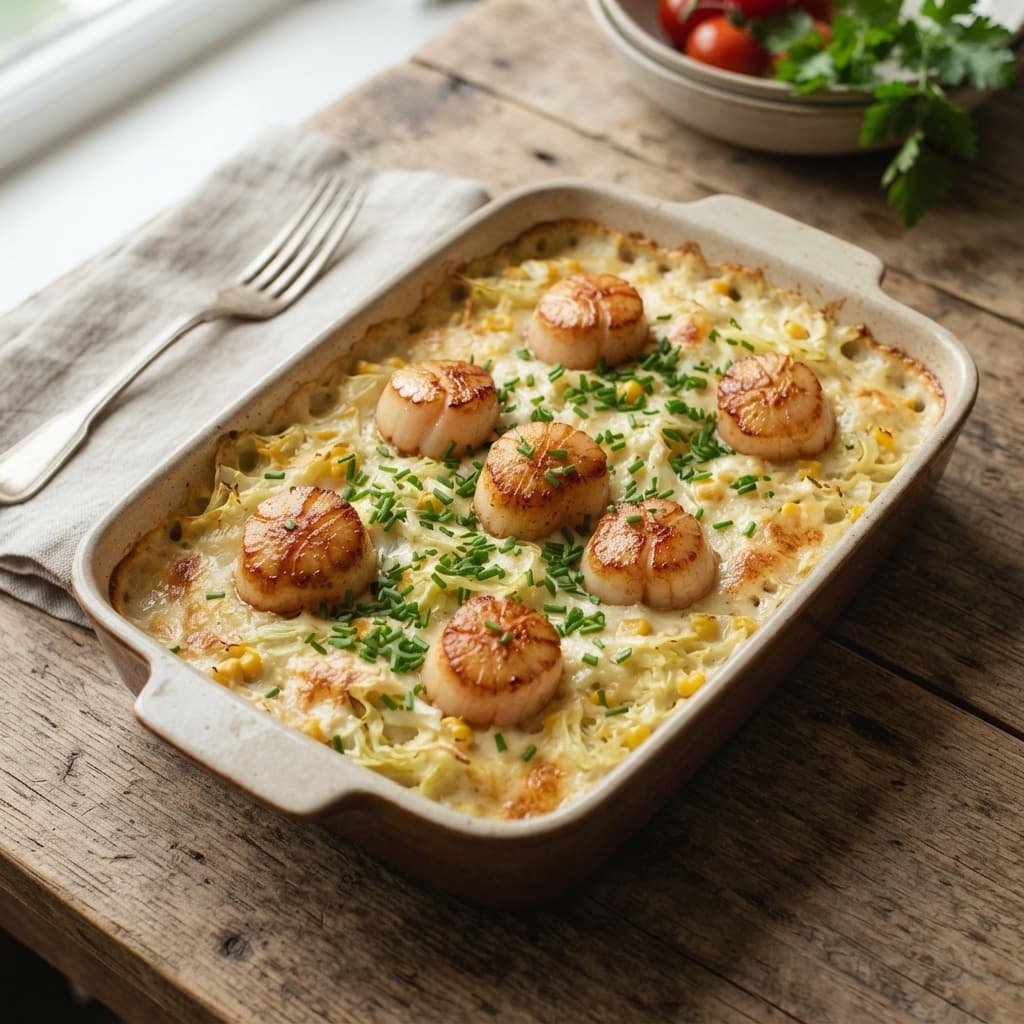
A scallop’s surface holds a surprising amount of moisture, and that moisture has to evaporate before real browning can begin. Skip drying the scallops thoroughly and the pan temperature drops the instant they hit the oil, steaming rather than searing the surface, and the deep golden crust that defines a properly cooked scallop never forms. Summer Scallops and Cabbage Casserole depends on managing that moisture carefully, searing the scallops hot and fast at the very end, only after the cabbage base has already finished baking low and slow underneath.
Seared scallops served over softened, baked cabbage is a genuine, well-documented pairing in real cooking, appearing in dishes from chef-authored recipes built around scallops with braised or gratinéed cabbage, leeks, and cream. This version leans into summer with fresh corn and herbs folded into the cabbage base, keeping the dish lighter than its typically richer, cream-heavy cold-weather versions while staying true to the same underlying technique.
Key Techniques for Summer Scallops and Cabbage Casserole
This dish takes about 50 minutes total. The cabbage casserole needs 30 to 35 minutes in the oven to soften and set, and the scallops need only 2 to 3 minutes per side in a hot pan right before serving, so the two components run on entirely different timelines.
Cabbage releases water as it cooks, and baking it low and covered first lets that moisture escape gradually into a light cream sauce rather than pooling at the bottom of the dish. Scallops work in the opposite direction: they need to stay as dry as possible right up until the moment they hit the pan, since any surface water left on them steams the exterior instead of browning it. Patting them dry thoroughly, and searing them in a pan hot enough to sizzle immediately on contact, is really the entire difference between a scallop with a proper golden crust and one that’s merely cooked through.
Ingredients
This serves 4.
For the Cabbage Casserole
- 1 small head green cabbage, thinly sliced (about 6 cups)
- 1 cup fresh corn kernels
- 1 leek, white and light green parts, thinly sliced
- 2 tablespoons butter
- 1 cup heavy cream
- 1/2 cup shredded Gruyère cheese
- 2 tablespoons fresh chives, chopped
- Salt and black pepper, to taste
For the Scallops
- 1 lb (about 450g) large sea scallops, tough side muscle removed
- 1 tablespoon neutral oil
- 1 tablespoon butter
- Salt and black pepper, to taste
How to Make a Scallop and Cabbage Bake with Seared Scallops on Top
- Preheat the oven to 375°F (190°C).
- Melt the butter in a large oven-safe skillet over medium heat. Add the leek and cook 3 to 4 minutes, until softened.
- Add the cabbage and cook, stirring occasionally, for 5 to 6 minutes, until it begins to wilt. Stir in the corn.
- Pour in the cream, season with salt and pepper, and stir to combine. Cover and transfer to the oven.
- Bake for 25 to 30 minutes, until the cabbage is tender and the sauce has thickened slightly.
- Remove from the oven, stir in the Gruyère and chives, and keep warm while you prepare the scallops.
- Pat the scallops very dry with paper towels and season both sides with salt and pepper.
- Heat the oil in a separate skillet over high heat until shimmering. Add the butter, then immediately add the scallops in a single layer without crowding.
- Sear for 2 to 3 minutes per side, until deeply golden and just opaque throughout.
- Arrange the seared scallops on top of the cabbage casserole and serve immediately.
Good vs. Excellent: The Details That Matter
A good version of this dish is already impressive. An excellent one comes down to a few specific calls.
- Dry the scallops more than feels necessary. Underestimating surface moisture is the single most common reason home-seared scallops turn out pale instead of golden brown.
- Don’t move the scallops once they hit the pan. Letting them sit undisturbed for the full searing time is what actually builds the crust; flipping too early tears it apart before it’s fully formed.
- Time the scallops last, not first. Scallops hold their heat and texture for only a few minutes once cooked, while the cabbage casserole stays warm and stable much longer.
- Don’t overcrowd the searing pan. Too many scallops at once drops the oil temperature and steams them, exactly the outcome careful drying was meant to prevent.
Troubleshooting Common Problems
Why did my scallops stay pale instead of browning? Almost always leftover surface moisture or an overcrowded pan. Pat them more thoroughly next time, and sear in batches if your pan isn’t large enough to give each scallop real space.
Why did the cabbage turn watery instead of creamy? This usually means the dish wasn’t covered while baking, letting moisture escape as steam rather than staying in the sauce. Cover tightly for the full baking time, and uncover only briefly at the end if you want a bit of browning on top.
Why did the scallops turn rubbery? They were almost certainly overcooked. Pull them from the heat the moment they turn opaque and just firm to the touch, since scallops continue cooking slightly from residual heat even after they leave the pan.
Variations and Substitutions
Savoy cabbage can replace green cabbage for a more tender, delicate texture, using the same method and timing. If Gruyère isn’t available, a sharp white cheddar or Comté works as a substitute without much change in flavor profile.
For a lighter version, half-and-half can replace heavy cream, though the sauce will be noticeably thinner. Bay scallops can be used in place of sea scallops for a smaller-bite version of this scallop cabbage bake, though they’ll need a shorter sear, closer to 1 to 2 minutes per side.
Serving and Pairing
This casserole is rich enough to serve as a full meal on its own, though a simple green salad with a sharp vinaigrette cuts through the richness nicely. Crusty bread on the side is good for anyone who wants to mop up extra sauce. A squeeze of fresh lemon over the finished scallops brightens the whole plate. This cabbage and scallop casserole also plates beautifully for a dinner party without much extra effort.
Storage and Reheating
Store the cabbage casserole and scallops separately in airtight containers in the refrigerator for up to 2 days. Reheat the casserole gently in a covered dish in a low oven, and cook a fresh batch of scallops for leftovers rather than reheating them, since they toughen significantly the second time around and rarely recover their original texture.
Nutritional Information
Values below are estimates per serving and will vary depending on exact brands and quantities used.
| Calories | 410 kcal |
| Protein | 24 g |
| Carbohydrates | 16 g |
| Fat | 29 g |
| Fiber | 4 g |
Final Thoughts
This recipe was tested and refined in the bebup.org kitchen, including a batch where the scallops went in without patting them dry first, just to confirm how much of a real difference that step makes before publishing.
Summer Scallops and Cabbage Casserole rewards attention to two separate timelines running at their own pace: a cabbage base that needs patient, covered baking, and scallops that need almost none of that patience at all, just a hot pan and a few disciplined minutes at the very end. Once both pieces are handled on their own terms, the dish comes together into something that looks far more complicated than it actually is.
Mastering the Technique
The skill that carries over from this dish to other seared proteins is recognizing that moisture is the enemy of browning, full stop. Whether it’s scallops, steak, or a thick-cut piece of fish, the same principle applies: pat the surface dry, use a pan hot enough to sizzle on contact, and resist the urge to move the protein before a real crust has formed. That patience in the final few minutes of cooking is almost always what separates a dish that looks restaurant-made from one that just tastes fine.
Summer Scallops and Cabbage Casserole
Ingredients
Method
- Preheat the oven to 375°F (190°C).
- Melt the butter, add the leek, and cook 3 to 4 minutes until softened.
- Add the cabbage and cook 5 to 6 minutes until it begins to wilt. Stir in the corn.
- Pour in the cream, season with salt and pepper, and stir. Cover and bake.
- Bake 25 to 30 minutes, until the cabbage is tender and the sauce has thickened.
- Stir in the Gruyère and chives. Keep warm.
- Pat the scallops very dry and season both sides with salt and pepper.
- Heat the oil in a separate skillet over high heat. Add the butter, then the scallops in a single layer.
- Sear 2 to 3 minutes per side, until golden and just opaque throughout.
- Arrange the scallops on top of the cabbage casserole and serve immediately.