The criterion that decides buying an action camera is how many minutes its battery records on a real day out. Everything else comes second. Tom, a father in Cardiff, takes two children aged six and nine on coast-path walks and bike rides, and he films about 40 minutes of clips each time. A camera that quits at lunchtime ends the record just as the afternoon gets interesting. Below, four checks are ranked by the regret they spare, followed by the specs that look grand and change little. Brands stay unnamed and prices stay unquoted, and every check here can be done at a shop counter.
What Matters Most When Buying an Action Camera
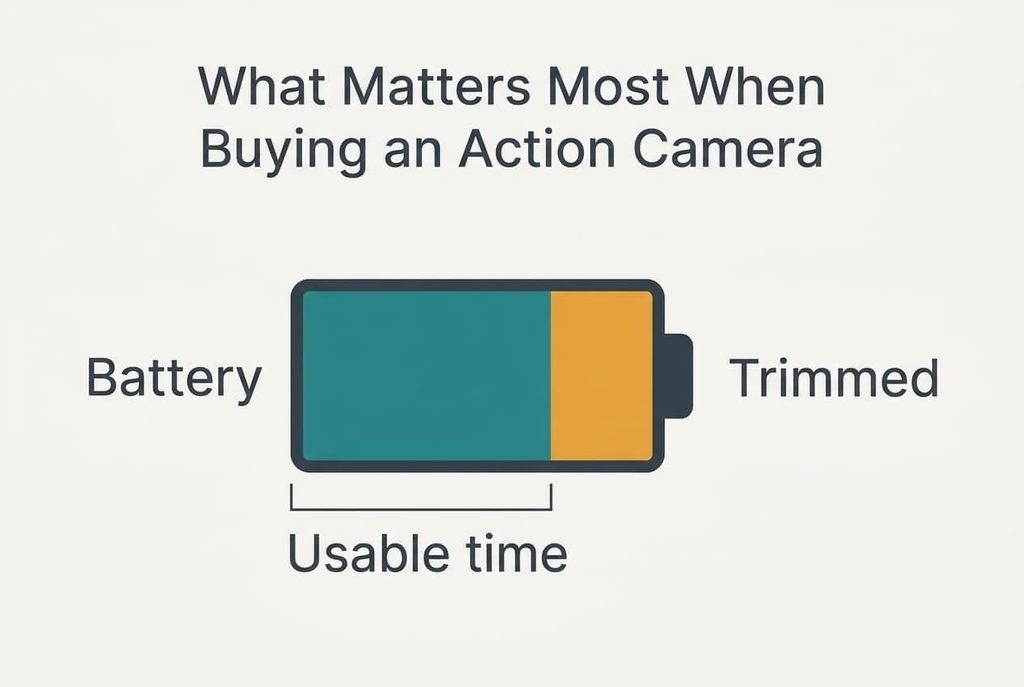
Runtime wins because a small body carries a small battery and drains it fast. The sensor and the screen both pull from that single cell, and the stabilising processor adds a further load. A spec sheet quotes runtime from a mild room with the screen dimmed. Real days differ from that room, and the difference explains why the planning estimate trims the quoted figure before anything else is weighed.
The minutes of footage the battery really delivers, set against the minutes you film, settle the first question. Take a stated runtime of 90 minutes. Cold air and the steadying load trim it to about 70% as a planning estimate, which gives 63 minutes. Tom needs 40, so one battery leaves him 23 minutes in hand. A camera that states 45 minutes works out at 31.5, and Tom would carry a second battery on every outing.
You’ll want that sum for your own days too.
List the minutes you expect to film, then set them beside the stated runtime multiplied by 0.7. Any gap means a spare battery or a camera that stays on the shelf.
Four Checks for an Action Camera, in Priority Order
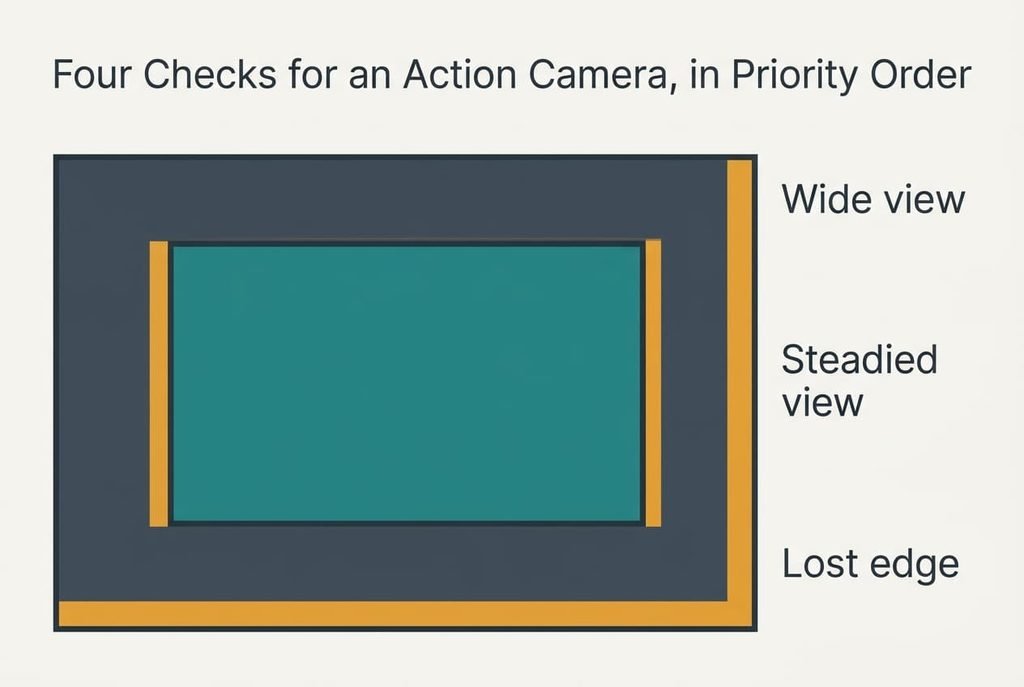
1. Runtime sits at the top. It decides whether the camera is still rolling when the children reach the beach. With 63 usable minutes Tom films freely, whereas about 31 forces him to ration clips and watch a battery icon. Multiply the stated figure by 0.7 before buying an action camera, then lay the answer beside your own filming minutes. A shortfall means rationed clips or a spare battery, and a battery sealed in removes that option.
2. Stabilisation and its crop come second, and it’s the one nearly every buyer skips. Steadying works by borrowing a margin of the sensor, so the steadied picture shows less than the raw one. Assume one quarter of the frame width is lost. At 1 m from the lens a sample wide view spans 1.33 m, and after the trim it spans 1.00 m. Two children and a parent sharing a 1.2 m bench fit in the first picture and spill out of the second. Look for the steadied view angle on the spec sheet, or film a wall mark at 1 m in both modes. A miss clips somebody off the edge of every shot.
3. Mounting takes third place. It sets the gap between spotting a moment and recording it. Tom reckons on 12 moments a day. At 10 seconds apiece he loses two minutes to setup, but a fiddly mount at 40 seconds costs eight, and some moments will be over by then. Time the sequence from bag to recording at the counter. A slow mount leaves the camera in the bag by lunchtime.
4. Water and knock ratings take fourth place. They decide whether a splash at the shoreline or a tumble onto the path ends the outing. Check the rated depth for the body alone. Paddling at 0.5 m asks far less than a body rated to 10 m, an assumed figure, while a rating that holds only with a case adds bulk and muffles the microphone. Rinse the body in fresh water after a salty afternoon, since dried salt can wear the seals. A miss means a case on every outing, or a repair.
Which Specs Are Oversold for Family Footage
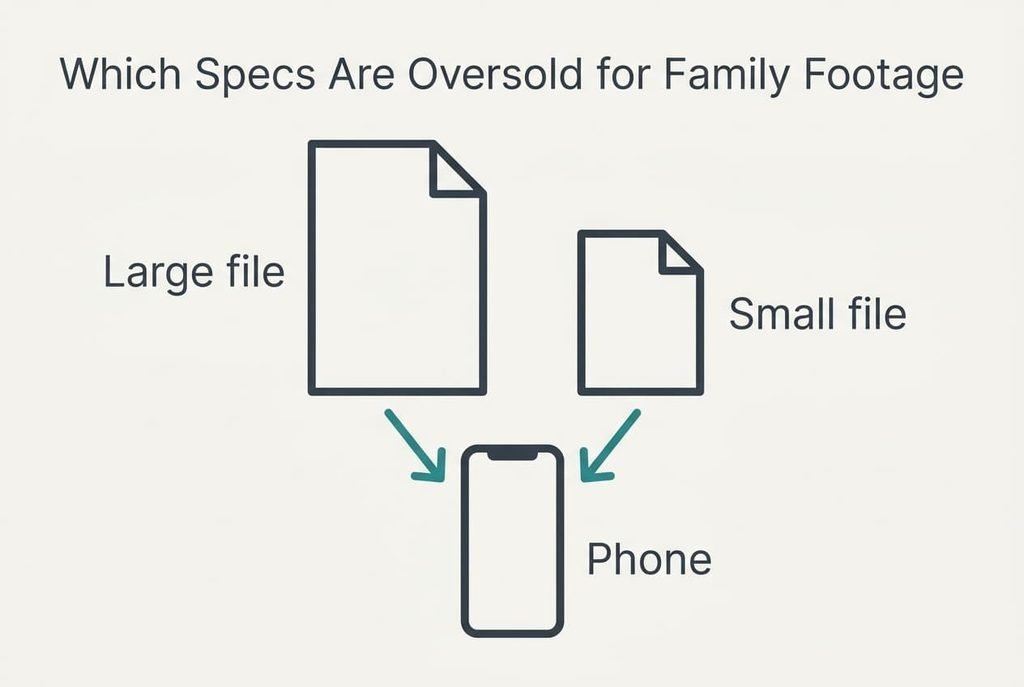
Some numbers on the box earn more room than they deserve. A headline resolution figure leads the list, because most family clips end up on phones and laptops where extra pixels show little. Forty minutes at 4K and a sample 60 Mbit/s fills 18 GB. At 1080p and 30 Mbit/s the same time fills 9 GB, and those smaller files copy across faster.
Slow-motion frame rates get promoted as the fun feature. They need strong light, and a clip shot at 120 frames a second and played at 30 runs four times slower. A one-second jump then lasts four seconds, and few family clips are watched twice. Many phones already offer slow motion for the odd special clip.
An ultra-wide lens looks dramatic in a brochure. The steadying trim then shrinks the view, and faces near the edge of the frame look stretched. Wide coverage doesn’t help when the steadied mode gives it back.
Three Readers and Which Checks Move
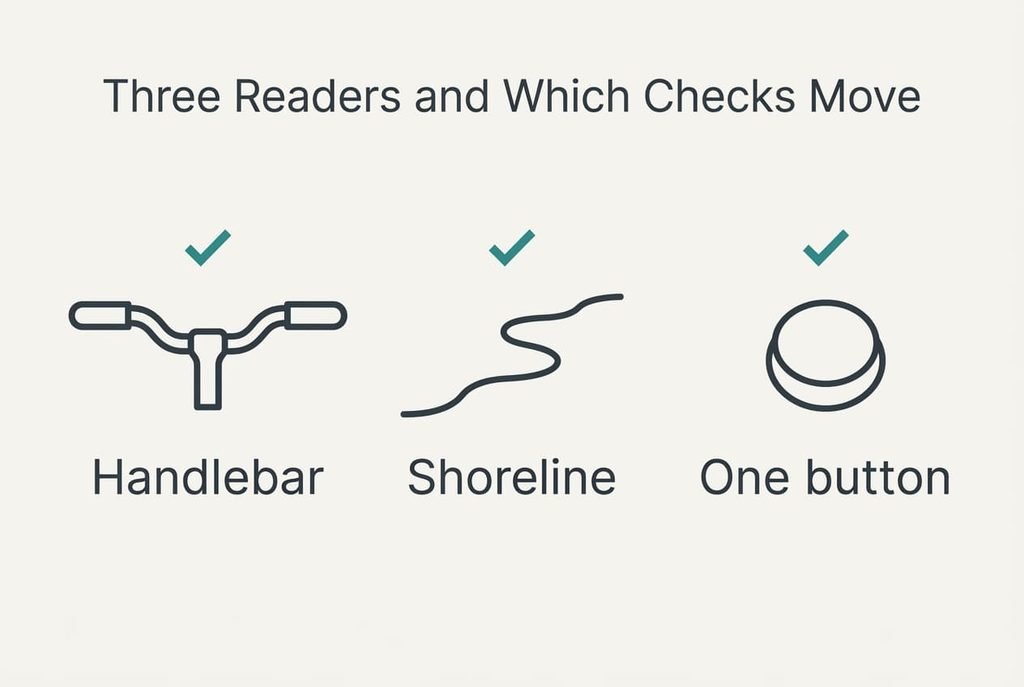
Cycling families lift stabilisation and mounting together. Handlebar mounts tend to shake more than a chest strap, so the trim matters more to them. Footage from a bouncing bike is the hardest case for steadying, which is why that family reads the crop figure with extra care.
At the beach, the water rating moves to second place, as sand wears seals across a summer. It’s also worth asking whether the body floats, because a camera dropped in a rock pool is hard to find again. A grandparent who films now and then should lift mounting instead, since one obvious start button beats any feature printed on the box.
Runtime holds first place for every reader, because a flat battery cancels each advantage the camera has.
When to Walk Away From the Idea
If you film less than ten minutes on a typical day out, walk away from the purchase. Ten minutes is a quarter of Tom’s 40, and a phone records that without another battery to charge. Buying an action camera for ten minutes of footage adds a charger and a bag of fittings that sit unused in a drawer.
Walk away from a camera sealed around its battery when your days run long. Tom’s 63 usable minutes cover his 40, yet a family filming 90 minutes would run flat by mid-afternoon with nothing to swap in.
A camera with no stated view angle for its steadied mode also stays on the shelf, since you can’t run the crop check without that figure. Ask the shop assistant for that number. A blank look usually means the maker keeps it quiet. Choose a model that publishes it.
A Two-Minute Check Before You Order
Write down your filming minutes beforehand, because buying an action camera without that figure leaves the runtime sum with nothing to compare against. Do this with the camera in your hand. If a shop won’t let you handle a demonstration unit, a return policy that covers a change of mind is the fallback worth having. At the counter, time yourself from the bag to a running recording, and aim for ten seconds. Next, film a mark on a wall from 1 m in plain mode and again in steadied mode, then compare how much wall each frame shows. A quarter missing is only the assumed figure, so read your own.
If the timing passes and the crop looks acceptable, the runtime sum from the first check decides the rest. A slow start sends the camera back to the shop. The routine fits in a lunch break, which is when Tom did it before placing his order. Then order, and keep the receipt through the first long outing.
Questions Readers Keep Asking
What specification should I check first?
The stated runtime, cut to about 70% for cold air and the steadying load. Tom’s 90 minutes becomes 63, against 40 minutes of filming. Compare that figure with your own filming minutes before you look at resolution, because a camera that stops early wastes every other number on the box.
How much should I spend compared with my phone?
Spend in line with the minutes you film away from the phone. When your phone already steadies the picture and you film ten minutes on a day out, a second camera adds little. At 40 minutes or more, put the extra into runtime and a spare battery ahead of resolution.
How long will it last, and what will I regret?
The body can last for years, and the battery fades first. An assumed 500 charges carries a weekly outing for nearly ten years, though capacity drops well before then. Most regrets come from a battery sealed in with no spare, or a steadied mode that crops the family out of the frame.