Tap a sheet of flat glass and your thumb swears that something clicked. Yet the glass travels about 0 mm, and what you felt was a sharp shake of the whole phone lasting around 18 ms. A small weight inside is driven by a coil, and the software times the shake to your touch. So how does haptic feedback work well enough to fool a fingertip? This page follows one tap through that chain, then shows where it fails. Every figure here is a sample for a 180 g phone, so replace each with a measurement of your own.
How Does Haptic Feedback Work? The Short Answer
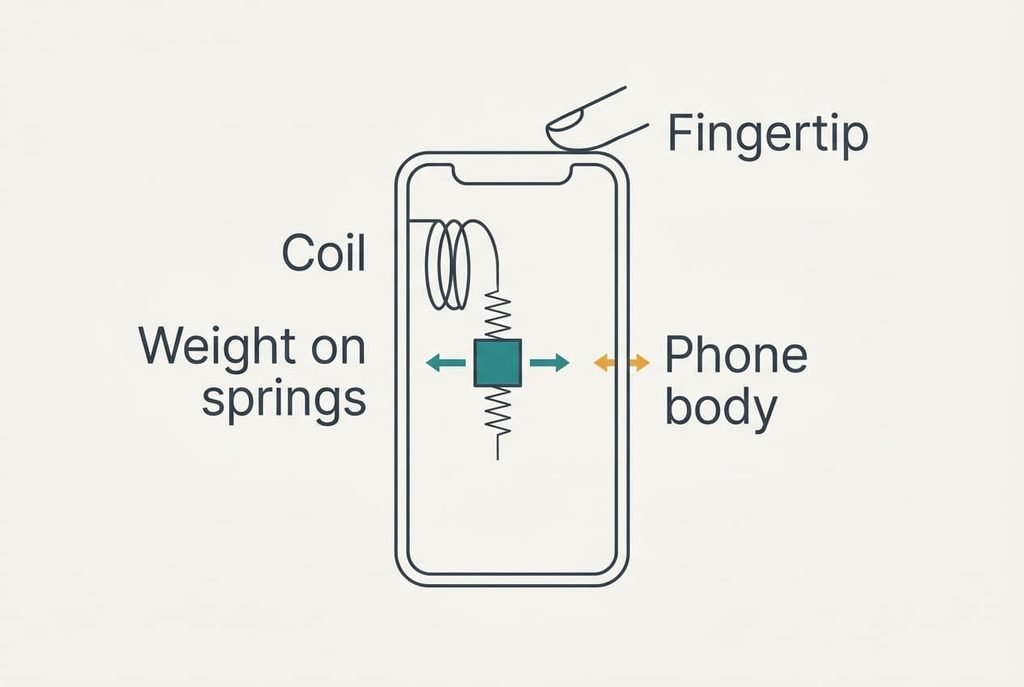
In one line, a coil pushes a small weight on springs through about two swings, and the sharp shake imitates the instant a key gives way, with a quick counter-push to stop the weight ringing.
Our sample weight rings at 170 Hz, so one swing lasts 1 ÷ 170 = 5.9 ms and two swings last 11.8 ms. A ringtone buzz of 200 ms runs for 34 swings instead. The weight is 2 g and travels 1 mm either side of centre. The phone body is 180 g, so it moves the opposite way by 2 ÷ 180 × 1 mm = 11 µm, a distance of about one hundredth of a millimetre.
That sounds tiny, yet fingertips are most sensitive near 200 Hz, where a movement of roughly a micrometre can be picked up. The shake sits far above that threshold.
That summary skips the delay before the shake starts, the shape of the brake and whatever weakens the effect. The next sections cover each of them.
One Tap on a Keyboard Key, Millisecond by Millisecond
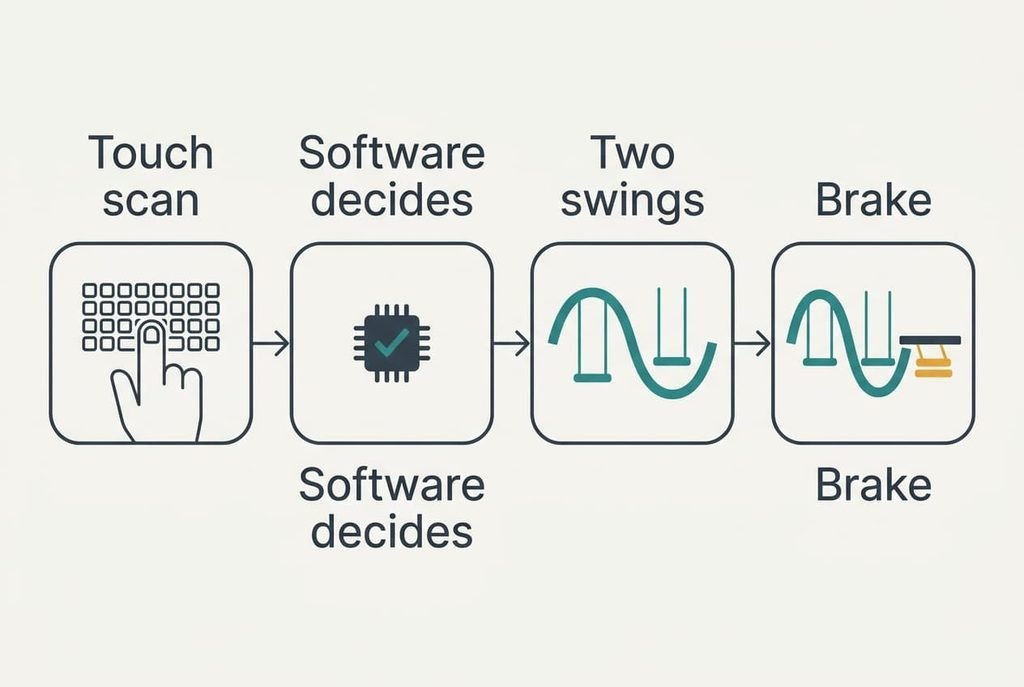
Put a thumb on a letter of an on-screen keyboard. At 0 ms the skin meets the glass. The touch controller scans the screen 120 times a second, once every 8.3 ms, so the contact may wait up to 8.3 ms before anyone notices it.
Next the software works out which key was hit and queues the click pattern. We allow 6 ms for that. A driver chip then turns the pattern into coil current, which we allow 3 ms to ramp up. The weight needs one full swing, 5.9 ms, to reach its peak. Adding the four stages makes the worst case 8.3 + 6 + 3 + 5.9 = 23.2 ms. Roughly speaking, a gap that short is read by the senses as one event. The tap and the click therefore feel simultaneous.
Now the pulse itself. The coil drives the weight for two swings, 11.8 ms. Left alone, the weight would go on ringing, losing about a third of its size on each swing. After six swings it would still sit at 10% of its peak, because 0.68 multiplied by itself six times gives 0.099. The ring would run for 35 ms after the drive stops. The total shake would last about 47 ms, which tends to feel like a soft thud.
That’s why the driver adds a brake. It pushes against the motion for one more swing, 5.9 ms, and the weight stops almost at once. The total shake is 11.8 + 5.9 = 17.7 ms, about 18 ms, which tends to feel like a click.
Finally, the energy. A coil taking 0.5 W for 18 ms uses 0.5 × 0.018 = 9 mJ per tap. How does haptic feedback work out as a cost? A day of 5,000 taps costs 5,000 × 9 mJ = 45 J, and a 15 Wh battery holds 54,000 J. The day’s taps use 0.08% of the charge.
The Drum Picture and Where It Breaks
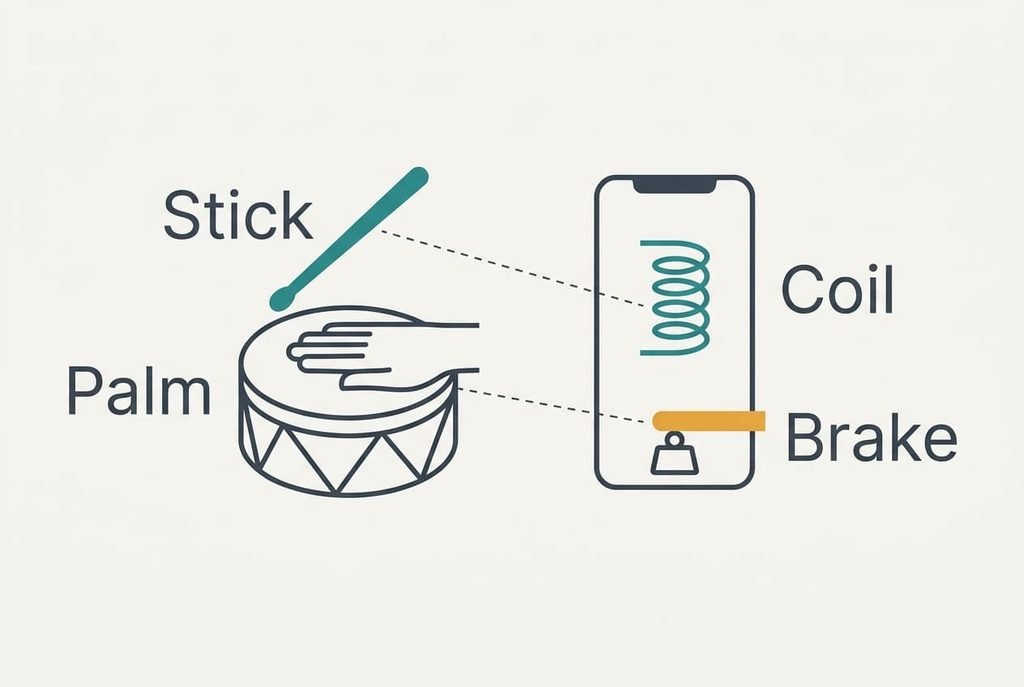
Picture a hand drum. A short strike gives a crisp tap, and a palm laid on the skin straight afterwards stops the ring. Leave the skin alone and the same strike becomes a long boom. The coil acts as the stick, and the brake acts as the palm. One motor can therefore give a click or a thud, depending only on whether the palm arrives in time.
The picture breaks at two points. A drum sends sound outwards into the room, but the weight’s shake stays inside the phone and reaches only the fingers that touch it. A drummer also decides each strike by feel, whereas the pattern here is a fixed recipe. So how does haptic feedback work differently from a drum? It replays one rehearsed shape every time.
Where Does Haptic Feedback Stop Working?
The tap-and-buzz trick has limits. The whole phone shakes, wherever your thumb lands, so the buzz carries no information about which key you hit. Your eyes still do that job. Two keys side by side feel identical, and an on-screen keyboard lacks the raised edge that gives each key of a printed one its own feel.
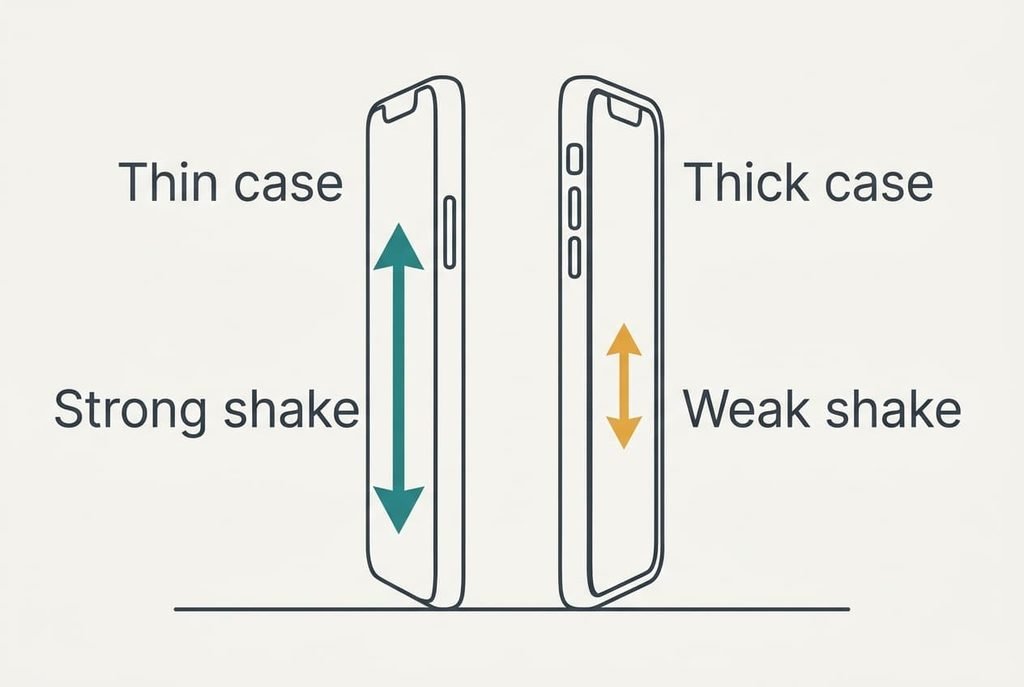
Weight in the way weakens the shake. Fit a case adding 40 g and the body now weighs 220 g. The movement falls to 2 ÷ 220 × 1 mm = 9.1 µm, which is 18% less than 11.1 µm. A phone lying on a table loses even more, because the table absorbs the shake and the device rattles instead. The effect also fades in tight gloves or under a thick screen cover, since both soften the contact.
A phone also can’t make a texture, since it offers only brief taps and a rough surface stays out of reach.
Three Beliefs About Phone Buzzing That Don’t Hold
Many people assume the glass dips under the thumb. Experience says so, because the click arrives exactly when a key would give way. In fact the glass stays put, and the sensation is built from timing alone, a shake of 11 µm arriving within 23 ms of the touch.
Another belief says a longer, stronger buzz feels more like a click. Stronger often feels better elsewhere, so it seems natural here. A click is short. Stretch the shake from 18 ms to 200 ms and it turns into a ringtone buzz of 34 swings.
A third belief is that the click and the ringtone buzz use different parts. They feel different, so people suppose separate hardware. Both run on the same weight and coil, and the pattern alone changes the feel. Older motors with a spinning off-centre weight need tens of milliseconds to speed up, which is why they can’t produce a sharp click.
A Rule for Deciding Whether to Keep Haptics On
Type the same three lines with the keyboard buzz on, then again with it off, and count the corrections each time. If the count falls by one or more with the buzz on, keep it switched on for typing. If the counts match, the choice is yours.
Battery gives no reason to switch it off, since 0.08% of a charge is a rounding error. A thick case or a quiet meeting is a better reason, and that’s easy to judge by feel. How does haptic feedback work in a meeting? The shake is silent on a soft surface but rattles on a hard desk.
Ten minutes with the test settles the question for your own phone, and you’ll hold a clear result. The buzz is cheap and brief, and your correction count shows whether it earns its place. Repeat the test after a new case or a software update, because either can change how the click feels. When a reader asks how does haptic feedback work, the practical answer is that it works while the shake stays short and your case stays light.
Questions Readers Keep Asking
Can a thick case weaken the click?
Yes. A case adding 40 g to a 180 g phone cuts the shake by 18%, from 11.1 µm to 9.1 µm. Most people still feel it, because that stays well above the threshold of a fingertip. A heavy case plus a soft table is where the click starts to disappear.
Do I need keyboard buzz switched on?
Not necessarily. It helps people who type fast and look at the keys less, and the test above shows whether it helps you. Since 5,000 taps use only 0.08% of a charge, the choice is about comfort and noise, never about battery life.
Is a click the same as the ringtone vibration?
Almost. Both come from the same weight and coil, but the click is 18 ms with a brake, while a ringtone buzz runs for 200 ms and 34 swings. The long buzz announces a call across a desk. The short pulse is meant for the fingertip alone.